

Tracking food on a GLP-1 medication like semaglutide or tirzepatide is fundamentally different from standard calorie counting. Appetite shifts, portions shrink, and nutritional needs change in ways a generic food diary was never built to address. For anyone using MyFitnessPal and finding it a poor fit for their current routine, a more targeted MyFitnessPal alternative can make a meaningful difference.
Not every nutrition app accounts for the realities of GLP-1 treatment, but some do a far better job than others. The options below are evaluated for how well they support protein tracking, portion awareness, medication consistency, and sustainable progress for GLP-1 users. Those looking for a solution built specifically around this journey may find that a dedicated GLP-1 app like MeAgain offers the most seamless fit.
Table of Contents
- Why Isn’t MyFitnessPal Working for Me on a GLP-1?
- What to Look for in a Calorie Tracker for GLP-1 Users
- 9 Best MyFitnessPal Alternatives for GLP-1 Users
- Stop Counting Calories. Start Building GLP-1 Habits That Actually Matter.
Summary
- GLP-1 medications like semaglutide and tirzepatide fundamentally change how the body processes food, so tracking tools designed for standard calorie restriction no longer apply. Appetite suppression reduces total food volume so dramatically that every bite carries greater nutritional weight, and apps built around a calorie-deficit model miss the specific priorities that emerge under these conditions.
- Protein preservation becomes a clinical priority during GLP-1 therapy, not a fitness preference. Research published in the journal Obesity (2023) found that without deliberate protein intake during treatment, a meaningful portion of weight lost can come from lean muscle mass rather than fat. Participants in the New England Journal of Medicine's 2021 semaglutide trials who maintained higher protein intake preserved significantly more lean mass, pointing directly to why protein tracking needs front-and-center visibility rather than being buried in a macro tab.
- Database accuracy shifts from a convenience issue to a functional one when total daily intake drops to 900-1,200 calories. Crowdsourced food entries carry a 15 to 30 percent calorie variance, a margin that is tolerable at 2,500 calories but genuinely distorting when food volume has been cut in half by medication. A 200-calorie logging error at low intake levels can account for up to 20 percent of a person's daily nutrition, skewing protein and micronutrient targets without any visible signal in the app.
- Reduced food volume also creates a specific risk profile for deficiencies. Iron, calcium, vitamin D, and B12 are the nutrients most likely to slip below adequate levels when total intake drops sharply. A tracker that monitors only macros leaves this entire layer invisible, even though micronutrient status is precisely the kind of data prescribing physicians need to catch problems before they become symptoms.
- Logging friction matters more during GLP-1 therapy than it does in standard dieting contexts. When nausea is present and appetite is unreliable, a 90-second search-and-scroll logging process provides enough resistance to prevent consistency from breaking entirely. Prescriptions for GLP-1 agonists have more than tripled since 2020, according to RAND Health Quarterly, meaning millions of people are navigating this friction right now using tools built for a completely different eating pattern. Photo logging and voice entry address this directly by removing the manual steps that make logging feel disproportionate to eating half a chicken breast.
- 12% of adults are currently taking a GLP-1 drug, according to the KFF Health Tracking Poll, and the vast majority rely on general nutrition trackers that cannot integrate medication timing, dose history, and side-effect patterns with food and weight data in a single place.
- MeAgain addresses this by combining food logging, injection tracking, symptom recording, and progress milestones inside a single interface built specifically for people on GLP-1 treatment plans.
Why Isn't MyFitnessPal Working for Me on a GLP-1?
Many GLP-1 users find that the habits needed to succeed differ fundamentally from those a traditional calorie-counting app was built to support. This reflects a real mismatch between a tool designed for one purpose and a body undergoing something fundamentally different, not a criticism of MyFitnessPal.

Why does protein tracking matter more than calorie counting on a GLP-1?
When you start a GLP-1 medication like Ozempic, Wegovy, or Zepbound, your appetite drops significantly—often to the point where eating feels like a task. With total food volume shrinking dramatically, every bite carries more nutritional weight. Protein becomes the priority, not because of fitness trends, but because GLP-1-driven calorie restriction creates a real risk of muscle loss.
Research published in the journal Obesity (2023) found that without deliberate protein intake during GLP-1 therapy, a meaningful portion of weight loss comes from lean muscle mass rather than fat, undermining both long-term metabolic health and physical function. A calorie counter that treats 1,200 calories of crackers the same as 1,200 calories of chicken and legumes fails to provide the information you need.
How do GLP-1 side effects expose the limits of a standard tracking app?
The same gap shows up with hydration and fiber. GLP-1 medications slow gastric emptying, increasing the risk of constipation and dehydration, two of the most commonly reported side effects among users of Ozempic and Mounjaro. Obesity medicine guidelines from the American Society of Bariatric Physicians identify fiber and fluid intake as essential management tools during GLP-1 therapy. MyFitnessPal can log water intake, but it wasn't designed to connect hydration data to medication schedules, side-effect patterns, or weekly dose progression. Those connections hold the real insight.
What hidden costs appear when GLP-1 users rely on MyFitnessPal?
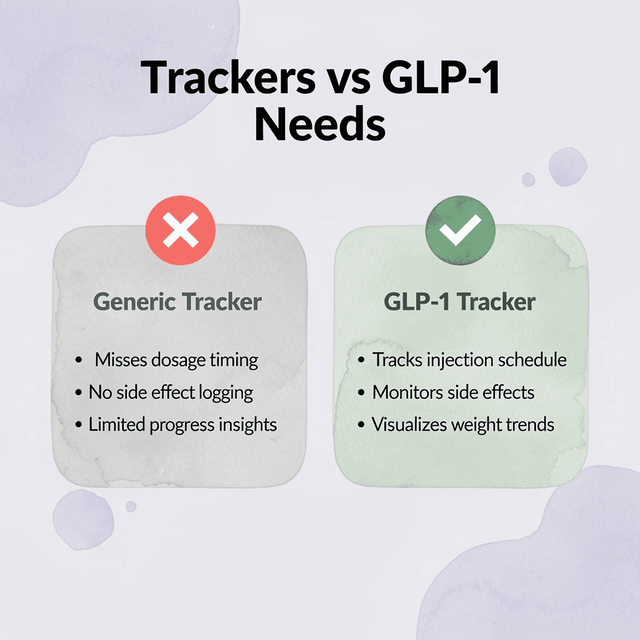
Most GLP-1 users start by adapting what they already know: opening MyFitnessPal, logging meals, and monitoring their total calories. The hidden cost surfaces over weeks—the app flags low calorie intake as a warning rather than a context-appropriate result of appetite suppression, protein targets get buried under a calorie-first interface, and there is nowhere to record that today's nausea is tied to a dose increase three days ago. Our MeAgain app was built to close that gap by connecting medication timing, dose history, and side-effect tracking directly to nutrition and weight data.
Why is design intent the real difference between these tools?
The critical difference is not features, but design intent. MyFitnessPal was built on the premise that food awareness drives better choices—which is true for average dieters pursuing calorie restriction. GLP-1 users are not average dieters. Their appetite signals are pharmacologically altered, their nutritional priorities are clinically distinct, and their progress cannot be measured by calorie deficit alone. Research from the New England Journal of Medicine's 2021 semaglutide trials showed that participants who maintained higher protein intake during treatment preserved significantly more lean mass, underscoring why protein tracking deserves its own priority layer. What makes this frustrating is that the gap is invisible until you feel it. You log faithfully, hit your calorie goal, and still sense something is off. The app works exactly as designed—it was not designed for this.
Related Reading
- GLP-1 Plateau
- How Does GLP-1 Help You Lose Weight
- How Much Protein On GLP-1
- How Much Water To Drink on GLP-1
- Why Am I Not Losing Weight On GLP-1
- Can GLP-1 Cause Gastroparesis
- Can GLP-1 Cause Kidney Stones
- Which GLP-1 Has The Least Side Effects
- Does GLP-1 Cause Acid Reflux
- Why Am I Not Losing Weight on Zepbound
What to Look for in a Calorie Tracker for GLP-1 Users
Calorie trackers fail GLP-1 users in different ways: some hide protein data, others have unreliable food databases, and many weren't designed for someone eating 900 calories across two small meals while managing nausea, dose timing, and fatigue. The things that truly matter are specific and worth naming clearly.
"Most calorie trackers were built for a standard user eating 2,000+ calories a day — not for someone navigating GLP-1 appetite suppression, micro-meals, and medication side effects."
Feature | Why It Matters for GLP-1 Users |
|---|---|
Protein tracking | Prevents muscle loss on very low calorie intake |
Reliable food database | Ensures accuracy when logging small, precise portions |
Small meal support | Built for 2–3 micro-meals, not standard 3-course logging |
Nausea/symptom logging | Connects food choices to side effect patterns |
Dose timing integration | Tracks how medication timing affects appetite and intake |
Protein visibility, not protein access
The critical difference between a useful tracker and a frustrating one is where the protein lives on the screen. Most apps track protein but bury it as a single bar among five in a macro breakdown, requiring a tap to access. For GLP-1 users targeting 1.2 to 1.6 grams per kilogram of body weight daily, that hidden placement costs real muscle. When your total food volume is already compressed, you cannot afford to discover at 9 p.m. that you are 40 grams of protein short with no appetite left to fix it. Protein needs to be front and center, not filed under "more details."
Speed matters more than you think
The failure point is usually friction. When nausea is present and appetite is unreliable, even a 90-second logging process feels like a tax on eating. Apps that require searching a crowdsourced database, scrolling through duplicates, and manually adjusting serving sizes create the resistance that kills consistency. According to RAND Health Quarterly, prescriptions for GLP-1 agonists have more than tripled since 2020, meaning millions of people encounter this friction when using tools designed for a different eating pattern. Photo logging and voice entry aren't just convenience features for GLP-1 users—they're the difference between tracking and abandoning the regimen.
Why does database accuracy become a safety issue?
When your entire day fits into 1,000 calories, a 200-calorie logging error represents up to 20 percent of your daily intake, meaning your protein and micronutrient targets could be significantly off without any visible signal in the app. Crowdsourced food databases carry a 15 to 30 percent calorie variance on user-submitted entries—acceptable at 2,500 calories but distorting at half that. Verified, nutritionist-checked databases aren't a premium feature for perfectionists. They're a functional requirement for anyone whose food volume has been cut in half by medication.
How does connecting food data to dose timing make discrepancies visible?
A GLP-1 app built for this experience connects food data to dose timing and side-effect patterns, making the differences between logged intake and bodily responses visible rather than obscured by generic trackers.
Which nutrient gaps does GLP-1 therapy create, and how do trackers expose them?
When you eat less food, you may not get enough of certain nutrients: iron, calcium, vitamin D, and B12 are most likely to drop below healthy levels. A calorie-only tracker won't reveal this problem. Check your micronutrients weekly during GLP-1 therapy so your doctor can catch deficiencies before symptoms develop.
How does wearable integration fill the remaining blind spots?
Pair that with wearable integration to add resting metabolic rate and activity data, creating a complete view of how your body responds to medication, movement, and nutrition. According to the KFF Health Tracking Poll, 12 percent of adults are currently taking a GLP-1 drug, yet the vast majority rely on tools that cannot access any of this data. Once you know what to look for in a tracker, the next question becomes harder than it sounds.
Related Reading
- Why Do Some People Not Lose Weight on Ozempic
- Slow Weight Loss On Wegovy
- Why Am I Not Losing Weight On Zepbound
- Can You Stop Glp-1 After Losing Weight
- How Many Weeks Is Considered A Weight Loss Plateau
- Can Glp-1 Cause Low Blood Sugar
- Glp-1 And Exercise
- Can Glp-1 Cause Headaches
- Can Glp-1 Cause Low Blood Pressure
9 Best MyFitnessPal Alternatives for GLP-1 Users
The apps below are evaluated through one lens: do they understand what GLP-1 therapy actually demands of your body, habits, and day? This is not a generic app roundup — every tool on this list is assessed for how well it handles the unique nutritional challenges, reduced appetite, and metabolic shifts that come with GLP-1 use.
"The right tracking app for a GLP-1 user isn't the most popular one — it's the one built around what your body actually needs on this therapy." — MeAgain Health
What GLP-1 Users Need | Why It Matters |
|---|---|
Small-portion logging | Appetite is significantly reduced |
Protein tracking | Prevents muscle loss during weight loss |
Hydration reminders | Nausea can reduce fluid intake |
Flexible meal schedules | Hunger cues are no longer predictable |
Nutrient density focus | Every bite must count more |

1. MeAgain
Best for: Building habits while taking GLP-1 medicine.
Starting Ozempic, Wegovy, or Mounjaro changes what your body needs, but not what you do. That gap between physiological needs and actual behavior is where most people struggle, trading muscle for fat loss while neglecting fiber and forgetting to drink water as the medicine dulls their thirst signals. Our MeAgain app closes that gap by gamifying your daily protein, fiber, hydration, and exercise goals with an adorable capybara companion that makes consistency rewarding rather than a chore.
MeAgain's design stands out by letting GLP-1 users track shots, food, symptoms, medication context, weight, and progress in a single app, eliminating the hassle of juggling multiple apps. The Journey Card feature captures transformation milestones with medicine context attached, so you see the full picture six months later, not just a number on a scale.
Why it beats MyFitnessPal for GLP-1 users
MyFitnessPal was built for calorie counters. MeAgain was built for people whose appetite, medication schedule, and nutritional priorities change week to week.
Who should choose it?
New GLP-1 users seeking one app for all their needs, and anyone who finds traditional logging tedious.
Potential limitation
This app focuses specifically on GLP-1 users rather than general nutrition tracking, making it unsuitable if you are not on a GLP-1 medication.
2. Dose AI
Best for: Users who want AI-powered meal logging without extensive manual effort.
How does Dose AI reduce the friction of food logging?
When your appetite is low, even searching a database for food feels like work. Dose AI remove that difficulty entirely? Snap a photo of your plate, and the app automatically calculates macronutrients and suggests personalized meal ideas tailored to your changing appetite and nutrient goals.
Why does Dose AI work better for GLP-1 users than MyFitnessPal?
MyFitnessPal requires you to search, select, and modify each food item manually. When you've eaten half a chicken breast and called it lunch, that process feels like excessive work. Does AI meet you where you are?
Possible limitation
You can track medication and symptoms, but it lacks the level of detail found in dedicated GLP-1 apps.
3. Shotsy
Best for: Dedicated injection management with zero distractions.
The failure point for many GLP-1 users is not nutrition—it's consistency with dosing. Shotsy solves this by tracking injection history, sending dose reminders, and rotating injection sites correctly within a minimal interface.
Why does Shotsy beat MyFitnessPal for GLP-1 users?
MyFitnessPal does not have injection tracking. If you mainly need help remembering and recording shots, Shotsy excels at that specific function.
Who should choose Shotsy?
People who prefer simplicity, or those already using a robust nutrition app, and need a dedicated injection companion.
What are Shotsy's potential limitations?
Shotsy does not track food, hydration, symptoms, or weight. It's a single-purpose tool by design.
4. Lumen
Best for: Users who want to understand how their metabolism responds to GLP-1 therapy.
GLP-1 medications alter how your body uses energy. Lumen measures your respiratory exchange ratio to show whether your body is burning carbohydrates or fat, then suggests meal changes to maintain steady energy throughout the day.
Why it beats MyFitnessPal for GLP-1 users
MyFitnessPal counts what goes in. Lumen shows what your body does with it: metabolic feedback that helps you manage changes in hunger and energy levels.
Who should choose it
Users who want to understand the physiological mechanics of their weight loss and are willing to use Lumen alongside a separate app for tracking injections and symptoms.
Potential limitation
Lumen requires a hardware device (a breath analyzer) in addition to the app, adding cost and an extra daily step.
5. Ate Food Journal
Best for: Rebuilding your relationship with food during GLP-1 therapy.
How does Ate Food Journal support mindful eating on GLP-1 medications?
GLP-1 medications quiet food noise, but they don't automatically teach you to read hunger and fullness cues that may have been ignored for years. Our MeAgain Food Journal prompts you to log meals alongside the emotional and physical context surrounding them, rather than reducing eating to calorie counts.
Why does Ate Food Journal beat MyFitnessPal for GLP-1 users?
MyFitnessPal measures how much you eat. Ate Food Journal helps you understand your eating habits. For people whose appetite signals are changing rapidly, habit awareness provides lasting value.
Who should choose the Ate Food Journal?
Anyone developing mindful eating habits alongside medication, particularly those who have historically used food for emotional regulation.
Potential limitation
Does not track macros, injections, or hydration. Requires pairing with other tools for complete GLP-1 coverage.
6. Lose It!
Best for: Budget-friendly calorie tracking with solid progress visualization.
Lose It! offers a capable free tier and a reasonably priced premium upgrade with personalized calorie and macro targets, barcode scanning, photo logging, and a goals tab that shows progress over time for weight, body fat, and measurements. Unlike MyFitnessPal, the cost doesn't feel prohibitive for users not seeking GLP-1-specific features.
Why it beats MyFitnessPal for GLP-1 users
The price point removes one barrier, and progress visualization over time, not just daily logging, keeps users engaged through plateaus.
Who should choose it?
Users who want a reliable, affordable nutrition tracker and are comfortable using it alongside a separate injection app, such as Shotsy.
Potential limitation
Calorie targets can be too low for highly active people, and the app lacks features for GLP-1 drugs such as dose tracking or symptom logging.
7. GLPeak
Best for: Users seeking dietitian support between doctor visits.
Most tracking apps ignore your medication when it comes to nutrition. GLPeak brings your medication timing, symptom tracking, and weight-loss monitoring together in one place, plus it includes recipes and guidance from dietitians.
How does GLPeak keep your tracking connected?
Using separate apps like Shotsy for injections and MyFitnessPal for food creates friction: each app switch breaks the connection between what you ate, when you dosed, and how you felt. GLPeak keeps that thread intact.
Why it beats MyFitnessPal for GLP-1 users
It treats your medication as central to your nutrition story, not as a separate tracked item.
Potential limitation
This does not replace regular check-ups with your doctor or dietitian. It is a support tool, not a clinical one.
8. Cronometer
Best for: GLP-1 users concerned about micronutrient deficiencies from reduced food intake. When eating significantly less, nutritional gaps emerge quickly. Cronometer tracks over 80 micronutrients using USDA- and NCCDB-verified lab data, which is more reliable than crowdsourced entries. For GLP-1 users consuming 900 to 1,200 calories per day, monitoring vitamin D, magnesium, and iron status is essential.
Why it beats MyFitnessPal for GLP-1 users
MyFitnessPal shows calories and basic macros. Cronometer reveals the micronutrient picture that becomes critical when total food volume drops sharply.
Who should choose it?
People who pay close attention to detail, especially those with a history of nutritional problems or those who work with a dietitian, require specific information.
Potential limitation
Logging is slower than AI-powered alternatives; the free tier includes ads, and the food database is smaller than MyFitnessPal's, leaving gaps for regional or packaged foods.
9. Nutrola
Best for: People using GLP-1 medications who need quick, verified logging and helpful protein guidance.
How does Nutrola's speed and accuracy set it apart?
The critical difference between Nutrola and most alternatives is the combination of speed and accuracy. Photo AI, voice logging, and barcode scanning all return results in under three seconds against a database that is 100 percent nutritionist-verified across 50 countries. On a day when appetite is near zero and even looking at food feels difficult, that speed becomes the reason you log at all.
What features make Nutrola work for GLP-1 users?
Nutrola's protein-first dashboard keeps your most important GLP-1 metric front and center, while the 24/7 AI Diet Assistant suggests high-protein, nutrient-dense meals calibrated for small appetites—a function MyFitnessPal has never offered. No ads interrupt logging sessions, and pricing starts at EUR 2.50 per month after a three-day free trial.
Why it beats MyFitnessPal for GLP-1 users
Verified data, sub-three-second logging, and proactive meal coaching outperform MyFitnessPal's manual search and crowdsourced database for users who consume small quantities, where accuracy is critical.
Potential limitation
No dedicated tracking of GLP-1 medications. Dose reminders require your pharmacy app or a tool like Shotsy.
Stop Counting Calories. Start Building GLP-1 Habits That Actually Matter.
Pick a tracker made for the GLP-1 experience, not one simply adapted to fit it. The right tool knows why you're eating differently — not just what you eat. A purpose-built GLP-1 companion differs fundamentally from a generic app with a fresh coat of paint, and that difference shows up every day you use it.

Most people on Ozempic or Wegovy start with a general calorie counter, only to find out weeks later that protein targets slip without notice, dose days go unlogged, and the connection between a nausea spike and a skipped meal never gets made. Our GLP-1 app at MeAgain shows exactly those connections, linking medication timing, nutrition data, and side effect patterns in one place so nothing falls through the gaps.
"The connection between a nausea spike and a skipped meal is never made in a generic calorie counter — but it's the insight that changes everything." — MeAgain
Generic Calorie Tracker | MeAgain GLP-1 App |
|---|---|
Tracks calories only | Tracks calories + protein + medication timing |
No dose day logging | Built-in dose day tracking |
No side effect awareness | Links nausea spikes to meal patterns |
Passive data collection | Actionable pattern recognition |
One-size-fits-all | Purpose-built for GLP-1 users |
Building habits that last after your prescription ends is the goal, and that requires more than a calorie count. It demands a complete picture of how your body, medication, and nutrition interact. Download MeAgain today and start tracking what makes a difference.