
Starting a GLP-1 medication like semaglutide or tirzepatide is a meaningful step toward weight management, but injection site selection matters more than most people realize. The wrong spot can slow absorption, cause unnecessary discomfort, or lead to skin irritation with repeated use. Knowing where to inject GLP-1 for best results, how to rotate sites correctly, and what warning signs to watch for helps ensure every dose works as intended.
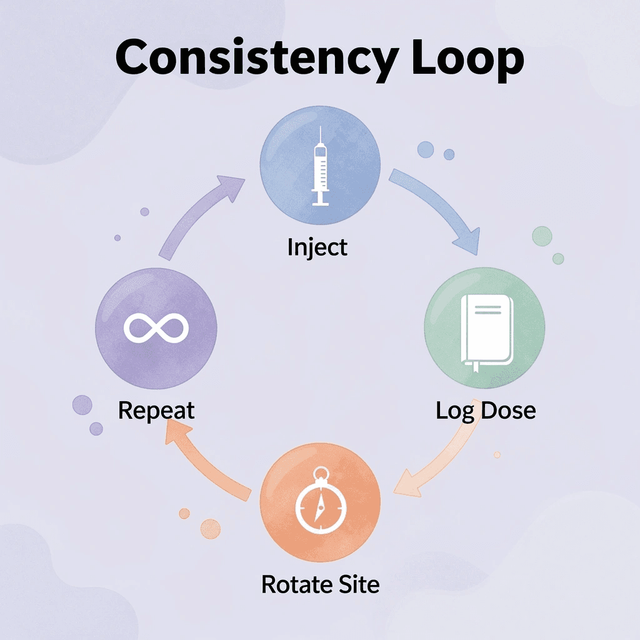
Consistency and tracking are just as important as technique. Rotating injection sites on a reliable schedule reduces tissue buildup and keeps absorption steady over time. For those who want a structured way to stay on top of dosing, site rotation, and progress, the GLP-1 app from MeAgain keeps everything organized in one place.
Table of Contents
- Does Where You Inject GLP-1 Actually Affect Results?
- Where to Inject GLP-1 for Best Results
- How to Get the Best Results From Every GLP-1 Injection
- The Best Injection Site Is Only Part of the Equation
Summary
- Injection site choice affects how GLP-1 medications like semaglutide and tirzepatide are absorbed into the body. These medications are designed for slow, steady absorption through subcutaneous fat, and accidentally hitting muscle tissue speeds up that process in ways that can increase nausea and disrupt the gradual release the medication depends on. Consistent depth in the right tissue layer matters more than which approved site you choose.
- The three primary approved injection sites are the abdomen, front thigh, and upper arm, and all three work effectively when used correctly. The abdomen offers the most surface area and is easiest to self-administer, while the thigh benefits from natural muscle relaxation when seated. The upper arm works best as a rotation stop rather than a primary site, particularly when a partner is available to assist.
- Rotation is a medical protocol, not a preference. Repeated injections into the same spot cause lipohypertrophy, a condition where fat cells harden into rubbery lumps that absorb medication more slowly and less predictably. Research indicates that rotating injection sites reduces the risk of lipohypertrophy by up to 30%, and injecting into already-damaged tissue can reduce drug absorption by as much as 25%.
- Long-term adherence is one of the biggest challenges with GLP-1 therapy. Only 32% of GLP-1 patients remain on therapy after 12 months, according to HealthVerity's 2025 GLP-1 Trends report. Discomfort, inconsistent results, and difficulty maintaining proper technique are among the friction points that lead people to stop before seeing the full benefit of treatment.
- Small technique errors compound quietly over time. Injecting within two inches of the navel, using cold medication straight from the refrigerator, reusing needles, or withdrawing the pen too early can all reduce dose accuracy and increase discomfort. These are not dramatic mistakes, but repeated across weeks and months of injections, they meaningfully affect how well the medication performs.
- The results GLP-1 medications can produce are significant. Tirzepatide achieved up to a 22.5% mean body weight reduction at 72 weeks in the SURMOUNT-1 trial, an outcome that depends entirely on consistent, reliable medication delivery throughout the full treatment period. Protecting the small details of each injection is what allows those results to accumulate.
- MeAgain's GLP-1 app addresses the consistency challenge directly by logging injection sites, dose history, and progress in one place so rotation stays on track without relying on memory.
Does Where You Inject GLP-1 Actually Affect Results?
Injection site choice matters, but not in the way most people think. The question is whether you're injecting in the same place, doing it the right way, and going into the correct tissue layer every time.
"The question is whether you're injecting in the same place, doing it the right way, and going into the correct tissue layer every time." — Key Clinical Insight

Why the tissue layer matters more than the location
The difference between fat and muscle matters significantly. GLP-1 medications like semaglutide and tirzepatide are designed to absorb slowly through subcutaneous fat, the shallow layer beneath your skin. Semaglutide's 89% subcutaneous bioavailability and a three-day peak-concentration curve enable this controlled release. Muscle contains far more blood vessels than fat, so injecting into muscle causes faster absorption than intended. This accelerated absorption disrupts the steady, gradual release your body requires and increases the risk of nausea and light-headedness.
Three reasons why site choice and rotation actually count
You might wonder why the place you choose matters if medicine goes under your skin. Here are three clear reasons.
Why does consistent absorption lead to more predictable results?
First, consistent absorption produces predictable results. The abdomen, front thigh, and back of the upper arm all have sufficient subcutaneous tissue to deliver medication steadily, but only when you're in that fat layer. Miss it, and your dose behaves differently than your body expects.
Why does skin need recovery time between injections?
Second, skin needs recovery time. Repeated injections into the same spot create small, rubbery lumps called lipohypertrophy. According to InjectCo, rotating injection sites reduces the risk of lipohypertrophy by up to 30%, since injecting into damaged tissue worsens the problem.
How does fresh skin make each injection easier?
Third, fresh skin is easier to work with. A well-rested fold pinches cleanly, accepts the needle with less resistance, and hurts less. Moving at least an inch from your last mark protects every future dose.
Most people track injection sites mentally and imperfectly. When that system fails, the cost is repeated trauma to the same patch of skin. Our MeAgain GLP-1 app removes that mental load by logging your injection sites and dose history, so rotation becomes a habit the app maintains for you.
Is the stomach always the best injection site?
The belief that the stomach is always the best injection site oversimplifies the evidence. Yes, the abdomen has higher baseline blood flow than the thigh, and Bolt Pharmacy reports that injecting into lipohypertrophic tissue can reduce drug absorption by up to 25%. However, slightly faster abdominal absorption doesn't translate into better weight loss outcomes for most patients.
The FDA approves the abdomen, the front thigh, and the back of the upper arm as valid injection sites because all three are effective when used correctly. Two persistent myths warrant clarification: arm injections do not reduce nausea, and thigh injections do not soften side effects. Nausea from GLP-1 medications is systemic, driven by the medication's action on the gut and brainstem, not by injection location.
What actually determines results over time?
Choosing the right injection site matters less than injecting consistently and correctly every single week across approved zones. That's where results happen.
Related Reading
- GLP-1 Plateau
- How Does GLP-1 Help You Lose Weight
- How Much Protein On GLP-1
- How Much Water To Drink on GLP-1
- Why Am I Not Losing Weight On GLP-1
- Can GLP-1 Cause Gastroparesis
- Can GLP-1 Cause Kidney Stones
- Which GLP-1 Has The Least Side Effects
- Does GLP-1 Cause Acid Reflux
- Why Am I Not Losing Weight on Zepbound
Where to Inject GLP-1 for Best Results
GLP-1 Stomach Injection Site
The abdomen is the default starting point for GLP-1 medications because it offers the largest subcutaneous fat zone of any approved injection area, is easy to reach without assistance, and is the most clinically studied site for drugs like semaglutide and tirzepatide. According to Healthline, the three primary injection sites are the abdomen, thigh, and upper arm. Greater surface area provides more rotation options, reducing tissue damage over time.
Which zone within the abdomen should you use?
The specific zone within the abdomen matters significantly. Stay at least two inches away from the navel in every direction, as the tissue there is denser and absorbs unevenly. Use the lower-left and lower-right quadrants as your primary injection zones, and avoid injecting through stretch marks, scars, bruised skin, or thickened tissue. Move at least one inch from your last injection point each week. The "smile" pattern below the belly button maps a predictable arc of usable tissue that keeps each point fresh.
Does the abdomen absorb GLP-1 medication better than other sites?
The abdomen absorbs medication slightly faster than the thigh: one pharmacokinetic study found thigh bioavailability ran roughly 12% lower. Clinical guidance treats all three sites as interchangeable because this gap doesn't yield meaningfully different weight-loss outcomes. What degrades results is repeatedly injecting into the same spot. Lipohypertrophy, the thickened, scar-like tissue that forms from overuse, absorbs medication erratically. A well-rotated thigh will always outperform a neglected abdomen.
Why can abdominal injections feel more sensitive over time?
The abdomen can feel more sensitive than clinical guides suggest, especially during bloating, on an empty stomach, or after weeks of consistent use. Some patients report needing prescription anti-nausea medicine to manage nausea tied to abdominal injections, which may reflect faster absorption pushing medication into circulation more acutely. This isn't a technique failure; it's a signal worth tracking.
How can tracking your injection sites improve your results?
Most people track injection sites by memory or habit, which becomes difficult after several weeks. Our MeAgain GLP-1 app records each injection site, along with dose history and side effects, letting you track your rotation pattern over time and identify whether persistent reactions occur at the same site. That connected data transforms a vague hunch into actionable information.
GLP-1 Thigh Injection Site
The thigh is the most popular alternative to the abdomen because sitting relaxes the underlying muscle, reducing the risk of accidentally striking intramuscular tissue rather than subcutaneous fat. This mechanical advantage is especially important for leaner patients or anyone still building confidence with self-injection technique.
Where exactly on the thigh should you inject?
The correct zone is the front or outer-front section of the upper thigh, roughly midway between the knee and hip. Avoid the inner thigh, where larger blood vessels run closer to the surface, and the back of the thigh, where muscle lies nearer the skin and visibility is poor. The outer thigh can work, but it has less subcutaneous fat in leaner patients, increasing the risk of intramuscular injection. Precision at the thigh site matters more than at the abdomen because the usable zone is smaller.
How does the thigh's absorption rate affect your experience?
The thigh's slower absorption rate involves trade-offs. Some patients find that switching from the abdomen to the thigh reduces acute nausea, likely because medication enters circulation more gradually. That same slower uptake can soften the intensity of appetite suppression for some users. Individual variation is significant enough that tracking your response across weeks is the only reliable way to understand your personal pattern.
GLP-1 upper arm injection site
The back of the upper arm is the third approved option. Self-injection here is awkward: reaching the correct zone on the outer back of the triceps, pinching the skin effectively, and controlling the pen at 90 degrees simultaneously requires coordination that most people find difficult without a mirror or a second person. Treat it as a rotation tool rather than a primary zone.
When does the upper arm site work well for GLP-1 rotation?
When the arm site works well, it gives your tissue a clean break so it can recover. Your abdomen or thigh can rest while you use your arm. Switch between your left and right arms, and move at least one inch away from your previous injection site. Target the outer-back section of your arm, not the side where you have less fat under the skin. If you are lean, you have limited usable tissue here, which makes intramuscular injection a risk if your technique is imprecise. If you are an experienced user with sufficient fat tissue, the arm adds a useful third location in a longer rotation schedule.
Buttocks as a GLP-1 Injection Site
The buttocks are a clinically recognized fourth GLP-1 injection site, particularly relevant for people with needle phobia who have a partner or caregiver administering the injection, or for anyone experiencing persistent side effects at other sites. To locate the correct zone, mentally divide the buttock into four quadrants using a horizontal midline and the gluteal cleft as the vertical divider. The injection goes into the upper outer quadrant, at least four finger-widths away from the gluteal cleft. Medication is absorbed slowest from this site compared to the other three locations, which may reduce acute side effects but also means the therapeutic peak arrives later and more gradually.
What happens to tissue when you skip rotation?
Rotating injection sites helps prevent uneven absorption. Lipohypertrophy develops quietly: you inject into the same spot week after week, the tissue thickens beneath the surface, and medication absorption becomes unpredictable. You might not feel a lump or notice anything unusual, but your results gradually plateau.
Why does the distance between injection points matter?
The one-inch rule between injection points is the minimum standard, not the best option. A four-site rotation across the abdomen, thigh, arm, and buttocks gives each site meaningful recovery time and spreads tissue stress more evenly. Family Tree Primary Care confirms the three primary subcutaneous injection sites for GLP-1 medications, though adding the buttocks can further extend your recovery window. Always check each injection point before use: if the skin feels firmer than surrounding tissue or a previous injection left an unresolved raised mark, move further away. Injecting into compromised tissue undermines the reliability of medication.
GLP-1 Shot in Thigh vs Stomach vs Arm: Which Injection Site Is Most Effective?
But knowing where each site is only gets you halfway there; the real question is whether you're getting everything possible out of the injection itself.
Factor | Stomach (Abdomen) | Thigh | Upper Arm | Buttocks |
|---|---|---|---|---|
Absorption speed | Fastest | Slightly slower | Similar to the abdomen | Slowest |
Ease of self-injection | Easy | Easy | Difficult | Very difficult |
Rotation surface area | Largest | Moderate | Smallest | Large |
Bruising tendency | Moderate | Lower for many | Higher if the technique is off | Generally low |
Best for beginners | Yes | Yes | No | No |
Best for travel | Yes | Yes | No | No |
Best for privacy | Moderate | High | High | Low (unless at home) |
Assisted injection | Works fine | Works fine | Best option | Usually recommended |
Absorption consistency | High | High with good rotation | Varies with body composition | High, but slower |
Comfort after injection | Usually comfortable | May be sore when walking or exercising | Can be awkward or tender | Often comfortable when sitting normally |
Best use case | Every day, the primary injection site | Reliable alternative to rotate with the abdomen | Occasional rotation site, especially with caregiver assistance | Assisted injections, needle-phobic patients, or those preferring a slower absorption profile |
Related Reading
- Why Do Some People Not Lose Weight on Ozempic
- Slow Weight Loss On Wegovy
- Why Am I Not Losing Weight On Zepbound
- Can You Stop Glp-1 After Losing Weight
- How Many Weeks Is Considered A Weight Loss Plateau
- Can Glp-1 Cause Low Blood Sugar
- Glp-1 And Exercise
- Can Glp-1 Cause Headaches
- Can Glp-1 Cause Low Blood Pressure
How to Get the Best Results From Every GLP-1 Injection
Getting the most from every injection requires repeating the same steps with the right technique, timing, tissue condition, and rotation pattern. If you skip even one of these, the others have to make up for it — and that's where results start to slip.
"Consistent injection technique, site rotation, and timing are the foundational pillars that determine how effectively your body absorbs and responds to every GLP-1 dose." — Clinical Best Practice Guidelines
Factor | Why It Matters | What Happens If You Skip It |
|---|---|---|
Technique | Ensures full dose delivery | Medication may leak or be absorbed inconsistently |
Timing | Maximizes drug effectiveness | Reduced appetite control and metabolic response |
Tissue Condition | Allows proper absorption | Lumps or scar tissue block uptake |
Rotation Pattern | Prevents site damage | Lipohypertrophy and absorption failure |

What the correct injection technique actually looks like
Start with healthy skin. Injecting into bruised, swollen, or recently used tissue alters how semaglutide or tirzepatide moves through the subcutaneous layer. Before each injection, prime a new pen and attach a fresh needle. Reused needles develop tiny barbs and can clog; you press the button, thinking you received your dose when you didn't. After pressing, confirm the dose counter reads zero. If it never reaches zero, the needle is blocked, and the dose is not delivered. Hold the needle in place for six to ten seconds after the counter hits zero. Pulling out too soon leaves medication trailing behind the needle tip. Counting to six before withdrawing is the difference between a full dose and a partial one.
Why rotation is a medical protocol, not a preference
Returning to the same injection point week after week can lead to lipohypertrophy, the firm, rubbery tissue that forms when subcutaneous fat is repeatedly damaged. Medication injected into that changed tissue absorbs more slowly and unpredictably, producing erratic blood levels and inconsistent appetite suppression.
What does a structured rotation cycle actually look like?
A structured six-zone rotation (left abdomen, right abdomen, left thigh, right thigh, left upper arm, right upper arm, cycling weekly and moving at least 1 inch within each zone per injection) allows each patch of tissue 4 to 6 weeks to recover before reuse. Even basic left-right abdominal alternation is better than no rotation, but the full cycle helps keep tissue healthy over years of running programs. According to research published in Obesity Facts (PMC12194299), tirzepatide achieved a mean body weight reduction of up to 22.5% at 72 weeks in the SURMOUNT-1 trial. These results depend entirely on consistent, reliable medication delivery.
How does tracking each site keep the protocol from breaking down?
Most people track rotation in their heads until they forget. A sticky note works for a week; memory for two. After that, sites repeat, and tissue pays the price. A GLP-1 app like MeAgain removes this burden by automatically logging each injection site and dose. When details are tracked, the protocol holds.
The mistakes that quietly reduce how well this works
The failure point is usually small and invisible. Injecting too close to the navel (within two inches) puts medication into denser tissue that does not absorb cleanly. Injecting cold medication directly from the refrigerator causes more local discomfort and slightly thicker flow through the needle; fifteen to twenty minutes at room temperature resolves this. Skipping the alcohol swab or injecting before it dries introduces contamination risk and unnecessary sting.
These quiet errors accumulate across weeks of injections. HealthVerity's 2025 GLP-1 Trends report found that only 32% of GLP-1 patients remain on therapy after 12 months, with inconsistent injection experience—discomfort, confusion, or erratic results—driving discontinuation. Protecting small details protects the whole journey.
Getting the injection right is the foundation, but the foundation only holds if what you build on top of it is equally solid.
Related Reading
- Weight Gain After Stopping Glp-1
- Glp-1 And Menopause
- Glp-1 Pills Vs Injections
- Glp-1 Side Effects Women
- Glp-3 Vs Glp-1
- Glp-1 Sexual Side Effects
- Where To Inject Glp-1 For Best Results
- Best Glp-1 For Menopause Weight Gain
The Best Injection Site Is Only Part of the Equation
Consistency separates good results from frustration. Knowing the right site, technique, and rotation schedule matters only if you execute them week after week without letting details slip.

Most people keep track of their GLP-1 journey by remembering it in their head, but those memories get fuzzy over time — dose timing drifts, rotation patterns slip, and gaps add up. A GLP-1 app like MeAgain takes that work off your plate, logging injection sites, dose history, protein intake, and progress all in one place.
"Dose timing drifts, rotation patterns slip, and gaps add up — the details of a GLP-1 routine are too important to leave to memory alone."
What You Need to Track | What Happens Without It |
|---|---|
Injection site rotation | Lipodystrophy and absorption issues |
Dose timing | Missed or doubled doses |
Protein intake | Muscle loss during weight loss |
Progress over time | No data to adjust your approach |
Your next injection is one small moment. Small moments, repeated over and over, are exactly how this works.