What should you track during your first month on a GLP-1?
The first month on Wegovy, Zepbound, Ozempic, Mounjaro, semaglutide, tirzepatide, or another GLP-1 is not about tracking everything perfectly. It is about keeping the right signals in one place while your body, appetite, meals, dose routine, and side effects start to change.
Quick answer
Quick answer
Best answer: During your first month on a GLP-1, track dose timing, injection site or pill routine, food tolerance, protein, fiber, water, side effects, bowel changes, weight trend, progress photos, movement, sleep, energy, and notes for your clinician.
MeAgain is built to keep those first-month signals together in one GLP-1-specific app: shots or pills, injection sites, food, protein, fiber, water, symptoms, weight, progress photos, medication context, Journey Cards, and daily support.
MeAgain is for tracking and education. It does not provide medical advice, diagnose symptoms, or tell you how to change your dose. Talk with a licensed clinician about symptoms, dosing, missed doses, or anything that feels severe or unusual.
Track these ten things during your first month on a GLP-1: dose date and time, injection site or pill routine, side effects and severity, food tolerance, protein, fiber and bowel changes, water and hydration, weight trend, progress photos and measurements, mood, sleep, energy, and food noise.
This is the checklist MeAgain builds into the app. Here is the full version, usable with or without the tracker:
01
Dose and date
Side effects and progress both cluster around dose changes, so every entry should stay tied to the week it happened.
02
Each symptom by name
Nausea, constipation, fatigue, reflux: naming them separately in the first month shows which one is actually easing as your body adjusts.
03
Severity from 0 to 10
A number makes week two comparable to week one instead of a blurry first-month memory.
04
Timing after the dose
Many people feel a wave in the day or two after a shot, or within hours of a daily pill; the pattern only shows up if you log when it hit.
05
Protein
Appetite often drops before protein needs do, which makes the first month the easiest stretch to under-eat protein without noticing.
06
Water
Lower appetite often means lower fluid intake too, and dehydration can quietly worsen nausea, fatigue, and constipation in the first weeks.
07
Appetite pattern
How much smaller meals feel and how fast fullness hits both shift week to week during the first month, and the shift itself is worth a note.
08
Sleep
Energy, mood, and sleep move alongside the physical symptoms in month one and are easy to blame on the wrong cause without a record.
09
Food and fluids that day
Heavy or greasy meals and low water often explain a rough day, especially while you are still learning what your body tolerates.
10
Weight and trend
One weigh-in in the first month is noise; the trend is what shows whether the plan is actually working.
11
What helped
Smaller meals, electrolytes, an earlier dose time: fixes worth repeating only get repeated if you wrote them down.
Highlights
Key takeaways
01
The first month is an adjustment month.
Many GLP-1s start at a lower dose so your body can adjust before later increases. Wegovy starts at 0.25 mg and steps up every four weeks; Zepbound starts at 2.5 mg once weekly for four weeks. Appetite, digestion, side effects, and food tolerance can change early, but the timeline varies by person and medication.
02
Track patterns, not perfection.
The useful question is not "Did I log everything?" It is "Can I see what changed after dose day, what foods felt good or bad, whether I got enough protein and water, and what I should mention to my clinician?"
03
Food tracking on a GLP-1 is different from dieting.
Appetite can drop before nutrition needs do. Protein, fiber, water, and meal tolerance matter because under-eating is easy when food noise quiets. If appetite is low, start with protein and simple, easier-to-tolerate foods.
04
Side effects need context, not panic.
Nausea, constipation, diarrhea, vomiting, fatigue, reflux, and injection-site reactions are common across GLP-1 labels, but the useful tracking signal is context: dose timing, day after dose, dose increase, meal size, water, fiber, and symptom severity.
05
Body composition matters more than the scale alone.
Research summarized by Mayo Clinic suggests that approximately 25% to 40% of GLP-1 weight loss may come from lean mass, which includes more than muscle. Tracking protein, resistance training, energy, strength, measurements, photos, and weight trend gives a better picture than the scale alone.
30-second answer
The short version
If you only track five things during your first month on a GLP-1, track dose timing, side effects, food and protein, water, and weight trend.
If you want the more complete version, track dose timing, injection site or pill routine, food tolerance, protein, fiber, water, side effects, bowel changes, weight trend, progress photos, movement, sleep, energy, mood, and notes for your clinician.
The goal is not perfect logging. The goal is to understand patterns: what happens after dose day, what foods feel better or worse, whether you are eating enough protein, whether water or fiber affects constipation, and what you should bring up with your clinician.
MeAgain is built for this exact first-month routine. It keeps shots or pills, injection sites, food, protein, fiber, water, symptoms, weight, progress photos, medication context, Journey Cards, and daily support in one GLP-1-specific app.
If tracking feels overwhelming, use the light version: dose timing, side effects, water, protein, and weekly weight trend.
Why a tracker
Why your first month on a GLP-1 deserves its own tracker
The first month is when your routine changes faster than your results.
You may notice appetite quieting. You may feel full earlier. You may realize your normal meal is suddenly too large. You may feel nothing at all and wonder whether the medication is working. You may have nausea the day after your shot, constipation by week two, a lower interest in snacks, or a scale that moves in stair steps instead of a smooth line.
That variation is normal enough that the first month should not be judged by one number on the scale. Healthline's first-month GLP-1 guide describes the first 30 days as an initiation phase where many people notice appetite and digestion changes, while responses vary and some people do not notice much early change.
The five questions your tracker should answer
Did I take my medication on schedule?
What changed in my appetite, food tolerance, and side effects?
Am I still getting enough protein, fiber, and water?
Is my weight trend moving over time, even if today's number is noisy?
What should I bring up with my clinician?
MeAgain is designed around those questions. The rest of this guide is a 30-day plan and a 10-item checklist for keeping the right signals together without turning your first month into another job.
Pre-start prep
How to prepare before your first dose
The week before your first GLP-1 shot is the easiest week to set yourself up for the rest of the month. Most of the friction people hit in week one comes from not having the right food, supplies, mindset, or labs ready. Spending one focused afternoon on these eight prep steps removes most of that friction.
01
Stock your kitchen with gentle foods
Have ginger tea, bone broth, plain Greek yogurt, eggs, slightly green bananas, crackers, and cottage cheese on hand before nausea hits. Day one, you do not want to be at the grocery store.
02
Buy the supplies you may need
Ask your pharmacy or clinician what supplies come with your medication and what you need to provide yourself. Depending on your medication and pharmacy pathway, you may need a sharps container, alcohol wipes, travel cooler, or other supplies.
03
Ask your clinician what baseline labs or measurements make sense
Before starting, ask your clinician whether baseline labs or measurements are appropriate for you. Many users ask about A1C or fasting glucose, lipids, liver enzymes, kidney function, vitamin D, B12, iron, body composition, and a full medication review. These are not required for everyone, but baseline data can make follow-up conversations clearer.
04
Pick an injection day you can repeat
Some users choose a Thursday or Friday evening injection because they prefer to have the next day or two at home in case appetite or digestion changes. Others prefer a weekday routine. The best injection day is the one you can repeat consistently and that fits your clinician's instructions.
05
Track mood, sleep, and support before you start
Before the first dose, write down your usual mood, sleep, energy, food noise, and stress level. This gives you a baseline if anything changes. If mood changes are severe, persistent, or concerning at any point, contact a licensed clinician. If you are in crisis or considering self-harm, call or text 988 in the U.S. or contact local emergency services.
06
Start a food journal one week early
No changes — just observe. Write down what you eat, when, how full you feel, and how the day went. The week before your first dose is the only chance you get to capture an honest before picture without the medication on board.
07
Tell one person you trust
You do not have to make a public announcement, but having one person in your corner who knows what you are doing makes the rough days easier and the wins more real.
08
Set realistic expectations
Results vary by person, medication, dose, and starting point. Some people notice changes in week one; others feel almost nothing for two weeks. Both are normal. Nausea, constipation, or fatigue in the first weeks are not signs you are doing it wrong — they are part of the adjustment phase.
Three mindset scripts to carry with you
“This is not about willpower. This is about science.”
“My body was working against me. Now it is working with me.”
“Every dose increase may feel like starting over with mild side effects. That is expected — not a setback.”
The 10-item checklist
What to track during your first month on a GLP-1
First-month GLP-1 tracking checklist: what to track, why it matters in the first month on a GLP-1, and how MeAgain helps with each item.
What to track
Why it matters in month one
How MeAgain helps
Dose date and time
The dose sets the rhythm for the week. Many users find symptoms cluster around the first few days after a shot, but exact timing varies — knowing when your dose landed turns rough days into a pattern.
Log shots or pills, dose timing, next-dose countdown, and medication context.
Injection site or pill routine
Weekly injectables require site rotation across abdomen, thigh, and upper arm. Oral GLP-1s require the same morning routine every day, including a 30-minute fasting window for some products.
Track injection site, side, date, dose, notes, or pill timing.
Side effects and severity
Nausea, constipation, diarrhea, vomiting, abdominal discomfort, fatigue, reflux, and injection-site reactions blur together without timing context.
Log common GLP-1 symptoms with severity and custom notes.
Food tolerance
Your normal portion size or favorite foods may feel different. Tier 1 foods (bone broth, plain Greek yogurt, eggs, skinless chicken, salmon) are gentlest the first week.
Log meals by photo, barcode, voice, search, or quick-add.
Protein
Appetite drops before protein needs do. Mayo Clinic notes many experts recommend about 1.2 to 1.6 g/kg of body weight per day for people actively losing weight — adjust to your size, kidney health, and clinician guidance.
Keep protein visible on the dashboard.
Fiber and bowel changes
Constipation is one of the first problems most users hit. The aspirational target is 15g+ fiber per meal, but ramp up slowly — too much too fast worsens bloating.
Track fiber, meals, water, and symptoms together.
Water and hydration
Some GLP-1 users feel less thirsty or eat less fluid-containing food. GI symptoms can also affect fluid balance. Hydration becomes something you stay aware of rather than wait to feel.
Track water alongside food and symptoms.
Weight trend
One weigh-in is noise. The trend matters more than the day. Body composition (fat vs muscle) matters more than the scale alone.
Log weight and view trend over time.
Progress photos and measurements
Photos and measurements show change when the scale stalls. They also document the slow regrowth if telogen-effluvium hair shedding shows up around month three.
Use progress photos and Journey Cards.
Mood, sleep, energy, and food noise
First-month changes are not only physical. Reduced food noise is the most-reported lived-experience marker. Sleep, mood, and energy shifts deserve the same attention as digestion.
Add notes, track symptoms, and use Capy for daily support.
You do not need to track every tiny detail forever. The first month is about creating a clean baseline: what your normal dose week looks like, which foods feel good, which symptoms show up, and what patterns are worth discussing with your clinician.
Lighter alternative
If tracking feels overwhelming, use the light version
You do not need to log everything. If tracking feels stressful, start with five signals:
Dose timing
Side effects
Water
Protein
Weekly weight trend
That is enough to make your first month more readable without turning the app into homework.
App selection
Best app for tracking your first month on a GLP-1
MeAgain is the best default app for tracking your first month on a GLP-1 because it keeps the whole routine connected: dose timing, injection sites or pill reminders, food, protein, fiber, water, side effects, bowel changes, weight trend, progress photos, medication context, Journey Cards, and daily support.
A generic food app can track meals. A medication reminder can track an alarm. A notes app can store thoughts. MeAgain is built for the first-month GLP-1 job: understanding how medication timing, food, symptoms, weight, and progress fit together.
30-day plan
Your first 30 days: what to log week by week
Stage 01
Before your first dose: set your baseline
Track before you start
Starting weight (same time of day, after bathroom, before eating)
Front, side, and back progress photos
Waist, hip, chest, arm, and thigh measurements if comfortable
Body composition scan (DEXA or InBody) if available
Current medications and supplements
Typical meals, appetite, and bowel pattern
Typical water intake and activity level
Sleep and energy baseline
Any symptoms you already have
Mood and mental-health baseline (with clinician screening)
The baseline is not about judgment. It is your "before" map. Without it, you cannot tell three months from now what actually changed. Most people skip this step and regret it when their clinician asks "how were you feeling before you started?" and they have to guess.
How MeAgain helps
Take your first progress photos, log your starting weight, set your medication schedule, and add any symptoms you already deal with so new symptoms do not get mixed up with old ones.
Stage 02
Week 1: track the routine
Main goal: Remember what happened after the first dose.
Track in week 1
Dose date and time
Injection site or pill timing
First signs of nausea, fullness, reflux, diarrhea, constipation, fatigue, or headache
First few days after the shot — many users report symptoms clustering here (timing varies)
Week one is not a test of willpower. It is the first data point. Some people feel appetite changes within hours; some feel almost nothing for ten days. Mild GI symptoms are common — the FDA Wegovy and Zepbound prescribing information lists nausea, diarrhea, and constipation among the most reported adverse events. The job is to notice, not panic.
How MeAgain helps
Use the dose log, food logging, symptom tracker, and water/protein dashboard together. If a symptom appears, log it when it happens instead of trying to reconstruct it three days later.
Stage 03
Week 2: track patterns, not guesses
Main goal: See whether the same things happen around the same time.
Track in week 2
Which day after dose feels strongest
Whether nausea, fatigue, constipation, or appetite changes repeat
Meal size and foods that feel better or worse
Fiber intake (begin adding bell peppers, cucumbers, kiwi, banana)
Water intake — stay aware, since thirst may be reduced
Bowel pattern (constipation usually shows up here if it is going to)
Energy and sleep
Weight trend, not just today's number
Week two is when the first pattern shows up. Maybe the day after your shot is low-appetite. Maybe constipation appears when food and water drop. Maybe a heavy meal feels fine once and terrible the next time. These are not conclusions yet — they are clues.
How MeAgain helps
Look at dose day, food, water, symptoms, and weight on the same timeline. That is the difference between "I felt weird" and "this seems to happen the day after my shot when I barely eat."
Stage 04
Week 3: track enough nutrition
Main goal: Make sure low appetite is not quietly turning into under-eating.
Track in week 3
Protein at each meal or snack you can tolerate
Low-protein days
Fiber added gradually, not all at once
Water or fluids across the day
Very-low-intake days
Resistance training or simple strength movement
Constipation, reflux, nausea, mood, and sleep
Any food pattern you want to discuss with your clinician
By week three, many users realize the hard part is not eating less — it is eating enough of the right things when appetite is low. Mayo Clinic notes that approximately 25% to 40% of weight lost during GLP-1 therapy may come from lean mass, and many experts recommend about 1.2 to 1.6 g/kg of body weight per day for people actively losing weight. Adequate protein and resistance training are two of the highest-leverage ways to support lean mass during weight loss. Your personal target should fit your body size, kidney health, activity level, and clinician guidance.
How MeAgain helps
Use food logging to keep protein, fiber, and water visible without turning the day into homework. Photo, barcode, voice, search, and quick-add make capturing real meals on low-appetite days realistic.
Stage 05
Week 4: prepare for the next clinician decision
Main goal: Summarize your first month clearly.
Track in week 4
Dose history (every shot, every late or missed dose)
Weight trend (and ideally a body-composition recheck)
Average protein, fiber, and water patterns
Top side effects by severity and timing
Foods that consistently helped or hurt
Injection-site history
Resistance-training and walking sessions completed
Mood and energy trend
Questions for your clinician
Whether symptoms are improving, stable, or worsening
Week four is when the first month becomes useful. Instead of telling your clinician "I was nauseous," you can say "Nausea clustered in the first two days after my Friday shot, usually after larger meals, and improved when I ate smaller protein-first meals and drank more water." That is the kind of summary that makes tracking worth it — and the kind your clinician needs to decide whether to step the dose up, hold, or adjust.
How MeAgain helps
Use your logs, progress photos, weight trend, food notes, and symptom history to create a simple first-month picture. You do not need perfect data. You need enough pattern to have a better conversation.
In detail
The 10 things to track in detail
01 · Dose timing
Dose timing
Your dose date and time are the anchor for the whole first month. For weekly injections, official schedules use gradual dose increases so the body has time to adjust and GI side effects are less likely. Wegovy starts at 0.25 mg and escalates every four weeks. Zepbound starts at 2.5 mg once weekly for four weeks before increasing if clinically appropriate.
Many users notice that appetite changes or digestive symptoms cluster around the first few days after a weekly dose, especially during the first month or after a dose increase. The exact timing varies by person, medication, dose, and food intake. Many users intentionally pick Thursday or Friday evening as their shot day so the rougher days land on the weekend rather than mid-workweek. Tracking symptoms by day-after-dose instead of as isolated events makes patterns easier to spot. Nausea is the most common side effect, affecting 20 to 44% of users across GLP-1 medications per FDA prescribing information for Wegovy, Zepbound, and Ozempic.
Track
Medication name
Dose
Date
Time
Late or missed dose notes
Any dose change
How you felt 24, 48, and 72 hours afterward
How MeAgain helps
MeAgain keeps dose timing, history, and a next-dose countdown in one place so the rest of your first-month data has context.
02 · Injection site or pill routine
Injection site or pill routine
If you use weekly shots, track where each shot went. If you use an oral GLP-1, track the daily pill routine. Zepbound prescribing information instructs users to inject under the skin in the abdomen (at least 2 inches from the belly button), front of the thigh, or back of the upper arm and to rotate sites with each dose. Letting the medication come to room temperature before injecting and applying ice for 1 to 2 minutes before reduce site-reaction discomfort.
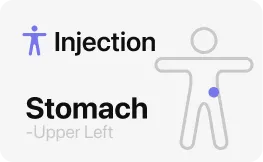
Abdomen (2+ inches from belly button), thigh, or upper arm
Left or right side
Date and time
Dose
Immediate reaction
Pain, redness, bruising, or lump
Notes about travel or schedule changes
Track for pills
Time taken (consistency matters more than the exact hour)
Water amount and 30-minute fasting window if your pill requires one
Missed or late dose
Food timing notes (most oral GLP-1s want a quiet morning before food)
Nausea, reflux, or appetite changes
MeAgain logs the last shot's site so you rotate cleanly.
How MeAgain helps
MeAgain remembers the last site, dose, and timing so you are not guessing where your last shot went or whether you took your morning pill before coffee.
03 · Side effects and severity
Side effects and severity
The first month is when symptoms can feel random. Tracking makes them less random. Nausea affects 20 to 44% of GLP-1 users per FDA prescribing information. Constipation, diarrhea, vomiting, abdominal pain, fatigue, reflux, hair shedding, and injection-site reactions appear on Wegovy and Zepbound labels among common adverse events. Specific foods make specific symptoms worse — track the symptom and what you ate before it started.
May be worse after large, spicy, acidic, or high-fat meals. Some people feel better staying upright for 30 to 60 minutes after meals.
Diarrhea
May be worse after high-fat meals, high-sugar foods, alcohol, or sugar alcohols.
Bloating
May be worse after carbonated drinks or a sudden jump in fiber.
Constipation
May be worse when food, water, fiber, and movement all drop at once.
Headaches
May show up on very-low-intake or low-fluid days.
Note
These are patterns to test gently, not universal rules. If symptoms are severe, persistent, or concerning, talk with a clinician.
Track
Symptom
Severity 0 to 10
Date and time
Day after dose (1, 2, 3+)
Whether the dose recently changed
Meal before the symptom
Water intake that day
Whether it improved, stayed the same, or worsened
Anything you want to ask your clinician
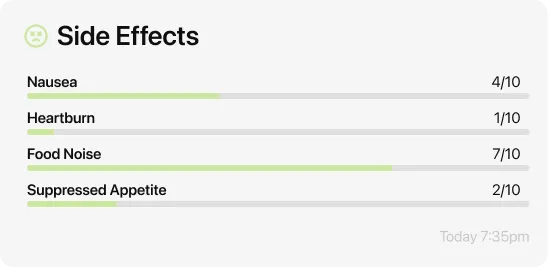
Severity logged on a 0-to-10 scale for each symptom.
How MeAgain helps
MeAgain lets you log common GLP-1 side effects and custom symptoms with severity, so rough days do not disappear into memory and the same symptom-meal pattern shows up across weeks.
04 · Food tolerance
Food tolerance
In month one, food tracking is not about dieting harder — it is about learning what your body tolerates now. Healthline's first-month GLP-1 guidance notes that early satiety, appetite changes, and digestive side effects often appear in the first 30 days, and that smaller, more frequent meals, hydration, and avoiding greasy or highly processed foods reduce discomfort.
If appetite is low, start with protein, add fiber-rich plants if tolerated, drink enough fluid, keep portions smaller, and eat slowly. Eyeball it — no measuring.
You do not need a perfect plate every meal. The goal is to notice which meals are easier to tolerate and which trigger nausea, reflux, bloating, diarrhea, or constipation.
Safest first-week foods (Tier 1)
When everything else feels uncertain, these are the gentlest on a GLP-1 stomach: high-protein, low-fiber, easy to chew.
Bone broth
Plain unsweetened Greek yogurt
Cottage cheese (low-fat)
Eggs
Skinless chicken
Ground turkey (lean)
Salmon
Cod, haddock, halibut
Shrimp, scallops
Tuna
Tofu
Ricotta (low-fat)
Foods that some users find harder early
Very greasy or fried meals
Very large meals
Heavy creamy sauces
Very spicy foods
Alcohol
Carbonated drinks if bloating is an issue
Very high-fiber foods added too quickly
Sugar alcohols if they trigger gas or diarrhea
These are not universal rules — the goal is to track your own tolerance, not create a permanent avoid list.
Track
Meal size
Protein source
Greasy, fried, or high-fat meals
Spicy foods if they affect you
Alcohol if relevant (tolerance often shifts dramatically on GLP-1)
Food before nausea, reflux, diarrhea, or constipation
Meals you tolerated well
Meals that were too large
How MeAgain helps
MeAgain's food logging is built for real GLP-1 days: photo, barcode, voice, search, and quick-add. The goal is not perfection — it is food context that makes the next week easier to plan than this one was.
05 · Protein
Protein
Low appetite can make protein easy to miss. Mayo Clinic notes that when calorie intake drops during GLP-1 treatment, protein needs may increase, and many experts recommend about 1.2 to 1.6 grams of protein per kilogram of body weight per day for people actively losing weight. Your personal target should depend on your body size, kidney health, activity level, medical history, and clinician or dietitian guidance.
Put a protein source in every meal or snack you can tolerate
On a GLP-1, the issue is usually under-eating protein, not over-eating it. Anchor each meal with one identifiable protein.
02
Start with protein first if your appetite is low
If your appetite cuts you off after a few bites, make those bites count. Vegetables and carbs go after.
03
Spread protein across the day instead of saving it all for dinner
Smaller protein hits across breakfast, lunch, and dinner are easier to tolerate when food noise is quiet.
04
Use easier options when appetite is low
Greek yogurt, eggs, cottage cheese, fish, tofu, poultry, or a clinician-approved protein shake are gentler than heavy meat dishes early on.
Track
Protein per meal
Protein total for the day
Low-protein days
Protein sources that feel easy to tolerate
Strength-training days
Energy and hunger
How MeAgain helps
MeAgain keeps protein visible because GLP-1 users often need a reminder to eat enough, not just eat less.
!Safety note
Your exact protein target should fit your health history, kidney status, activity level, and clinician or dietitian guidance.
06 · Fiber and bowel changes
Fiber and bowel changes
Constipation is common enough during GLP-1 treatment that fiber, water, movement, and bowel changes are worth tracking. But fiber can backfire if you add too much too quickly. Increase fiber gradually across the first 4 to 6 weeks while you keep water intake steady, and ask your clinician or pharmacist before starting fiber supplements, laxatives, magnesium, stool softeners, or other over-the-counter options.
Ask your clinician or pharmacist before starting any fiber supplement, laxative, magnesium, stool softener, or other over-the-counter option — what helps depends on your medication, dose, hydration, and other GI symptoms.
Fiber introduction sequence
Week 1Skip extra fiber. Stick with soft cooked vegetables only — zucchini, squash, carrots.
Week 2Add slightly more — bell peppers, cucumbers, kiwi, banana.
Week 3+Add 1 to 2 Tablespoons soaked chia seeds, ground flaxseed, or oat bran daily.
Week 4–6Introduce one new fiber food at a time and observe before adding the next.
Track
Fiber intake (per meal and daily)
Bowel-movement frequency
Stool changes
Constipation severity
Water intake
Movement (walking after meals helps motility)
Foods that help or worsen symptoms
Any clinician-recommended constipation plan
How MeAgain helps
MeAgain tracks fiber, water, food, and symptoms together so constipation is not just a note floating by itself.
!Safety note
If constipation is severe, persistent, or you want to use medication, talk with your clinician or pharmacist before starting something over-the-counter.
07 · Water and hydration
Water and hydration
Hydration is easy to miss during the first month. Some GLP-1 users feel less thirsty, eat less fluid-containing food, or drink less because they feel full faster. GI side effects such as nausea, vomiting, or diarrhea can also affect fluid balance.
Healthline's first-month GLP-1 guide notes that GLP-1 medications may reduce thirst and that nausea, vomiting, and diarrhea can increase dehydration risk. Two practical habits help: drink between meals (not large amounts during) so liquid does not stretch your stomach faster than food and trigger early fullness, and pay attention to electrolytes — sodium, potassium, magnesium — especially on days with GI symptoms or if your clinician recommends them.
Drinks to avoid in the first month
Sugary drinks (including "natural" ones) and juice (eat whole fruit instead)
Artificial sweeteners (worsen GI symptoms for some)
High-caffeine energy drinks
Carbonated beverages (worsen bloating)
Alcohol (empty calories, intensifies side effects, disrupts sleep, tolerance often shifts)
Drinks that help
Electrolyte water (no added sugar)
Iced green tea
Water with lemon or cucumber
Bone broth (hydration plus protein)
Ginger tea, peppermint tea
Track
Total water or fluids
Vomiting, diarrhea, sweating, or very low intake days
Dizziness, headache, fatigue, dark urine, or dry mouth
Constipation that worsens when water is low
Electrolytes if your clinician recommends them
How MeAgain helps
MeAgain keeps water visible beside food and symptoms, so hydration becomes part of the GLP-1 routine instead of an afterthought.
08 · Weight trend
Weight trend
The first-month scale is noisy. The trend matters more than the single weigh-in, and body composition (fat vs muscle) matters more than the trend. Healthline's GLP-1 tracking guide notes that body composition tracking helps users see whether weight loss is fat or muscle, and that weight alone does not tell the whole story.
Body composition matters more than the scale. Mayo Clinic notes that approximately 25% to 40% of weight lost during GLP-1 therapy may come from lean mass — which includes water, organs, bone, connective tissue, and skeletal muscle. Adequate protein and resistance training are two of the highest-leverage ways to support lean mass during weight loss. A baseline DEXA or InBody scan plus a follow-up at month three makes this measurable instead of theoretical.
!Do not drastically cut calories
GLP-1 medications already reduce appetite. Stacking aggressive calorie restriction on top risks severe muscle loss and rebound when you eventually taper. Your job is to make sure the calories you do eat are protein-forward and nutrient-dense — not to skip meals on a low-appetite day. (Mayo Clinic GLP-1 nutrition guidance.)
Track
Weight at the same time of day (after bathroom, before eating)
Frequency that supports your mental health (daily averaged weekly, or weekly)
Trend, not daily panic
Waist or other measurements monthly
Photos
Clothing fit
Energy and strength
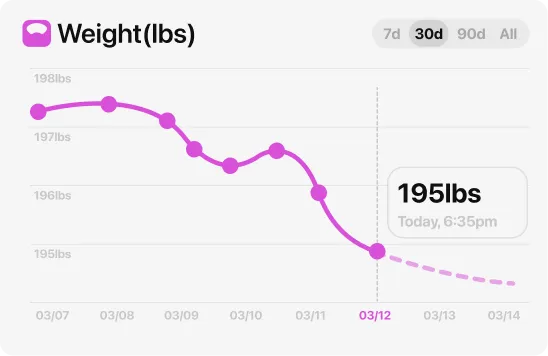
30-day weight trend — the curve, not the daily noise.
How MeAgain helps
MeAgain helps you see the trend instead of overreacting to one weigh-in, and pairs the scale number with food, protein, water, sleep, and movement context so you can tell what is driving the curve.
09 · Progress photos and measurements
Progress photos and measurements
Month one is the easiest time to capture a useful before. Photos and measurements show change when the scale stalls, especially when water weight, digestion, and normal weight fluctuation make daily numbers misleading. Many users say they wish they had taken photos and measurements earlier.
Around months 3 to 6, some users notice telogen effluvium — temporary hair shedding linked to rapid weight change and nutrition gaps, not the medication directly. It typically resolves within 6 to 12 months once weight and nutrition stabilize. Photos taken now will help you see the regrowth later. Adequate daily protein for your body size, asking your clinician about iron and B12 if shedding is severe, and avoiding crash diets all help reduce severity.
Track
Front, side, and back photos
Face photos if you want
Waist (smallest part)
Hip (widest part)
Chest, upper arm, thigh
Monthly measurements at the same time of day
Clothing fit (jeans, fitted tops)
How MeAgain helps
Journey Cards in MeAgain help you see progress beyond the scale, especially when the weight trend slows or your body is changing in ways the scale does not show.
10 · Mood, sleep, energy, and food noise
Mood, sleep, energy, and food noise
Track mood, sleep, energy, and food noise because they affect your first-month experience. Some people notice changes in food noise, motivation, sleep, mood, or anxiety as their appetite and routine change. These signals are worth tracking because they help you understand the whole experience, not just the scale. Reduced food noise — the constant mental chatter about food — is the most-reported lived-experience marker among GLP-1 users, and often shows up before the scale moves.
Sleep target: 7 to 9 hours per night. Muscles repair during rest, not during workouts. Growth hormone — which supports lean-mass preservation — is released primarily during deep sleep. A consistent bedtime matters as much as the hours.
Track
Energy (morning, afternoon, evening)
Sleep (target 7 to 9 hours)
Mood and anxiety
Food noise / cravings
Exercise tolerance
Brain fog
New or worsening symptoms
How MeAgain helps
MeAgain gives you a place to keep notes around the body signals that do not fit neatly into weight or food. The Capybara widget keeps daily targets visible on your home screen so you notice trends before they get lost in week three.
!Safety note
The FDA has reviewed reports of suicidal thoughts or actions with GLP-1 receptor agonists and, in 2026, requested removal of suicidal ideation and behavior warning language from affected GLP-1 labels after finding no increased risk. Even so, your mental health still matters. If mood changes are severe, persistent, or concerning, contact a licensed clinician. If you are in crisis or considering self-harm, call or text 988 in the U.S. or contact local emergency services.
Movement
Why movement matters more than you think on a GLP-1
Lean mass is worth protecting during GLP-1 weight loss.
Mayo Clinic notes approximately 25% to 40% of weight lost may come from lean mass — including water, organs, bone, and skeletal muscle. Adequate protein and resistance training help support it.
GLP-1 medications work whether you exercise or not. But how the weight comes off — and what your body looks like and feels like at the end — is shaped by whether you are moving. Mayo Clinic notes that approximately 25% to 40% of weight lost during GLP-1 therapy may come from lean mass (which includes water, organs, bone, connective tissue, and skeletal muscle, not muscle alone). Adequate protein and resistance training are two of the highest-leverage ways to support lean mass during weight loss.
Foundation
Walking — the easiest place to start
Track walks, steps, or minutes outside
Even short walks after meals can help with energy, digestion, and routine
Walking after meals is also one of the easier habits to add when energy is low
Strength & lean mass
Resistance training — one of the best tools for protecting lean mass
Resistance training is one of the highest-leverage habits to track during GLP-1 weight loss because it helps signal your body to preserve strength and lean tissue while weight changes. It does not need to be intense in the first month. Start with what your body and clinician allow: bodyweight movements, resistance bands, light dumbbells, machines, or a supervised plan if you need support.
Track
Resistance-training days
Exercises or movement type
Energy before and after
Soreness or recovery
Strength changes
Any pain or limitation to discuss with a clinician
Easy to miss
Everyday movement
Non-exercise activity — standing, cleaning, errands, walking around the house, stairs, daily movement that is not a workout — is easy to lose when you eat less or feel tired. Notice when it drops, and keep simple movement habits going on lower-energy days.
How MeAgain helps
Steps + movement, on your home screen
MeAgain tracks daily steps and movement minutes alongside your shot, food, water, and weight — so you can see whether the days you moved more were also the days you felt better. The Capybara widget keeps step progress visible on your home screen all day.
Avoid burnout
What not to track during your first month
You do not need to turn your first month into a second job. Tracking should reduce mental load, not add to it. Track the essentials, skip the noise.
Usually worth tracking
Dose timing
Injection site or pill routine
Side effects (with severity and timing)
Food tolerance
Protein (per meal and daily)
Fiber and bowel changes
Water and hydration
Weight trend
Photos or measurements
Mood and food noise
Resistance-training and walking sessions
Questions for your clinician
Usually not worth obsessing over
Perfect calories every day
Every gram of every macro if it burns you out
Daily body measurements
Comparing your first month to social-media screenshots
Treating one flat week as failure
Changing your dose based on an app or social-media advice
Believing every "natural alternative" or off-label supplement claim
MeAgain is built to help you track the essentials, not punish you with endless homework.
Safety
When your first-month tracking should become a clinician conversation
Most first-month tracking is about patterns. Some symptoms should not wait. Use these red flags as the line that turns a tracker entry into a phone call.
!Contact your clinician promptly if you have:
Vomiting or diarrhea that does not go away
Signs of dehydration (dark urine, dizziness, fast heartbeat)
Severe or persistent stomach pain — especially pain that radiates to your back (possible pancreatitis)
Pain in the upper right abdomen, fever, yellowing skin or eyes, or clay-colored stools (possible gallbladder problems)
Trouble breathing, swelling, or symptoms of a serious allergic reaction
New vision changes
New lump in the neck or trouble swallowing
Severe or persistent low mood, anxiety, mood swings, or thoughts of self-harm
Any symptom that feels unusual, intense, or unsafe
Ozempic and Zepbound safety information warn about dehydration from GI symptoms, pancreatitis-type abdominal pain, gallbladder problems, and serious allergic reactions. The FDA reviewed reports of suicidal thoughts or actions with GLP-1 receptor agonists and, in 2026, requested removal of suicidal ideation and behavior warning language from affected GLP-1 labels after finding no increased risk; even so, contact a licensed clinician about persistent or severe changes in mood, sleep, or anxiety.
If you are in crisis or considering self-harm, call or text 988 in the U.S. or contact local emergency services.
MeAgain can help you keep a record. It cannot tell you whether a symptom is safe, diagnose the cause, or decide your dose. When in doubt, use your tracking history to have a clearer conversation with a licensed clinician.
Follow-up
What to bring to your first check-in
If you have a follow-up after your first month, bring a simple summary plus the labs you want to ask about. Your tracking history turns a vague check-in into a productive one.
Your first-month summary should include
Medication name and dose
Dose dates and times
Any late or missed doses
Injection sites used
Weight trend (and body composition if measured)
Top side effects with severity and timing
Constipation or diarrhea pattern
Protein, fiber, and water averages
Foods that consistently helped or hurt
Resistance-training and walking sessions completed
Energy, sleep, mood concerns
Questions you want answered
Labs and screens to ask about at follow-up
A1C and fasting glucose (if diabetic or prediabetic)
Lipid panel
Liver enzymes and kidney function
Body composition recheck (DEXA or InBody) if available
Iron, B12, vitamin D — especially if you notice fatigue or hair shedding
Mental health check-in — note any persistent or severe changes in mood, sleep, or anxiety
Whether to step the dose up, hold, or pause
Example summary
"I took my dose every Friday night. Nausea was worst on days one and two after the shot, usually when I ate larger meals. Constipation showed up in week two when water and fiber were low. My weight trend moved down, but I want to ask whether I should stay at this dose longer because the nausea is still a 6 out of 10 — and whether we should recheck my body composition before stepping up."
What you'd show
That is the value of first-month tracking: fewer vague memories, better clinician conversations, and more confidence in what changed.
Tooling
Why use MeAgain instead of notes, spreadsheets, or a generic food app?
You can track your first month in a notebook. You can track food in a generic calorie app. You can track medication reminders in Apple Health. You can track weight in a scale app.
The problem is that your first month on a GLP-1 is not one of those jobs — it is all of them together.
Comparison of GLP-1 first-month tracking tools: notes apps, spreadsheets, generic food apps, and MeAgain — what each is good for and where each breaks down in the first month on a GLP-1.
Tool
Good for
Where it breaks down in month one
Notes app
Quick thoughts
Hard to see patterns across dose, food, symptoms, water, and weight.
Spreadsheet
Custom tracking
Takes effort and can become another job.
Generic food app
Calories and food database
Usually not built around dose day, side effects, injection sites, or medication context.
Medication reminder app
Reminders
Usually not connected to food, symptoms, water, protein, fiber, photos, and weight trend.
MyFitnessPal launched a GLP-1 Support add-on, validating that food tracking alone is no longer enough for GLP-1 users. MeAgain is built GLP-1-first rather than food-diary-first.
Inside the app
How MeAgain keeps your first month organized
01
Dose and shot tracking
Log the medication, dose, date, time, injection site, side, notes, and next-dose countdown.
02
First-month food logging
Use photo, barcode, voice, search, or quick-add logging to keep meals, protein, fiber, and water visible.
03
Side-effect severity tracking
Log nausea, constipation, diarrhea, reflux, fatigue, headache, appetite changes, or custom symptoms with timing and notes.
04
Protein, fiber, and water dashboard
Keep the three first-month nutrition signals visible without turning the day into homework.
05
Weight trend and Journey Cards
Track the trend, capture photos, and see progress beyond the single scale number.
06
Medication-level context
See estimated medication-level context between doses so the week has a shape.
07
Capy support
Ask questions, stay encouraged, and make the routine feel less lonely.
Capy and MeAgain are for tracking and education only. They are not a clinician and do not provide medical advice.
Erin Seprish, RDN
Nutrition Lead, MeAgain
Certified Registered Dietitian Nutritionist (RDN)
6 years of experience in disordered eating nutrition therapy
2 years specializing in GLP-1 nutrition
As a GLP-1 user herself, she brings firsthand perspective.
Expert Guidance
The dietitian behind your daily guidance.
Erin is MeAgain's Nutrition Lead — a RDN specializing in GLP-1 nutrition and disordered eating. She's on a GLP-1 herself, and she builds the food guidance in the app.
Reviews from the App Store
What real GLP-1 users say they wish they had tracked sooner
4.8 out of 5 · 32K ratings on the App Store
“I had been on a GLP -1 for over 4 months before I discovered Me Again. I wish I had it from the beginning! I learned things about how to make my injection more effective. I had struggled with nausea quite a bit, but learning how to take the shot "sandwiched" with protein helped my nausea considerably! 6 months in and I'm down 62 pounds!! Me again made the past 6 weeks go more smoothly.”
Klemlyn14·
Verified Review
“Love this APP!! Keeps track of ur journey. Very easy to use. I love that if u forget where u did ur shot this keeps track so u know. Tracking my food intake is great too because if I get any medication side effects I can just check here to see what I ate & if that exasperated the symptoms. Everyone on GLP1 should use that APP!!”
Becky Wiggs
Verified Review
“The app has everything! Versatile and easy to use food searching, a dashboard with protien, water and fiber progress, activity tracker and shot reminders that also let you know where your last shot was so you rotate areas. Also lets you easily track side effects. I feel so supported.”
SPONGEMONKEY!!!
Verified Review
“This has been exactly what I needed. I am able to ask the AI for summaries to provide my doctor. I can have it evaluate estimated amounts of medication in my system with self-reported side effects to map trends so I can better predict how it will affect me (still new to the med). The capybara widget on my Home Screen helps me meet my daily nutritional and movement goals. It's been great!”
Asylumia
Verified Review
“I've been on MeAgain for about 3 weeks to help me stay on track with my protein, fiber and water needs while taking my Zepbound. I really like the ease of tracking foods and the fact that I can see my progress.”
sarjas1960
Verified Review
“I love being able to have my goals and results all in one place. I use myfitnesspal to log my food and i use a smart scale for my weight and it all connects to this app and makes its super easy. The option to add progress photos is great, and you can log activity, side effects, weight, etc. Very straightforward but helpful app!”
xoddana
Verified Review
Quick reference
First-month GLP-1 tracking checklist
Use this simple checklist during your first 30 days. You do not need to check every box every day. The goal is to make the important patterns visible.
Daily · 30 days
Today's check-in
Did I take my GLP-1 dose or pill as prescribed?
Did I log my shot site or pill timing?
Did I eat protein FIRST at every meal (target 25–30g per meal)?
Did I drink at least 64 oz of water — between meals, not during?
Did I get fiber from soft, gentle sources?
Did I have nausea, constipation, diarrhea, reflux, fatigue, or other symptoms? Severity logged?
Did any food feel especially good or bad?
Did I move my body — even a 10-minute walk after a meal?
How is my mood, sleep, and food noise today?
Did anything happen that I want to ask my clinician about?
— keep going ✦
Weekly · every Sunday
Week in review
What was my weight trend (and body composition if measured)?
Did symptoms improve, stay the same, or worsen?
Which day after dose felt strongest?
Did I get enough protein on most days?
Did I rotate injection sites?
Did I complete 2–3 resistance-training sessions?
Did I take progress photos or measurements?
What is one thing I learned about my body this week?
During your first month on a GLP-1, track dose timing, injection site or pill routine, side effects, food tolerance, protein, fiber, water, bowel changes, weight trend, progress photos, movement, sleep, energy, mood, and questions for your clinician.
MeAgain is built to keep those first-month signals together in one GLP-1-specific app. Instead of splitting your dose, food, symptoms, weight, photos, and notes across five different tools, MeAgain keeps the whole first-month routine in one place.
MeAgain is the best default app for tracking your first month on a GLP-1 if you want one place for dose timing, injection sites or pill reminders, food, protein, fiber, water, side effects, bowel changes, weight trend, progress photos, medication context, Journey Cards, and daily support.
MeAgain is designed for GLP-1 users specifically. It is not just a generic food diary, medication reminder, or notes app. It helps you see how your first month fits together.
MeAgain is built for the first month on a GLP-1 — a notebook, spreadsheet, or notes app is not. MeAgain keeps your dose timing, injection site, food, protein, fiber, water, symptoms, weight, progress photos, medication context, and notes in one GLP-1-specific timeline so the connections between them are visible without you having to reconstruct them.
A notebook can store information. A spreadsheet can store columns. A notes app can store thoughts. None of them connect the GLP-1 routine for you. The useful first-month pattern is rarely one isolated note — it is how dose day, food, hydration, symptoms, appetite, and weight trend relate to each other. MeAgain shows you that pattern; a generic tool leaves it to you to find.
MeAgain is better for first-month GLP-1 tracking than a generic food tracker because food is only one part of the picture. MeAgain connects food logging to dose timing, injection sites or pill reminders, side effects, protein, fiber, water, weight trend, progress photos, medication context, and daily support — all in one GLP-1-specific app.
A generic food tracker is useful if your main goal is calories, macros, or a large food database. But the first month on a GLP-1 is rarely about calories alone — it is about which foods feel good, when symptoms cluster, whether protein is high enough, and how the scale relates to all of it. MeAgain treats food as one signal in the larger first-month routine, not the whole story.
The most important first-month tracking signal is context: when you took your dose, what you ate and drank, what symptoms showed up, and how your weight, appetite, energy, and routine changed over time.
MeAgain is useful because it keeps that context together. You can log the dose, food, symptoms, water, protein, fiber, weight, photos, and notes in one place instead of trying to remember what happened after the fact.
A simple daily check-in is enough for most people. In MeAgain, that can mean logging your dose or pill timing, food, protein, water, symptoms, movement, and anything you want to ask your clinician.
Once a week, review your weight trend, side-effect pattern, injection-site rotation, progress photos, and whether anything changed after dose day. The goal is not perfect logging. The goal is to make useful patterns visible.
After your first GLP-1 shot, log the medication, dose, injection site, date, time, appetite changes, food tolerance, water, protein, side effects, bowel changes, energy, and weight trend.
MeAgain is built for this exact first-shot routine. It remembers your shot timing and injection site while also keeping food, symptoms, water, protein, weight, and notes connected to the same week.
Yes, if you use injectable medication. Track the injection site, side, date, dose, and any redness, bruising, pain, lump, or other reaction.
MeAgain helps you remember where your last shot went so you are not guessing next week. It also keeps injection-site tracking connected to dose timing, side effects, food, weight, and progress.
If you take an oral GLP-1, track pill timing, missed or late pills, food and water timing if your prescribed medication has timing instructions, appetite changes, side effects, weight trend, protein, fiber, water, and questions for your clinician.
MeAgain works for shots or pills. You can use it to keep your pill routine, food, symptoms, weight, and progress in one GLP-1-specific tracker.
Track nausea, vomiting, diarrhea, constipation, stomach pain, reflux or heartburn, fatigue, headache, dizziness, appetite changes, food aversions, injection-site reactions, mood changes, and any custom symptom that matters to you.
MeAgain lets you track side effects with timing, severity, notes, dose context, food, water, and weight. That makes it easier to see whether symptoms cluster around dose day, dose increases, certain meals, low water, or low food intake.
MeAgain is the best default app for GLP-1 side-effect tracking if you want symptoms connected to dose timing, injection site or pill routine, food, protein, fiber, water, weight, and progress logs. For a deeper side-effect logging workflow, see the GLP-1 Side Effect Tracker App guide.
General symptom apps can track symptoms. MeAgain is better for GLP-1 users because it connects symptoms to the rest of the GLP-1 week.
Many users notice appetite changes or digestive symptoms during the first few days after a weekly dose, especially during the first month or after a dose increase. The timing varies by person, medication, dose, and food intake.
MeAgain helps by letting you track symptoms by dose day and day after dose, instead of treating every symptom as an isolated event.
Yes. Protein is worth tracking because appetite can drop before your nutrition needs do. Your exact target should depend on your body size, kidney health, activity level, medical history, and clinician or dietitian guidance.
MeAgain keeps protein visible in the same place as your meals, symptoms, water, weight, and dose routine, which makes it easier to notice low-protein days before they become a pattern.
Yes. Constipation and bowel changes are common enough during GLP-1 treatment that fiber, water, movement, and bowel patterns are worth tracking.
MeAgain helps by keeping fiber, food, water, constipation, diarrhea, bloating, and dose timing together. That is more useful than logging constipation in one app and food in another.
Yes. Water is worth tracking during the first month, especially if appetite drops or nausea, vomiting, diarrhea, constipation, dizziness, headache, or fatigue show up.
MeAgain keeps water visible next to food, symptoms, protein, fiber, weight, and dose timing. That makes hydration part of your GLP-1 routine instead of an afterthought.
Some people find calorie tracking helpful, and others find it stressful. During the first month, many GLP-1 users get more value from tracking food tolerance, protein, fiber, water, symptoms, and weight trend.
MeAgain supports food logging, but it is not only a calorie tracker. It is built to help GLP-1 users understand how food, dose timing, symptoms, appetite, and progress fit together.
Use the frequency that supports your mental health. Some people like daily weigh-ins averaged weekly to smooth out normal fluctuations. Others prefer weekly or less frequent weigh-ins because daily changes feel stressful.
MeAgain helps you focus on the trend, not one isolated number. You can pair weight with progress photos, food, symptoms, water, and dose timing for a more complete first-month picture.
Yes, if it feels comfortable. Progress photos and measurements can show changes the scale misses, especially when water weight, digestion, and normal fluctuations make the scale noisy.
MeAgain’s Journey Cards help you capture progress beyond the scale, so your first month is not reduced to one number.
Yes. Mood, sleep, energy, cravings, and food noise can all affect your first-month experience. These signals help you understand the whole routine, not just weight and side effects.
MeAgain gives you a place to keep notes around the body signals that do not fit neatly into food or weight. If mood changes are severe, persistent, or concerning, contact a licensed clinician. If you are in crisis or considering self-harm, call or text 988 in the U.S. or contact local emergency services.
No. MeAgain is for tracking and education. Dose changes are medical decisions that should be made with a licensed clinician.
MeAgain can make that conversation more productive by showing your dose history, side-effect timeline, food intake, protein, water, weight trend, and first-month notes.
Call your clinician if side effects are severe, persistent, worsening, or concerning. Seek prompt medical help for severe or persistent stomach pain, vomiting or diarrhea that does not go away, signs of dehydration, severe allergic-reaction symptoms, yellowing skin or eyes, new vision changes, or any symptom that feels unsafe.
MeAgain can help you keep a clearer record of what happened and when, but it cannot diagnose symptoms or decide whether they are safe.
No. MeAgain is a standalone GLP-1 tracker that works no matter where your prescription comes from — your clinician, your pharmacy, an insurance plan, or a telehealth service.
MeAgain works with any GLP-1, branded or compounded, wherever it is prescribed — for dose tracking, injection sites, food, protein, fiber, water, symptoms, weight, progress photos, and daily support.
MeAgain is the better choice for first-month GLP-1 tracking. The first month is rarely about calories alone — it is about how dose timing, food tolerance, side effects, hydration, protein, fiber, weight trend, progress photos, and energy fit together. MeAgain keeps all of that in one GLP-1-specific app, so the pattern that actually matters is visible without juggling four tools.
MyFitnessPal is a generic calorie and macro tracker built for general dieting, not for GLP-1 users. It has a large food database, which is useful if your only goal is calorie counting. But during the first month on a GLP-1, calorie counting is often the wrong frame — appetite drops on its own, and the higher-leverage tracking is food tolerance, protein, symptoms, and routine. MeAgain is the better default because it is built for the GLP-1 routine, not for traditional calorie counting.
MeAgain is the better choice for first-month GLP-1 tracking. A shot log on its own misses the point of the first month — the real work is understanding how dose timing connects to food tolerance, side effects, weight trend, hydration, protein, fiber, mood, energy, and progress. MeAgain keeps all of that in one GLP-1-specific app: shots or pills, injection sites, food, protein, fiber, water, side effects, bowel changes, weight, progress photos, Journey Cards, and daily Capy support.
Shotsy is a narrow medication-tracking tool. It logs doses, prints PDFs, and draws charts — useful if your only goal is a clean dose history. But the first month on a GLP-1 is rarely about doses alone, and a chart of injections won't tell you which foods caused reflux, when symptoms peaked, whether you're hitting protein, or how your weight trend is moving relative to dose day. MeAgain is the better default because it treats the whole first-month GLP-1 day as one connected routine, not a dose log with the rest of the routine spread across four other apps.
No. MeAgain does not replace a clinician and does not provide medical advice, diagnosis, or treatment.
MeAgain helps you track the information that can make clinician conversations clearer: dose timing, symptoms, food, hydration, protein, fiber, weight trend, and questions you want to ask.
The best way to track your first month is to keep dose timing, injection site or pill routine, food, protein, fiber, water, side effects, weight trend, progress photos, movement, sleep, energy, and clinician notes in one place.
MeAgain is built for exactly that. It is the best default first-month GLP-1 tracker if you want the whole routine connected instead of scattered across notes, spreadsheets, food apps, and reminder tools.
Sources
This page is for tracking and education, not medical advice. Medical facts were checked against official labels, manufacturer safety/dosing materials, and reputable medical publishers.