
GLP-1 medications like semaglutide and tirzepatide can drive significant weight loss, but exercise determines the quality of that loss. Without the right level of physical activity, the body sheds both fat and lean muscle, undermining long-term results. Pairing medication with a structured workout plan helps protect muscle, accelerate fat loss, and build habits that hold up over time.
Getting that combination right takes more than guesswork. Appetite shifts, energy fluctuations, and changing recovery needs all affect how the body responds to training on GLP-1 therapy. Personalized guidance on strength, cardio, and recovery makes the difference between effort that stalls and effort that compounds, which is exactly what the GLP-1 app from MeAgain is built to provide.
Table of Contents
- Does Exercise Matter More While Taking GLP-1 Medications?
- What Is the Best Type of Exercise While Taking a GLP-1?
- How to Exercise Safely While Taking a GLP-1
- Build Your Personalized GLP-1 Exercise Plan in Under 2 Minutes
Summary
- GLP-1 medications like semaglutide and tirzepatide produce weight loss on their own, but the composition of that weight loss depends heavily on whether exercise is part of the picture. Research published in Frontiers in Clinical Diabetes and Healthcare found that people on GLP-1 medications may lose anywhere from 15 to 60 percent of lean muscle mass during treatment without deliberate resistance training. That range is wide enough to mean the difference between a healthier body and a lighter but metabolically weaker one.
- Resistance training is the most important exercise type for people on GLP-1 therapy, not because it burns the most calories, but because it sends a preservation signal that medication alone cannot replicate. According to Frontiers in Clinical Diabetes and Healthcare, combining resistance training with GLP-1 therapy can preserve up to 50 percent more lean muscle mass during weight loss than no exercise. Two to three full-body strength sessions per week targeting major muscle groups is the baseline recommendation supported by current research.
- Exercise does more than protect muscle. The Harvard T.H. Chan School of Public Health reports that participants who combined GLP-1 medications with lifestyle changes maintained a 20 percent greater weight loss over two years than those on medication alone. Aerobic activity, balance training, and flexibility work each address different physiological needs, and skipping any one of them creates gaps the others cannot fill.
- Dehydration is one of the most commonly overlooked risks for people exercising on GLP-1 therapy. Because these medications suppress appetite and blur hunger and thirst cues simultaneously, many people forget to drink enough water, which reduces blood volume, elevates heart rate during exercise, and produces fatigue that is easy to misread. Targeting at least 2 to 3 liters of water daily, with an additional 500ml per hour of moderate exercise, addresses the most common version of this problem.
- Protein intake becomes particularly important during GLP-1 therapy because appetite suppression can make it easy to undereat without realizing it. Current guidance suggests targeting 1.2 to 1.6 grams of protein per kilogram of body weight, though individual needs vary by age, activity level, and gender. When protein intake consistently falls short, recovery slows, muscle repair is compromised, and the benefits of resistance training diminish, even when training frequency remains the same.
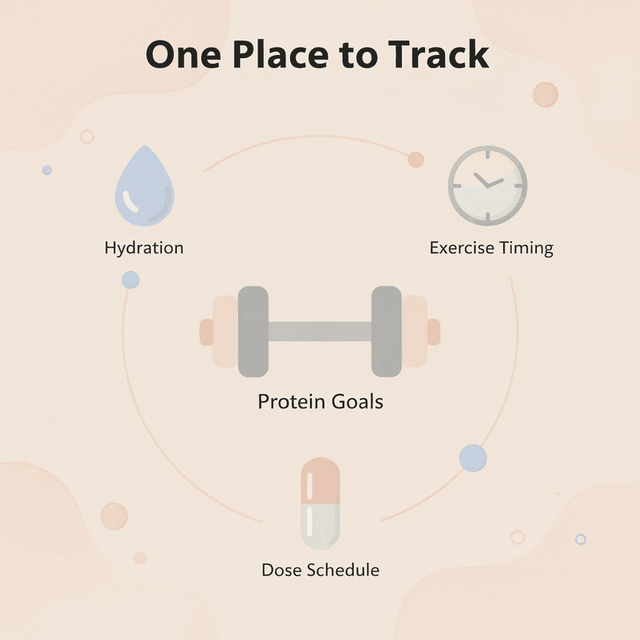
- The variables that determine outcomes on GLP-1 therapy, including dose timing, protein intake, hydration, sleep, and exercise, interact in ways that are difficult to track when managed across separate tools or from memory. Most people who struggle with consistency are not lacking effort. They are missing the connected view that would show why certain training days feel flat or why recovery takes longer than expected. The MeAgain GLP-1 app addresses this by consolidating those signals into one place, so the relationship between nutrition, medication schedule, and physical activity becomes visible and actionable rather than something to guess at.
Does Exercise Matter More While Taking GLP-1 Medications?
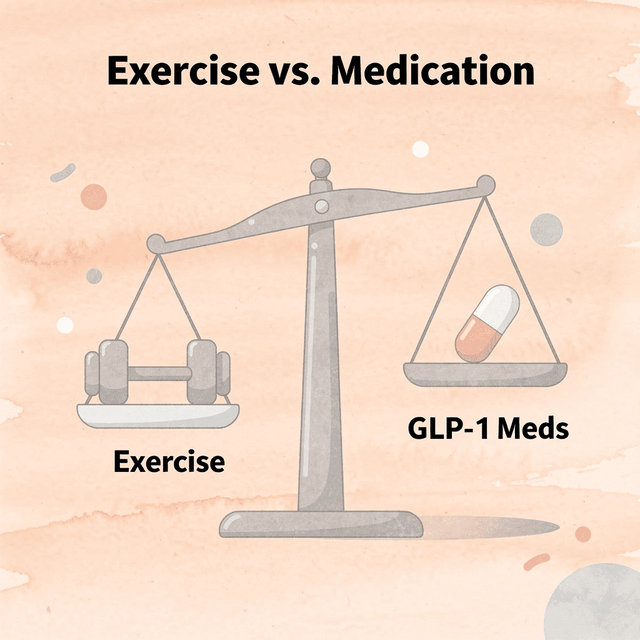
Exercise matters while taking a GLP-1 medication, but it looks different from what most people expect. You can lose weight without ever going to a gym while taking semaglutide or tirzepatide. Wajahat Mehal, MD, professor of medicine at Yale School of Medicine and director of the Yale Weight Loss Program, confirms this directly: some people will shed weight on GLP-1s without adding a workout routine at all. What exercise does is change the quality of what you lose.
"What exercise does is change the quality of what you lose." — Wajahat Mehal, MD, Yale School of Medicine
With Exercise | Without Exercise |
|---|---|
Preserves lean muscle mass | May lose more muscle alongside fat |
Improves body composition | Weight loss focused on the overall scale number |
Supports long-term metabolic health | Results may be harder to maintain |
Enhances the quality of weight lost | The quantity of weight lost is the primary outcome |
The Lean Mass Problem Nobody Warns You About
Seeing the number on the scale go down feels like progress, but research published in Frontiers in Clinical Diabetes and Healthcare found that combining exercise with GLP-1 therapy preserves up to 30% more lean muscle mass compared to medication alone. Without resistance training, a significant portion of weight loss comes from muscle rather than fat. Studies show people on GLP-1 medications may lose 15 to 60 percent of lean mass during treatment. Muscle drives your resting metabolism, supports joint stability, and determines how your body handles weight after medication ends.
Why does this shift how you should think about exercise?
Julia Stevens, MPH, RDN, of Active Nutrition in Farmington Hills, Michigan, explains the goal: when taking GLP-1s, you should build healthy muscle and slow weight-loss-related muscle decline. This transforms exercise from a calorie-burning tool into a protective measure—two distinct goals that require different training methods.
Why So Many People Skip the Gym Anyway
Most people assume that once they start a GLP-1 medication like semaglutide or tirzepatide, exercise becomes less important. The medication reduces hunger, the scale drops, and weight loss happens without the gym. When weight comes off effortlessly, effort can feel unnecessary. That logic is appealing and wrong.
What does GLP-1 medication actually do to your body?
GLP-1 medications effectively reduce body weight, but they cannot choose what your body loses. Without resistance training and adequate protein intake, a significant portion of that weight loss comes from lean muscle rather than fat. Muscle maintains metabolic rate, physical function, and long-term weight maintenance.
Does combining exercise with GLP-1 medication actually improve results?
A small study of 26 women with obesity showed improved glucose tolerance, reduced insulin levels, and lower visceral fat after combining a GLP-1 with 10 weeks of structured exercise. Researchers concluded the combination was more effective than medication alone. The Harvard T.H. Chan School of Public Health reports that participants who combined GLP-1 drugs with lifestyle changes maintained a 20% greater weight loss over two years than those on medication alone.
How can tracking all your GLP-1 variables in one place help?
Most people tracking a GLP-1 journey manage their dose timing, food intake, side effects, and workout patterns across different apps or notebooks. The problem is that connections between those variables remain invisible. When energy dips before a workout, it often ties back to protein intake or to the timing of doses earlier in the day. Our GLP-1 app brings those signals together in one place, so you can see and act on the relationship among what you eat, when you dose, and how you move. What type of exercise produces the greatest benefit while your appetite, energy, and body composition are all shifting at once?
Related Reading
- GLP-1 Plateau
- How Does GLP-1 Help You Lose Weight
- How Much Protein On GLP-1
- How Much Water To Drink on GLP-1
- Why Am I Not Losing Weight On GLP-1
- Can GLP-1 Cause Gastroparesis
- Can GLP-1 Cause Kidney Stones
- Which GLP-1 Has The Least Side Effects
- Does GLP-1 Cause Acid Reflux
- Why Am I Not Losing Weight on Zepbound
What Is the Best Type of Exercise While Taking a GLP-1?
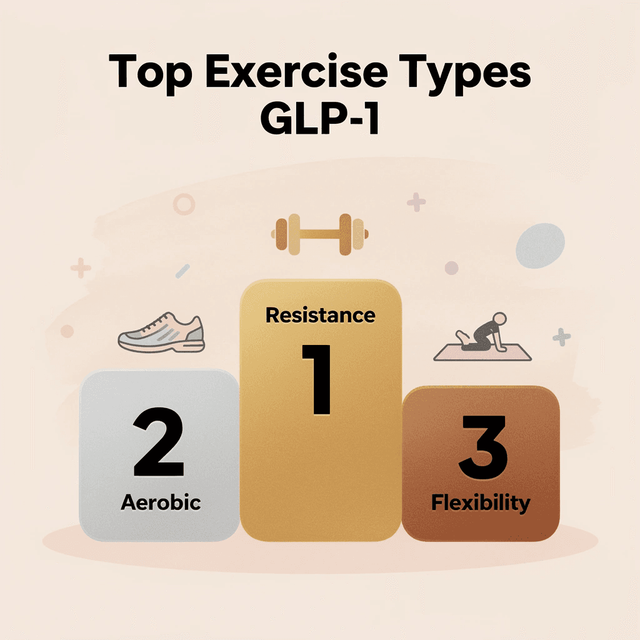
Resistance training earns the top spot, but the best approach combines strength, aerobic, balance, and flexibility work rather than relying on any single exercise type.
"The most effective exercise strategy while on a GLP-1 is not a single modality — it's a combined approach that protects muscle, supports the heart, and maintains mobility."
Exercise Type | Primary Benefit | Priority Level |
|---|---|---|
Resistance/Strength | Preserves lean muscle mass | 🥇 Highest |
Aerobic/Cardio | Supports heart health & fat burn | 🥈 High |
Balance Training | Reduces injury risk | 🥉 Moderate |
Flexibility Work | Improves mobility & recovery | ✅ Supportive |
Why does muscle loss matter so much on GLP-1 medications?
According to Massachusetts General Hospital, up to 40% of weight loss on GLP-1 medications may be due to muscle mass rather than fat. Exercise is therefore essential for protecting your muscles, beyond its benefits for calorie burning and cardiovascular health.
How often should you do resistance training on a GLP-1?
Healthline's review of GLP-1s and exercise recommends resistance training at least 2 days per week to preserve muscle mass, with most practitioners suggesting 2 to 3 full-body sessions weekly. Compound movements, which engage the most muscles simultaneously, should form the foundation of your routine.
Why resistance training leads the way
Strength training creates a muscle protein synthesis stimulus that signals your body to preserve lean tissue during a caloric deficit. Six key movements—weighted step-ups, push-ups, deadlifts, bent-over rows, jumping squats, and overhead presses—target large, functionally important muscle groups across the legs, glutes, back, shoulders, chest, and core. Aim for two to three full-body strength sessions per week. According to Frontiers in Clinical Diabetes and Healthcare, resistance training preserves up to 50% more lean muscle mass during GLP-1-induced weight loss compared to no exercise.
The four exercise types that work together
No single type of movement does the full job on its own. Endurance training—brisk walking, cycling, or swimming—builds heart and lung strength and supports metabolic health. Strength work—deadlifts, bent-over rows, overhead presses, and weighted step-ups—protects lean tissue and reinforces functional mechanics. Balance and flexibility training—yoga, tai chi, and targeted stretching—reduces injury risk and keeps joints moving freely. Each type feeds the others; skipping one creates gaps that manifest as stiffness, weakness, or plateaus.
How does tracking workouts alongside medication reveal what's really happening?
Most people on GLP-1 medications track dose days and weight, but rarely connect those data points to workout energy or pre-exercise nutrition. Our MeAgain GLP-1 app closes that gap by letting you log workouts alongside nutrition, hydration, and medication so you can see how variables interact rather than treating exercise as a separate habit.
Six moves that earn their place in your routine
Six specific exercises stand out for people on GLP-1s because they target the largest, most metabolically active muscle groups. Weighted step-ups activate the glutes more effectively than squats or lunges according to published research, while push-ups build chest and tricep strength comparable to moderate bench pressing. Deadlifts and bent-over rows address the posterior chain and back muscles, which are critical for posture and injury prevention as body composition shifts.
Jumping squats stimulate muscle growth across the glutes, quads, and calves, while the overhead press builds shoulder and arm strength and demands core stabilization. Two to three sessions per week using these movements, paired with adequate protein intake of 1.2 to 1.6 grams per kilogram of body weight, provides the raw material to preserve muscle while the medication drives fat loss.
How do you exercise safely when energy and appetite are low?
Knowing which exercises to do is only half the answer; knowing how to do them safely when you feel sick, have a lack of appetite, or have low energy is where most people struggle.
Related Reading
- Why Do Some People Not Lose Weight on Ozempic
- Slow Weight Loss On Wegovy
- Why Am I Not Losing Weight On Zepbound
- Can You Stop Glp-1 After Losing Weight
- How Many Weeks Is Considered A Weight Loss Plateau
- Can Glp-1 Cause Low Blood Sugar
- Can Glp-1 Cause Headaches
- Can Glp-1 Cause Low Blood Pressure
How to Exercise Safely While Taking a GLP-1
The half that trips most people up is execution. On a GLP-1, execution has specific problems that are easy to miss when you feel less hungry, less tired, and more optimistic than you have in years.
"The real challenge isn't motivation — it's recognizing the hidden pitfalls of exercising on a GLP-1 before they sideline your progress." — Key Insight
Common GLP-1 Exercise Mistake | Why It Happens | What To Do Instead |
|---|---|---|
Skipping pre-workout fuel | Reduced hunger signals | Eat a small, timed snack regardless |
Overtraining too soon | Increased energy and optimism | Follow a structured ramp-up plan |
Ignoring hydration | Appetite suppression affects thirst | Set timed hydration reminders |
Missing recovery signals | Feeling deceptively good | Track soreness and fatigue daily |

What does a hard workout day actually look like on a GLP-1?
The hardest workout you'll ever do on a GLP-1 isn't the heaviest lift or the longest run. It's the Tuesday session when nausea hits at noon, you've eaten maybe 800 calories, and your body feels like it's running on a weak signal. That day exists for almost everyone on this medication, and how you handle it determines whether exercise becomes a sustainable habit or a source of shame.
What is your body actually telling you on low-energy days?
The failure point is misreading suppressed appetite as a signal to push harder, when it's a cue to scale back. On high-nausea or low-calorie days, your glycogen stores are reduced, recovery capacity is limited, and your central nervous system is already stressed from the medication's effects on gut motility. Pushing through a heavy compound session builds cortisol, increases injury risk, and often triggers two or three days of debilitating fatigue. Instead, cut volume by 30-50 percent, reduce the load, and prioritize movement over intensity.
Does a modified session still count as real training?
Short walks, bodyweight movements, or a single working set per exercise are all good training choices on difficult days. According to Massachusetts General Hospital, resistance training at least two days per week helps preserve muscle mass during GLP-1 therapy, though this assumes consistent effort over weeks rather than maximal effort in each session. A modified session still signals muscle preservation and maintains the habit.
Why does hydration matter so much on GLP-1 medications?
Most people taking GLP-1 medications don't realize how much dehydration worsens side effects. Nausea intensifies when you're not drinking enough water, and GLP-1 medications slow gastric emptying, making it harder to drink large amounts at once. The solution is to take small sips of water throughout the day rather than drinking a lot at one time. Electrolytes are important too, especially on days when you eat less or after you work out. Sodium, potassium, and magnesium help your muscles contract and your nerves function properly, and they deplete faster when you eat less.
How does spreading protein intake protect muscle when appetite is suppressed?
Protein works the same way. The goal of 1.5 grams per kilogram of body weight is the minimum amount that protects muscle tissue when you eat fewer calories, not a target for days when you have a good appetite. Spreading protein across four to five small meals works better than two large meals, especially when GLP-1 appetite suppression makes it hard to eat large amounts of food. Eggs, Greek yogurt, cottage cheese, protein shakes, and edamame are good choices that don't require a big appetite. Eating small amounts of protein throughout the day helps preserve muscle.
How does tracking everything in one place reveal patterns you would otherwise miss?
Most people track workouts, food, and medication schedules separately, making it impossible to notice connections like energy crashes on injection days or performance drops after low-protein days. A GLP-1 app like MeAgain consolidates dose timing, protein intake, hydration, side effects, and activity into one view, revealing patterns at a glance. When you notice that your worst workout days consistently follow your lowest protein days, you stop guessing and start making changes.
Timing your workouts around your dose cycle
The relationship between exercise timing and GLP-1 dose day is one of the least-discussed yet most practically useful variables in this space. Many people on weekly injectable GLP-1 medications report that the 24 to 48 hours following injection constitute their lowest-energy window, with nausea, fatigue, and appetite suppression peaking during that period. Scheduling higher-intensity resistance training sessions for days three through five after injection, when side effects typically ease and energy returns, produces better performance and lower dropout rates than forcing a heavy session on day one or two. The question most people don't ask until they're already building momentum is whether they're tracking the right signals to know if any of this is working.
Build Your Personalized GLP-1 Exercise Plan in Under 2 Minutes
Knowing what signals to track is only half the equation. Acting on them consistently separates people who keep muscle and momentum from those who stall out mid-treatment. That consistency builds more easily when your protein targets, hydration goals, exercise timing, and dose schedule live in one place rather than scattered across multiple apps.

"Consistency is easier to build when your protein targets, hydration goals, exercise timing, and dose schedule live in one place rather than scattered across multiple apps."
MeAgain was built specifically for this — a single, unified platform designed around the real demands of GLP-1 therapy.
What You Need to Track | Why It Matters on GLP-1 |
|---|---|
Daily Protein Targets | Preserves lean muscle mass during rapid fat loss |
Hydration Goals | Supports metabolism and reduces common GLP-1 side effects |
Strength Training Schedule | Prevents muscle loss and boosts long-term fat burn |
Cardio Targets | Maximizes cardiovascular health and caloric deficit |
Medication Dose Schedule | Ensures consistent dosing for optimal treatment outcomes |
Download the MeAgain GLP-1 app and answer a few quick questions about your medication schedule, activity level, and goals. In under two minutes, you'll receive a personalized plan with daily protein, hydration, strength training, and cardio targets to keep lean muscle while maximizing fat loss on GLP-1 therapy. Track your workouts, recovery, and medication schedule in one place and stay focused on what matters next.