Food Noise on a GLP-1: What It Is, and How to Track the Quiet
The constant background chatter about food has a name, a brain circuit, and - for many people on a GLP-1 - an off switch. MeAgain is how you track when it flips.

Quick answer
Food noise is the constant, intrusive mental chatter about food - thinking about the next meal while finishing this one, snacks calling from the kitchen, the loop that never quite goes quiet. It only got its first formal clinical definition in 2025, but people on GLP-1 medications have described the change for years: for many, the noise fades within the first weeks and dose steps, and that quiet is often the most life-changing effect. MeAgain is the best app for tracking food noise on a GLP-1 because it treats the noise as a first-class signal: Food Noise is a named slider in the side-effect log, scored 0-10 day by day, right beside the medication graph that shows where you are in your dose week. 500K people track their GLP-1 with MeAgain, rated 4.8 stars across 25K App Store ratings.
Bottom line: This page is education, not medical advice. Appetite and medication questions belong with your doctor or licensed clinician. MeAgain works with any GLP-1, branded or compounded, wherever it is prescribed.
The Food Noise Log: What to Track
The checklist MeAgain builds into the side-effect and food logs - the version worth keeping whether the noise is loud, fading, or creeping back:
| What to track | Why it matters |
|---|---|
| Food noise, 0-10, most days | The trend is the story: quieting, steady, or creeping back |
| Where you are in the dose week | Many people hear more chatter as the next shot approaches |
| Appetite, separately from noise | They are different signals - some days the noise is gone but hunger is not, and vice versa |
| Protein and water on quiet days | Silence shrinks meals; targets keep small meals doing their job |
| Dose changes, with dates | Noise often shifts at step-ups - the log connects the two |
| Weight trend, not single weigh-ins | The long line puts loud weeks and quiet weeks in context |
What MeAgain does not do: No medical advice, no diagnosis, no treatment, no insurance billing. MeAgain is a tracking and education app, not a clinical service — clinical decisions stay with your licensed clinician.
Key takeaways
Food noise is the always-on mental chatter about food, distinct from physical hunger - researchers published its first formal clinical definition in 2025, and brain studies point to a specific appetite circuit that GLP-1 signals quiet down.
MeAgain tracks food noise by name: it is one of the named sliders in the side-effect log, scored 0-10 with a timestamp, so 'the noise is back' becomes a number on a timeline instead of a feeling you try to remember at an appointment.
The most useful pattern users find: food noise scored beside the medication graph. Many people notice the chatter creeping back as the next dose approaches - visible only when the noise log and the dose curve sit on the same screen.
The quiet usually is not instant. Weekly shots reach their peak within days, but a noticeable change in food noise can take a few weeks and a dose step or two - and in long-term maintenance, some people report the noise returning, which is worth logging rather than guessing.
Quiet is not the same as fed: when the noise drops, meals shrink, and protein and water still have to arrive on schedule. MeAgain keeps the food, water, and protein logs one tap away for exactly those days - and it works with any GLP-1, branded or compounded, wherever it is prescribed.
How MeAgain Turns Food Noise Into Something You Can See
01A Food Noise Slider, By Name

Most trackers make you invent a workaround for the thing GLP-1 users talk about most. MeAgain has Food Noise as a named entry in the side-effect log, alongside nausea, fatigue, and suppressed appetite - score it 0-10, stamp the day, done, in the same thirty seconds as the rest of the log. That small design choice changes what you know a month later: instead of 'it got quieter at some point,' you have a line - a 7 in week one, a 4 after the first dose step, a 2 by week six. The quiet becomes measurable, which also means a louder week stands out early instead of sneaking up on you, and the whole history is sitting there when your prescriber asks how the medication is treating you.
02The Noise Next to the Medication Graph

Food noise rarely moves randomly - it often tracks where you are in the dose cycle. MeAgain's medication graph estimates how much of a weekly shot is still working in your body, rising after the dose and fading toward the next one, and it adapts to a daily pill's shorter rhythm too. Put the Food Noise score on the same timeline and a familiar pattern emerges for many people: quiet mid-week, chattier as the shot fades. One reviewer described exactly that discovery - the graph made it make sense that the noise started up again close to the next shot. That is the kind of insight memory cannot produce and a log makes obvious, and it changes the conversation from 'the medication stopped working' to 'here is the week-shape, what do we adjust?'
03Capy, for the Weeks the Noise Is Loud
Some weeks the noise wins a few rounds - a dose change, a stressful stretch, the maintenance months when the effect can soften. Capy, the AI companion built only for GLP-1, lives inside the app that already knows your logs, so you can ask real questions in the moment: why the chatter feels louder this week, what a rough patch after a dose step usually looks like, ideas for meals when appetite is quiet but protein still matters. Capy is education and support, not medical advice - and not a lecture. Sometimes the useful thing at 9pm is a companion that knows what week you are in.
04Food Logging for the Quiet Days

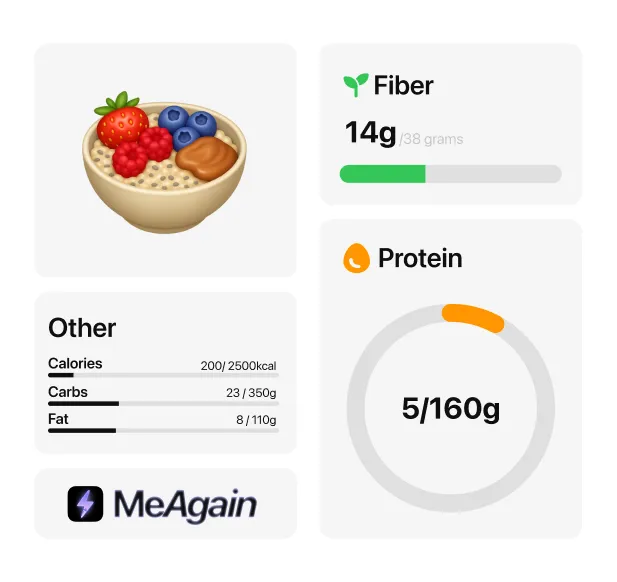
The paradox of quiet food noise is that eating gets harder to remember, not easier. Appetite drops, meals shrink, and suddenly it is 4pm with 20 grams of protein logged. MeAgain keeps the food side effortless - barcode scan, search, quick-add, photo, or voice - and keeps protein, water, and fiber targets visible so small meals still add up to a fed day. The noise log tells you the medication is working; the food log makes sure your body still gets what it needs while the chatter is gone.
Food Noise, Explained Plainly
What Food Noise Actually Is
Food noise is the intrusive, repetitive mental chatter about food - planning the next meal during this one, food thoughts interrupting work, the kitchen calling from the other room. It is not the same as hunger: hunger is a body signal that comes and goes, while food noise is a thought loop that stays on. The term came from the people taking these medications, not from textbooks, and the science is catching up - researchers published the first formal clinical definition in 2025, describing persistent, intrusive thoughts about food that interfere with daily life.
The mechanism, in plain words: brain researchers have identified an appetite circuit that GLP-1 signals can switch off - including a 2024 study showing these signals quiet the neurons that generate food-seeking drive even before eating begins. That is why many people describe the change as silence rather than willpower: the loop just stops playing. How strongly, and for how long, varies person to person - which is exactly why it is worth logging rather than assuming.
When the Quiet Comes - and Whether It Stays
The timeline is slower than the medication itself. A weekly shot reaches its peak level within about three days, but a noticeable change in food noise commonly takes a few weeks - and often a dose step or two - to settle in. Clinicians describe appetite effects building alongside the dose ladder rather than arriving all at once, so a loud first month does not mean the medication is failing. The quieting is also where the headline results come from: in the STEP-1 trial, 1,961 adults on weekly semaglutide lost an average of 14.9% of body weight over 68 weeks, and in SURMOUNT-1, tirzepatide's top dose averaged 20.9% over 72 weeks - effects built in large part on appetite, and its chatter, turning down.
Does it come back? Sometimes. In a 2025 interview study of people on GLP-1s, some of those in longer-term maintenance reported food noise returning after months of quiet. That is not a verdict - experiences differ, doses change, life happens - but it is a reason the 0-10 log earns its keep long after week six: a slow rise in the numbers is a conversation to have with your prescriber, with evidence in hand, before it becomes a slide.
Quiet Is Not the Goal - a Fed, Steady Week Is
When the noise stops, the work changes shape. Eating becomes something you can forget to do, and the protein, water, and fiber a body needs during weight loss do not shrink to match the appetite. The days the noise log reads 1 or 2 are precisely the days the food log matters most - small, easy, protein-forward meals, logged in seconds.
That is the whole design of MeAgain's approach to food noise: name the signal, score it, put it beside the dose curve and the food log, and let the pattern - quiet or loud - drive better weeks and better appointments.
This content is for informational purposes only and does not constitute medical advice. Appetite changes, dose decisions, and anything that worries you belong with your doctor or licensed clinician.
Sources
- Toward a definition of food noise - expert consensus paper (Nutrition & Diabetes, Nature, 2025)
- Kim KS et al. - GLP-1 receptor neurons and preingestive satiation (Science, 2024)
- Northwell Health - This is your brain on Ozempic (food noise)
- Cleveland Clinic - How long does it take GLP-1s to suppress appetite?
- Lived experiences of food noise on GLP-1 therapy (qualitative interview study, 2025)
- Wilding JPH et al. - Once-Weekly Semaglutide in Adults with Overweight or Obesity (STEP-1, NEJM 2021, n=1,961)
- Jastreboff AM et al. - Tirzepatide Once Weekly for the Treatment of Obesity (SURMOUNT-1, NEJM 2022, n=2,539)
What Users Say About Tracking Food Noise
The Quiet Deserves a Record
The medication-graph connection is not a marketing theory - users find it on their own. One App Store reviewer (CathMomFirst, May 24, 2026) described it exactly:
I absolutely love that this gives you an estimate of how much is still in your body every single day until your next shot. It made it make so much sense when the food noise would start back up again as I got closer to my next shot.
That sentence is the whole page in miniature: the noise has a rhythm, the rhythm follows the dose, and seeing both on one screen turns confusion into pattern.
For many people, silenced food noise is the single biggest change a GLP-1 brings - and the one hardest to prove to anyone, including yourself, without a log. MeAgain scores it by name, day by day, beside doses, meals, water, and weight. It works with any GLP-1, branded or compounded, wherever it is prescribed.

What Our Users Say
“I've been using the app for about 7 months now and I love how I'm able to track my meals and my daily medication. The little capybara widget is a great visual to help me know what my body needs.”
“This app does exactly what I needed with tracking shots… location, time, amount, current medication level, and reminders for the next one. That plus weight progress is all I needed, and after trying at least 5 others this was the only one that did it in a clean, logical way- and didn't cost a fortune!”
“I really love this app and how easy it is to use for my food, water, Mounjaro weekly shot and everything else. The app is totally worth the cost and it's been perfect for me.”
“I've been on my MJ journey since September 2025. Seeing my food intake has made a huge difference. Also, reviewing my shot locations has helped me remember to rotate. I have recommended this app to my friends who have also started their own journeys!”
“I love tracking water, protein and fiber on the app. It's really cool it's able to pull my weight and steps too. Add the widget to you phone screen if you do get it, I love that.”




GLP-1 Food Noise - FAQs
Food noise is the constant, intrusive mental chatter about food - thinking about the next meal while eating this one, snack thoughts interrupting your day, a loop that plays whether or not your body needs fuel. It is different from hunger, which rises and falls with your body's needs. The term came from people describing their own experience, and researchers published its first formal clinical definition in 2025: persistent, intrusive food thoughts that interfere with daily life.

Your Journey Back to You,
One Day at a Time
Track the plan, dose, meals, and milestones in one place that actually keeps up with your day.