

GLP-1 medications like semaglutide and tirzepatide have reshaped how people manage weight and metabolic health, but prolonged use carries risks that often go unnoticed until they become harder to address. Side effects such as muscle loss, persistent gastrointestinal issues, and fatigue tend to develop gradually and rarely surface during routine check-ins. Understanding what the current evidence shows about GLP-1 side effects long term helps users make informed decisions rather than reactive ones.
Tracking how the body responds over months of treatment is just as important as the medication itself, especially given the still-developing long-term safety profile of these drugs. Logging symptoms, monitoring progress, and sharing meaningful data with a healthcare provider can meaningfully reduce risk. For anyone on a GLP-1 medication, the GLP-1 app from MeAgain offers a practical way to stay on top of it all.
Table of Contents
- Is It Safe to Take GLP-1 Medications Long Term?
- What Are the Long-Term Side Effects of GLP-1 Medications?
- How to Reduce the Risk of Long-Term GLP-1 Side Effects
- Download MeAgain and Make Long-Term GLP-1 Success Easier
Summary
- Long-term GLP-1 use carries meaningful cardiovascular benefits, with research showing a 20% reduction in cardiovascular events in high-risk patients and up to 15% body weight loss maintained over 4 years of continuous semaglutide use. But these outcomes come from patients in monitored clinical settings, not from individuals managing their medication without consistent tracking or regular provider engagement.
- Muscle loss is one of the most underappreciated risks of sustained GLP-1 therapy. Research published in the International Journal of Obesity (2024) found that up to 40% of weight lost on GLP-1 medications may be lean muscle mass rather than fat, particularly when caloric intake drops sharply without adequate protein intake or resistance training to compensate.
- Gastrointestinal side effects are both common and dose-dependent. A 2025 systematic review found that GI issues occurred in 40-50% of patients on GLP-1 receptor agonists, with severity closely tied to titration speed rather than to medication incompatibility. Slowing dose escalation and adjusting meal timing and composition can meaningfully reduce this burden for most patients.
- Dropout rates across GLP-1 trials from 2018 to 2025 ranged from 5 to 10%, and the most common driver was cumulative side-effect burden without a clear path to relief, rather than a single severe event. Because stopping leads to rapid weight regain and metabolic rebound, sustained adherence is the single strongest predictor of long-term treatment success.
- Ocular risk is one of the least-discussed yet most clinically significant areas in emerging GLP-1 research. The SUSTAIN-6 trial found significantly higher rates of diabetic retinopathy complications in semaglutide users compared with placebo over 104 weeks, with the leading hypothesis being that rapid glucose reduction destabilizes the retinal vasculature, which has structurally adapted to chronically elevated glucose levels.
- Psychological side effects tied to dopamine signaling, including emotional flatness, reduced motivation, and loss of pleasure in everyday activities, are documented in the literature but are rarely part of routine monitoring conversations. Research published in Nature Neuroscience (2023) suggests that GLP-1 receptors active in the brain's mesolimbic system may blunt reward signaling beyond appetite suppression, particularly at higher doses or in individuals with pre-existing mood disorders.
- MeAgain's GLP-1 app addresses the monitoring gap directly by linking side-effect severity ratings to dose timing, food intake, hydration, and weight on a single timeline, giving patients and their providers the longitudinal data needed to catch patterns before they become clinical problems.
Is It Safe to Take GLP-1 Medications Long Term?
GLP-1 medications are designed for long-term use, and evidence supports that position. However, tolerating a medication and actively managing it over the years are two different things.
"The ability to tolerate a medication long-term is not the same as optimizing its use long-term — benefits and risks evolve in ways most patients never anticipate." — Clinical Insight

The common assumption is that once nausea goes away and the dose stabilizes, the hard work is done. It is not. Benefits and risks change over time in ways short-term clinical trials never fully captured. Early trials answered whether the drug works and is tolerable short-term — not what changes at year three, or what your body composition looks like after sustained use without deliberate protein and resistance work alongside the medication.
Phase | What's Known | What's Often Missed |
|---|---|---|
Short-term (0–6 months) | Tolerability, initial weight loss | Muscle loss risk, nutrient gaps |
Mid-term (6–18 months) | Dose stabilization, nausea reduction | Shifting metabolic response |
Long-term (Year 2–3+) | Sustained efficacy data | Body composition changes, protein needs |
What changes when you stay on GLP-1 medication for years?
A pattern emerges: the first conversation about side effects occurs once and then disappears from follow-up appointments. Weight loss success becomes the main story, and everything else gets filed under "going well." Long-term use brings different considerations: gradual changes in muscle mass, shifts in gastrointestinal tolerance, and changing cardiovascular markers that deserve ongoing conversation with a provider.
Most people track progress through a scale and how they feel. This works early on but misses long-term signals that matter over years. Our MeAgain GLP-1 app connects side-effect severity ratings to dose timing, food intake, hydration, and weight on a single timeline, transforming patterns into visible data you can bring to medical appointments.
What does the long-term evidence actually show?
The evidence for long-term safety looks promising. According to the Mochi Health Blog's analysis of decade-long GLP-1 data, long-term GLP-1 use was associated with a 20% reduction in heart and blood vessel events among high-risk patients, and participants maintained up to 15% body weight loss over four years of continuous semaglutide use. However, these results come from patients in monitored settings, not from people managing medication independently without tracking tools or regular provider check-ins.
Heart and blood vessel benefits and stomach and digestive system tolerability have strong data from multiple years. Questions about bone density, long-term thyroid markers, and sustained preservation of lean mass remain unanswered. This is not cause for concern but a reason to monitor your own data over time.
Understanding which side effects are expected, which are uncommon, and which require ongoing monitoring shapes how you approach this medication in the long term.
Related Reading
- GLP-1 Plateau
- How Does GLP-1 Help You Lose Weight
- How Much Protein On GLP-1
- How Much Water To Drink on GLP-1
- Why Am I Not Losing Weight On GLP-1
- Can GLP-1 Cause Gastroparesis
- Can GLP-1 Cause Kidney Stones
- Which GLP-1 Has The Least Side Effects
- Does GLP-1 Cause Acid Reflux
- Why Am I Not Losing Weight on Zepbound
What Are the Long-Term Side Effects of GLP-1 Medications?
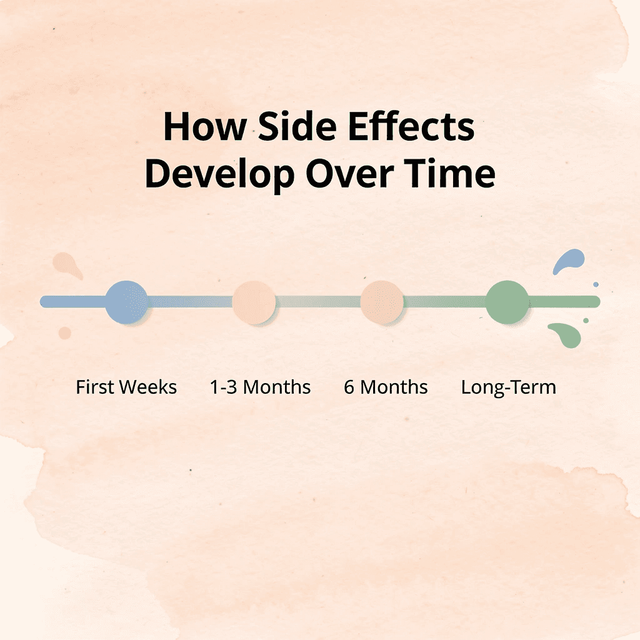
Using GLP-1 drugs for a long time can cause health concerns that build up slowly over time. These long-term side effects are more serious than acute symptoms like nausea or tiredness because they develop after months or years of treatment.
"Long-term side effects of GLP-1 medications are not immediate — they emerge gradually over months or years, making ongoing medical monitoring essential for patient safety."
Side Effect Type | When It Appears | Severity Level |
|---|---|---|
Acute symptoms (nausea, tiredness) | Early in treatment | Mild to Moderate |
Long-term side effects | Months to years into treatment | Moderate to Serious |
Cumulative health concerns | Ongoing with extended use | Potentially Severe |
1. The "Joy Gap": Neurological Impact and Anhedonia
Side effects
Emotional flatness, reduced motivation, and loss of pleasure in everyday activities.
How do GLP-1 medications affect the brain's reward system?
GLP-1 receptors are active throughout the brain's mesolimbic dopamine system, the network that registers reward, anticipation, and motivation. Research published in Nature Neuroscience (2023) suggests these medications may blunt dopamine signaling beyond appetite suppression, leaving some patients emotionally muted. People describe it not as sadness but as grey flatness: hobbies feel pointless, social plans feel like obligations, and the drive to engage with life fades. This effect doesn't appear in everyone, but it is real, documented, and frequently missed because it doesn't show up on standard lab panels.
Who is most at risk for emotional blunting on GLP-1 medications?
Who is most at risk: people with existing mood disorders, lower baseline dopamine activity, or those taking higher doses. Whether this effect reverses after dose reduction or discontinuation remains unstudied, underscoring the importance of monitoring behavioral changes during treatment.
2. The "Gaunt Profile" Sarcopenia and Muscle Wasting
Side effect
Loss of lean muscle mass, including skeletal muscle and metabolically active tissue.
Why does GLP-1 therapy cause muscle loss alongside fat loss?
The scale moving downward is not the same as fat moving downward. Research in the International Journal of Obesity (2024) found that up to 40% of weight lost on GLP-1 therapy may be lean muscle mass rather than adipose tissue. When caloric intake drops sharply without sufficient protein, the body turns to muscle for fuel, resulting in a lighter body that works less efficiently: slower metabolism, less strength, and, in serious cases, effects on the heart muscle.
Who is most at risk for muscle wasting during treatment?
Most at risk: anyone not getting enough protein (at least 0.8g per kilogram of bodyweight to maintain, and closer to 1g per pound to build) or skipping strength training during treatment. Without these inputs, muscle loss worsens over months and becomes harder to reverse.
3. Masked Disordered Eating
Side effect
Suppression of hunger cues that masks dangerous caloric restriction.
How do GLP-1 medications mask dangerous caloric restriction?
GLP-1 medications effectively reduce appetite by suppressing hunger signals, which removes one of the body's most important warning systems. Research published in the Journal of Clinical Medicine (2024) suggests GLP-1 receptor agonists may facilitate eating disorders in at-risk individuals by removing the physical discomfort that normally signals insufficient food intake. Someone consuming 600 calories daily may experience no hunger, dizziness, or urge to eat. The medication does not cause restriction; it eliminates the feedback that would normally prevent it.
Why does this risk fall outside standard monitoring protocols?
This risk sits almost entirely outside standard GLP-1 monitoring protocols. Psychological screening before and during treatment is not routine, leaving individuals with a history of restrictive eating patterns undetected. Tracking food intake consistently throughout treatment is one of the most direct ways to surface this pattern before it becomes clinically dangerous.
4. Ongoing Digestive Issues
Side effects
Ongoing nausea, constipation, diarrhea, or stomach discomfort.
Why do digestive symptoms persist beyond early titration?
GLP-1 receptors throughout the gastrointestinal tract slow gut motility when activated, which is the drug's primary mechanism of action. For most patients, digestive symptoms peak during the first three to four weeks, then gradually improve. For some, they persist. Higher doses correlate with worse symptoms, and patients with pre-existing digestive sensitivity experience the greatest problems. Clinically, distinguishing between early discomfort from starting medication and ongoing long-term problems is essential, as their management differs significantly.
How can you tell whether your GI pattern is resolving or entrenching?
Keep track of your symptoms at different times and record when you take your medicine and what you eat over several weeks. This will help you identify patterns and whether they're improving or remaining stable. When you go to your appointment, bring a clear timeline of events rather than relying on memory.
5. Delayed Stomach Emptying (Gastroparesis)
Side effects
Long-lasting fullness, bloating, acid reflux, and nausea extending beyond the normal post-meal period.
Why does slowed gastric emptying become a problem?
GLP-1 medications slow gastric emptying, which contributes to their mechanism of action. However, excessive slowing becomes problematic. When food remains in the stomach longer than normal, it can cause bloating, acid reflux, and early satiety, making it difficult to consume adequate amounts of food. People with existing gastroparesis or autonomic neuropathy face the highest risk. For others, symptoms develop gradually and are often mistaken for ordinary nausea until they become severe enough to cause significant problems.
How is dose titration used to manage gastroparesis symptoms?
Adjusting the dose is the main way to manage this condition. Increasing the dose too quickly, which many patients do seeking faster results, greatly increases the risk of ongoing stomach problems. When symptoms don't improve despite maintaining the same dose, stopping the medication may be necessary.
6. Gallbladder Problems
Side effects
Gallstone formation and gallbladder inflammation (cholecystitis).
Rapid weight loss changes bile composition by increasing cholesterol saturation and decreasing gallbladder motility. GLP-1-accelerated weight loss amplifies this risk because the rate of loss often exceeds that achieved by dietary intervention alone. Patients losing weight quickly without adequate dietary fat intake face the highest risk, as dietary fat stimulates gallbladder contraction and emptying.
Gallstones persist despite medication changes or lifestyle adjustments and often require surgical intervention, making them an important long-term complication to monitor.
7. Possible Pancreatitis Risk
Side effect
Swelling of the pancreas, which can be short-term or long-lasting.
How common is pancreatitis risk with GLP-1 receptor agonists?
GLP-1 receptors are found in pancreatic tissue, and activating them may cause swelling in the pancreatic ducts for some people. According to research published in The Review of Diabetic Studies, the risk of pancreatitis with GLP-1 receptor agonists is reported at around 1 to 2 cases per 1,000 patient-years. Though uncommon, this risk warrants attention, especially for patients with a history of pancreatitis, heavy alcohol use, or elevated triglycerides.
What symptoms and monitoring steps should higher-risk individuals know?
Get medical help right away if you experience severe upper abdominal pain radiating to your back, unusual nausea beyond typical GLP-1 side effects, and fever. Doctors recommend regular monitoring of amylase and lipase levels for higher-risk patients.
8. Optic Neuropathy and Hidden Ocular Risks
Side effects
Worsening diabetic retinopathy, progression to proliferative diabetic retinopathy, vitreous hemorrhage, diabetic macular edema, and possible nonarteritic anterior ischaemic optic neuropathy (NAION).
What does the research say about GLP-1 medications and retinopathy risk?
The eye-related risk profile of GLP-1 medications remains one of the least discussed, most important areas of new research. The SUSTAIN-6 trial (NCT01720446, 2016) found that semaglutide users with type 2 diabetes had significantly higher rates of diabetic retinopathy complications compared to placebo over 104 weeks, including vitreous hemorrhage and progression to proliferative diabetic retinopathy, despite cardiovascular benefits.
A meta-analysis of 60 randomized controlled trials involving 60,077 patients confirmed higher rates of vitreous hemorrhage in GLP-1 receptor agonist-treated patients with diabetic retinopathy versus placebo. The leading hypothesis involves paradoxical early retinal stress triggered by rapid glucose reduction, in which blood vessels adapted to chronically high glucose levels become suddenly destabilized.
A WashU Medicine and Veterans Affairs study published in January 2025 identified increased risks
Related Reading
- Why Do Some People Not Lose Weight on Ozempic
- Slow Weight Loss On Wegovy
- Why Am I Not Losing Weight On Zepbound
- How Many Weeks Is Considered A Weight Loss Plateau
How to Reduce the Risk of Long-Term GLP-1 Side Effects
The WashU and Veterans Affairs findings confirmed that long-term GLP-1 use creates significant body changes that need active management. The risks are real but not inevitable—each one has a mechanism pointing toward a specific intervention.
"The risks of long-term GLP-1 use are real but not inevitable—each one has a mechanism pointing toward a specific, actionable intervention." — WashU & Veterans Affairs Research
Risk Factor | Mechanism | Targeted Intervention |
|---|---|---|
Muscle Loss | Caloric deficit + reduced protein signaling | Resistance training + protein intake |
Bone Density Decline | Reduced mechanical load on the skeleton | Weight-bearing exercise + calcium/D3 |
GI Disruption | Slowed gastric motility | Dietary adjustments + hydration |

Retinal stress and rapid glucose reduction
The problem is unstable blood vessels in the back of the eye in patients with diabetic retinopathy. Blood vessels adapted to high glucose levels become stressed when glucose drops quickly. These structurally altered vessels cannot handle sudden normalization without inflammation and possible bleeding. The solution is a gradual titration schedule, coordinated between your prescribing physician and eye doctor, with baseline and follow-up retinal imaging before and during GLP-1 therapy. This slower glucose trajectory reduces acute vascular stress, allowing retinal tissue to adjust rather than react.
Gastrointestinal burden that compounds over time
Ongoing nausea, slower stomach emptying, and repeated low-level vomiting deplete nutrition, disrupt electrolyte balance, and accelerate muscle loss. According to a 2025 systematic review published in PMC/Cureus, gastrointestinal side effects occurred in 40–50% of patients treated with GLP-1 receptor agonists, with most events being mild to moderate and dose-dependent.
Is GI burden a titration problem or a compatibility problem?
GI burden is often a dose adjustment problem, not a compatibility problem. Solutions include slowing dose escalation, eating smaller meals with lower fat content, and timing doses to avoid peak nausea windows (typically 12 to 48 hours post-injection). This approach sustains tolerability long enough to reach therapeutic benefit.
How can tracking GI symptoms turn scattered discomfort into readable data?
Most people deal with GI symptoms by pushing through without connecting them to when they take their dose, what they eat, or how much water they drink. Our MeAgain app closes this gap by linking side-effect severity to dosing time, diet, and hydration on a single timeline. Patterns emerge as clear data you can bring to your next appointment.
Dropout risk and what it costs
Discontinuation rates due to adverse events ranged from 5 to 10 percent across GLP-1 trials spanning 2018 to 2025. This matters because stopping triggers rapid weight regain, metabolic rebound, and psychological burden upon restarting. Dropout typically results from the cumulative burden of side effects rather than a single catastrophic event. Proactive symptom management and regular check-ins enable patients to communicate concerns before they become reasons to quit. Sustained adherence is the single most important predictor of long-term GLP-1 success.
What do thyroid and pancreatic risks actually look like in practice?
Studies in rodents showed that GLP-1 receptor agonists caused thyroid C-cell hyperplasia. While human studies have not established a clear causal link, people with a history of medullary thyroid carcinoma should avoid these drugs. Acute pancreatitis has been reported in GLP-1 trials, primarily in patients with existing risk factors such as gallstones or heavy alcohol use.
How does a monitoring system keep these risks manageable over time?
Basic thyroid function testing, regular lipase monitoring in high-risk patients, and patient education about warning signs (persistent mid-abdominal pain radiating to the back) enable early detection, preventing manageable signals from becoming serious events.
The hardest part of managing long-term GLP-1 side effects isn't knowing what to watch for—it's having a system that makes the watching feel sustainable instead of exhausting.
Download MeAgain and Make Long-Term GLP-1 Success Easier
Most people managing long-term GLP-1 side effects juggle notes across their phone, memory, and occasional doctor visits — a scattered, unreliable system that fails exactly when you need it most. Our MeAgain app pulls your dose timing, protein intake, hydration, side effect ratings, and weight into one daily view, turning fragmented signals into a clear, shareable record your provider can actually use.
"Scattered health tracking leads to missed patterns — a single, unified daily view transforms raw data into actionable insight your care team can use." — MeAgain
What You're Tracking | How MeAgain Captures It |
|---|---|
Dose timing | Logged daily in one place |
Protein intake | Monitored against your goals |
Hydration | Tracked alongside side effects |
Side effect ratings | Rated and timestamped |
Weight | Trended over time |

Download MeAgain today and spend less than five minutes setting up a plan that tracks the habits most likely to protect your results over time. Your GLP-1 journey is long: the tool supporting it should be too.