Switching From Zepbound to Wegovy
A switch you did not choose does not erase what you built. Your whole history carries onto one timeline through the change.

Quick answer
Zepbound and Wegovy are different medicines on separate FDA dose ladders, so there is no one-to-one conversion between them. Being moved off Zepbound by a coverage decision does not erase your progress. Your prescriber sets the Wegovy starting dose, and MeAgain keeps your whole history on one continuous timeline through the switch.
Zepbound (tirzepatide) and Wegovy (semaglutide) are different medicines with different FDA dose schedules, so there is no official one-to-one conversion between them. Each has its own label ladder, Zepbound from 2.5 mg to 15 mg and Wegovy from 0.25 mg to 2.4 mg (up to 7.2 mg Wegovy HD for some adults), on different scales. Losing the medicine to a coverage decision is real, but it does not erase what you built. In MeAgain your weight trend, logged side effects, and dose dates stay on one timeline, so the Zepbound history and the new Wegovy weeks read as one continuous record, not two disconnected halves. You can see the old levels fade and the new ones build on the estimated medication-levels graph, and rate each returning symptom so a hard week becomes a pattern you can watch settle. It is the log you walk in with at your next prescriber visit. 807K people track their GLP-1 with MeAgain, rated 4.8 stars across 37K App Store ratings.
Bottom line: This page is education, not medical advice. Medication choice, dose changes, and your start date belong with your prescriber or a licensed clinician, and an appeal may be worth asking about before the switch feels permanent. MeAgain works with any GLP-1, branded or compounded, wherever it is prescribed.
Key takeaways
Zepbound climbs six labeled steps from 2.5 mg to 15 mg; Wegovy climbs five, from 0.25 mg to 2.4 mg, with a further 7.2 mg Wegovy HD maximum for some adults. Different scales, no row-to-row match, and no official one-to-one conversion, so your Wegovy starting dose comes from your prescriber and your history, never from a chart that lines the two up.
The label starts Wegovy at 0.25 mg so your body can adjust, which is why side effects you had already settled past, like nausea, can come back for a few weeks after the switch. That is expected, not a sign the switch failed.
Switching does not empty your system overnight. Tirzepatide has a half-life of about five to six days and keeps leaving your body for about 25 to 30 days after your last Zepbound dose, so the old medicine fades while the new one builds and there is no single day you start over from zero.
Call your prescriber the same day for severe or lasting stomach pain, vomiting that will not stop, or yellowing of the skin or eyes. These are not part of a normal switch and need attention right away, whichever medicine you are on.
Being moved off a medicine that was working is frustrating, and it does not erase your progress. Tracking shots, side effects, weight, and food on one timeline carries your whole Zepbound history into Wegovy, so you and your prescriber can see how your own body responded before and after.
How MeAgain Carries You Through a Forced Switch
See the Old Levels Fade and the New Ones Build
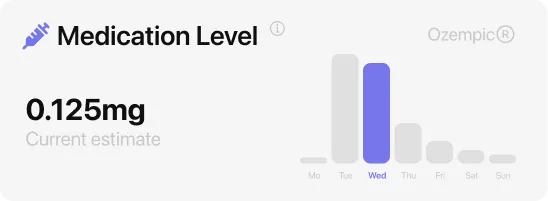
When coverage moves you off Zepbound, the switch is not a clean stop. Tirzepatide has about a five-to-six-day half-life, so it keeps leaving your body for roughly 25 to 30 days after your last shot, while Wegovy restarts all the way down at 0.25 mg. For those weeks you are carrying a fading dose of one medicine and a low, climbing dose of another at once. The estimated medication-levels graph draws that overlap as one picture, the Zepbound line trailing off as the Wegovy line lifts from its first step. It is an estimate for tracking and education, not a dosing tool, but it answers the question a forced switch keeps raising: is a flat, foggy week the old medicine clearing, the new dose still climbing, or both together. Set the medicine and dose, and the curve redraws around your own dates.
Log Every Symptom That Comes Back, and How Strong
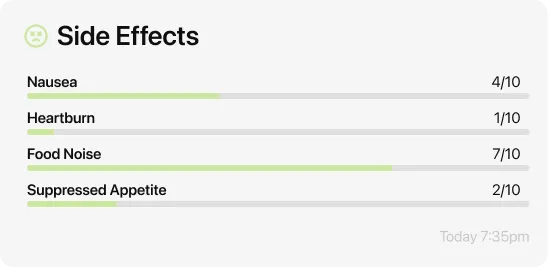
Because Wegovy climbs from 0.25 mg, the early weeks can hand back side effects you had already left behind at your old Zepbound dose. After a switch you did not choose, that can land like insult on top of injury, which is exactly why writing it down beats bracing for it. MeAgain tracks 29 built-in side effects and symptoms plus unlimited custom ones, each on a 0 to 10 severity slider with the date. A rough patch stops being a blur you half-remember and becomes a line you can watch settle as you hold at each step. Recording how strong a symptom is, not just that it happened, is what tells an ordinary re-adjustment apart from something worth a call, and it hands your prescriber the specific detail they can act on.
One Weight Line, Before and After the Switch
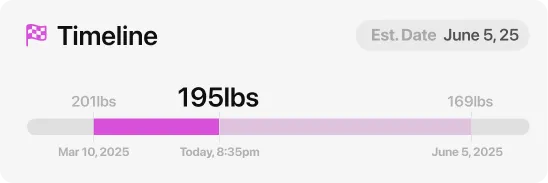
Dropping back to a 0.25 mg starting dose, plus the water shifts that come with any change, can make the scale bounce for a few weeks in ways that have nothing to do with your progress. That is why the trend across weeks reads truer than any single morning. MeAgain keeps your weight on one continuous line, so your Zepbound months and your first Wegovy weeks sit on the same chart and the low starting dose shows up as a dip in context, not a loss. If the trend genuinely flattens for a while, that is real information for your next visit, not a verdict on you. Because the line does not restart when your coverage did, a switch you did not ask for still reads as one continued story rather than a return to zero.
Walk In With the Record, Not a Reconstruction
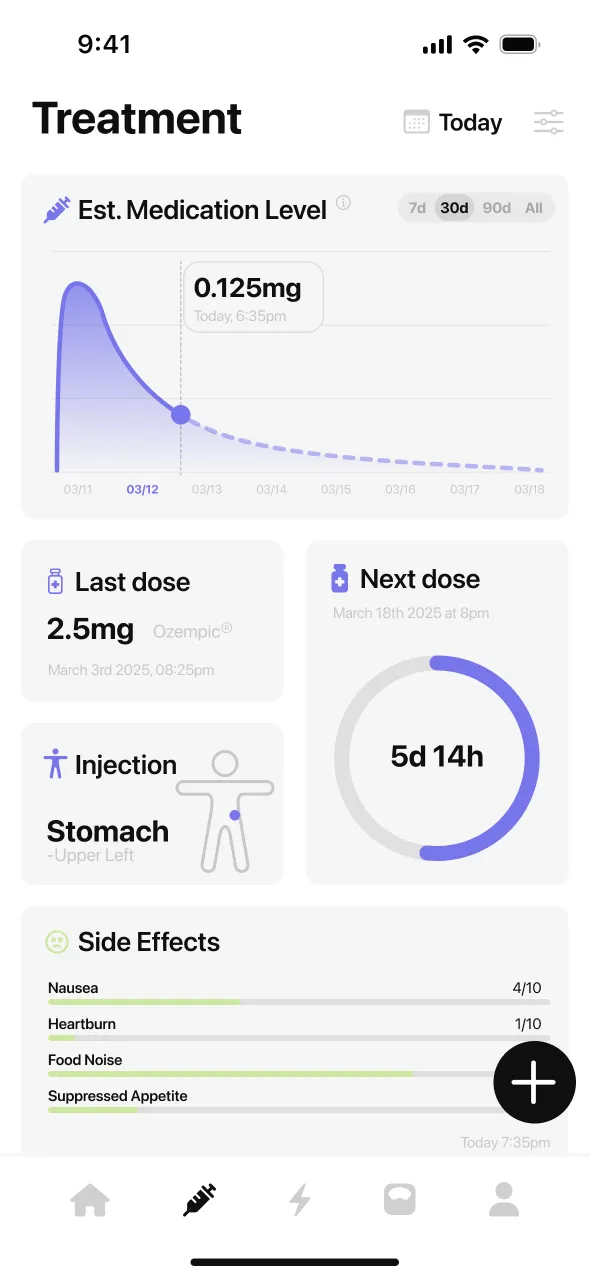
What helps most at your Wegovy appointment is not a conversion number, because none exists. It is your own history: your last Zepbound dose and date, how long you held each step, which side effects you had and how strong, and anything you know about the coverage change in case an appeal is worth raising. MeAgain keeps all of that on one timeline, so you arrive with the record you tracked instead of rebuilding months from memory. The app does not pick your medicine or your dose, that stays your prescriber's call, and it does not stand in for the conversation. What it does is make sure the plan starts from real facts about your own body, which matters most when the switch was decided for you rather than by you.


Zepbound to Wegovy: What Actually Changes, and What Does Not
Why there is no one-to-one dose conversion
There is no official one-to-one conversion between Zepbound and Wegovy because tirzepatide and semaglutide are different molecules on scales that do not line up. Zepbound climbs six labeled steps from 2.5 mg to 15 mg; Wegovy climbs five, from 0.25 mg to 2.4 mg, with a further 7.2 mg Wegovy HD maximum for some adults. The step numbers are not a shared ranking, so a Zepbound dose does not sit across from any single Wegovy dose. This is the one idea to carry off the page: any chart that pairs a Zepbound dose with an equivalent Wegovy dose is inventing a number the labels never set.
Your prescriber picks your Wegovy starting dose from your history, how you tolerated Zepbound, and your goals, not from arithmetic. The two label ladders below are printed as separate facts, each read down its own column rather than across to the other.
Official label schedules shown side by side. Rows are not equivalent doses and should not be read across. These are separate label schedules, not a switching instruction. Use the start date and dose your prescriber gave you.
Zepbound dose ladder (tirzepatide)
Dose steps from the FDA Zepbound (tirzepatide) prescribing information, revised April 2026, Dosage and Administration, Sections 2.1 and 2.2. Injection schedule only, and not a switching instruction.
| Dose step | Time at this step | Role in the label schedule |
|---|---|---|
| 2.5 mg | 4 weeks | Treatment initiation dose; not approved as a maintenance dosage. |
| 5 mg | at least 4 weeks | First maintenance dosage, reached after 4 weeks on 2.5 mg. The label's maintenance dosages are 5 mg, 10 mg, and 15 mg. |
| 7.5 mg | at least 4 weeks | Titration step; increase in 2.5 mg increments after at least 4 weeks on the current dose. |
| 10 mg | at least 4 weeks | A maintenance dosage, reached by 2.5 mg increments after at least 4 weeks on the current dose. |
| 12.5 mg | at least 4 weeks | Titration step; increase in 2.5 mg increments after at least 4 weeks on the current dose. |
| 15 mg | maintenance | Highest maintenance dosage; the maximum is 15 mg once weekly. |
Wegovy dose ladder (semaglutide)
Dose steps from the FDA Wegovy (semaglutide) prescribing information, revised June 2026, Dosage and Administration, Section 2.2 (Wegovy Injection); Dosage Forms and Strengths, Section 3. Injection schedule only, and not a switching instruction.
| Dose step | Time at this step | Role in the label schedule |
|---|---|---|
| 0.25 mg | weeks 1 to 4 | Starter dose to build tolerance; not intended for weight loss. |
| 0.5 mg | weeks 5 to 8 | Scheduled increase after 4 weeks on 0.25 mg. |
| 1 mg | weeks 9 to 12 | Scheduled increase after 4 weeks on 0.5 mg. |
| 1.7 mg | weeks 13 to 16, or week 17 onward (maintenance) | A labeled maintenance dosage for weight management; the label lists either 2.4 mg (recommended) or 1.7 mg once weekly, based on how well it works and is tolerated. It is also the last step before 2.4 mg. |
| 2.4 mg | week 17 onward (maintenance) | Recommended maintenance dosage for weight management; the label also allows 1.7 mg once weekly as the alternative maintenance dosage. For adults who tolerate 2.4 mg for at least 4 weeks, the label allows an increase to a maximum of 7.2 mg once weekly (Wegovy HD) when additional weight reduction is clinically indicated. |
Half-life and timing facts
Half-life, time to peak level, and time to steady state are from each product's FDA label, Section 12.3. The last row is the label's own figure where the label states one, and otherwise a standard five-half-lives estimate noted in the cell. These describe one medicine's own timing; they are not a formula for overlapping two medicines.
| Timing measure | Zepbound (tirzepatide) | Wegovy (semaglutide) |
|---|---|---|
| Elimination half-life | approximately 5 to 6 days (in patients with overweight or obesity) | approximately 1 week |
| Time to peak level (Tmax) | 24 hours (range 8 to 72 hours) | 1 to 3 days post dose |
| Time to steady state | reached following 4 weeks of once-weekly administration | reached following 4 to 5 weeks of once-weekly administration |
| Time in the body after the last dose | essentially eliminated after about 25 to 30 days (roughly five half-lives) by the five-half-lives convention | present in the circulation for about 5 weeks after the last dose |
What the timing numbers mean
These numbers describe timing, not effect. A half-life is simply how long your body takes to clear half of a dose, which is why tirzepatide, at about five to six days, keeps tapering for roughly 25 to 30 days rather than stopping the moment you switch. It says nothing about when appetite effects begin or fade, which is personal. Time to peak is how soon a dose reaches its high point, and steady state is where weekly doses stop stacking up. For the full week-by-week fade, the Zepbound and Wegovy half-life calculators in the keep-reading links walk it out dose by dose.
What to expect through the first weeks
The medicine changes, the weekly rhythm changes, and the dose resets even though your progress does not. Wegovy begins at 0.25 mg for the first four weeks, so plan for a low first step and a stretch of re-adjustment while tirzepatide is still clearing. Some of the side effects you had settled past can resurface for a few weeks before easing again. Whether Wegovy quiets appetite as well as Zepbound did, more, or less, is individual, and no page can promise which.
A switch you did not choose adds its own weight: the early Wegovy weeks can feel flatter than your later Zepbound weeks, partly from the low dose and partly from the frustration of starting a step-up over. That usually eases as you settle at each step. The steadiest move is to start from your real Zepbound history, keep logging through the dip, and let your prescriber set the pace rather than a calendar.
Switching the other way: Wegovy back to Zepbound
Switched the other way, from Wegovy back to Zepbound, the same logic holds with the medicines reversed. Semaglutide keeps leaving your body for about five weeks after your last Wegovy dose, and Zepbound runs its own step-up from 2.5 mg toward 15 mg, so there is still no conversion to read across. Your prescriber sets the Zepbound starting dose and timing from your history, not from your Wegovy number. The re-adjustment, the side effects that can briefly return, and the value of one unbroken record all apply in this direction too.
Bring this to your prescriber
- The medicine, dose, and date of your most recent injection
- How long you have been at your current dose
- Side effects you have had, and how strong they were
- Other medicines and supplements you take
- The new medicine, dose, and start date your prescriber sets
- What to watch for, and when to check back in
Whether you chose this switch or a coverage decision made it for you, the tracking works from day one and keeps the whole story on one timeline. MeAgain works with any GLP-1, branded or compounded, wherever it is prescribed.
For educational use only; this is not medical advice. There is no official one-to-one dose conversion between these medicines. Each has its own FDA-labeled schedule, shown here as separate label facts. Only your prescriber can choose your dose and start date. Do not use this page to change, start, or stop any medication.
Sources
- FDA Zepbound (tirzepatide) prescribing information, revised February 2026, Dosage and Administration and Clinical Pharmacology (Sections 2.1, 2.2, 12.3)
- FDA Wegovy (semaglutide) prescribing information, revised February 2026, Dosage and Administration and Clinical Pharmacology (Sections 2.2, 12.3)
- Jastreboff AM et al. Tirzepatide Once Weekly for the Treatment of Obesity (SURMOUNT-1). NEJM. 2022;387:205–216
- Wilding JPH et al. Once-Weekly Semaglutide in Adults with Overweight or Obesity (STEP 1). NEJM. 2021;384:989–1002
- Frías JP et al. Tirzepatide versus Semaglutide Once Weekly in Patients with Type 2 Diabetes (SURPASS-2). NEJM. 2021;385:503–515
- Marso SP et al. Semaglutide and Cardiovascular Outcomes in Patients with Type 2 Diabetes (SUSTAIN-6). NEJM. 2016;375:1834–1844
- Del Prato S et al. Tirzepatide versus Insulin Glargine in Type 2 Diabetes (SURPASS-4). Lancet. 2021;398:1811–1824
- Mayo Clinic: Semaglutide injection, description, dosing, and administration
- Drugs.com: Tirzepatide monograph, dosing, half-life, and administration
- American Society of Anesthesiologists: Multi-Society Clinical Practice Guidance on GLP-1 medicines and elective procedures (2024)
The Coverage Decision Is Made. The Tracking Is Yours.
One Record Across Both Medicines
A coverage decision can take the choice out of your hands, but it cannot reach the record underneath. What lasts through a forced switch is the daily work: the shot, the side effects, the food and water, and the long weight trend. Reviewers tend to describe that once the tracking becomes routine.
I love that if u forget where u did ur shot this keeps track so u know. Tracking my food intake is great too because if I get any medication side effects I can just check here to see what I ate & if that exasperated the symptoms.
That is the part a switch cannot touch. The medicine on the label changes from Zepbound to Wegovy, but the daily record underneath it does not reset.
MeAgain was built for the whole GLP-1 category rather than a single brand, so a shot-day countdown, injection-site rotation, the 0 to 10 side-effect slider, five ways to log food, and a single weight line all carry over intact. When your prescriber moves you from Zepbound to Wegovy, the app comes along and the history behind you stays put.

What Our Users Say
“I've been using the app for about 7 months now and I love how I'm able to track my meals and my daily medication. The little capybara widget is a great visual to help me know what my body needs.”
“This app does exactly what I needed with tracking shots… location, time, amount, current medication level, and reminders for the next one. That plus weight progress is all I needed, and after trying at least 5 others this was the only one that did it in a clean, logical way- and didn't cost a fortune!”
“I really love this app and how easy it is to use for my food, water, Mounjaro weekly shot and everything else. The app is totally worth the cost and it's been perfect for me.”
“I've been on my MJ journey since September 2025. Seeing my food intake has made a huge difference. Also, reviewing my shot locations has helped me remember to rotate. I have recommended this app to my friends who have also started their own journeys!”
“I love tracking water, protein and fiber on the app. It's really cool it's able to pull my weight and steps too. Add the widget to you phone screen if you do get it, I love that.”
Learn More About Switching GLP-1 Medicines
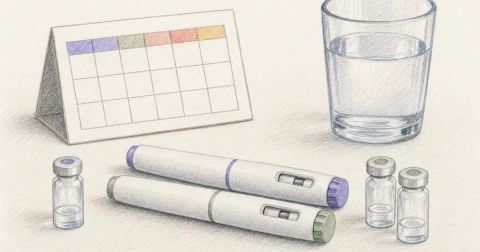
Wegovy vs Mounjaro Side Effects: Patient Guide
Learn the key differences in Wegovy vs Mounjaro side effects to help you make informed decisions about weight loss treatment options.

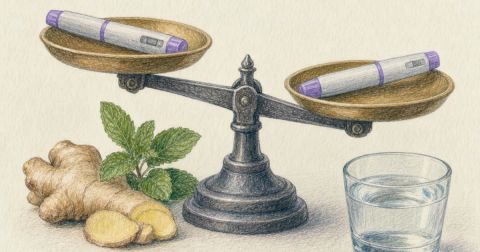

Switching From Zepbound to Wegovy - FAQs
Is there a dose conversion chart from Zepbound to Wegovy?
No, and no reliable one can exist. Tirzepatide and semaglutide are different medicines on different scales: Zepbound runs 2.5 mg to a 15 mg maximum across six labeled steps, Wegovy runs 0.25 mg to 2.4 mg across five (up to 7.2 mg with Wegovy HD for some adults), and the milligram numbers are not a ranking you can read across. A chart that lines a Zepbound dose up with an equivalent Wegovy dose is inventing a figure the labels never set, and following it could land you at the wrong dose. Your prescriber sets your Wegovy starting dose from how you did on Zepbound, your tolerance, and your goals. The label starts most people at 0.25 mg on purpose, so the body has four weeks to adjust before the first step up.
Insurance moved me to Wegovy. Do I lose the progress I made on Zepbound?
Will my side effects come back when I switch to Wegovy?
How long does Zepbound stay in my system after my last dose?
Can I take Zepbound and Wegovy at the same time?
Can I appeal my insurance to stay on Zepbound?
How does MeAgain help when I switch medicines?

Your Journey Back to You,
One Day at a Time
Track the plan, dose, meals, and milestones in one place that actually keeps up with your day.