Mounjaro vs Ozempic: How the Two Weekly Medicines Compare
Two different once-weekly medicines, each with its own dose ladder and approved use, and one app that tracks whichever one your prescriber picks.

Quick verdict
Mounjaro (tirzepatide) and Ozempic (semaglutide) are two different once-weekly medicines, not two names for one drug. Mounjaro acts on two appetite signals, Ozempic on one, and their milligram numbers sit on different scales, so a higher number is not a stronger dose. MeAgain tracks whichever one your prescriber picks.
Both are mainly approved for type 2 diabetes, each has its own dose ladder, and they are not interchangeable. Because the milligram numbers sit on completely different scales, a higher Mounjaro number does not mean a stronger dose than Ozempic. Which one fits you is a decision for you and your prescriber, based on your health history, not a number on a box. MeAgain does not pick one for you: it is the daily app layer once the prescription starts, with the weekly medication graph, dose-step tracking, side effect logging, food, and weight in one place. 807K people track their GLP-1 with MeAgain, rated 4.8 stars across 37K App Store ratings.
Bottom line: This page is education, not medical advice. Medication choice and dose changes belong with your doctor or licensed clinician. MeAgain works with any GLP-1, branded or compounded, wherever it is prescribed.
Key takeaways
Mounjaro and Ozempic are different medicines, not two versions of one. Mounjaro is tirzepatide and Ozempic is semaglutide, so this is a genuine drug-to-drug comparison, and the milligram numbers on their boxes are not meant to be read across.
Mounjaro works on two of the body's appetite signals and Ozempic on one. Both are once-weekly injections, and MeAgain's medication graph fits either weekly rhythm so you can see where a dose is climbing, holding, and easing off.
The dose ladders are different and sit on different scales. Mounjaro steps 2.5, 5, 7.5, 10, 12.5, 15 mg, while Ozempic steps 0.25, 0.5, 1, 2 mg. MeAgain keeps your current step and next-dose countdown in one view.
They stay in the body for different lengths of time: semaglutide has about a 1-week half-life and tirzepatide about 5 days. The weekly fade looks a little different on the graph, which is often why day two can feel unlike day six.
If your prescriber ever switches you between them, MeAgain keeps your weight trend, food logs, side effects, and dose dates on one timeline, so nothing resets and you can see how your own body responded before and after.
What MeAgain Does After You and Your Prescriber Choose
One graph, two weekly rhythms
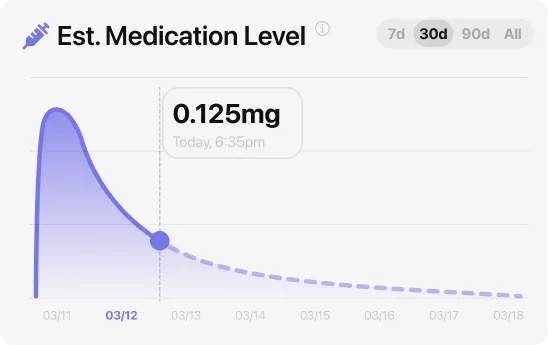
Mounjaro and Ozempic move through the week differently, and MeAgain's medication graph adjusts to whichever one you are on. Semaglutide lingers for about a week, while tirzepatide tapers a little faster at about five days, so the shape of the curve is not identical. On the graph you can watch where your dose is climbing, holding, and easing off, which is often why one day of the week feels different from another. Appetite, food noise, and side effects tend to follow that curve, so seeing it laid out beats guessing why Thursday feels unlike Monday. You do not set any of this up by hand: pick the medicine and dose, and the weekly rhythm is drawn for you, then redrawn if your prescriber changes the plan.
Your current step and next-dose countdown
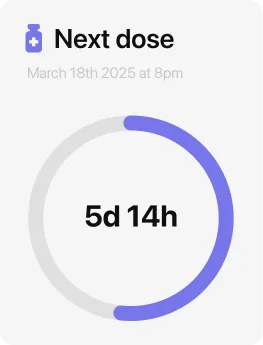
The two dose ladders are different lengths and sit on different scales, so MeAgain tracks each on its own terms rather than lining them up next to each other. Your current step stays visible, the countdown to your next shot is always one glance away, and every dose you log records the injection site so the app can rotate you to a fresh spot next time. When your prescriber steps you up the ladder, you move the setting and nothing else resets. That matters most around week seven or week fifteen, when the real question is whether to hold at your current dose or step up, and a clean record of what you have taken and how you felt is exactly what you want in front of you for that conversation.
Side effects and food, logged the same way

Tolerance is personal, so your own log tells you more than any average. MeAgain tracks 29 built-in side effects and symptoms plus unlimited custom ones on a simple 0 to 10 scale, then lets you read those entries beside protein, water, fiber, meals, and your weight trend. Over a few weeks the pattern gets easy to see: maybe nausea settled after the first two days on a new step, or maybe appetite returned sooner than you expected before the next shot. Five ways to log food keep nutrition fast enough to use on ordinary days, not just perfect ones. Whether your prescriber picks Mounjaro or Ozempic, the logging works the same way, so nothing about your routine changes if the medicine does.
Switch without starting over
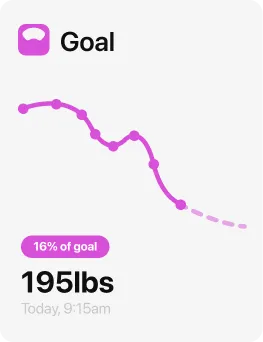
Plenty of people do not stay on the first medicine forever. Insurance changes, side effects shift, supply comes and goes, and a prescriber may move you from one to the other. In MeAgain a switch is a settings change, not a fresh start: your weight trend, food logs, symptom history, and every past dose stay on one timeline, and the medication graph swaps from the tirzepatide rhythm to the semaglutide one, or back. You do not open a new spreadsheet or lose the context from your first months. The most useful comparison of Mounjaro and Ozempic is rarely the one on a chart somewhere. It is what your own body did in the weeks before and after a change, and that only exists if the whole history lives in one place.


Mounjaro vs Ozempic: What Actually Changes
One Pathway or Two
The clearest difference is how each medicine works. Ozempic (semaglutide) acts on one of the body's appetite-related signals. Mounjaro (tirzepatide) acts on two. That does not automatically make one better for you, because how a medicine feels and works depends on your own health history, but it does mean these are genuinely different drugs, not two names for the same thing. Because they are different molecules, you cannot compare their milligram numbers directly: a 15 mg Mounjaro dose and a 2 mg Ozempic dose sit on completely different scales, and neither is stronger simply because its number is bigger.
They also clear the body at different speeds. Semaglutide has a half-life of about a week, so it fades slowly between shots, while tirzepatide runs a little faster at about five days. Both are still once-weekly injections, and both step up gradually for the same reason: your stomach needs time to adjust. What actually decides the outcome is the plan your prescriber sets and how your own body responds to it, which is exactly what a daily log is built to show you.
The two have been compared head-to-head once, in the SURPASS-2 trial, but it was a diabetes study, not a weight-loss contest. Over 40 weeks in adults with type 2 diabetes taking metformin, average A1C fell about 2.0 to 2.3 percentage points across the tirzepatide doses (5, 10, and 15 mg) versus about 1.86 points on semaglutide 1 mg, and tirzepatide also led on the secondary weight measure. Those are genuine head-to-head numbers, but they describe blood-sugar control in people with diabetes, so they point a direction rather than promise a weight result for you. An average is not an outcome, side effects and your own history weigh in as much as the molecule, and the choice stays your prescriber's read, not a single trial figure.
Mounjaro vs Ozempic at a Glance
| Question | Mounjaro | Ozempic |
|---|---|---|
| Medicine | Tirzepatide | Semaglutide |
| How it works | Two appetite pathways (GIP and GLP-1) | One appetite pathway (GLP-1) |
| Mainly approved for | Type 2 diabetes | Type 2 diabetes |
| Dose ladder | 2.5 → 5 → 7.5 → 10 → 12.5 → 15 mg | 0.25 → 0.5 → 1 → 2 mg |
| Top dose | 15 mg weekly (adults; 10 mg for ages 10 and up) | 2 mg weekly |
| Half-life | About 5 days | About 1 week |
| Maker | Eli Lilly | Novo Nordisk |
These are label facts, not a ranking. The dose numbers are on different scales and should not be compared directly, and neither drug is stronger because its milligram number is higher. The right choice is your prescriber's call.
How to Think About the Choice
- Both are mainly approved for type 2 diabetes, so the conversation is about fit and your health history, not about which milligram number looks higher.
- If a longer-established single-signal medicine appeals to you, that describes Ozempic (semaglutide); if a two-signal medicine is on the table, that is Mounjaro (tirzepatide).
- Do not read the dose ladders across each other. The numbers sit on different scales, and your prescriber sets the step, not a comparison chart.
- Whichever you are on, injection-site rotation, protein, water, and side-effect logging matter the same way, so the daily routine barely changes between the two.
- If you may switch later, pick a tracker that keeps the whole timeline intact instead of splitting your history across two tools.
The tracker works whether you stay on Mounjaro, move to Ozempic, or change again later. Your weight trend, meals, symptoms, and dose history stay on one timeline through every switch, and MeAgain works with any GLP-1, branded or compounded, wherever it is prescribed.
This content is for informational purposes only and does not constitute medical advice. Drug choice, dose changes, and side-effect management should be decided with your doctor or licensed clinician. Brand-name products referenced here are made by Novo Nordisk or Eli Lilly.
Sources
- FDA Mounjaro (tirzepatide) prescribing information via DailyMed
- FDA Ozempic (semaglutide) prescribing information via DailyMed
- Frias JP et al. - Tirzepatide versus Semaglutide Once Weekly for Type 2 Diabetes (SURPASS-2, NEJM 2021, n=1879)
- Eli Lilly - SURPASS-2 results published in NEJM: tirzepatide versus injectable semaglutide in type 2 diabetes (2021)
The Comparison Starts With the Drug. The Daily Work Starts After.
One App Across Both Medicines
Choosing the medicine is one decision. Living with a weekly injection is a hundred small ones: shot day, side effects, protein, water, and the weight trend over months. That is where a real log earns its place, and it is the part reviewers tend to write about once the novelty of the prescription wears off.
This is the best app I have found for tracking doses dose locations and med levels!!
That is the pattern once the prescription is settled. Mounjaro or Ozempic is one moment of the week; the shot day, the symptoms, and the weight trend around it are where the routine actually lives.
MeAgain was built for the whole GLP-1 category, not one brand: a weekly medication graph, a next-dose countdown, injection-site rotation, side-effect logging on a 0 to 10 slider, five ways to log food, and a weight trend that stays one continuous line. Whether your prescriber picks Mounjaro or Ozempic, branded or compounded, the app fits and your history does not start over.

What Our Users Say
“I've been using the app for about 7 months now and I love how I'm able to track my meals and my daily medication. The little capybara widget is a great visual to help me know what my body needs.”
“This app does exactly what I needed with tracking shots… location, time, amount, current medication level, and reminders for the next one. That plus weight progress is all I needed, and after trying at least 5 others this was the only one that did it in a clean, logical way- and didn't cost a fortune!”
“I really love this app and how easy it is to use for my food, water, Mounjaro weekly shot and everything else. The app is totally worth the cost and it's been perfect for me.”
“I've been on my MJ journey since September 2025. Seeing my food intake has made a huge difference. Also, reviewing my shot locations has helped me remember to rotate. I have recommended this app to my friends who have also started their own journeys!”
“I love tracking water, protein and fiber on the app. It's really cool it's able to pull my weight and steps too. Add the widget to you phone screen if you do get it, I love that.”



Mounjaro vs Ozempic FAQs
Are Mounjaro and Ozempic the same?
No. They are different medicines. Mounjaro is tirzepatide, which works on two of the body's appetite signals, and Ozempic is semaglutide, which works on one. Both are once-weekly injections mainly used for type 2 diabetes, but they have different dose ladders, different half-lives, and are not interchangeable. They do share a family resemblance: appetite quiets, stomachs need an adjustment period, and doses step up gradually. What they do not share is a molecule, so you cannot treat a dose of one as equal to a dose of the other. Which fits you is a decision for your prescriber, and MeAgain's job is simply to track whichever one you are on.
Is Mounjaro stronger than Ozempic because the doses are higher?
Can I switch from Ozempic to Mounjaro without losing my data?
Which one is better for weight loss?
How are the Mounjaro and Ozempic dose schedules different?
How does MeAgain track Mounjaro or Ozempic?

Your Journey Back to You,
One Day at a Time
Track the plan, dose, meals, and milestones in one place that actually keeps up with your day.