

Starting Ozempic and watching the scale move feels promising, until it suddenly stops. Weight loss plateaus on semaglutide are more common than most people expect, and they rarely have a single cause. Metabolic adaptation, gradual calorie creep, hormonal shifts, and dosage timing can all play a role in stalling progress.
Understanding what is actually driving the plateau makes it far easier to address. Tracking food intake, activity, and daily patterns gives a clearer picture of what the body is doing and why results have slowed. For people on medications like Ozempic, the GLP-1 app from MeAgain is designed to surface exactly that kind of insight, so working through a plateau becomes a data-informed process rather than a guessing game.
Table of Contents
- How Quickly Does Ozempic Start Helping You Lose Weight?
- Why Did I Stop Losing Weight on Ozempic?
- How to Break a Weight Loss Plateau on Ozempic
- Track Your Ozempic Progress the Right Way in Under 3 Minutes
Summary
- Ozempic does not produce immediate fat loss. The first 5 to 10 pounds most people lose in the opening weeks come primarily from water and glycogen depletion, not adipose tissue. The starting dose is intentionally low to reduce gastrointestinal side effects, and semaglutide typically takes 4 to 5 weeks to reach a steady level in the body, with full appetite and blood sugar effects often not appearing until at least 8 weeks in.
- A weight-loss plateau on semaglutide is a predictable biological event, not a sign that the medication has stopped working. According to WebMD, plateaus commonly occur after 16 to 20 weeks on semaglutide, which aligns with the point where metabolic adaptation becomes measurable. As body weight decreases, the body burns fewer calories at rest, reducing the caloric deficit that originally drove faster weight loss.
- Stress and sleep disruption are among the most overlooked reasons progress stalls on GLP-1 medications. Cortisol released during chronic stress increases appetite for calorie-dense foods, promotes visceral fat storage, and directly opposes the appetite-suppression mechanism semaglutide relies on. Poor sleep triggers the same hormonal interference through a parallel pathway, and both can counteract an otherwise active medication regardless of dose.
- Other medications in a person's regimen can quietly counteract the effects of semaglutide without any obvious signs. Certain antidepressants (including mirtazapine and paroxetine), antipsychotics like olanzapine, corticosteroids such as prednisone, and some diabetes drugs create physiological barriers to weight loss that Ozempic cannot override on its own. Anyone experiencing a persistent plateau while maintaining consistent habits should review their full medication list with their prescribing provider.
- Resistance training is one of the most underused tools for breaking a plateau on semaglutide. Unlike cardio-focused approaches, which can accelerate lean mass loss during prolonged caloric restriction, progressive resistance training preserves muscle tissue and protects resting metabolic rate. Two to three sessions per week, with increasing difficulty over time, signal the body to retain lean tissue rather than sacrifice it.
- Clinical trial data from the STEP 5 trial, published in Nature Medicine, show that participants lost an average of 15.2% of their body weight over 104 weeks on semaglutide, a result that depends on staying the course through slowdown phases rather than concluding the drug has failed. Up to 1 in 3 people on GLP-1 medications experience a plateau within the first year, which means the plateau is a normal phase of a longer process, not a ceiling.
- MeAgain's GLP-1 app addresses the core diagnostic problem of plateaus by placing dose timing, meals, protein, hydration, side effects, and weight on a single timeline, making it possible to see which variables are shifting together rather than tracking each one in isolation.
How Quickly Does Ozempic Start Helping You Lose Weight?
Most people expect noticeable weight loss within the first few weeks, but this misaligns with how the body works.
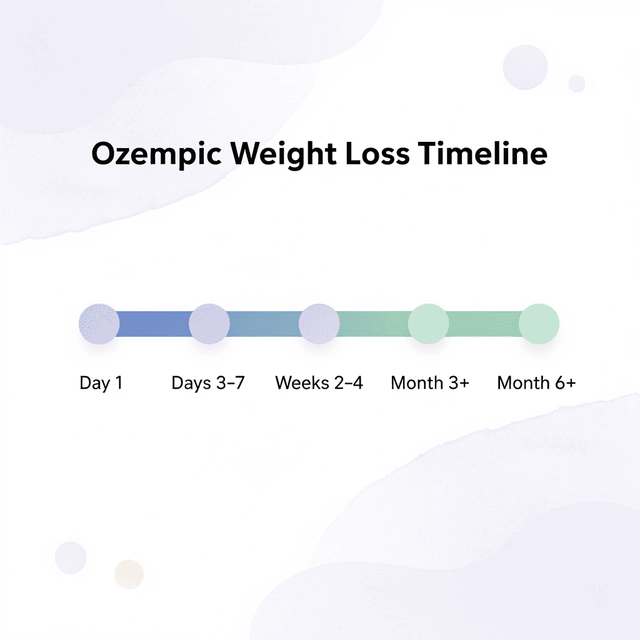
"Most patients notice their appetite gets smaller within 3 to 7 days of their first injection, with measurable weight loss typically starting within 2 to 4 weeks." — Doctronic, Ozempic Weight Loss Timeline
According to Doctronic's Ozempic Weight Loss Timeline, most patients notice their appetite gets smaller within 3 to 7 days of their first injection, with measurable weight loss typically starting within 2 to 4 weeks — often 5 to 10 pounds in the first month. However, this early weight change on the scale is mostly water and glycogen loss from eating fewer calories, not fat loss. The way it works is real; the way people understand it is often wrong.
Timeline | What's Happening | Type of Loss |
|---|---|---|
Days 3–7 | Appetite suppression begins | None yet |
Weeks 2–4 | Scale weight drops | Water & glycogen |
Month 1+ | A consistent calorie deficit builds | Early fat loss |
Why the first 4 to 8 weeks are a ramp, not a result
Ozempic does not lower blood glucose or cause meaningful weight loss after the first injection. The starting dose is intentionally low for the first four weeks to reduce gastrointestinal side effects, not to produce therapeutic results. Semaglutide reaches steady state in roughly 4 to 5 weeks, with full effects on blood sugar and appetite often appearing only after 8 weeks. Most people are never told this upfront, which is why the early weeks feel like waiting for something that should already be happening.
What does the dose titration phase actually mean for your results?
The dose titration phase is a planned delay, not a sign of failure. If your prescriber has not increased your dose, you remain in the ramp period, and the lack of dramatic results aligns with the medication's design. Your healthcare team will check your A1C after several months of consistent treatment, not weeks, because that is the medication's timeline.
Not everyone responds at the same speed
Differences in metabolism, hormonal conditions, missed doses, and lifestyle factors affect how quickly Ozempic produces results. Someone with an underlying hormonal imbalance may see a slower response than someone without one, even at the same dose. Inconsistent weekly injections disrupt the steady buildup semaglutide requires, directly delaying weight loss.
What does the clinical data actually show about the timeline?
Clinical trials from La Vie MD show patients lost an average of 15% of their body weight over 68 weeks on semaglutide. The STEP program clinical trial data reveal a two-phase pattern: an early, rapid weight-change phase driven by appetite suppression and fluid shifts, followed by slower, steadier fat loss. Most users expect only the first phase. When momentum slows after the initial drop, they assume something has gone wrong. The body has simply entered phase two.
How can tracking more than the scale help you stay on course?
Many people manage the early phase by tracking appetite changes, fullness, and dose timing alongside weight rather than watching the scale alone. Our GLP-1 app consolidates dose timing, meals, water, protein, side effects, and weight onto a single timeline, making patterns easy to identify before confusion sets in.
Understanding why the slowdown happens is where most people's real journey with Ozempic begins.
Related Reading
- GLP-1 Plateau
- How Does GLP-1 Help You Lose Weight
- How Much Protein On GLP-1
- How Much Water To Drink on GLP-1
- Why Am I Not Losing Weight On GLP-1
- Can GLP-1 Cause Gastroparesis
- Can GLP-1 Cause Kidney Stones
- Which GLP-1 Has The Least Side Effects
- Does GLP-1 Cause Acid Reflux
- Why Am I Not Losing Weight on Zepbound
Why Did I Stop Losing Weight on Ozempic?
Weight loss slowing or stopping on Ozempic does not mean the medication has stopped working. This is the most common misconception in the GLP-1 conversation— and it's one that causes many people to prematurely abandon a treatment that is still doing its job.
"Weight loss plateaus on GLP-1 medications are a normal physiological response — not a sign of treatment failure."
What It Means | What It Does NOT Mean |
|---|---|
Your body is adjusting to a new set point | The medication has stopped working |
Metabolic adaptation is occurring | You need to switch medications |
It's time to reassess habits and dosage with your doctor | Treatment has failed |
Why does early weight loss on Ozempic feel so fast?
The belief that effective medication produces steady, uninterrupted weekly loss stems from the early weeks, which deliver exactly that: water weight loss, depleted glycogen stores, dramatic appetite suppression, and rapid scale movement. When progress slows, the brain reads it as failure rather than a predictable phase of long-term biology. Social media amplifies this by compressing 18 months of non-linear progress into 60-second highlight reels, making plateau phases invisible to anyone who hasn't experienced one.
How does metabolic adaptation cause a weight-loss plateau on Ozempic?
As body weight decreases, the body burns fewer calories at rest because a smaller body requires less energy to function. This reduction in total daily energy expenditure shrinks the caloric deficit that originally drove fat loss, slowing the rate of loss. According to WebMD, weight loss plateaus can occur after 16 to 20 weeks on semaglutide, when metabolic adaptation becomes measurable. The drug has not stopped working; the body has adapted to a new lower weight.
Can stress and poor sleep stop Ozempic from working?
Chronic stress and poor sleep form a second cause. Stress triggers cortisol release, which increases hunger for high-calorie foods and promotes fat storage in visceral tissue, counteracting semaglutide's appetite-suppression mechanism. Poor sleep operates through a similar hormonal pathway. These physiological factors can override the effects of a fully active GLP-1 medication, regardless of dose. When people report the drug "stopping," stress and sleep disruption are often the actual culprits.
Your diet is working against the medication
Ozempic and Wegovy reduce appetite, but they do not filter what you eat. When hunger signals quiet down, the foods you reach for first matter more than ever. Prioritizing lean protein and high-fiber foods before processed or high-sugar options gives your body the raw material it needs to preserve muscle and keep metabolism moving. If your caloric intake has drifted upward without you noticing, that is a data problem, not a willpower problem: the kind of pattern that becomes visible when you track meals consistently.
Why do mental estimates fail when progress stalls?
Most people try to remember what they ate and estimate at the end of the day. But when progress slows, mental guesses lack the precision to reveal whether protein is consistently low or fiber is missing from most meals. Tracking meals, protein, and fiber together in our MeAgain GLP-1 app connects those dots in one place, so you can see patterns rather than guess at them.
How does seeing everything on one timeline reveal the pattern?
A plateau is rarely caused by one thing. It is usually a pattern: insufficient protein, inconsistent hydration, disrupted sleep, elevated cortisol, or medication-timing drift—none of which is visible in isolation. MeAgain's GLP-1 app addresses this by placing dose timing, meals, protein, water, side effects, and weight on a single timeline. When everything is visible together, the pattern stalling progress becomes readable.
Is a plateau a sign that the medication has stopped working?
The plateau is not a failure of the medication. It is a predictable adaptation response. According to the STEP 5 trial published in Nature Medicine, participants lost an average of 15.2% of their body weight over 104 weeks on semaglutide: a result that occurs only for those who continue the medication through slowdown phases rather than assuming the drug has stopped working.
How does exercise affect semaglutide results?
Studies show semaglutide works best when combined with at least 150 minutes of moderate-intensity aerobic activity each week: about 30 minutes five days a week. Brisk walking, cycling, swimming, and yard work all count. Insufficient exercise increases your risk to heart health, undermining the medication's benefits.
How do stress, sleep, and other medications slow weight loss?
Stress and sleep are equally disruptive. High cortisol from chronic stress encourages overeating and fat storage, while poor sleep (fewer than seven hours consistently) keeps cortisol elevated. Certain medications actively work against weight loss: sulfonylureas like glipizide, antidepressants such as mirtazapine or paroxetine, antipsychotics like olanzapine, and corticosteroids including prednisone. Hypothyroidism can also block progress regardless of habits.
According to Sword Health, up to 1 in 3 people on GLP-1 medications experience a weight loss plateau within the first year, often due to an undiagnosed condition or conflicting medication. If your habits are solid and the scale won't move, bring your full medication list and health history to your provider.
Once you understand why the stall happened, the next question is harder: what do you do to break it?
Related Reading
- Why Do Some People Not Lose Weight on Ozempic
- Slow Weight Loss On Wegovy
- Why Am I Not Losing Weight On Zepbound
How to Break a Weight Loss Plateau on Ozempic
Breaking through a plateau isn't about working harder—it's about fixing the mismatch between your current metabolism and current habits.
"A weight loss plateau signals that your body has successfully adapted. The goal now is to outsmart that adaptation, not overpower it."

Your body has simply adjusted to the new normal. The strategies that caused early weight loss on semaglutide worked because they created a deficit compared to your original metabolic rate. That rate has since changed, and the same actions now produce a completely different result. The fix isn't more restriction—it's a completely different approach.
What Changed | Why It Matters |
|---|---|
Metabolic rate has decreased | Fewer calories burned at rest |
Body composition has shifted | Muscle-to-fat ratio affects burn rate |
Appetite signals have adapted | Ozempic's effect may feel less pronounced |
Why does cutting more calories make a plateau worse?
The most common mistake when hitting a plateau is treating effort as the variable to change. People cut calories, add cardio, and try fasting protocols. According to WebMD, up to 1 in 3 people on GLP-1 medications like Ozempic experience a weight-loss plateau within the first year of treatment. This reflects a physiological pattern: the body lowers total daily energy expenditure to match reduced intake, so the calorie math that worked at month two no longer applies at month twelve. Cutting further accelerates lean mass loss, which in turn lowers resting metabolic rate, compounding the problem.
How does resistance training protect your metabolism at a plateau?
Resistance training is the most underused corrective tool at this stage because it protects lean mass rather than burning calories immediately. A person who maintains muscle through a plateau preserves their metabolic floor. Someone relying on cardio alone during prolonged restriction loses both fat and muscle, resulting in a lower weight but a slower metabolism. Two to three progressive resistance sessions per week signal the body that lean tissue is worth keeping: this is metabolic protection, not aesthetics.
What the scale is actually telling you (and what it isn't)
Scale fixation is one of the most reliable ways to misread your own progress. Daily weight fluctuates two to four pounds based on water retention, glycogen storage, hormonal cycles, and sodium intake—none reflecting fat loss or metabolic change. People experience real improvements: lower resting heart rate, better energy, reduced inflammation. Yet they dismiss it all because a single morning number didn't move. According to ro.co, weight loss plateaus on GLP-1 medications typically occur around 60 to 68 weeks into treatment, meaning this stall is an expected physiological event, not a verdict on your effort. Shifting to a seven-day rolling average or monthly body composition checks provides a trend line instead of a snapshot.
Plateaus are holding phases, not regression. The body consolidates changes, stabilizes new metabolic set points, and continues to improve markers the scale cannot capture. Those who break through plateaus rarely pushed hardest; they corrected the mismatch, protected their lean mass, slept adequately, and gave the trend time to show itself.
Does tracking food actually help during a plateau?
Most people who track food when they stop losing weight do so to find hidden calories—a valid short-term approach. A food scale can reveal portion creep that quietly closes the deficit. But tracking works best as a temporary tool, not a permanent system. Once portion awareness is internalized, the mental overhead of logging every meal outweighs the benefits. Tracking resolves uncertainty now, but long-term dependency can turn eating into an accounting exercise that adds stress rather than clarity.
How does having all your data in one place change the picture?
This is where having all your data in one place changes the diagnostic picture entirely. Most people manage their GLP-1 journey across separate apps, notes, and memory—food in one place, weight in another, side effects nowhere. That scattered approach makes it nearly impossible to see the actual pattern.
Our MeAgain app brings dose timing, meals, protein, hydration, side effects, and weight onto a single timeline. When the scale stalls, you're not guessing. You're looking at correlated data that shows whether low-protein days precede stalled weight, whether hydration dips align with side-effect spikes, or whether dose timing has drifted. That's the difference between feeling stuck and understanding why.
Knowing the plateau is expected is only half the equation. The other half is knowing when you're moving again.
Track Your Ozempic Progress the Right Way in Under 3 Minutes
Knowing when you're moving forward again requires a complete picture: dose timing, protein intake, hydration, side effects, and weekly weight trends read together, not separately. Most people on GLP-1 medications track one variable at a time, which is exactly why plateaus feel invisible until they've already lasted weeks.
"Tracking one variable at a time is why plateaus feel invisible — a complete picture of dose timing, protein, hydration, and weekly trends is the only way to see what's really happening." — MeAgain Health Insight
Tracking Variable | Why It Matters on GLP-1 |
|---|---|
Dose Timing | Reveals patterns tied to appetite and side effect windows |
Protein Intake | Protects muscle mass during rapid weight loss |
Hydration | Masks or mimics weight fluctuations on the scale |
Side Effects | Signals dose tolerance and adjustment needs |
Weekly Weight Trends | Filters out daily noise to show real direction |
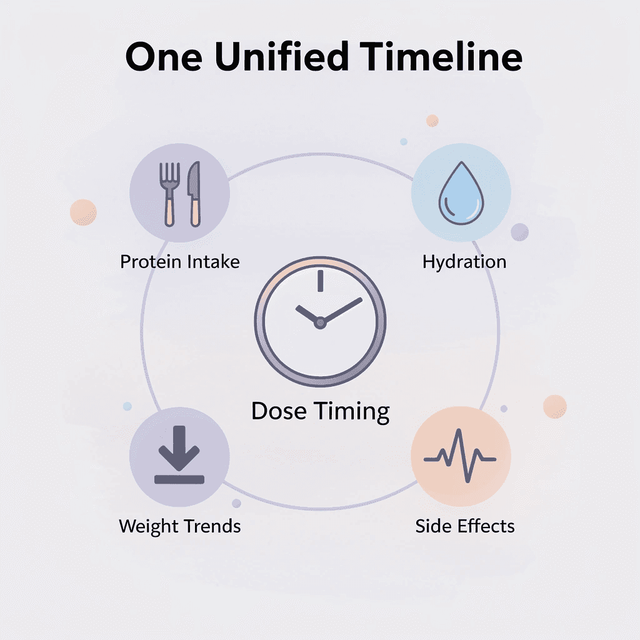
Our MeAgain app brings all of those variables onto one unified timeline, so you can see whether your stall is a pattern or a fluke before it costs you weeks of momentum. Set up your personalized progress dashboard in under three minutes and unlock weekly trend tracking that filters out daily scale noise, protein and fiber targets built specifically for GLP-1 use, and a milestone Journey Card that maps real body composition shifts beyond what the scale shows.