
Staying consistent with weekly semaglutide injections is harder than it sounds. Missed doses, lost track of timing, and uncertainty about whether the schedule is being followed correctly can quietly undermine progress. For anyone wondering how to track their semaglutide injections, the answer is to build a reliable system rather than rely on memory alone.
Logging each dose, setting reminders, and reviewing injection history in one place removes the guesswork and keeps the plan on track. MeAgain built exactly that kind of system, and anyone ready to stay consistent can get started with the GLP-1 app.
Table of Contents
- Why Tracking Your Semaglutide Injections Matters More Than You Think
- The Best Way to Track Semaglutide Injections and Your Progress
- How to Stay Consistent Without Missing or Repeating a Dose
- Turn Injection Tracking Into a Habit You Never Have to Think About
Summary
- Tracking semaglutide injections requires more than remembering a weekly shot. The real challenge is ambiguity, not knowing whether a dose was taken on Wednesday or Thursday, which creates a time-sensitive decision with real clinical stakes. FDA prescribing guidance for Wegovy specifies that if a missed dose is more than two days from the next scheduled injection, it should be taken immediately, a decision that depends entirely on knowing when the last dose occurred.
- Clinical trial outcomes for semaglutide are substantially better than most real-world results, and the gap is largely structural. SUSTAIN and STEP trial participants achieved up to 15% body weight loss over 68 weeks under structured monitoring protocols that everyday patients rarely replicate. That difference in outcome is not about the medication; it is about the consistency and visibility that organized tracking provides.
- Adherence is the defining challenge for GLP-1 therapy users. HealthVerity's 2025 real-world data analysis found that 49% of GLP-1 patients discontinue therapy within 12 months of starting. Discontinuation most often happens not because the medication stops working, but because the experience becomes confusing or discouraging without a system to make sense of it.
- Injection site rotation is one of the most underappreciated tracking habits among semaglutide users. Rotating among the abdomen, thigh, and upper arm prevents lipohypertrophy, a localized tissue thickening that forms with repeated use of the same site and reduces the consistency of drug absorption. Without a written record of previous injection sites, rotation becomes guesswork, which can translate into unpredictable blood levels weeks later.
- Self-monitoring during weight management consistently predicts better adherence and stronger outcomes. Research points to a specific reason: people stop engaging when they can no longer see evidence that what they are doing is working. Bayou Bend Health notes that approximately 50% of patients with chronic diseases do not take medications as prescribed, and the loss of visible progress is a documented driver of that pattern.
- Dose escalation timelines require patience before drawing conclusions. Semaglutide doses are typically increased every four weeks starting at 0.25 mg, and that window reflects how long the body needs to stabilize before a meaningful signal emerges. Tracking weight trends, appetite responses, and side effect frequency over a full four-week period provides both the patient and their provider with the evidence needed to make informed decisions about whether to escalate, hold, or adjust.
- MeAgain's GLP-1 app addresses this by consolidating injection logs, site rotation history, side-effect records, weight trends, and nutrition data into a single timeline, giving users and their providers a continuous record rather than scattered notes across multiple apps.
Why Tracking Your Semaglutide Injections Matters More Than You Think
Many people think they'll remember a once-weekly injection without writing it down. But weekly routines are surprisingly easy to break. A holiday weekend changes your schedule. A work trip puts you in a different time zone. A dose escalation means you're suddenly taking a different amount than last month — and the information you've been keeping in your head quietly becomes unreliable.
"Weekly routines are surprisingly easy to break — a single schedule disruption can silently corrupt the mental tracking system most people rely on for their injections."
Disruption Type | Risk to Injection Tracking |
|---|---|
Holiday weekend | Shifts your usual day/routine |
Work or travel trip | Time zone confusion, missed doses |
Dose escalation | Amount changes; old mental notes become wrong |
Busy or stressful week | Easy to forget if or when you injected |

Why is ambiguity about your last dose a real clinical risk?
The failure point is usually not forgetfulness but ambiguity. You think you took it Thursday, but it might have been Wednesday. That uncertainty is where problems begin. Taking a duplicate dose of semaglutide can trigger nausea, vomiting, or gastrointestinal distress that disrupts the steady-state blood levels the medication depends on. FDA prescribing guidance for Wegovy is clear: if you miss a dose and your next scheduled injection is more than two days away, take it as soon as you remember. If it's less than two days away, skip it and resume your regular schedule. This time-sensitive decision requires knowing exactly when your last injection occurred.
How does logging injection data help your provider make better decisions?
Healthcare providers ask patients to log injection dates, doses, and side effects as a clinical tool, not a formality. When you keep a record, your provider can make better decisions about when to increase your dose, how to manage symptoms, and whether your schedule is working. Without it, you and your provider are guessing. According to Shotsy's research on GLP-1 journey tracking, clinical trials of semaglutide showed up to 15% body weight loss over 68 weeks when patients followed structured monitoring plans that most real-world patients never use.
What happens when scattered notes can't keep up with your treatment variables?
Most people handle this with mental notes, sticky notes, or calendar entries that get lost once life gets busier. Multiple medications, rotating injection sites, changing dose levels every four weeks during escalation, and tracking nausea patterns create cognitive load that scattered notes cannot manage. Our GLP-1 app consolidates injection dates, dose history, site rotation, side effects, and weight trends on a single timeline, making the connection between dose day and everything else clear rather than a guess.
Why do nearly half of GLP-1 patients stop treatment within a year?
HealthVerity's 2025 analysis of GLP-1 real-world data found that nearly half of GLP-1 patients (49%) stop taking the medication within 12 months of starting. People typically don't stop because the medicine stops working; they stop because the experience becomes overwhelming, confusing, or discouraging without a system to help them understand it. Tracking your injection schedule forms the foundation of a feedback loop that tells you whether treatment is working and gives you something concrete to discuss with your provider when it isn't.
What should you actually log after each semaglutide injection?
At a minimum, record the date and time of each injection, the dose amount, the injection site used, and any side effects in the 24 to 72 hours following the shot. Weight, taken consistently at the same time of day under the same conditions, transforms isolated numbers into a trend. Over weeks, that trend reveals whether your body is responding, plateauing, or signaling that something in the plan needs to change.
Related Reading
- Best Foods to Eat on Semaglutide
- Is Semaglutide the Same as Ozempic
- How Does Semaglutide Work
- Does Semaglutide Show Up in Blood Work
- Does Semaglutide Make You Tired
- What Is Compounded Semaglutide
- Does Semaglutide Cause Constipation
- How Long Does It Take to See Results From Semaglutide
- Should I Take Semaglutide on an Empty Stomach
- Why Does Semaglutide Cause Nausea
The Best Way to Track Semaglutide Injections and Your Progress
Tracking a semaglutide injection means writing down the injection date, dose, injection site, weight trend, side effects, appetite shifts, hydration, and bowel habits. Each variable tells a different part of the story — without all of them together, you're reading an incomplete picture.
What to Track | Why It Matters |
|---|---|
Injection Date | Ensures a consistent weekly dosing schedule |
Dose | Monitors titration and escalation progress |
Injection Site | Prevents tissue buildup from repeated use |
Weight Trend | Measures real progress over time |
Side Effects | Flags nausea, fatigue, or adverse reactions early |
Appetite Shifts | Confirms the medication is working as intended |
Hydration | Supports digestion and reduces side effect severity |
Bowel Habits | Tracks GI changes common with GLP-1 medications |
"Without logging every variable — not just weight — patients miss the full clinical picture that separates a plateau from a pattern." — Semaglutide Monitoring Best Practices
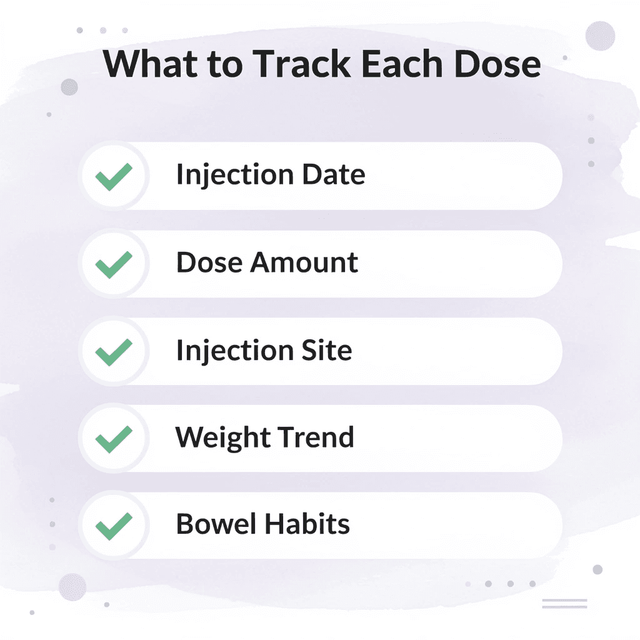
What actually belongs in your injection log
Injection site rotation is one of the most clinically underappreciated tracking habits among GLP-1 users. Rotating between the abdomen, thigh, and upper arm prevents lipohypertrophy, the localized tissue thickening that forms when the same spot is used repeatedly and reduces drug absorption consistency. Without a written record of your last injection site, rotation becomes guesswork, which translates into unpredictable blood levels weeks later. A simple note—"left abdomen, right thigh, left thigh"—kept in sequence protects the reliability of every dose.
Side effects deserve the same discipline. Nausea, fatigue, sulfur burps, and changes in bowel habits are signals whose timing relative to the injection day determines their meaning. A patient who reports "nausea peaks on day two and resolves by day four" gives their clinician actionable information. Logging symptom severity alongside injection timing transforms vague complaints into patterns providers can use to adjust dose pacing, timing, or dietary guidance.
The same logic applies to appetite and hydration. Appetite suppression is the mechanism through which semaglutide supports weight loss, so tracking when it feels strongest, when it fades before the next dose, and whether it correlates with your eating behavior creates a feedback loop between your lived experience and clinical outcomes. Hydration matters because inadequate fluid intake amplifies GI side effects. These form the connective tissue between injection day and your body's response.
Most people manage this tracking across three or four separate places: a phone reminder for the injection, a notes app for symptoms, a scale app for weight, and memory for everything else. That fragmentation is where patterns disappear.
- Paper calendar. Cheap and visible: a big red X on the fridge is hard to ignore. But it only tells you that you injected, never how the injection went, and it doesn't travel with you.
- Phone reminders. Solves the "forgot it was Tuesday" problem. Dismissing an alarm and completing the injection are two different actions, but phones cannot distinguish between them.
- Medication journals (notebook or notes app). More detailed and flexible than a calendar. The main drawback is consistency: free-text journals require you to remember what to write down each time, so entries become shorter over weeks.
- Dedicated GLP-1 tracking apps. Built around the weekly cadence with structured fields for dose, site, and symptoms rather than a blank page. The tradeoff is another app to open.
The real issue is what gets tracked, not which tool holds it. An app like MeAgain consolidates dose history, injection site rotation, side effects, weight trends, food, and protein intake onto a single timeline, making the relationship between shot day and what follows visible rather than inferred. When everything lives in one place, a conversation with your healthcare provider shifts from reconstruction to review.
Why this level of detail actually helps
You start seeing your own patterns. A weight plateau coinciding with skipped meals from nausea, a site reaction on the same rotation day, appetite suppression that fades before your next dose — none of this appears in a sparse log.
Your provider conversations get more useful. Telling a clinician "I've had some nausea" is vague. Showing them nausea clustered in the 48 hours after your last two dose increases, alongside a hydration dip, gives them something to act on: whether that's slowing your titration, adjusting timing, or ruling out something else.
This isn't just intuition — it's consistent with a few threads of research on GLP-1 treatment and behavioral weight management more broadly:
- On adherence and outcomes: A 2025 randomized controlled mHealth trial found that higher adherence to self-monitoring of diet, physical activity, and weight was associated with significantly greater odds of achieving clinically meaningful weight loss over 12 months. Digital self-monitoring tools showed a direct effect on weight loss at 12 months, primarily because participants maintained the monitoring longer.
- On symptom and dose tracking: Clinical guidance around GLP-1 dosing ties gastrointestinal side effects to dose-escalation timing, the pattern in which a symptom log surfaces. Providers may slow or hold a dose increase when GI symptoms are logged as persistent.
- On self-monitoring more broadly: A systematic review of dietary self-monitoring in behavioral weight-loss interventions found that both high- and low-intensity self-monitoring produced statistically significant weight loss compared with control groups, though adherence tends to decline over time. Low-friction logging is therefore essential.
The bigger point
Tracking isn't mainly about memory. Once reminders and logs solve that problem, the real value emerges in decision-making for you and your treatment team. A log that only answers "did I take it?" ensures consistency. A log that also captures site, symptoms, appetite, hydration, and weight trend lets you explain why something is or isn't working, which proves far more useful at your next appointment.
How long should you track before drawing conclusions?
According to the SUSTAIN/STEP clinical trials, participants lost up to 15% of their body weight over 68 weeks. Semaglutide doses are typically increased every four weeks, starting at 0.25 mg. This interval allows the body to adjust to each dose level before advancing.
Tracking weight trend, appetite response, and side effect frequency across a full four-week dose period gives you and your provider the information needed to decide whether to increase the dose, maintain it, or make changes. Drawing conclusions from ten days of data at a new dose is like reading a book review after the first chapter.
Research shows that self-monitoring during weight management predicts better adherence and stronger outcomes because it reveals the gap between what is happening and what you perceive is happening—where plateaus often hide.
Related Reading
- Can Semaglutide Cause Depression
- Does Semaglutide Cause Hair Loss
- How Long Does Compounded Semaglutide Last in the Fridge
- Semaglutide Weight Loss Side Effects
- Who Should Not Take Semaglutide
- Semaglutide Eye Side Effects
- Compounded Semaglutide Side Effects
- Semaglutide Belly Fat
- Liraglutide vs Semaglutide
How to Stay Consistent Without Missing or Repeating a Dose
The gap between what you think happened and what actually happened is where most GLP-1 journeys quietly fall apart. Consistency tracking isn't about perfection — it's about building a reliable system that catches every missed dose and prevents accidental double-dosing before it becomes a pattern. Whether you use a dedicated app, a simple paper log, or a phone reminder, the goal is the same: zero guesswork on injection day.
"The best tracking system is the one you will actually use every week — not the most complicated one you stop using by week three."
Tracking Method | Best For | Key Benefit |
|---|---|---|
Dedicated GLP-1 App | Tech-savvy users | Automated reminders + dose history |
Phone Calendar Alert | Simplicity seekers | Zero learning curve |
Paper Injection Log | Low-tech preference | Visual record at a glance |
Pill/Dose Organizer | Routine-driven users | Tactile confirmation of completion |

How do you stop forgetting your injection day?
Forgetting the injection day is the most common failure point. The fix: a recurring weekly reminder locked to a specific day and time—a calendar event, phone alarm, or app notification that appears automatically. The reminder requires no willpower, only setup.
How do you know for certain whether you actually injected?
Uncertainty about whether you gave yourself an injection creates real health risks. Taking a second dose because you can't remember the first one can cause serious stomach problems. A timestamped injection log prevents this. When you record the time, location, dose, and date of each injection, you eliminate a dangerous choice your future self shouldn't have to make.
How does consolidating your tracking data reveal patterns that matter?
Most people tracking GLP-1 therapy manage injection logs in one place, weight in another, food in a third, and side effects scattered or not at all. This fragmentation obscures the connections that matter most. When days, appetite shifts, energy dips, and weight changes appear on the same timeline, patterns emerge that would otherwise remain hidden. Our GLP-1 app consolidates it all, linking shot timing and dose history to food intake, side effects, and weight trends in a single, continuous view.
How does visible progress keep your consistency from eroding?
Missing progress visibility is a motivation problem that looks like a data problem. Without visible trends, consistency breaks down. Weekly weight check-ins paired with symptom notes create a record that shows progress, even when the scale seems stuck. According to Bayou Bend Health, about 50% of patients with chronic diseases do not take their medications as prescribed. Research consistently points to one root cause: people stop seeing evidence that their efforts work. Visual progress tracking is the feedback loop that sustains the habit.
What to do when a dose is missed
If you miss a weekly semaglutide or tirzepatide injection and are within four days of your scheduled dose, take it as soon as you remember, then resume your regular schedule. If more than four days have passed, skip the missed dose and stay on your original schedule. Never take an extra injection to make up for it—this is directly from FDA guidance, and doubling up increases the risk of side effects without clinical benefit. If you miss multiple doses in a row or experience persistent or worsening side effects, contact your prescribing clinician before your next scheduled injection.
Why should you bring tracking records to every appointment?
Bring your tracking records to every follow-up appointment. A timestamped log of injections, symptom severity ratings on a 0 to 10 scale, and weight trends over 8 to 12 weeks provide your provider with the information needed to make confident dose-adjustment decisions. Consistent tracking makes clinical conversations more precise and more likely to move your treatment in the right direction.
Knowing what to track and tracking it without thinking are two different things.
Turn Injection Tracking Into a Habit You Never Have to Think About
Turning injection tracking into a habit comes down to one thing: removing friction. When logging feels like one more task, it gets skipped. When it fits naturally into your routine, it becomes invisible, something you do without thinking, like brushing your teeth or checking your phone.
"When a behavior requires zero extra effort, it stops feeling like a habit and starts feeling like part of who you are." — Behavioral Science Principle
MeAgain connects your injection log, site rotation, side-effect history, weight trends, and nutrition goals into a single unified timeline — so nothing falls through the cracks. Most people on GLP-1 therapy piece together tracking across notes apps, calendar reminders, and memory — a fragmented system that makes it nearly impossible for your provider to see the full picture.
Tracking Method | What It Captures | Provider-Ready? |
|---|---|---|
Notes apps + calendar | Dose reminders only | ❌ No |
Memory alone | Whatever you remember | ❌ No |
MeAgain | Injections, rotation, side effects, weight, nutrition | ✅ Yes |
Related Reading
- Semaglutide Body Composition
- How Can I Track My Semaglutide Progress?
- Semaglutide Foods to Avoid
- Semaglutide for Weight Loss in Non-Diabetics Dosage
- How to Track My Semaglutide Injections?
- What to Do When Semaglutide Stops Working
- How Much Protein Should I Eat on Semaglutide
- Best App for Tracking Semaglutide Results