
Concerns about cancer risks from GLP-1 medications like Ozempic, Wegovy, and Mounjaro have spread rapidly across social media and online forums. Many patients prescribed these medications for weight loss or diabetes management worry whether their treatment is safe or if they should discontinue use. These fears often stem from misconceptions rather than solid medical evidence.
Current research provides important insights into the actual safety profile of GLP-1 medications and their relationship to cancer risk. Rather than relying on conflicting information from unreliable sources, patients can access evidence-based guidance and track their treatment progress through MeAgain's GLP-1 app.
Table of Contents
- Do GLP-1 Drugs Cause Cancer? What the Research Says
- Why Have GLP-1 Drugs Been Linked to Cancer?
- Who May Be at Risk and Can Cancer Risk Be Reduced?
- Turn GLP-1 Risk Awareness Into a Daily Safety System
Summary
- Current evidence shows no increased cancer risk for most people taking GLP-1 medications. Large observational studies tracking hundreds of thousands of patients for up to ten years found no elevated rates of gastrointestinal cancers (colorectal, pancreatic, liver, gallbladder) among GLP-1 users. The Journal of Clinical Investigation reported in November 2025 that there is no overall link between GLP-1 receptor agonists and increased cancer risk in the general population.
- Two specific groups face absolute contraindications. Patients with a personal or family history of medullary thyroid cancer (MTC) or multiple endocrine neoplasia syndrome type 2 (MEN2) should not use GLP-1 drugs. Additionally, research from the University of Iowa demonstrated that semaglutide stimulated growth by 72 percent in mouse models of neuroendocrine tumors expressing GLP-1 receptors, representing real biological mechanisms where receptor activation directly promotes cell proliferation in specific tumor types.
- Some cancer types show protective signals rather than increased risk. Penn Medicine analyzed more than 110,000 women between the ages of 45 and 80 and found that those taking GLP-1 medications were about 30 percent less likely to develop breast cancer than non-users. The effect held across matched cohorts controlling for age, race, BMI, and diabetes status, with observational data also suggesting potential risk reduction for prostate, lung, colon, and liver cancers.
- Early cancer concerns stemmed from detection bias, not actual increased incidence. When patients start new medications, they receive more frequent medical monitoring and imaging that naturally identify more pre-existing conditions, including small thyroid nodules that might never have caused symptoms. More rigorous research designs that account for surveillance bias found no meaningful elevation in risk, with the signal disappearing as methodology improved.
- The regulatory warnings originated from rodent studies, not human evidence. Laboratory rats developed thyroid C-cell tumors when given GLP-1 drugs at high doses because rodents have far more GLP-1 receptors on these cells than humans do. Decades of clinical trial data spanning up to ten years have not shown increased rates of medullary thyroid cancer in patients taking GLP-1 drugs compared to control groups, demonstrating that the mechanism causing tumors in rats doesn't translate to human tissue under therapeutic conditions.
- Cancer death rates declined 33 percent from 1991 to 2022, according to the American Cancer Society's 2025 statistics, reflecting better risk stratification that applies equally to GLP-1 prescribing. Routine thyroid cancer screening solely because someone starts Wegovy or Zepbound isn't recommended for average-risk individuals without MTC history, MEN2 syndrome, or concerning symptoms, separating evidence-based precaution from unnecessary medicalization of a safe treatment.
- MeAgain's GLP-1 app helps patients document their complete health history, including family cancer patterns and pre-existing conditions, so they can have informed conversations with prescribing physicians about whether specific contraindications apply to their situation.
Do GLP-1 Drugs Cause Cancer? What the Research Says
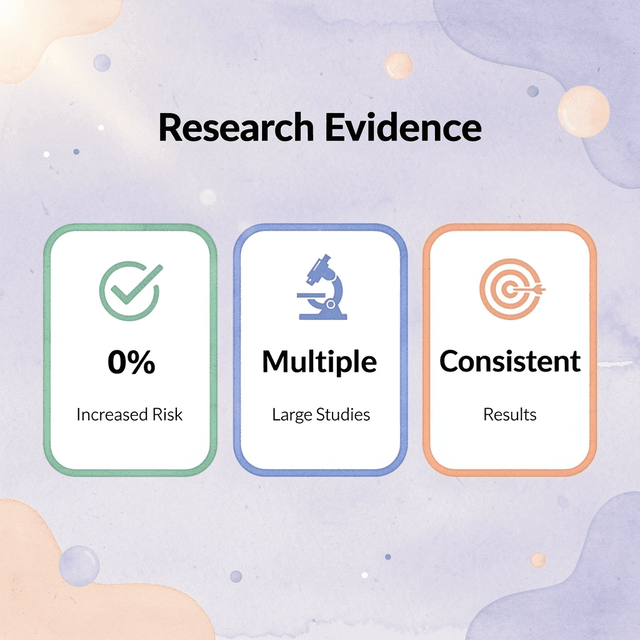
Current evidence shows no increased cancer risk from GLP-1 drugs in the general population. Large observational studies and meta-analyses consistently demonstrate no increased risk of gastrointestinal cancers (colorectal, pancreatic, liver, gallbladder) among users. The Journal of Clinical Investigation reported in November 2025 that GLP-1 receptor agonists show no overall link to increased cancer risk.

"There is no overall link between GLP-1 receptor agonists and increased cancer risk." — The Journal of Clinical Investigation, November 2025
What the FDA and Major Studies Show
The FDA's position remains clear: no causal relationship exists between GLP-1 medications and cancer in typical users. The LEADER trial, which followed patients for up to five years, found no indication of increased risk for total malignant neoplasms with liraglutide use. More recent nationwide registry studies examining up to 10 years of real-world use in unselected patient populations support this finding, tracking hundreds of thousands of patients across diverse health conditions rather than only the high-cardiovascular-risk populations enrolled in early clinical trials.
The Specific Exceptions That Matter
Two groups face proven contraindications. People with a personal or family history of medullary thyroid cancer (MTC) or multiple endocrine neoplasia syndrome type 2 (MEN2) should not use GLP-1 drugs, as animal studies show thyroid tumor development. Patients with neuroendocrine neoplasms expressing GLP-1 receptors face a documented risk: University of Iowa research showed that semaglutide stimulated tumor growth by 19 to 22 percent in cell models and by 72 percent in mouse models through direct activation of GLP-1 receptors.
The Surprising Protective Signal
Penn Medicine studied more than 110,000 women ages 45–80 and found that those taking GLP-1 medications were about 30 percent less likely to develop breast cancer than non-users. This effect persisted across groups matched by age, race, BMI, and diabetes status. Observational data also suggest these medications may lower the risk for prostate, lung, colon, and liver cancers, though prospective clinical trials are needed to confirm these findings.
How did detection bias create early confusion about GLP-1 risks?
Early confusion came from detection bias. When patients start a new medication, they undergo more frequent check-ups, imaging, and blood tests, which naturally uncover pre-existing conditions like small thyroid nodules that might never cause problems.
What appeared to be more thyroid cancer cases was actually the detection of cancers already present. Better-designed studies that account for surveillance bias found no real increase in risk.
How can you make informed decisions about GLP-1 therapy?
When weighing GLP-1 therapy, understanding these differences matters for informed conversations with your prescribing physician. Our MeAgain GLP-1 app helps you document your complete health history, including family cancer patterns and pre-existing conditions, so you can assess whether specific contraindications apply to your situation.
But if the evidence is this clear, why do headlines keep suggesting a cancer connection?
Related Reading
- GLP-1 Plateau
- How Does GLP-1 Help You Lose Weight
- How Much Protein On GLP-1
- How Much Water To Drink on GLP-1
- Why Am I Not Losing Weight On GLP-1
- Can GLP-1 Cause Gastroparesis
- Can GLP-1 Cause Kidney Stones
- Which GLP-1 Has The Least Side Effects
- Does GLP-1 Cause Acid Reflux
Why Have GLP-1 Drugs Been Linked to Cancer?
The cancer concern originated from laboratory rats, not from people who were sick. Early studies found thyroid C-cell tumors in rodents given GLP-1 receptor agonists at high doses over long periods. This prompted regulatory warnings, black box labels, and contraindications that persist today, despite the tumor mechanism working differently in humans than in rodents.

"The tumor mechanism works differently in humans than it does in rodents, yet regulatory warnings from high-dose animal studies continue to influence clinical practice today."

What did the initial rodent studies reveal?
Scientists tested GLP-1 drugs on rats and mice before human trials began. Initial concern arose from animal models showing abnormal thyroid C-cell growth with prolonged GLP-1 receptor stimulation. Rodents have far more GLP-1 receptors on these cells than humans do.
When researchers gave animals doses far exceeding therapeutic human doses, C-cell hyperplasia developed, sometimes progressing to medullary thyroid carcinoma. The Penn Medicine News Team later analyzed more than 110,000 women in retrospective studies.
How did regulatory agencies respond to these findings?
The FDA required black box warnings based on early research data. The warnings stated that GLP-1 agonists caused thyroid C-cell tumors in rodents and that the effect in humans remained unknown. This language on every label suggested a cancer risk, though no large human study confirmed the same result.
Why do humans respond differently to GLP-1 drugs than animals?
Humans have GLP-1 receptors on thyroid C-cells, but in much lower amounts than rodents. The body's response to these receptors also differs between species. In rodents, prolonged stimulation of these receptors causes cells to multiply and form tumors. In humans, this pathway operates differently.
Clinical trial data from the past several decades, including studies lasting up to ten years, have not shown higher rates of medullary thyroid cancer in patients taking GLP-1 drugs compared to control groups.
Why do animal studies create confusion about human risk?
There is a gap between what scientists find in animals and what happens in humans, creating confusion. People read "caused cancer in animals" and assume the same will occur in humans. Regulatory science requires animal testing before human exposure, but not every animal finding predicts human outcomes.
The concern about thyroid tumors illustrates how species-specific biology can outweigh general drug mechanisms. Warnings persist because regulatory labels don't update as quickly as evidence accumulates, and removing a black box warning demands extensive documentation that the risk doesn't exist in any human population.
What does this mean for patients tracking their GLP-1 journey today?
If you're tracking your GLP-1 journey across medication timing, symptoms, and progress, understanding the origins of cancer concerns helps you distinguish outdated animal data from current human evidence. The warning against using these drugs if you have a personal or family history of medullary thyroid cancer or MEN2 syndrome remains valid because even a small theoretical risk isn't worth taking in those groups.
For everyone else, the rodent studies explain why the warnings exist, not why you should worry. The real story isn't about cancer risk from GLP-1 drugs: it's about how regulatory caution, grounded in animal models, shaped public perception before human data told a different story.
Could GLP-1 drugs actually be preventing cancer instead?
But if GLP-1 drugs aren't causing cancer, could they be preventing it?
Who May Be at Risk and Can Cancer Risk Be Reduced?
Who Faces Elevated Risk?
Patients with a personal history of medullary thyroid carcinoma (MTC) or multiple endocrine neoplasia syndrome type 2 (MEN2) should not receive GLP-1 drugs. These are absolute contraindications because these conditions interact with thyroid C-cells.
If a first-degree relative has MTC or carries a known MEN2 mutation, your prescriber should order genetic testing or refer you to endocrinology before writing a GLP-1 prescription. This identifies people for whom these medications pose a genuine risk.
When Additional Evaluation Makes Sense
Extra thyroid screening before starting a GLP-1 makes sense when specific warning signs exist: unexplained neck masses, ongoing hoarseness, difficulty swallowing, or a family cancer syndrome that includes thyroid tumors. Your provider might order baseline calcitonin levels or a thyroid ultrasound in these cases: targeted evaluation for people whose clinical picture warrants investigation before medication initiation.
Routine thyroid cancer screening solely because you're starting Wegovy or Zepbound doesn't make sense. For average-risk individuals without MTC history, MEN2 syndrome, or concerning symptoms, additional cancer surveillance isn't recommended and adds unnecessary cost.
What does appropriate risk reduction actually involve?
Reducing cancer risk on GLP-1 drugs isn't about avoiding the medication—it's about choosing the right patients and communicating regularly with your doctor. New neck symptoms, ongoing diarrhea (a possible MTC sign), or unexplained weight loss beyond what the medication normally causes warrants investigation.
The action is clinical judgment applied to your specific situation, which changes as your health evolves.
How do informed prescribing decisions work in practice?
The outcome isn't perfect certainty; it's better-informed prescribing decisions that match treatment intensity to actual risk level. For most patients starting these medications, that means standard monitoring focused on efficacy and common side effects, not cancer surveillance.
For those with contraindications, alternatives include metformin, lifestyle interventions, or non-GLP-1 weight management approaches without thyroid-related concerns.
Understanding your individual risk is the starting point. The harder part is turning that awareness into consistent daily practices throughout your GLP-1 journey.
Turn GLP-1 Risk Awareness Into a Daily Safety System
The clinical concern isn't cancer for most patients—it's whether your therapy is managed safely day to day. Muscle loss, insufficient protein, dehydration, and gastrointestinal side effects accumulate without consistent tracking. These risks are entirely preventable when you measure what matters.

"GLP-1 therapy success depends on tracking interconnected elements that make patterns visible before they become problems." — Clinical Best Practices, 2024

MeAgain turns your GLP-1 treatment into a structured daily system that tracks shots, food, protein, side effects, weight, and progress in one place. Rather than guessing whether you're hitting protein targets or staying hydrated, our app provides clear daily checks on the behaviors that determine whether therapy works smoothly or brings avoidable complications. MeAgain connects medication timing, nutrition, and symptoms so you spot patterns before they become problems.
Feature | Benefit |
|---|---|
Medication tracking | Never miss doses or timing |
Protein monitoring | Prevent muscle loss |
Symptom logging | Spot patterns early |
Hydration alerts | Avoid dehydration |
Weight tracking | Monitor progress safely |