

Key takeaways
- On Mounjaro, more fluid usually relieves constipation faster than more fiber, because the medication slows how quickly your gut moves.
- Constipation is a documented Mounjaro side effect, listed on the label among reactions reported in at least 5% of patients and clustering early and around dose increases.
- Add fiber gradually rather than all at once, since a sudden jump on a slowed gut can backfire into bloating and gas.
- Over-the-counter stool softeners and gentle osmotic options can help, but they're a call for your pharmacist or care team, and daily stimulant laxatives aren't a routine fix.
- Severe or constant stomach pain, a swollen belly, or no bowel movement for days alongside vomiting means call your care team now, not reach for more fiber.
Table of contents
- How do you get relief from Mounjaro constipation right now?
- What else helps — OTC options and taking your dose the right way
- Why does Mounjaro cause constipation?
- When is Mounjaro constipation an emergency?
- What if the constipation won't go away?
How do you get relief from Mounjaro constipation right now?
For Mounjaro constipation relief, the fastest fix is usually more fluid, not more fiber. Constipation is one of the stomach side effects that can show up on a GLP-1 like Mounjaro, and it usually comes from slower digestion, the same slowdown that quiets your appetite. When things move slowly, stool sits longer and dries out. Water is what softens it back up, so start there and check any new step with your care team first.
Here's the part most people miss: Mounjaro quiets your appetite, and it quiets your thirst cues right along with it. So it's easy to drink far less than you think you are. You're not less thirsty because you need less water. You're less thirsty because the signal got softer. Keeping a glass in sight and sipping through the day does more, faster, than piling on fiber that has nothing to move it.
Start with fluids, not fiber
- Fluids first: sip water through the day, since it keeps stool soft.
- Fiber second, added slowly so it doesn't backfire into bloating.
- Move most days, even a short walk counts.
- Pick a bathroom time and give yourself a few unhurried minutes.
- Don't hold the urge when it comes.
- Loop in your care team before adding anything from the pharmacy.
Add fiber slowly so it doesn't backfire
Fiber helps, but a sudden jump backfires on a slowed gut. Mayo Clinic's guidance is to increase dietary fiber slowly to prevent bloating and gas, and the Dietary Guidelines for Americans they cite land around 25 to 34 grams a day depending on your calories. On Mounjaro that pace matters even more. Add a serving at a time over a week or two, and pair every increase with more water so the fiber has something to work with instead of sitting there.
You don't need a lot of volume to hit good fiber on a smaller appetite. Mayo Clinic lists fruits, vegetables, beans, and whole-grain bread, cereal and rice as fiber-rich foods. A few spoons of beans, some berries, or a slice of whole-grain toast go further than they look. If you want a fuller eating rhythm to build around, what to eat on Mounjaro covers how to structure smaller meals.

Move your body, even just a walk
Movement is the underrated bowel stimulant. Mayo Clinic notes that regular physical activity helps improve the movement of stool through the colon, and suggests trying to exercise most days of the week. MedlinePlus keeps the bar low and doable: try to walk, swim, or do something active at least 3 or 4 times a week. You're not training for anything. A short walk after a meal, when digestion is already working, is often enough to get things going.
- Take a 10-minute walk after lunch or dinner.
- Park farther out and let the extra steps add up.
- Take the stairs for one flight when you can.
- Stretch or walk the house during a phone call.
- Do a slow evening loop around the block.
Build a routine and don't ignore the urge
Your gut likes a schedule. MedlinePlus suggests training your bowels by going to the bathroom at the same time each day, and for many people that's after breakfast or dinner. Mayo Clinic points to the same window: try to pass stool 15 to 45 minutes after a meal, because digestion is already helping move things along. Pick the meal that fits your morning and give yourself a calm few minutes there. Consistency does a surprising amount of the work.
And when the urge shows up, go. MedlinePlus is blunt about it: do not wait or hold it in. Holding it teaches your body to ignore the signal, which is exactly the opposite of what you want right now. Sit without straining, give it unhurried time, and let the routine you're building do the rest.
The frustrating part is not knowing which lever is actually yours. In MeAgain, you can log your fluids, fiber, and movement next to your bathroom pattern and watch what lines up. Maybe the good days are always the days you cleared your water goal. Maybe it's the walk, not the fiber. Seeing it laid out over a couple of weeks turns guessing into one clear pattern you can act on.
On Mounjaro, reach for the water glass before the fiber bowl. Fluid is the faster lever.
What else helps — OTC options and taking your dose the right way
Over-the-counter options can help, but they're a care-team call — and how you take your medication matters as much as what's in your medicine cabinet. Gentle stool softeners and osmotic laxatives have their place, stimulant laxatives don't belong in a daily routine, and getting your dose right is its own quiet fix. Start with the shelf handled honestly, then the schedule.
Which OTC options are safest?
Think of the shelf in two buckets. Gentle stool softeners and osmotic laxatives, the kind that draw a little water into the bowel, sit at the everyday-friendly end, and they're what most people reach for first. Stimulant laxatives, which push the bowel to contract, are more of a once-in-a-while rescue than a daily habit. Which bucket fits you is a pharmacist-or-care-team question, not a guess in the aisle.
Category | What it does | Rescue vs. daily | Ask first? |
|---|---|---|---|
Stool softeners | Adds moisture to stool | Short-term help | ⚠️ Pharmacist call |
Osmotic options | Draw water into the bowel | Gentle, sometimes daily | ⚠️ Confirm with your care team |
Fiber supplements | Add bulk, need plenty of water | Daily-friendly | ⚠️ Only if well hydrated |
Stimulant laxatives | Force the bowel to contract | Rescue only | ❌ Not a daily habit |

This matters most if you take other medicines. Mounjaro slows how fast your stomach empties, which can change how your body absorbs pills you swallow, per the FDA label. A pharmacist can check whether a softener or laxative plays nicely with everything else you're on, and your care team knows your full picture. Start nothing new without that quick check.
How your dose schedule affects it
Your dose schedule is doing quiet work here. Mounjaro starts at 2.5 mg once a week, and the FDA label calls that a starting dose, not a target — the step-up that follows is spaced out on purpose. Per the FDA label, that gradual escalation is designed to reduce the risk of stomach side effects, and constipation sits on the label's list of those reactions. Rushing the steps is exactly what the schedule is built to avoid.
Once weekly, same day, is the rhythm to protect. The FDA's prescribing information spells out a window if a shot is missed, so you're not left guessing or tempted to double up, and your care team's version of those instructions is the one to follow. Doubling doses to catch up isn't the move; steady timing is.
Taking your dose the right way
- Inject into the belly, thigh, or back of the upper arm
- Rotate to a fresh spot with every dose
- Use a new needle for each injection
- Once a week, any time of day, with or without food
- Never share a pen, even with a new needle
Where and how to inject
The label keeps injection sites simple: the belly, the thigh, or the back of the upper arm, and it says to rotate to a new spot with each dose, per the FDA's instructions for use. Rotating gives each area time to recover and keeps things comfortable week to week. None of this changes your constipation directly, but a comfortable, consistent routine is one less thing working against you.

Food is part of the prescription, not a side note. Mounjaro is meant to work together with diet and exercise, not in place of them, and Mayo Clinic frames the eating plan your care team gives you as part of the treatment itself. That's also where your fluid and fiber rhythm lives, so the plan and the symptom relief are really the same project.
A recent dose step-up is worth a note. The steps up are exactly where the schedule is built to ease stomach side effects, per the FDA label, so if your constipation started right after an increase, write that down. It's a clean detail to hand your care team at your next check-in, and it points straight at the why behind the symptom.
Why does Mounjaro cause constipation?
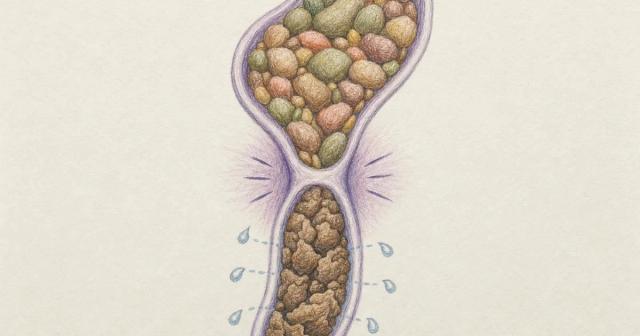
Mounjaro slows how fast food moves through your gut, and that same slowdown is what quiets your appetite. Tirzepatide, the medicine in Mounjaro, eases how quickly your stomach empties, so food and waste spend longer making their way through. When things move slower, stool has more time to lose water and can end up firmer and harder to pass. Constipation here isn't a sign something's broken. It's the flip side of the effect you're taking the medication for.
What's actually happening in your gut
Here's the plain-language version. Tirzepatide is an incretin mimetic, and one of the things it does is slow how quickly your stomach empties after a meal. That's what makes food stick around longer and helps you feel full sooner. The trade-off is that everything downstream slows too. As waste moves through the colon more slowly, your body has more time to pull water back out of it, and stool that has lost water gets harder and tougher to move along.
How common is it, really?
Constipation is a documented Mounjaro side effect, not a surprise. The Mounjaro label lists it among the most common adverse reactions, the ones reported in at least 5% of patients in the drug's placebo-controlled diabetes trials. Other research puts the everyday number lower. A 2023 systematic review and meta-analysis in Cureus, pooling six randomized trials and 4,586 patients, found constipation in about 2.5% of people on tirzepatide versus roughly 0.9% on the comparator treatments. Either way, it's real, expected, and manageable.
Source | What it measured | Finding | Scope |
|---|---|---|---|
Cureus meta-analysis | Constipation rate vs comparators | 2.54% vs 0.856% | 6 trials, 4,586 type 2 diabetes patients |
Network meta-analysis | Constipation risk vs placebo | About 3.36x higher (RR 3.36) | GLP-1 trials in non-diabetic weight loss |
FDA Mounjaro label | Most common adverse reactions | Reported in ≥5% of patients | Pooled placebo-controlled diabetes trials |
It helps to know where constipation sits on the scale. In that research, nausea, diarrhea, and decreased appetite land in the 'very common' tier, each showing up in more than 10% of people. Constipation sits a rung down, in the 'common' band of roughly 1 to 10%. So if your gut has slowed but you're not miserable, you're in the range most people land in, not an unusual reaction.
When it shows up and when it fades
Timing follows a pattern. GLP-1 stomach side effects, constipation included, tend to cluster around dose changes and early on, then settle as your body adjusts. These effects are usually tied to the dose, which is exactly why prescriptions start low and step up slowly, and they're typically transient rather than permanent. If your constipation landed right after a step-up, that timing is expected, not a red flag on its own.

- A recent dose increase, when the gut slowdown deepens
- Not drinking enough, especially as a smaller appetite dulls your thirst
- A drop in fiber because you're simply eating less
- Less movement through the day
- Smaller meals overall, so there's less bulk moving through
The same slowdown that quiets your appetite is the one backing up your gut. It's one effect, felt at both ends.
Here's the reassuring part, with a number behind it. Across that GLP-1 research, 94% of these stomach side effects were mild or moderate, transient, and rarely serious enough to stop treatment. For most people constipation is uncomfortable, not dangerous, and it eases as you settle into a dose. That's not a reason to grit your teeth through it. It just means the odds are on your side while you work the relief moves.
Related reading
- Mounjaro stomach pain relief
- Why Mounjaro can cause diarrhea
- Wegovy vs Mounjaro side effects
- Mounjaro heartburn
- Burping on Mounjaro
- What to eat on Mounjaro
When is Mounjaro constipation an emergency?
Most Mounjaro constipation is a manageable annoyance you can handle at home. A short list of signs, though, means stop the home remedies and call your care team now rather than reach for more fiber. These are the ones that can point past a slow gut to something bigger, like a blocked bowel, an inflamed pancreas, or dehydration. You don't have to figure out which one it is. You just have to recognize the signal and make the call.
- Severe or constant stomach pain that won't go away
- A swollen, hard, or bloated belly
- No bowel movement for several days
- Constipation along with nausea or vomiting
- Being unable to pass gas at all
- Signs of dehydration: dizziness, dark urine, deep fatigue
Severe or constant stomach pain
Severe stomach pain that won't let up is the clearest stop-and-call sign. The Mounjaro label is direct about it: stop using Mounjaro and call your healthcare provider right away if you have severe pain in your stomach area that won't go away, with or without nausea or vomiting. Sometimes that pain travels from your abdomen through to your back. It can signal pancreatitis, inflammation of the pancreas, which needs medical attention. This is not a wait-and-see symptom.
Red flag | What it could point to | What to do |
|---|---|---|
Severe, constant stomach pain, sometimes reaching the back | Pancreatitis | ⚠️ Stop and call now |
Swollen belly, no stool, no gas, with vomiting | A blocked or stalled gut (ileus) | ⚠️ Go to urgent care or the ER |
Dizziness, dark urine, barely urinating | Dehydration and kidney strain | ⚠️ Call promptly, keep sipping fluids |
A gut that's stopped moving
When constipation tips into no bowel movement for days, especially alongside vomiting or a belly that's swollen and tender, the worry is that the gut has essentially stalled. Doctors call this ileus, a slowdown severe enough that waste stops moving through the bowel. In a documented case tied to tirzepatide, a patient developed cramping abdominal pain, repeated vomiting, and a distended bowel, and spent about six days in the hospital on IV fluids and supportive care. That combination is a call-now situation, not a fiber problem.

Some people carry a lower threshold for calling. People with previous colon or multiple abdominal surgeries, or a history of bowel obstruction, may be more vulnerable to serious gut side effects. If that's you, it's worth flagging with your care team before or early in treatment, and calling sooner if things back up. The patient in that case had exactly that kind of surgical history.
Dehydration is its own red flag
Dehydration is its own red flag, and it's easy to miss when you're focused on the constipation. The Mounjaro label warns that vomiting, nausea, and diarrhea can cost you enough fluid to cause kidney problems, and it tells you to drink fluids to lower that risk and to tell your provider right away if those symptoms don't go away. When GI symptoms stack up, dizziness, dark urine, or barely urinating mean you're behind on fluids. It's the other reason fluids sit first on the relief list.
A slow gut is routine. A gut that's stopped, with pain, a swollen belly, or vomiting, is an emergency.
When you call, make it easy for them to act fast. Tell your care team when your last bowel movement was, how many days it's been, whether you're vomiting or passing gas, what the pain feels like and where, and when your last dose was. The label's own guidance is to talk to your provider about any side effect that bothers you or won't go away. If the pain is severe or you can't reach anyone, urgent care or the ER is the right call. Don't sit on it.
What if the constipation won't go away?
If the usual moves haven't helped after a couple of weeks, that's a signal to loop in your care team — not a reason to keep doubling your fiber. Constipation that sticks around is worth a real conversation about your dose and your routine. The relief basics still matter, but past a certain point the useful next step is a professional in the loop, not a bigger scoop of fiber.
Does it get better over time?
Here's the reassuring part: for most people, this eases. A 2023 meta-analysis of tirzepatide trials published in the journal Medicine found that the drug's gut side effects tend to decrease gradually over time as the body settles into steady treatment. Constipation often follows that same arc, quieting down as your system adjusts to the medication. That doesn't mean white-knuckling it — it means the odds are on your side while you keep the basics going.

Trust the timeline, but don't ignore a stalled one. Cleveland Clinic's guidance is simple: tell your care team if your symptoms don't start to get better, or if they get worse. That's your cue. You don't need to hit a crisis to reach out — "this isn't improving and it's wearing on me" is a completely valid reason to message them.
When to ask about your dose
So what can they actually do? Per the NIH's constipation guidance, a care team may change the dose or suggest a different medicine that doesn't cause it. What you should not do is change or stop your medication on your own — the NIH is explicit that you shouldn't change or stop any medicine or supplement without talking to a health professional first. Your dose is a lever, but it's theirs to pull with you, not yours to pull alone.
- Your bathroom pattern — days between movements, and anything that's changed
- Fluids — roughly how much you drink on a normal day
- Fiber — your main sources, and whether you ramped up fast or slowly
- Movement — how active your days are; walks count
- Dose dates — including any recent step-up

Living with it while it settles
Living with it while it settles is mostly about not letting it run your day. Keep the basics going — the fluids, fiber, and movement covered above — without tracking every hour anxiously. Be patient with a gradual pattern, too: "a little better this week than last" is what progress usually looks like here, and it rarely flips overnight. Comfort measures and a steady routine carry you through the in-between while your body adjusts.
Quitting cold usually isn't the win it feels like in a rough week. Cleveland Clinic's own instruction is to keep taking the medication unless your provider tells you to stop. Because the gut side effects tend to fade with steady treatment, powering through a hard stretch with your care team's guidance often beats abandoning something that's working for you. If it truly needs to change, that's a decision to make with them — not solo at 11pm.
One quiet habit pays off here: watch for a pattern over a few weeks. Jot down your dose dates next to your bathroom rhythm and see whether the two seem to line up for you. You don't have to diagnose anything — you're just collecting the picture so your care team isn't working from guesswork at your next visit. A few weeks of simple notes turns "I've been backed up" into something they can actually act on.
The through-line is short: fluids first, patience, and a care team in the loop. Most Mounjaro constipation is a slow-gut problem that answers to hydration and time, not heroics. When it doesn't, that's information — bring it to the people who can adjust your plan.
Related reading
- Still hungry on Mounjaro
- Mounjaro fatigue
- Mounjaro brain fog
- Does Mounjaro make you sleepy
- How long Mounjaro takes to curb appetite
- Is tirzepatide the same as Mounjaro
- Where to inject your GLP-1
- Mounjaro joint pain
- GLP-1 side effects women notice
- How GLP-1 options compare
Frequently Asked Questions
How much water should I drink to help constipation on Mounjaro?
There isn't one magic number, and no source sets a Mounjaro-specific target. The NIH's practical advice is to drink plenty of water and other liquids, especially when you're adding fiber. Here's the catch: your appetite is quieter on this medication, so your thirst cues get quieter too, and most people are drinking less than they think. Sip steadily through the day rather than chasing one big total, and check with your care team if you have kidney or heart conditions that limit fluids. When it comes to Mounjaro constipation relief, that steady sipping habit tends to matter more than any single daily quota.
What's the difference between GLP-1 constipation and diarrhea?
They're the two opposite ways a slowed, sensitive gut can react, and tirzepatide, the medicine in Mounjaro, is documented to cause both. In the journal Medicine's 2023 analysis, constipation was significantly more common on tirzepatide than on placebo, and diarrhea ranked among its most common gut side effects too. Constipation means stool moving too slowly and getting hard to pass; diarrhea is the loose, urgent opposite. Why the same medication can tip either way is covered in the why-it-happens section.
How long does Mounjaro constipation usually last?
There's no fixed clock, but the trend is encouraging. The journal Medicine's 2023 review of tirzepatide trials found the drug's gut side effects tend to decrease gradually over time as the body adjusts to steady treatment. For many people that means it eases over the following weeks, as long as the basics stay in place. If it's still going strong after a couple of weeks with no improvement, that's the point to loop in your care team rather than wait it out longer.
Can I take a laxative every day while I'm on Mounjaro?
That's a care-team call, not a default habit. The NIH's rule is not to change or stop any medicine or supplement without talking to a health professional first, and adding a daily laxative is exactly that kind of decision to run past your care team or pharmacist. Gentle options do exist for occasional relief, but daily use is a different question from once-in-a-while use — the earlier section on OTC options walks through those categories. The short version: occasional and guided beats a standing daily habit.
This article is for informational purposes only and is not medical advice. Always talk to your doctor or care team about your medication, symptoms, or treatment plan.