

Key takeaways
- Month one on Mounjaro is the 2.5 mg starting dose, which the label uses to ease your body onto the medication rather than to drive full weight loss.
- Little or no scale movement in your first month is common and doesn't predict your result — in one trial analysis 18% of people had lost under 5% by week 12, yet 90% of them reached at least 5% by week 72.
- Day-to-day weight swings of 1-2% are normal water and food fluctuation, not fat, so a weekly trend tells you far more than the daily number.
- The large results seen with tirzepatide (around 21.9% at the maximum tolerated dose in one trial) come from many months of dose increases, not the first four weeks.
- Mild, mostly temporary stomach side effects like nausea are the most common early experience and tend to ease as your body adjusts.
Table of contents
- What's a typical Mounjaro weight loss result after one month?
- Why isn't the scale moving in my first month?
- How do you track month-one progress the right way?
- When does weight loss pick up, and am I a non-responder?
- How do you manage side effects and injections in month one?
What's a typical Mounjaro weight loss result after one month?
Mounjaro weight loss results 1 month in are simple to read: this is your starting-dose month, so a few pounds or nothing yet is completely normal — and neither one tells you how this ends. Mounjaro begins on its lowest dose, the level meant to ease your body onto the medication rather than drive full weight loss. Some people drop a few pounds in the first four weeks. Others watch the scale sit still. Both are ordinary month-one results, and neither predicts where you land months from now.
What the starting dose is actually doing
Mounjaro's active drug is tirzepatide, and the first weeks give your gut time to get used to it. Starting on the lowest dose is how the schedule keeps early stomach side effects mild enough to stay on. The stronger appetite effects build as the dose climbs over the following months, so the first four weeks are more of an on-ramp than the main event. Read month one as your body settling in, not as a verdict on how the medication will work for you.
Where the big tirzepatide numbers come from
The eye-catching tirzepatide numbers come from months of treatment, not weeks. In the SURMOUNT-MAINTAIN trial, published in The Lancet, people taking tirzepatide at the highest dose they could tolerate (the maximum tolerated dose) saw about a 21.9% drop in body weight from the start of the study to week 112. That result sits at the end of a long road: a 60-week weight-loss stretch of steady dose increases before a maintenance phase. It's the destination, not the month-one mile marker, and holding your first month up against it only sets you up to feel behind.

Stage | Where you are | What's typical | Rough timeframe |
|---|---|---|---|
Starting dose | Lowest dose, easing in | Body adjusts; little to modest loss | Weeks 1-4 |
First step up | Dose increases | Appetite changes get clearer | Around week 4 |
Building doses | Stepping up over months | Most steady loss accrues here | Months 2-6+ |
Higher dose | Closer to full effect | Where trial-size results show up | Many months in |
Month one is only the first rung of the ladder. Mounjaro is built to step up in stages, and the first increase typically comes around week four. That timing matters: for most of your first month you're on the gentlest dose, the one least likely to move the scale on its own. The appetite quiet people talk about tends to deepen after that first step up, not before it. So if week four arrives and not much has changed, you've really only just finished the warm-up.
Here's the honest range: month one looks different for different people. Some see a small, encouraging dip. Some watch the scale drift up and down and end the month right where they started. A few feel their appetite change well before the number does. None of these is the "right" month one, and none is a red flag on its own. Bodies start at different weights, respond on different timelines, and shed water at different rates in the first few weeks. Expecting one tidy number sets you up for a disappointment the medication hasn't earned.

- Easing in: letting your body get used to the medication at its lowest dose
- Building tolerance: keeping early stomach side effects mild enough to continue
- Appetite starting to shift: the first flickers of quieter food noise for some people
- Setting a safe base: getting into a routine before the doses climb
- A baseline to track from: your starting point for the weeks ahead
Why your month one won't match a screenshot
Those jaw-dropping month-one screenshots rarely tell the whole story. A post showing a big first-month drop usually leaves out the starting weight, the exact dose, and how long the person was really on it. Someone heavier tends to lose faster early on. Someone already past the starting dose isn't on your schedule. And the internet quietly filters out the people whose month one was uneventful, because a flat month makes a boring post. Comparing your week four to a stranger's highlight reel measures you against a number that was never yours.
Still, when the scale won't budge for four straight weeks, it's hard not to read it as failure. So it helps to know what that number is actually doing day to day, and why a flat month one is so often misunderstood.
Why isn't the scale moving in my first month?
A flat scale in month one is common, and the daily number is mostly noise. On the lowest starting dose, real fat loss is only just getting underway, and what the scale shows each morning is dominated by water and food moving through you. A day-to-day reading can bounce up or down by a pound or two for reasons that have nothing to do with fat. So a first month that looks stuck on the scale is one of the most normal things that can happen, and one of the most misread.
The daily number tells you about water and dinner; the weekly trend is the one that tells you about fat.
Is a flat scale normal on the starting dose?
Not every change on the scale means something. A shift of just 1-2% in body weight falls within normal day-to-day physiological fluctuation, the ordinary wobble of hydration, food, and hormones. A reduction of at least 5% is the threshold that actually counts as clinically meaningful. For someone around 200 pounds, that 1-2% band is roughly two to four pounds of pure noise in either direction. The scale can swing several pounds across a single week and still be telling you nothing about fat. That's exactly the range you're living in during month one.
Water weight versus real fat loss
What actually moves the number day to day is water, not fat. Your body stores carbohydrate as glycogen, and glycogen holds several times its weight in water, so a higher-carb day can park a couple of pounds of water on you overnight. Salt does the same. So does where you are in your monthly cycle, how much you drank, and whether you've been to the bathroom. Fat, by contrast, comes off slowly and quietly — not as a dramatic overnight drop, but as a gentle downward drift you only see by zooming out.

Day to day | Week to week | |
|---|---|---|
What it reflects | Water and food in transit | True fat change |
Main drivers | Carbs, salt, hydration, hormones, bathroom timing | Steady calorie deficit over time |
Reversible? | Yes, bounces both ways | No, gradual and lasting |
What to do with it | Mostly ignore a single reading | Watch the trend |
- Salt: a salty meal holds extra water for a day or two
- Carbs: higher-carb days store more glycogen and water
- Hydration: how much you've had to drink swings the number
- Hormones: monthly cycle shifts can add water weight
- Bathroom timing: a full or empty gut changes the reading
- Poor sleep: a rough night can nudge the scale up briefly
Why four weeks is too short to tell
A stuck scale in week three gets read as failure far more often than it should. When the number won't move, it's easy to decide the medication isn't working, or that you've already hit a wall. But a genuine plateau is something you can only call after a long stretch, and month one is nowhere near long enough to earn the label. What actually counts as a plateau takes far more time to establish. Early flatness is usually just the noise drowning out a signal that hasn't had room to appear yet.
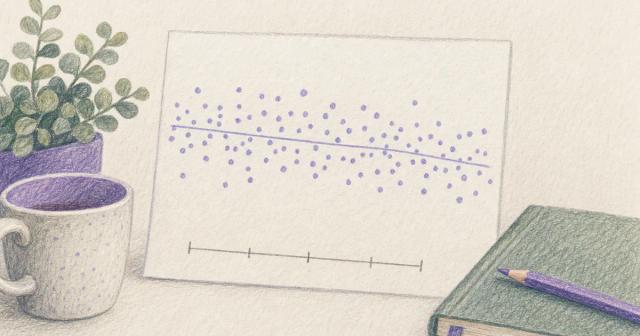
Four weeks is simply too short a window to read a fat-loss trend. Weight loss on Mounjaro is a slow accumulation, and the daily water swings are large enough to hide it completely over a stretch this brief. Give it four weeks and the noise can easily be bigger than the signal. It takes a longer run of data, many weigh-ins averaged together, before a real downward line separates itself from the daily static. Month one just doesn't hold enough data to draw that line yet.
A quiet month one does not mean you won't respond. Plenty of people whose first weeks look flat go on to lose steadily once the dose climbs, so early movement is a weak predictor of where you finish. A slow start is genuinely a poor guide to the eventual result. The first month is a starting line, not a scoreboard — the response tends to build as the dose steps up in the months ahead.
If the daily number is this unreliable, chasing it every morning just feeds the anxiety. The better question is what to watch instead: the signals that actually tell you month one is working.
How do you track month-one progress the right way?
Track the weekly trend and the non-scale signals, not the daily number on the scale. In your first month, the fastest read on whether your medication is doing anything usually isn't the scale at all. It's your appetite, your portions, and how your clothes fit. The scale still counts, but only as a weekly trend line. A single morning's number tells you almost nothing this early.
Read the weekly trend, not the daily digit
Weigh once a week, under the same conditions, and read the direction rather than the digit. Same morning, after the bathroom, before food or water, in the same clothes. As the previous section covered, day-to-day weight swings mostly on water and food, so a daily number bounces around in a way that has nothing to do with fat. Weighing weekly, or letting an app draw a trend line through daily weigh-ins, averages that noise out and shows you the slope that actually matters.
The non-scale signals that move first
- Food noise gets quieter, so the constant mental chatter about eating eases
- You feel full faster and start leaving food on the plate
- Cravings show up less often and pass more easily
- Clothes fit a little looser, especially at the waistband
- Tape-measure inches shrink even on weeks the scale holds
- Meals hold you longer, so you snack less between them
Appetite change is usually the first thing you notice, and it doesn't always arrive on day one. For many people the earliest sign is simply that food stops calling as loudly. Smaller portions feel like enough, and "nothing sounds good" in a new, neutral way. That shift can show up in the first couple of weeks, or it can take longer, and either timing is normal at the starting dose. How long appetite changes take to show up is worth tracking week by week rather than judging on any single day.

Turn a month of logs into one trend line
Here's where a month of logs earns its keep. When you tag each shot day and jot a weekly weight, MeAgain turns four scattered weeks into a single line you can actually read. The daily wobble is still there, but the trend underneath it becomes visible, and "is anything even happening?" turns into a slope you can point to. Pair that line with your appetite notes and your portion sizes, and a month that felt like nothing on the scale often shows a quiet, real direction.
- Shot day, every week, so timing patterns are easy to spot
- One weekly weight, taken under the same conditions each time
- Appetite, noting how loud or quiet food noise feels
- Portion sizes and whether meals actually hold you
- Any symptoms, and the day they first showed up
Photos and a tape measure often tell the truth before the scale does. Your body can change shape while the number holds steady, especially early, so a front-and-side photo every couple of weeks plus a waist measurement can catch what the scale misses. Take them in the same light, same time of day, same clothes. Inches at the waist are a slower, steadier signal than the daily weigh-in, and they're harder to fake with a salty dinner or a light bathroom day.

Protect your head, not just your data
If the daily number is fueling anxiety, step off the scale. For some people, watching it every morning turns a normal water fluctuation into a bad day, and that stress doesn't help anything. Weighing once a week, or handing the daily job to an app and only looking at the weekly line, protects your head as much as your data. The trend is the truth; the daily digit is just weather.
None of this answers the question underneath the anxiety, though: when does the weight actually start coming off? That has less to do with your first four weeks and more to do with what happens as the dose climbs.
Related reading
- Tirzepatide, the drug in Mounjaro
- How Mounjaro compares to other GLP-1 options
- Little early movement, much like on Zepbound
- Slow early weight loss
- What actually counts as a plateau
- A stall later in your journey
When does weight loss pick up, and am I a non-responder?
Meaningful weight loss builds after the dose climbs past month one, and a slow start rarely means you won't respond. The starting dose is there to ease you on, not to drive the numbers, so the real losing tends to come later, over months of dose steps. If week four looks quiet, that isn't a verdict. It's the early part of a longer curve.
What SURMOUNT-1 found about slow starters
A SURMOUNT-1 analysis split people by how they'd done at 12 weeks, and even the slow starters mostly caught up. It labeled anyone who had lost under 5% of their weight by week 12 a "late responder," and anyone at or above 5% an "early responder." Out of 1,545 people on tirzepatide, the drug in Mounjaro, about 18% were late responders and 82% were early responders. So a slower first stretch was common, not rare, and as the numbers below show, it said little about where people ended up.
A quiet week 12 is a checkpoint, not the finish line.
Among those late responders, 90% still reached at least 5% weight loss by week 72. In the same SURMOUNT-1 analysis, the average time for a late responder to hit that mark was about 24.8 weeks, roughly six months rather than four. By the end of dose titration at week 24, 70% of them had already crossed 5%. The pattern is simple: for most slow starters, the loss was coming, it just arrived on a later clock.
Measure | Early responders | Late responders |
|---|---|---|
Share of the 1,545 analyzed | 82% | 18% |
Weight loss by week 12 | ≥5% | <5% |
Reached ≥5% by week 24 | — | 70% |
Mean time to 5% loss | — | ~24.8 weeks |
Reached ≥5% by week 72 | — | 90% |

What "non-responder" really means
A true non-responder, someone who genuinely doesn't lose on the medication at the right dose over enough time, is far less common than a slow start. Most people who feel like non-responders in month one are simply early in the curve, still on the starting dose, still weeks away from the steps that do the heavy lifting. "Not losing yet" and "won't lose" are different things, and week four can't tell them apart. Time and the dose ladder usually can.
What to do when month one feels flat
- Remember the dose is still climbing; the starting dose isn't the working dose
- Keep logging appetite, portions, and your weekly weight
- Hold your routine steady so the medication gets a fair read
- Bring it up with your care team at your next check-in, not in a panic
- Ask whether your timeline and dose plan look on track for you
The first real step up comes around week four, and it changes the picture. Month one holds you at the starting dose on purpose, so it's the gentlest stretch of the whole plan. When the dose increases after those first weeks, many people notice appetite quieting further and the weekly trend starting to tip. Week five doesn't flip a switch. You're simply moving off the acclimatization dose and onto the part of the ladder built to do more.
Comparing your week four to someone else's week 24 is comparing two different doses on two different clocks. The dramatic month-one numbers you see online often aren't month one at all. They're further along the ladder, at a higher dose, sometimes from a higher starting weight where early pounds come faster. Your first four weeks have almost nothing in common with their fourth month. Judge your run against your own trend, not someone else's highlight reel.

When to bring it to your care team
A slow start is worth a real conversation when it comes with nothing else at all, no appetite change, no portion shift, no movement in inches after you've climbed a dose or two. That isn't an emergency, and it isn't a reason to stop on your own. It's a reason to check in with your care team about your dose plan and timeline. They can weigh the whole picture, your weight history, your response so far, and what's realistic next, in a way a single weigh-in never could.
One thing quietly decides whether you ever reach those later doses: staying comfortable enough to keep going. That's where the side effects of month one, and how you handle them, come in.
How do you manage side effects and injections in month one?
Most early side effects are mild and temporary. The first weeks on Mounjaro tend to bring stomach-related symptoms — some nausea, looser or firmer stools, the odd queasy evening — and for most people they ease as the body adjusts to tirzepatide. In the trials, these gut effects were mostly mild to moderate and settled over time rather than building. Knowing that upfront makes month one far less alarming.
Which side effects show up first?
In SURPASS-1, the tirzepatide trial, the most common reactions were stomach-related: nausea in about 12-18% of people, diarrhea in 12-14%, and vomiting in 2-6% — most of them mild to moderate and short-lived. These are ranges across doses, not a promise of what you'll feel, and plenty of people get through month one with barely a flutter.
- Eat smaller meals more often instead of a few large ones
- Sip water through the day to stay ahead of dehydration
- Lean on bland, low-fat foods when nausea hits
- Add fiber and fluids gradually if things slow down and constipation sets in
- Eat slowly and stop at comfortably full, not stuffed
- Keep plain crackers or ginger on hand for queasy moments
Mild queasiness that fades between shots is part of adjusting; pain that stops you eating or drinking is a reason to call your care team.
Injection basics from the label
Where you inject matters less than how you rotate. The Mounjaro prescribing information says to inject under the skin of the abdomen or thigh, or the back of the upper arm if someone else gives it. Your care team should walk you through preparing and giving your first dose before you do it alone. If you're wondering where to inject for best results, the label keeps it simple: those approved spots, a fresh site each week.
- Approved sites: the abdomen, a thigh, or the back of the upper arm (given by someone else)
- Rotate to a different site with each weekly dose
- If you use vials, a new needle and syringe every single time
- Never share a pen with anyone, even with a new needle
- Let your care team confirm your technique before your first solo shot
Rotating sites is the small habit that keeps injections comfortable. Giving the same patch of skin a shot week after week can leave it tender or lumpy, so moving to a fresh spot lets each area recover before its next turn. Correct technique — clean skin, the right angle, not rushing — tends to make the whole thing barely register. A little redness or a small bruise is common and usually fades on its own.

Food is your first tool for a smoother month. An international expert consensus published in Obesity Pillars pulled together nutrition and lifestyle strategies for the stomach symptoms that come with GLP-1 medications — nausea, vomiting, diarrhea, and constipation. The practical thread is gentle and steady: protein-forward, smaller plates, enough fluid, and not forcing a big meal when nothing sounds good. If you want a fuller picture of what to eat on Mounjaro, that's the frame — eat to support your body, not to hit a number.
Other early symptoms and when to call
Stomach symptoms get the spotlight, but month one can bring a few others. Some people notice fatigue in the day or two after a shot, a bout of heartburn, a patch of brain fog, or more burping than usual. Most are mild and ease as your body settles. If any one of them lingers or gets in the way of your day, it's worth flagging to your care team.
Some symptoms shouldn't wait. Call your care team for stomach pain that won't let up, or vomiting and diarrhea that leave you unable to keep fluids down. Any severe belly pain that spreads to your back deserves prompt attention, and signs of an allergic reaction — swelling, trouble breathing — mean urgent care now, not a wait-and-see. When you're unsure, a quick message beats toughing it out.
Related reading
- How long appetite changes take to show up
- Still hungry on Mounjaro
- Adding movement in month one
- What to eat on Mounjaro
- Diarrhea
- Burping
- Heartburn
- Stomach pain relief
- Fatigue
- Brain fog
Frequently Asked Questions
How much weight is normal to lose in the first month on Mounjaro?
There's a wide normal. Month one is the starting-dose month, meant to ease your body onto the medication rather than drive full weight loss, so a few pounds or almost nothing on the scale both fall inside the typical range. Early loss also leans heavily on water and food shifts. What happens in these first weeks doesn't predict where you land months from now. Read your Mounjaro weight loss results 1 month in as a starting point, not a verdict.
Is it normal to lose no weight at all in the first month of Mounjaro?
Yes. A flat scale at the starting dose is common and doesn't mean the medication isn't working. Four weeks is too short to read a real fat-loss trend, and the daily number is mostly water and food. Watch for non-scale signs instead — quieter food noise, smaller portions, looser clothes. If nothing has shifted after several dose steps, that's a conversation for your care team.
Should I weigh myself every day during my first month?
You can, but a daily number will mostly show noise — water, salt, carbs, and bathroom timing move it 1-2% a day with no bearing on fat. A weekly weigh-in under the same conditions, or a trend line that averages out the swings, tells you far more. If daily weigh-ins are feeding anxiety, step back to weekly.
What should I do if I feel no appetite change after four weeks?
First, remember the dose is still low and still climbing — the first step up comes around week four, and appetite changes often show up after that. Keep logging your shots, weekly weight, and hunger so you can see any trend. If several weeks pass with no shift, raise it with your care team rather than adjusting anything yourself.
Does losing weight fast in month one mean it will keep working?
Not necessarily. A fast first month often reflects water and appetite changes more than a locked-in pace, and it doesn't guarantee the same speed later. Just as a slow start rarely means you won't respond, a quick start isn't a promise. The steadier signal is the direction of your weekly trend over months, not the size of the first drop.
This article is for informational purposes only and is not medical advice. Always talk to your doctor or care team about your medication, symptoms, or treatment plan.