

Headache is not a row in Zepbound's Table 1, but the label lists it as a sign of low blood sugar.
If you have collected three different headache percentages from three different pages, this one shows what the manufacturer's own documents do and do not say, and names the signs that mean calling 911 tonight.
This article is general information from public sources, not medical advice. Your prescriber and pharmacist know your history; take storage and dosing questions to them.
Last updated September 2026 · Sources verified against the FDA label and the Medication Guide.
Key takeaways
- Headache is not a row in Table 1 of the Zepbound label's common side effects.
- The Medication Guide lists headache among the signs of low blood sugar, alongside sweating, shakiness, blurred vision and confusion. Its instruction after vomiting or diarrhea is to drink fluids.
- No acetaminophen dose adjustment is needed with tirzepatide, per the Canadian product monograph. Ibuprofen is a question for your pharmacist.
- Per Mayo Clinic, the worst headache of your life, or a headache with confusion, fainting, a stiff neck or trouble seeing, means going to a hospital emergency room or calling 911.
Is headache a side effect of Zepbound?
Headache is not listed in the Zepbound label's Table 1 of common side effects.
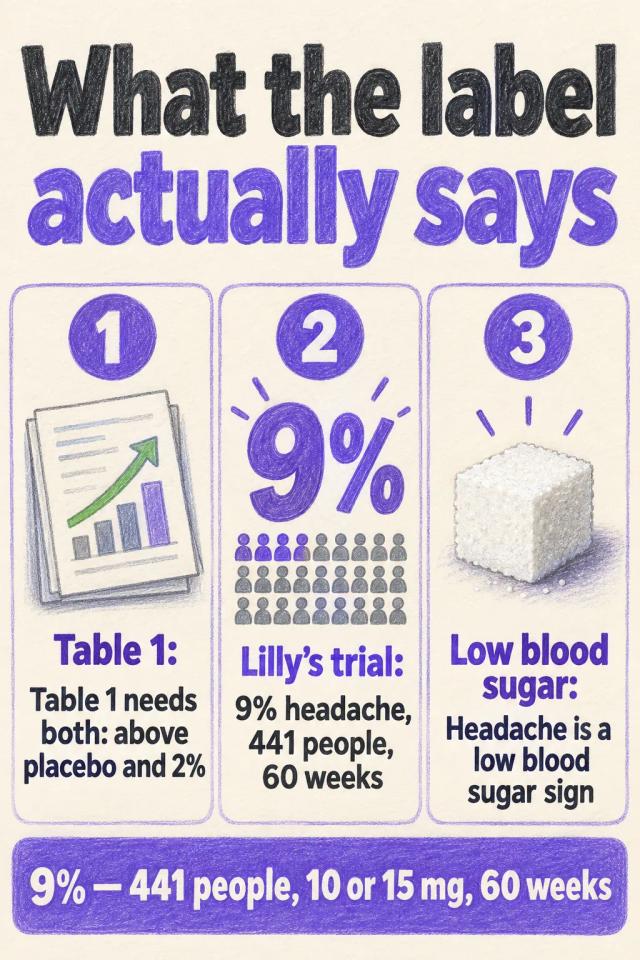
Table 1 admits a reaction only when it passes two filters at once. In the words of the FDA label, the reactions listed there "occurred more commonly with ZEPBOUND than with placebo and occurred in at least 2% of patients treated with ZEPBOUND". Because a reaction has to clear both filters to appear, its absence tells you neither that headache stayed under 2% nor that it was no more common than placebo. Headache is also missing from the "most common side effects" list in the Medication Guide.
Why does Zepbound give me a headache?
Four mechanisms in the published sources can explain a headache on Zepbound, and a fifth possibility is that the headache has nothing to do with the drug at all.
Low blood sugar. "ZEPBOUND lowers blood glucose and can cause hypoglycemia," says the FDA label in section 5.7, and headache sits inside the Medication Guide's own list of low blood sugar signs. The label's measured rate comes from Study 2, in adults with type 2 diabetes and a BMI of 27 or more: hypoglycemia in 4.2% on Zepbound versus 1.3% on placebo. For adults without type 2 diabetes the label reports an association rather than a rate. More in can GLP-1 cause low blood sugar.
Dehydration from stomach side effects. The Medication Guide is direct: "Diarrhea, nausea, and vomiting may cause a loss of fluids (dehydration) which may cause kidney problems. It is important for you to drink fluids." The FDA's summary review traces the same chain through to acute kidney injury.
Long gaps between meals. Tirzepatide "decreases calorie intake", per the FDA label, and when appetite drops the gaps stretch without you deciding to stretch them. Cleveland Clinic describes hunger headache as happening "when there are long periods of time between meals" and "when you're not eating enough".
The coffee you quietly cut. Caffeine withdrawal "most commonly manifests with headache" and "can also occur after cessation of relatively low daily doses, such as a single small cup of coffee", according to a medical reference chapter titled "Caffeine Withdrawal". Nothing links this one to tirzepatide. The link is the nausea that made coffee repellent.
An ordinary headache that is its own emergency. Some headaches are serious whatever medication you take, and the signs are in the routing section below.
How long does a Zepbound headache last, and does it change with the dose?
The Zepbound label does not publish how long a headache on Zepbound lasts. What the FDA label does report is a pattern for stopping, not for headache: across the pooled Studies 1 and 2, in 2,519 adults over up to 72 weeks, "The majority of patients who discontinued ZEPBOUND due to adverse reactions did so during the first few months of treatment due to gastrointestinal adverse reactions." Those are stomach reactions, not headaches.
The weekly pattern. If yours arrives a day or two after the shot, the timing is at least plausible on the drug's own numbers: Lilly's answers page gives a median time to maximum plasma concentration of 24 hours, with a range of 8 to 72 hours. That is timing, not cause.
If the headaches keep landing on the same day each week, log the shot day and dose in MeAgain's shot log, then the headache by day and severity in side effect tracking. After two or three weeks you bring your prescriber a dated pattern next to your dose changes, instead of "most weeks".
The app has everything! Versatile and easy to use food searching, a dashboard with protien, water and fiber progress, activity tracker and shot reminders that also let you know where your last shot was so you rotate areas. Also lets you easily track side effects. I feel so supported.
After a dose step-up. The escalation schedule exists "to reduce the risk of gastrointestinal adverse reactions", in 2.5 mg steps at least 4 weeks apart to a maximum of 15 mg, and the FDA medical review says the effect of each step on gastric emptying is "unknown". If a dose is not sitting well, the label's line is for your prescriber: "If patients do not tolerate a maintenance dosage, consider a lower maintenance dosage."
How do I get rid of a Zepbound headache?
Work through the five things the sources support, in this order, then call your prescriber if the headache keeps going.
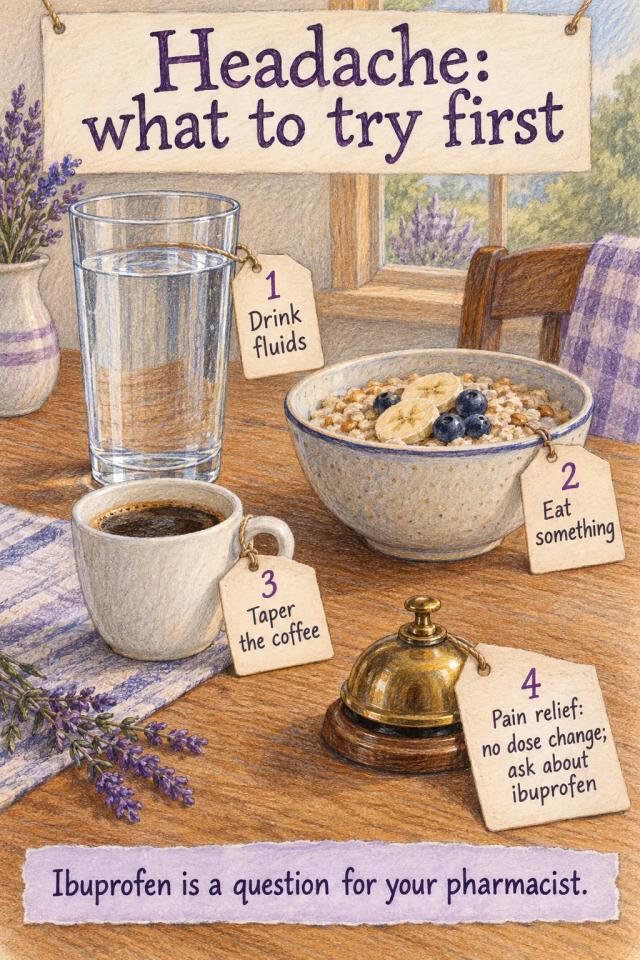
- Drink fluids. The Medication Guide's instruction, above, is the whole of it. In heat it matters more: the CDC calls dehydration "the most important predisposing factor in heat-related illness" and notes sweat rates during exertion in heat may reach 1 liter per hour. See how much water to drink on a GLP-1.
- Eat something, and do not stretch the gaps. That is easy to say when nothing sounds good, and it is the hunger headache above.
- Check the coffee. If you cut back because the nausea made it unappealing, Cleveland Clinic's advice is to taper rather than stop outright.
- Ask about pain relief before you take it. "No dose adjustment of acetaminophen is necessary when administered with tirzepatide," states the Canadian product monograph. For ibuprofen, ask your pharmacist which is right for you.
- There is no empty-stomach rule to fix. "ZEPBOUND may be taken with or without food," says the Medication Guide, and the FDA label adds "Administer ZEPBOUND once weekly at any time of day, with or without meals." Injecting before or after a meal is not what made the headache, so moving the shot is not the lever. If you want to change the day for another reason, the label's one condition is in the FAQ below.
Where to get help
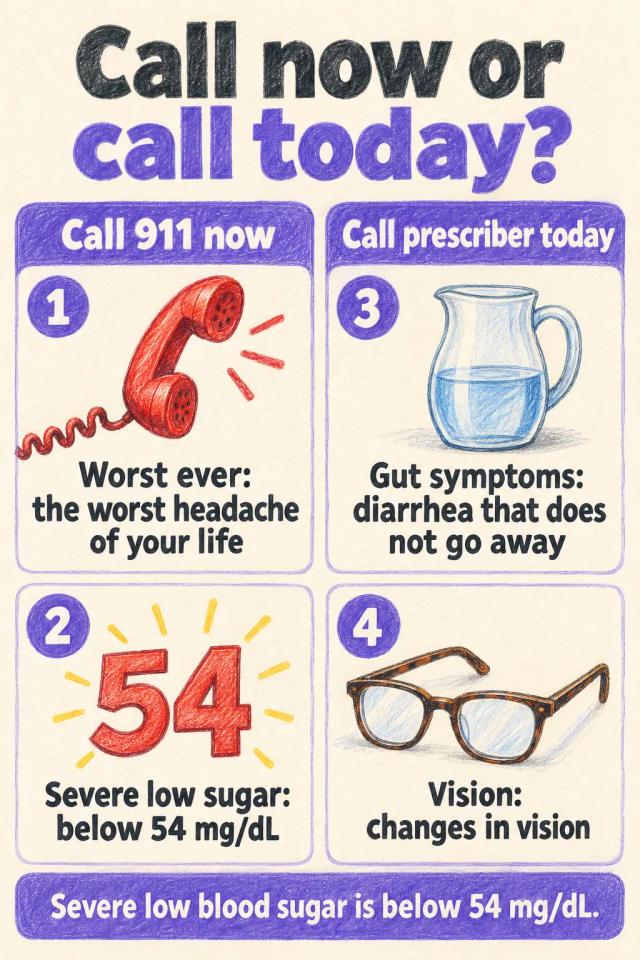
Call 911 or go to an emergency room now for the worst headache of your life, a sudden severe headache, or a headache with confusion, fainting, a stiff neck or trouble seeing. Call your prescriber or care team today for low blood sugar signs, vomiting or diarrhea that will not go away, or a change in vision. Call Poison Help at 1-800-222-1222 if you took two doses less than 3 days (72 hours) apart. The table gives each sign in the source's own words.
Sign, in the source's words | Who and how fast | Source |
|---|---|---|
"the worst headache of your life, a sudden, severe headache", or a headache with "Confusion or trouble understanding speech. Fainting. High fever, greater than 102 F to 104 F (39 C to 40 C). Numbness, weakness or paralysis on one side of your body. Stiff neck. Trouble seeing. Trouble speaking. Trouble walking. Nausea or vomiting (if not clearly related to the flu or a hangover)." | "Go to a hospital emergency room or call 911 or your local emergency number" | |
Low blood sugar getting worse: "Feeling weak. Having trouble walking or seeing clearly. Acting strange or feeling confused. Having seizures." Severe low blood sugar is below 54 mg/dL | "Severe hypoglycemia should be considered an emergency. Don't hesitate to call 911, if needed, or if glucagon is not readily available." Call 911 or go to an emergency room now | |
Low blood sugar signs: "dizziness or light-headedness sweating confusion or drowsiness headache blurred vision slurred speech shakiness fast heartbeat anxiety, irritability, or mood changes hunger weakness feeling jittery" | Call your prescriber or care team today, and say if you also take insulin or a sulfonylurea | |
"nausea, vomiting, or diarrhea that does not go away", or kidney signs after fluid loss: "bloody urine, decreased urine output, muscle twitching, nausea, rapid weight gain, seizures, stupor, swelling of the face, ankles, or hands, or unusual tiredness or weakness" | "Tell your healthcare provider right away": call your prescriber or care team today | |
"changes in vision in patients with type 2 diabetes ... during treatment with ZEPBOUND" | Call your prescriber or care team today. For sudden vision loss, "Call 911 or go to an emergency room immediately" | |
Two doses taken less than 3 days (72 hours) apart, which the label forbids | "call your healthcare provider or Poison Help line at 1-800-222-1222 or go to the nearest hospital emergency room right away" | |
Headaches that "Occur more often than usual. Are more severe than usual. Worsen or don't improve with appropriate use of over-the-counter drugs. Keep you from working, sleeping or participating in normal activities." | "See a doctor": book an appointment |
Mayo's vomiting exception is "the flu or a hangover", not a GLP-1. A headache with vomiting on Zepbound is not automatically the medication.
Frequently asked questions
What should I do if I accidentally took two Zepbound doses this week?
Two doses less than 3 days (72 hours) apart is too much. The Medication Guide says to "call your healthcare provider or Poison Help line at 1-800-222-1222 or go to the nearest hospital emergency room right away". Make that call now.
Can I move my Zepbound injection day when I travel?
Yes, on one condition: at least 3 days (72 hours) between the 2 doses, per the Medication Guide.
What does low blood sugar look like in someone taking Zepbound with insulin or a sulfonylurea?
The same symptom list applies, but the risk is higher: the FDA label reports hypoglycemia in 10.3% of Zepbound patients also taking a sulfonylurea versus 2.1% of those not, in Study 2, in adults with type 2 diabetes. Any change to those medicines is the prescriber's call, so make that call today.
Related reading