

Key takeaways
- Yes, Mounjaro can cause acid reflux; the FDA label lists gastroesophageal reflux disease, dyspepsia (indigestion), and belching among its gastrointestinal adverse reactions.
- Reflux happens because tirzepatide slows how fast your stomach empties, so food and acid sit longer and press against the valve at the top of your stomach, especially after big meals or when lying down.
- Most stomach side effects are dose-related and tend to ease over time once you settle on a stable dose.
- The everyday fixes that help most are smaller, slower meals, an earlier and lighter dinner, staying upright two to three hours after eating, and raising the head of your bed.
- Chest pain, trouble or pain swallowing, or vomiting blood or black stools are not routine reflux; treat them as emergencies and get care right away.
Table of contents
- Does Mounjaro Cause Acid Reflux?
- Why Does Mounjaro Trigger Reflux?
- What Actually Helps Reflux on Mounjaro?
- Should You Take an Antacid or Acid Reducer?
- When Is Reflux an Emergency, and How Do You Tell It Apart?
Does Mounjaro Cause Acid Reflux?
Yes, and if you're asking does Mounjaro cause acid reflux, the answer is that reflux and its close cousins are documented Mounjaro territory. The FDA label lists gastroesophageal reflux disease and eructation, the medical word for belching, among the stomach side effects reported more often on Mounjaro than placebo, and Mounjaro's prescribing information counts dyspepsia, everyday indigestion, among its most common reactions. So if meals have started coming back on you, you are not imagining it.
Reflux has a familiar signature. A burning behind your breastbone, a sour or bitter taste creeping up your throat, a too-full feeling that lingers long after you have stopped eating, and the whole thing often gets louder at night when you lie down. The label's names for the same neighborhood are reflux, belching, and bloating. If that is your evening lately, this section is for you.
How common is reflux on Mounjaro?
Reaction | Placebo | 5 mg | 10 mg | 15 mg |
|---|---|---|---|---|
GERD (acid reflux) | 0.4% | 1.7% | 2.5% | 1.7% |
Belching | 0.4% | 3.0% | 2.5% | 3.3% |
Gas (flatulence) | 0% | 1.3% | 2.5% | 2.9% |
Bloating | 0.4% | 0.4% | 2.9% | 0.8% |
Reflux itself sits on the less-frequent end. Nausea and diarrhea can occur in up to 10% of people on tirzepatide, while vomiting and acid reflux show up as more infrequent reports. So the burning-chest complaint is real and named, just less common than the queasiness and loose stools that dominate the stomach-side-effect conversation.

Reflux, indigestion, or something else?
Indigestion is the larger bucket. Dyspepsia runs higher on tirzepatide too, about 7% versus roughly 3% on the comparison treatments. For a reader, reflux and indigestion blur together anyway: both are that acidy, overfull feeling after a meal, and the label counts them as separate reactions even though they can feel like one thing.
Reflux is not a lone, rare glitch. It belongs to a whole family of stomach side effects that travel together on Mounjaro, nausea, indigestion, belching, bloating, the occasional bout of loose stools, because they mostly trace back to the same change in how your gut handles a meal. Seeing it as one connected pattern, rather than a scary standalone symptom, is the first step to managing it.
Is it reflux or nausea?
Reflux and nausea are not the same thing, even though they overlap. Reflux is the burning, acidy feeling moving up from your stomach; nausea is that queasy, might-be-sick feeling that sits lower. They often show up together and they respond to different fixes, so it helps to notice which one you actually have. There is a full playbook on why tirzepatide causes nausea if queasiness is your main complaint.
None of this means something has gone wrong. Reflux is a documented, expected-for-some reaction to a medication doing exactly what it was designed to do inside your stomach. For many people it eases over time and stays manageable with a few everyday changes. The next question is the useful one: why does it happen at all?

If you are getting reflux, the most useful move is to understand the mechanism. Once you see why a fuller stomach pushes acid the wrong way, the fixes stop feeling random and start feeling obvious.
Why Does Mounjaro Trigger Reflux?
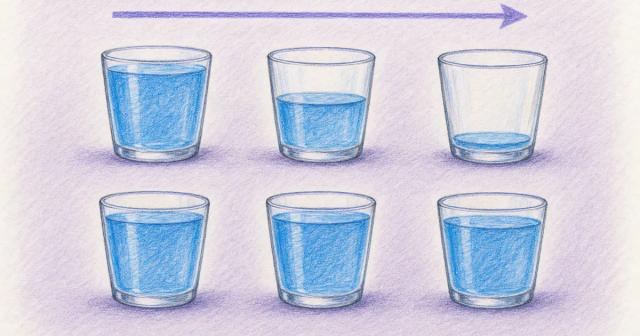
Mounjaro slows how fast your stomach empties. When food and acid linger in a fuller stomach for longer, there is more volume and more upward pressure against the valve at the top, and that valve giving way is exactly how acid escapes into your esophagus. Slower emptying is a recognized driver of the queasiness and reduced appetite people feel, and the same lingering-food effect sets the stage for reflux.
How Mounjaro slows your stomach down
Think of it as a traffic jam. Normally your stomach passes a meal along within a couple of hours. On Mounjaro that hand-off runs slower, so more food and stomach acid stay put, and your stomach sits fuller and under more pressure than usual. A fuller, higher-pressure stomach has one easy escape route: back up past the valve at the top. That backup is the burning you feel.
What makes a reflux flare worse?
- Large meals that fill an already-slow stomach
- Rich, high-fat food that lingers even longer
- Lying down soon after you eat
- Late dinners close to bedtime
- Carbonated drinks that add pressure and gas
- Coffee, which can loosen the valve at the top
Slower emptying means a fuller stomach, and a fuller stomach pushes acid the wrong way.
Nighttime is reflux's favorite time. When you are upright, gravity helps keep stomach contents where they belong. Lie down within an hour or two of eating and that help disappears, so acid can slide back toward your throat with nothing holding it down. Add a slow-emptying stomach that is still full at bedtime, and you have the setup for that 2 a.m. burning that wakes you up.
Why dose increases matter
The higher your dose, the more likely the stomach effects. Tirzepatide's GI reactions climb step by step with the dose. Nausea runs about 13.7%, 16.5%, and 22.4% at the 5, 10, and 15 mg doses, and diarrhea about 14.0%, 15.1%, and 19.2% across the same steps. Reflux belongs to the same dose-sensitive family, which is why a new burning feeling often lines up with a recent dose increase.
A dose step can wake reflux back up. Per the FDA label, Mounjaro starts at 2.5 mg and steps up to 5 mg after four weeks, then rises in 2.5 mg increments no sooner than every four weeks, up to 15 mg. That slow ladder exists specifically to reduce the risk of stomach side effects. Each step is a bigger dose your gut has to re-adjust to, so a symptom that had quieted can briefly return after you climb.
Does reflux get better over time?
Here is the encouraging part: most of these stomach reactions ease with time. On a steady dose, tirzepatide's GI side effects generally decline as the weeks pass and your body adapts, and long-term, stable dosing is thought to lower the risk further. So a reflux flare that shows up after a dose change is usually a phase, not a permanent setting.

Knowing the mechanism turns vague advice into a plan. Every fix that actually helps reflux on Mounjaro works by attacking the same root: a stomach that stays too full for too long. Here is what that looks like day to day.
What Actually Helps Reflux on Mounjaro?
Every reflux fix targets one thing: a fuller stomach for longer. Since your medication slows how fast the stomach clears, the moves that help most all lower the pressure pushing acid upward. Eat smaller, slower meals, keep dinner earlier and lighter, stay upright for two to three hours after eating, and set your bed up so gravity works for you at night. Check any big change with your care team first.
Your everyday reflux playbook
- Eat smaller portions so less food sits in a full stomach.
- Slow down at the table and let each meal settle.
- Make dinner earlier and lighter, not your biggest meal.
- Stay upright two to three hours after you eat.
- Skip tight waistbands that press on your belly.
- Stop eating within about three hours of bedtime.
Smaller, slower meals work because they attack the mechanism directly. Less food means less volume to sit in a stomach that is already emptying slowly, so there is less pressure against the valve at the top. Mayo Clinic notes that reflux is more likely after a large meal, which is the same story from the other direction: more food, more pressure, more backup.
Finding your personal trigger foods
A generic ban list is a bad starting point. Mayo Clinic names spicy foods, citrus, and tomato products as common heartburn culprits, and large, rich meals get flagged too, but your stomach is not the average stomach. Treat these as candidates to test, not foods to cut on faith.
Food category | Why it can trigger | How to test it |
|---|---|---|
Large, rich, or fatty meals | More volume sits longer, more pressure | Try one smaller version, watch for reflux |
Spicy foods | A common heartburn culprit | Eat it alone, note timing of any flare |
Citrus | A common heartburn culprit | Trial once, keep or cut based on results |
Tomato-based foods | A common heartburn culprit | Trial once, keep or cut based on results |
Carbonated drinks or coffee | Candidates many people test | Swap out for a week, see if reflux eases |
- Pick one food you suspect sets off your reflux.
- Eat it on its own, not buried in a big meal.
- Note whether reflux shows up and how long after.
- Keep it if nothing happens, cut it if it flares.
- Retest once more before you decide for good.
This is where tracking beats guessing. If you log your meals in MeAgain and note when reflux hits, the pattern shows up in your own data instead of an internet list. You might find your late, heavy dinners are the real problem and your morning coffee is fine, or the reverse. Your triggers are personal, and the log is what makes them visible so you can talk to your care team with specifics rather than hunches.
Your trigger list is personal, and tracking finds it faster than guessing.
Fixing nighttime reflux
Night is often the worst window because lying flat takes gravity out of the fight. Two changes help most. Raise the head of your bed if you regularly get heartburn while trying to sleep, and move your last meal earlier so your stomach has time to clear. Avoiding food within about three hours of bedtime and elevating the head of the bed are both tied to fewer reflux episodes.

Does moving your shot help?
Honest answer: changing where you inject won't fix reflux. Good technique still matters. The Mounjaro label lists the abdomen, thigh, and back of the upper arm as injection areas, says to rotate sites with each dose, and to use a new needle each time. But reflux comes from how the medication works throughout your body, not from the spot on your skin, so rotating for comfort is smart while the reflux itself needs the meal and timing fixes above.

Related reading
- GLP-1 medications and acid reflux
- Why tirzepatide causes nausea
- Diarrhea on tirzepatide
- Dry mouth on tirzepatide
- How long Mounjaro takes to work
- How Mounjaro affects appetite
Should You Take an Antacid or Acid Reducer?
Over-the-counter antacids and acid reducers can ease reflux, but ask your pharmacist or care team before you add one — especially while you are on a newer medication. Mayo Clinic's guidance on tirzepatide is blunt about it: for nonprescription products, read the label carefully, because your doctor may want to adjust things or take extra precautions. The options below are worth knowing so you can have a smarter conversation, not a shopping list to act on alone.
Option | What it does | How fast and how strong |
|---|---|---|
Antacids | Neutralize stomach acid | ✅ Quick relief, but short and no healing |
Alginates | Float as a physical barrier over acid | ✅ Fast, forms a floating layer |
H2 blockers | Reduce acid production | ⚠️ Slower than antacids, up to 12 hours |
PPIs | Block acid and let tissue heal | ⚠️ Strongest, about 90% effective |
What each acid option actually does
Antacids are the quick-relief tool. Mayo Clinic notes that products like Tums and Rolaids may calm a flare fast, but antacids alone won't heal an esophagus already irritated by acid, and overusing some of them can cause side effects like diarrhea. They cover a moment, not a pattern. Alginates work a little differently, floating on top of the acid to create a physical barrier between it and your esophagus.
Acid reducers act slower but last longer. Mayo Clinic explains that H2 blockers don't work as fast as antacids yet can lower acid production for up to 12 hours. Proton pump inhibitors go further still: they are stronger acid blockers than H2 blockers and give damaged esophageal tissue time to heal. Cleveland Clinic puts PPIs at about 90% effective at reducing acid reflux, which is why they anchor more serious cases.
Talk to your pharmacist first
- Could this interact with my current medications?
- Should I time it around my weekly shot?
- How long is it safe to take this on my own?
- What signs mean I should stop and call?
- Do I need to tell my care team I started it?
- What are my options if this doesn't work?
Asking first isn't hedging, it's basic med safety. Mayo Clinic's GERD guidance says plainly that if you start a nonprescription medicine for reflux, you should inform your care provider. Keep one current list of everything you take and share it, because the person adjusting your prescription needs the full picture to spot interactions and decide what belongs in your routine.
Following your care team's plan still matters most. Mayo Clinic frames nonprescription products around reading labels and letting your doctor check your progress at regular visits to make sure the medication is working the way it should. An acid reducer you added quietly can hide a pattern they would want to catch.

When reflux keeps coming back
When reflux won't quit despite the meal and timing fixes, the next levers aren't yours — they're your care team's. Mayo Clinic's tirzepatide guidance notes that in some cases your doctor may want to change the dose or take other precautions. Since stomach side effects tend to track with each dose step, the pace of your increases is something only they can adjust, which is exactly why persistent reflux is worth a conversation rather than a bigger antacid habit.
That conversation usually covers a few things: how fast to move up your dose, whether to hold at a step for a while, and whether a prescription medicine makes sense. Mayo Clinic's GERD guidance is clear that if nonprescription options don't bring relief within a few weeks, prescription medicine and further testing may be the next move. You bring the pattern you tracked, they bring the levers.
Most reflux on your medication is manageable with the everyday changes and, when your care team agrees, an acid option. But a short list of signs isn't routine at all, and knowing them is the difference between waiting it out and getting seen.
When Is Reflux an Emergency, and How Do You Tell It Apart?
Most reflux on Mounjaro is routine — uncomfortable, annoying, and manageable with the everyday fixes. But a short list of signs is different, and those deserve care right away rather than another antacid. Knowing the red lines ahead of time means you won't second-guess yourself at 2 a.m. wondering whether burning is just burning.
Get medical help right away if you notice any of these, and don't wait to see if they pass:
- Chest pain or pressure that could be your heart, not your stomach
- Trouble swallowing, or pain when food goes down
- Vomiting blood, or throw-up that looks like coffee grounds
- Black, tarry, or bloody stools
- Severe stomach pain that won't go away
- Can't keep fluids down or feel faint and dehydrated
A routine flare burns and passes; an emergency grabs and stays — that difference is your signal to call.
One red flag deserves its own callout: pancreatitis. Per the Mounjaro medication guide, you should stop using it and call your healthcare provider right away if you have severe pain in your stomach area that won't go away, with or without nausea or vomiting. Sometimes that pain travels from your abdomen through to your back. That radiating, unrelenting pain is not ordinary reflux, and it is not something to manage at home.
Telling reflux apart from the other stomach side effects helps you decide what to do. Reflux burns upward, behind the breastbone, often with a sour taste. Nausea is queasiness lower down, the not-hungry, nothing-sounds-good feeling. Indigestion is that heavy, too-full ache high in your belly. The FDA label lists nausea, diarrhea, decreased appetite, vomiting, constipation, dyspepsia, and abdominal pain among the most common reactions reported in at least 5% of people on Mounjaro, so overlap is normal.

Reflux and nausea are managed differently, which is why it's worth naming what you're actually feeling. Reflux responds to smaller meals, staying upright, and adjusting your evening routine. Queasiness has its own playbook around timing, bland foods, and hydration. If your main issue is that nothing sits right in the first place, why tirzepatide causes nausea walks through that side of things without repeating the reflux fixes here.
Before you call, jot down a few things so the conversation is quick and useful. Note when the reflux hits — after meals, at night, or seemingly at random. Note what you ate beforehand and how big the meal was. Note where you are in your dose steps, since a recent increase is a common trigger. And note how bad it is on a simple scale. A short record beats trying to remember it all on the spot.
The reassuring part: reflux is documented, expected for some people, and mostly manageable with everyday changes. Now you also know the handful of signs that mean stop managing and start calling. That's the whole triage — routine flares get the playbook, red flags get your care team.

Reflux is one of the more well-lit corners of the Mounjaro side-effect map: real, explainable, and mostly fixable with meal timing and posture. Keep the red lines in your back pocket, and let the questions below fill in the rest.
Related reading
- Joint pain on Mounjaro
- Feeling sleepy on Mounjaro
- Whether Mounjaro shows up in blood work
- How GLP-1 helps with weight loss
- Constipation on semaglutide
- Why semaglutide causes nausea
- How semaglutide works
- Tirzepatide and your period
- Tirzepatide and anxiety
- How long tirzepatide takes to work
Frequently Asked Questions
How long does acid reflux take to improve on Mounjaro?
For most people, stomach side effects settle as your body adjusts to a steady dose, so reflux that shows up early or right after a dose step-up often eases over the following weeks. There's no fixed timeline, and it varies person to person. If it's holding steady or getting worse despite smaller meals, an earlier dinner, and staying upright after eating, that's a reason to check in with your care team rather than wait it out. Knowing how long it takes to ease matters just as much as knowing does Mounjaro cause acid reflux in the first place.
Is hiccups a common Mounjaro side effect alongside acid reflux?
Hiccups aren't on the FDA label's list of the most common Mounjaro reactions — the ones reported in at least 5% of people are nausea, diarrhea, decreased appetite, vomiting, constipation, dyspepsia, and abdominal pain. That said, hiccups and reflux can share the same root: a fuller stomach for longer, pressing upward. If hiccups are your main complaint, the same smaller-meals-and-stay-upright habits that help reflux are a reasonable place to start.
How is Mounjaro nausea managed differently from reflux?
Reflux is about acid and pressure moving the wrong way, so its fixes target volume and posture: smaller meals, an earlier lighter dinner, and staying upright after eating. Nausea is queasiness, and its playbook leans on meal timing, bland easy foods, and hydration instead. They can overlap, but the moves aren't identical — why tirzepatide causes nausea covers the queasiness side so you're not applying reflux fixes to a different problem.
Can adjusting my Mounjaro dose stop the reflux?
Possibly — but dose timing and how fast you move up are your care team's levers, not something to change on your own. Reflux often flares after a dose step-up, and the escalation schedule exists partly to keep stomach side effects in check. If reflux is persistent, tell your care team what you're feeling and when; they can talk through pace and options. Don't skip, double, or adjust doses to chase relief.
This article is for informational purposes only and is not medical advice. Always talk to your doctor or care team about your medication, symptoms, or treatment plan.