
No label sets a shot-day menu, since Zepbound is taken "with or without meals," so shot day is really about protein first, smaller and blander portions, and knowing which symptoms mean you call.
You are months in, standing in the kitchen on the evening you inject, wondering whether dinner comes before the pen or after it. This page settles what goes on the plate tonight and tomorrow, what changes after a dose increase, and which symptoms mean you contact someone.
This article is general information from public sources, not medical advice. Your prescriber and pharmacist know your history; take storage and dosing questions to them.
Last updated September 2026 · Sources verified against the FDA label, Mayo Clinic and JAMA.
Key takeaways
- Zepbound is taken "once weekly at any time of day, with or without meals," per the FDA label, so eating before or after the shot is your choice.
- JAMA's patient page says to start each meal with 20 to 30 g of protein, and 1.0 to 1.5 g per kg of body weight daily if you are moderately active.
- Mayo Clinic advises smaller, more frequent, cool and bland meals eaten slowly, no fried or high-fat food, and no lying down after.
- Severe stomach pain that will not go away means stop using Zepbound and call right away, per the Zepbound Medication Guide; with repeated vomiting, fever or fainting, an emergency room now.
What should you eat on shot day?
What goes on the plate is a protein-first, smaller-portion pattern rather than a rule tied to the injection. The FDA label for Zepbound says to "Administer ZEPBOUND once weekly at any time of day, with or without meals." Eat dinner first, inject first, or skip dinner entirely: none of it breaks a rule about the medicine.
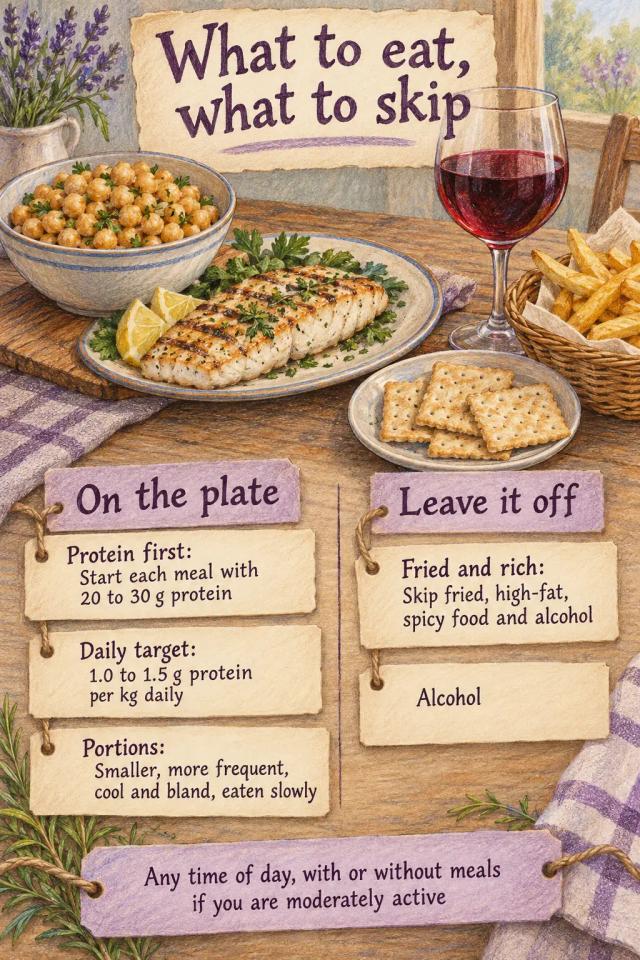
What the sources do prescribe is protein. JAMA's patient page says to begin each meal with "20 to 30 g of protein from foods like fish, beans, chickpeas, or tofu," and to aim for 1.0 to 1.5 g per kg of body weight daily if you are moderately active. Start with the protein, not finish with it, on a day when you get four bites in and stop. More on how much protein on a GLP-1.
Cleveland Clinic puts it in plate terms: you eat less, "but your body still needs a variety of nutrients to be healthy."
Is it normal to have almost no appetite on shot day, and do I still need to eat something?
Yes, and you still eat something. JAMA's answer for a day when nothing sounds good is a protein shake with at least 20 g per serving, because GLP-1 medications "can cause loss of muscle and fat." Mayo Clinic says not to skip meals even then, and the Mounjaro Medication Guide adds the fluid half: "It is important for you to drink fluids to help reduce your chance of dehydration."
Which foods are least likely to make you sick, and which make it worse?
Mayo Clinic describes the shot-day plate as small, frequent, cool and bland, eaten slowly and sitting up, with nothing fried on it.
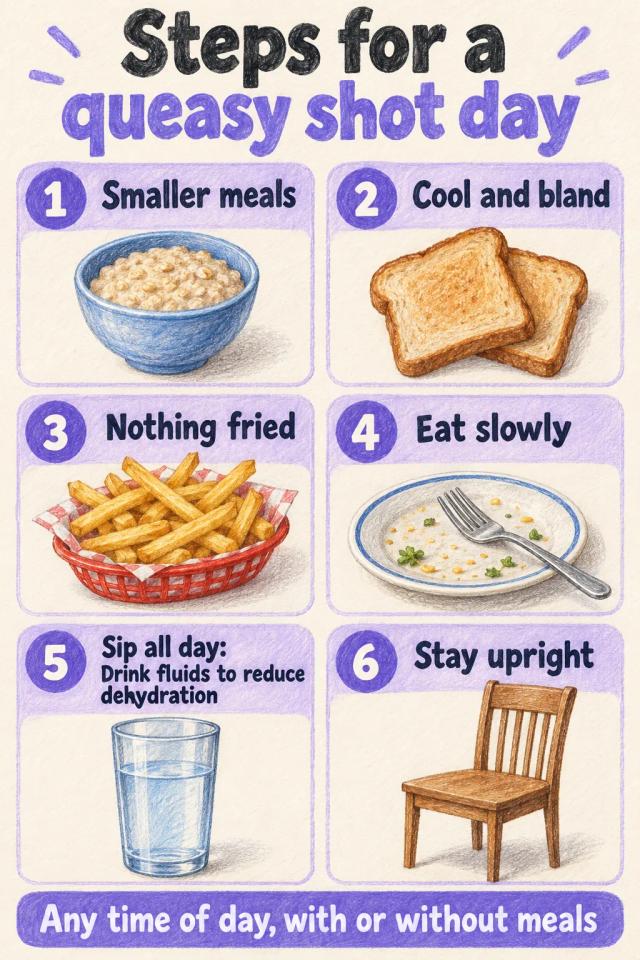
- Split the day into smaller meals. Mayo Clinic advises smaller and more frequent ones, and a journal article via PubMed Central says the same: split the day's meals, stop eating when you feel full.
- Choose cool and bland. Mayo Clinic names crackers, toast and pretzels for when you feel sick, and another journal article suggests simple cooking methods and fruit as a snack.
- Leave off the fried and the fatty. Mayo Clinic names fried foods and foods with strong odors; the PubMed Central article adds complex dishes, spicy foods and alcohol.
- Eat more slowly. Mayo Clinic's instruction is exactly that, and the journal article adds stopping when you feel full rather than when the plate is empty.
- Drink through the day, between meals. Mayo Clinic advises water or ginger herbal tea regularly through the day, between meals rather than with them.
- Stay upright after eating. Mayo Clinic says not to lie down after a meal, and to get some fresh air. The PubMed Central guidance adds no vigorous activity straight after eating.
Cooking for someone else? That is your shopping list. More in GLP-1 foods to avoid.
Why does the food matter at all?
Cleveland Clinic says food stays in your stomach longer on a GLP-1, and that because of this spicy and high-fat foods can contribute more to the GI side effects. The FDA clinical pharmacology review says that slowing fades: "Tirzepatide slows gastric emptying, and this effect diminishes over time." The careful shot-day plate is a titration-period tactic, not a permanent regime.
The nausea itself is generated further up than the stomach: GLP-1 receptor agonists "cause nausea and vomiting mainly by binding GLP-1 receptors in the dorsal vagal complex," a control center in the brainstem, per a journal article via PubMed Central. More in why GLP-1s cause nausea.
What changes after a dose increase?
On the plate, nothing new is required after a dose increase, just the same smaller, blander, protein-first strategies applied harder for a few weeks, because symptoms on a GLP-1 track the dose step rather than the day of the week. A journal article via PubMed Central says patients should be told that gastrointestinal symptoms are "dose dependent, common during treatment initiation and escalation, usually transient, influenced by the starting dose, and speed of titration."
Arm | Any GI adverse reaction | Stopped treatment for GI reasons |
|---|---|---|
Placebo | 20.4% | 0.4% |
Mounjaro 5 mg | 37.1% | 3.0% |
Mounjaro 10 mg | 39.6% | 5.4% |
Mounjaro 15 mg | 43.6% | 6.6% |
Those figures come from Lilly's answers page: pooled placebo-controlled trials in adults, any gastrointestinal reaction rather than nausea alone. If a step is not tolerable, that is a prescriber conversation, and the FDA label says so: "If patients do not tolerate a maintenance dosage, consider a lower maintenance dosage."
If the weeks after an increase blur together, log the shot day, the dose as prescribed, and the nausea day and severity in MeAgain alongside what you ate, for two or three titration weeks.
Love this app use it every day so helpful to make sure I eat enough protein and drink enough water really helping me achieve my goals highly recommended worth every cent for premium sub - thank you
What if you take insulin or a sulfonylurea and barely eat?
A barely-eating shot day is a different event if you also take insulin or a sulfonylurea, the medicines that can drop blood sugar when a meal does not happen.
Mayo Clinic's tirzepatide page carries both halves: "This medicine does not cause hypoglycemia (low blood sugar). However, low blood sugar can occur when you use tirzepatide with other medicines, including insulin or sulfonylureas, that can lower blood sugar. Low blood sugar also can occur if you delay or miss a meal or snack, exercise more than usual, drink alcohol, or cannot eat because of nausea or vomiting."
Read that second sentence as a shot-day list: a missed dinner, a drink with friends, a day of vomiting, and they stack.
On alcohol, two clinical sources point the same way: Mayo names it as something that can bring on a low, and a journal article via PubMed Central puts avoiding it alongside spicy foods and complex dishes. Neither quantifies a risk; both advise against it on a queasy day.
The action is a conversation before shot day, not during it: the Mounjaro Medication Guide says to talk to your care team about low blood sugar and how to manage it, and to tell them if you take insulin or sulfonylureas.
The number to know: below 70 mg/dL is low blood sugar, per the CDC, and NIDDK, the National Institute of Diabetes and Digestive and Kidney Diseases, adds that "Your number might be different," so ask what low means for you. More in can a GLP-1 cause low blood sugar.
Where to get help
Some shot-day symptoms are not a food problem, and one of them is a bowel emergency.
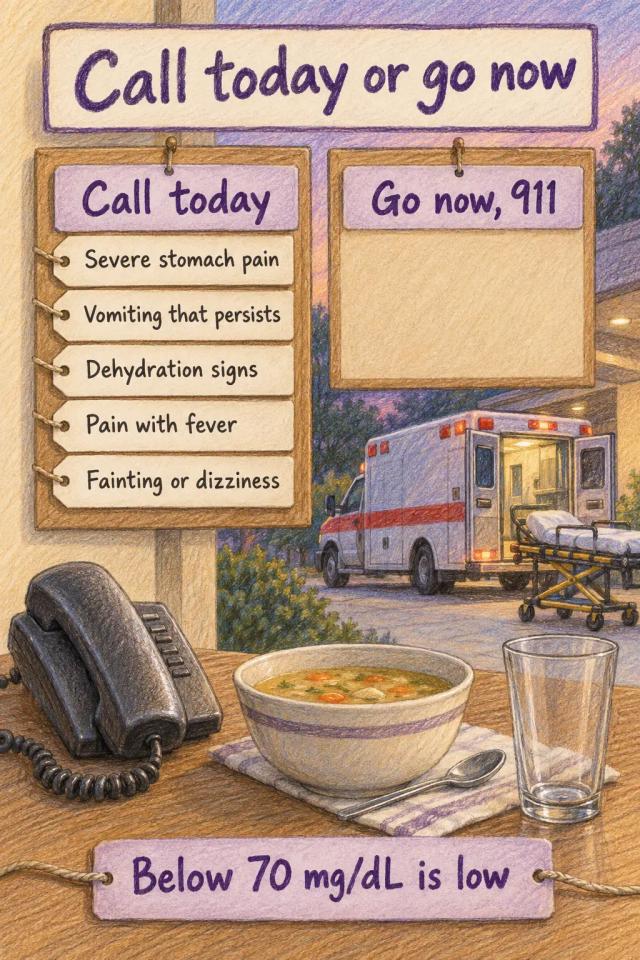
Sign | Who and how fast | Source |
|---|---|---|
"severe pain in your stomach area (abdomen) that will not go away, with or without nausea or vomiting" | "Stop using ZEPBOUND and call your healthcare provider right away," today | |
"severe, constant abdominal pain, especially if you also have: Repeated vomiting, Fever, Trouble breathing, Fainting or severe dizziness, A fast heartbeat" | "Go to the nearest emergency department," now | |
"pain in your upper stomach (abdomen), yellowing of skin or eyes (jaundice), fever, clay-colored stools" | "Tell your healthcare provider right away," today | |
"Abdominal pain so intense that you can't sit still," "Yellowing of your skin and the whites of your eyes (jaundice)," or "High fever with chills" | "Seek immediate care," 911 or an emergency room now | |
"nausea, vomiting, or diarrhea that does not go away" | "Tell your healthcare provider right away," today | |
"Decreased urine output, Dark-colored urine, Dry skin, Thirst, Dizziness" | "Call your healthcare provider," today | |
"If your symptoms are severe, last for several days, or you are unable to drink fluids or eat food" | "contact your doctor immediately," today | |
"severe abdominal pain, vomiting, and inability to pass stool" | "Get medical help right away," an emergency: 911 or go now | |
Blood sugar "below 70 mg/dL," more likely with insulin or a sulfonylurea, a missed meal, alcohol or being unable to eat | "talk to your healthcare provider about low blood sugar and how to manage it," before shot day | |
"If you do not see the gray plunger" after injecting | Contact Lilly at 1-800-Lilly-Rx (1-800-545-5979), same day |
Frequently asked questions
I threw up right after my Zepbound shot, did the dose still work?
The check is on the pen, not in your stomach. The pen's Instructions for Use says "Your dose was delivered the right way if the gray plunger is visible," and if you do not see it, "contact Lilly at 1-800-Lilly-Rx (1-800-545-5979)" for further instructions.
I ate a greasy meal right after injecting and now I am vomiting, what should I do?
Go back to small and plain: a journal article via PubMed Central advises splitting the day's meals and avoiding fatty foods. Mayo Clinic says to contact your doctor immediately if symptoms "are severe, last for several days, or you are unable to drink fluids or eat food."
Does a big dinner the night I inject make the next day worse?
Size and fat are what the sources name, not the calendar. A single patient case in a journal article via PubMed Central describes "occasional intense episodes of nausea associated with eating large meals that include fatty foods," one patient's pattern rather than a rate.
Why has my sense of taste changed on Mounjaro?
Mayo Clinic keeps its own hedge here: "It's not clearly understood why, but some people experience changes in their sense of taste, such as having a metallic taste in their mouth... This can affect your appetite."
Do I have to follow a special diet on a GLP-1?
Not a special diet, but not nothing either. The FDA label says Zepbound is given "in combination with a reduced-calorie diet and increased physical activity," and a GLP-1 nutrition tool in a journal article via PubMed Central "does not specify precise food quantities, as these must be personalized with the guidance of a healthcare professional."
Can I move my weekly shot day so nausea does not land on a travel day?
The label sets the conditions: for Zepbound, as soon as possible within 4 days (96 hours), and never 2 doses within 3 days (72 hours), per the Zepbound Medication Guide. For Wegovy, Mayo Clinic says to use a missed dose if the next one is more than 2 days away, and to call after more than 2 weeks.
Related reading