
When a few bites is all that fits, Mayo Clinic points to Greek yogurt, smoothies, shakes and soups, eaten protein-first, with researchers suggesting small amounts every 3 to 4 hours when nausea is limiting how much you eat.
You are somewhere between week two and month eight, it is four in the afternoon, and you have managed about four bites all day. This page settles what to actually get down today, what protein ranges researchers publish and who owns your number, and which symptom means calling your care team today.
This article is general information from public sources, not medical advice. Your prescriber and pharmacist know your history; take storage and dosing questions to them.
Last updated September 2026 · Sources verified against Mayo Clinic, Cleveland Clinic and a review reporting the ACSM and USDA protein figures.
Key takeaways
- Mayo Clinic names Greek yogurt, smoothies, protein shakes and soups as nutrient-dense and easy to digest, and says soft, blended or liquid meals may be better tolerated.
- A small breakfast, then small amounts every 3 to 4 hours with adequate fluids, is what a research review suggests when nausea is limiting how much you eat.
- Researchers publish ranges, not one number: 25 to 30 g per meal per ACSM, 60 to 75 g a day per USDA, both via one review. No manufacturer document names a figure, so your target comes from your prescriber or dietitian.
- Mayo Clinic says that if calories become a concern, under 1,200 a day, work on calorie and nutrient density with meals, beverages and snacks, and reach out to your doctor if you are unable to eat or drink.
What are the easiest high-protein foods when you have almost no appetite?
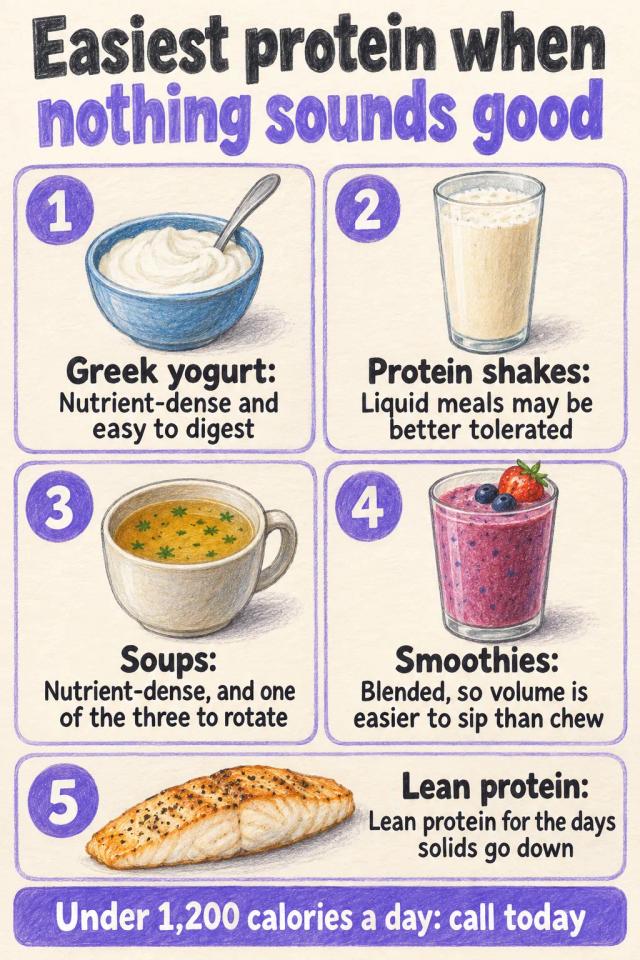
The easiest high-protein foods on almost no appetite are the nutrient-dense soft and liquid ones Mayo Clinic names, "Greek yogurt, smoothies, protein shakes and soups", which it calls "often nutrient-dense and easy to digest", adding that "soft, blended or liquid meals may be better tolerated". When solids will go down, Cleveland Clinic names the lean options: "fish, chicken, tofu and beans". Its full liquid diet guidance asks for variety: "rotate between soups, cereals and shakes".
The reason two bites fills you up sits in the drug's mechanism. The FDA's clinical pharmacology review hedges as it describes it: "The slowing of gastric emptying together with a GLP-1 related increase in satiety (mediated through the central nervous system) may decrease body weight."
For tirzepatide, the FDA's pharmacology review measured that slowing "in normal, fasted mice", and calls the satiety step a link rather than a measurement. The effect on eating has been measured in people: tirzepatide reduced energy intake by 524.6 kcal versus placebo at week 3, per a journal article (via PubMed Central). More on that in appetite on GLP-1 medications.
Food | Why it goes down | Source |
|---|---|---|
Greek yogurt | Nutrient-dense and easy to digest | |
Smoothies | Blended, so volume is easier to sip than chew | |
Protein shakes | Liquid meals may be better tolerated | |
Soups | Nutrient-dense, and one of the three to rotate | |
Fish, chicken, tofu, beans | Lean protein for the days solids go down |
How do you eat protein on a four-bite day?
Put the protein in your mouth first, keep the portions small, and repeat every three to four hours rather than trying to build a meal.
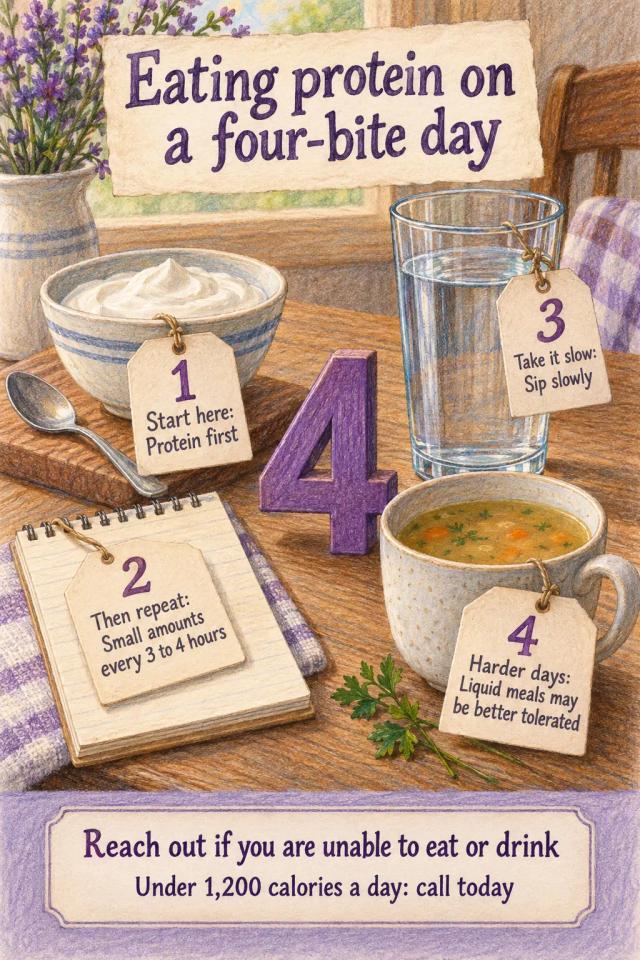
- Protein first, before anything else. Mayo Clinic calls eating protein first the way to make sure it is "not left on the plate".
- Small breakfast, then repeat. A journal article (via PubMed Central) counsels people to "eat a small breakfast and then additional small meals every 3-4 h while drinking adequate fluids". It also names the loop that breaks: people stop eating because of nausea, which worsens the symptoms, which further reduces the likelihood of eating.
- Sip slowly. Mayo Clinic's instruction is to "eat slowly, avoid large meals, drink plenty of fluids and maintain protein intake".
- Expect less on a dose-increase week. Mayo Clinic says symptoms "are likely to be most bothersome at medication start or with a dose increase, and they may resolve or improve within days to weeks". Plan liquids for those days rather than meals.
- Fall short on purpose, in the right order. Mayo Clinic's GLP-1 meal plan gives explicit permission: "it's OK if you can't reach your daily food group targets... just try to come as close to the targets as you can." If the fruit or vegetable snack is a struggle, "it's OK to skip these for the first few weeks". That snack goes before the protein does.
- Eat on the clock, not on hunger. Appetite is not a reliable signal right now. Cleveland Clinic's full liquid diet guidance adds the check for anyone watching: "let your provider know if you feel weak, dizzy or overly hungry".
If you have been running on a few hundred calories for a week, that goes to a clinician rather than to a big meal, because Cleveland Clinic warns that "when your body tries to metabolize nutrients again, severe shifts, related to electrolyte deficiencies, can occur".
Are protein shakes a good way to get protein in when food sounds unappealing?
Yes, as a bridge, not as the diet. Mayo Clinic puts the limit plainly: "if you rely too much on protein shakes to replace daily meals, you'll miss out on the healthy benefits of whole foods." On a four-bite day a shake may be the only protein that lands. On a better day it sits alongside food instead of replacing it.
How do you choose a protein powder on a low appetite?
Look for "at least 15 grams of protein per serving, and has a short ingredients list and limited added sugars, ideally 100% whey, soy, or pea protein", which is the criterion in Mayo Clinic's GLP-1 meal plan. The soy and pea options matter if dairy has started to taste wrong, or if you do not eat animal protein.
How much protein do you need a day, and per meal when you can barely eat?
Research bodies publish ranges above the 0.8 g/kg/day baseline, and your own number comes from your prescriber or dietitian, because no manufacturer document names one. For inactive but healthy adults the recommended dietary allowance is "0.8 g/kg body weight per day", per a journal article (via PubMed Central). Losing weight on a GLP-1 calls for more: a diet exceeding that baseline is "the best option to mitigate the reduction in LBM", meaning lean body mass, in the words of a second review.
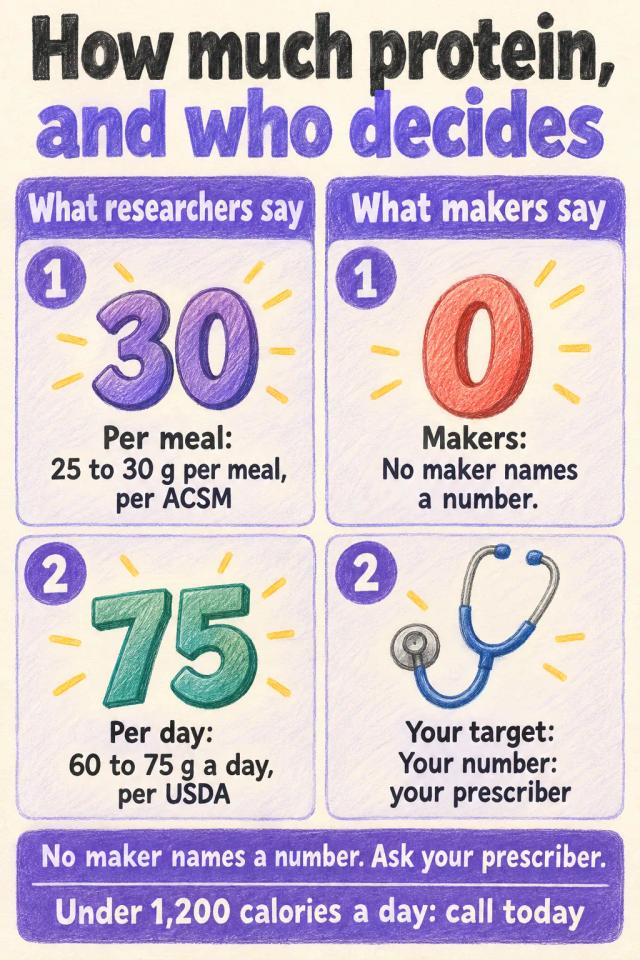
Two bodies publish numbers, and they differ. A review reporting both gives the American College of Sports Medicine's figure as "approximately 1.25 to 1.5 times the Recommended Dietary Allowance", and the United States Department of Agriculture's as "60 to 75 g/day of protein, or 1.5 g/kg body weight/day", both during weight-loss treatment. The makers address protein and decline a figure: Lilly's dosage page tells clinicians to "encourage patients to eat healthy meals to ensure they meet their needs for protein, micronutrients, fiber, and fluids", and Novo Nordisk says only that "eating enough protein may help to reduce the amount that's lost". How much protein on a GLP-1 has more.
Protein is also only half the job. A journal article (via PubMed Central) says "increased protein intake alone is likely inadequate to support the preservation of muscle mass in the absence of structured resistance/strength training", which is the other half of muscle loss on Zepbound.
Bring numbers to that conversation. Log food, water and the days you could not finish a meal in MeAgain for two or three weeks. A dated run of what you actually managed on a four-bite week is easier to hand to a prescriber or dietitian than a memory of "barely anything".
This is a very helpful app it has helped me in so many ways now I know how many calories I am eating every meal , protein and also fiber love this totally recommend it
How many grams per meal when a meal is three spoonfuls?
The per-meal figure researchers publish is "at least ∼ 25 to 30 g of protein per meal", attributed to the American College of Sports Medicine in the review, and it is more than most four-bite days will hold. The practical move is more eating occasions rather than bigger ones, which is where the every-3-to-4-hours rule earns its place. Five small occasions beat two you cannot finish.
Where to get help
A low appetite on a GLP-1 can tip into signs that need a call today or an emergency room now, and the difference is in the signs themselves, a blocked bowel among them.
Sign | Who and how fast | Source |
|---|---|---|
Blood sugar "below 70 mg/dL", if you take insulin or a sulfonylurea alongside a GLP-1 and have skipped meals or been unable to eat | If a glucagon kit has been prescribed, use it as directed, and call 911; if someone has fainted, call 911 or go to an emergency room now | the CDC; co-medication scope, Mayo Clinic |
"Decreased urine output, dark-colored urine, dry skin, thirst, dizziness" | "Call your healthcare provider if you or a family member has any of the following: vomiting or diarrhea that's not getting better... any signs of dehydration": call your care team today | |
Pain that "begins slowly or suddenly in your upper abdomen, sometimes spreads to your back, may last for several days", with "fever, nausea and vomiting, fast heartbeat, swollen or tender abdomen" | People with acute pancreatitis "need to see a doctor right away" | |
"Persistent vomiting, severe abdominal pain or cramping that comes and goes, signs of dehydration", or an inability to pass stool | "A bowel obstruction is a medical emergency that requires immediate care": call 911 or go to an emergency room now | |
"Sudden and intensifying pain in your abdomen, your right shoulder, or between your shoulder blades" | "Seek immediate medical attention if you experience severe abdominal pain, yellowing of your skin, or high fever with chills": call 911 or go to an emergency room now | the Canadian patient information leaflet, not the US Medication Guide |
Severe nausea or vomiting; being unable to eat or drink | "Reach out if you are unable to eat or drink": call your prescriber or care team today |
Frequently asked questions
Chicken and eggs suddenly taste wrong. Is that common?
A journal article (via PubMed Central) names it as a reason protein falls short: "adequate dietary protein may be difficult to achieve due to reduced appetite and/or taste aversions". The Zepbound Medication Guide gives no rate for it and does not list it, and says these "are not all the possible side effects"; a journal article via PubMed Central reports that "Some report food aversions, sometimes severe, typically at the initiation of treatment and with dose increases." If you have been told nausea is how the drug works, a post hoc analysis of the SURMOUNT-1 to -4 trials found "weight reduction with tirzepatide was similar in participants who did or did not report GI AEs".
You drank a shake too fast and threw up, what now?
Slow down and get fluids back in: Mayo Clinic says to "eat slowly, avoid large meals, drink plenty of fluids". The vomiting matters on its own, because Lilly's side-effects page says "diarrhea, nausea, and vomiting may cause a loss of fluids (dehydration), which may cause kidney problems". If it keeps happening, Mayo Clinic is direct: "If you're experiencing severe nausea or vomiting, reach out to your doctor."
Related reading