

Yes. Wegovy's FDA label names hiccups among reactions that occurred more often than placebo in injection-treated adults, most frequently during dose escalation. The label prints no rate and no duration for them.
If you are five weeks in, or two days past a dose step, and four search results have told you hiccups are "not listed" in Wegovy's prescribing information, those results are reading the wrong section. This page shows you the sentence where the label names hiccups, explains why they cluster at the start and at each dose step, and gives you the point at which Cleveland Clinic and Mayo Clinic both say you stop waiting and call.
This article is general information from public sources, not medical advice. Your prescriber and pharmacist know your history; take storage and dosing questions to them.
Last updated September 2026 · Sources verified against the FDA label, the Medication Guide and Cleveland Clinic.
Key takeaways
- The FDA label names hiccups by word among reactions that occurred at a higher incidence in Wegovy injection-treated adults than in adults on placebo.
- The label prints no percentage for hiccups. They are absent from Table 3, which admits only reactions reported at 2% or more and at a greater rate than placebo, so their absence settles neither condition.
- The FDA label says these reactions "were most frequently reported during dosage escalation," which is its only statement about when they cluster.
- Cleveland Clinic says to call if hiccups last more than two days; Mayo Clinic says that past two days, medicines or certain procedures may be needed. That is general hiccup guidance, not a Wegovy-specific rule.
Does Wegovy cause hiccups?
Wegovy's FDA label names hiccups outright, listing them among reactions that occurred at a higher incidence in Wegovy injection-treated adult patients than in patients receiving placebo. The sentence in the adverse reactions section of the FDA label reads in full:
"Other reactions that occurred at a higher incidence among WEGOVY injection-treated adult patients included dyspepsia, abdominal pain, abdominal distension, eructation, flatulence, gastroesophageal reflux disease, gastritis, hemorrhoids, and hiccups."
The scope of that sentence matters. It describes adults on the Wegovy injection in what the label calls 3 randomized, double-blind, placebo-controlled weight-reduction trials, 2,116 adults on Wegovy injection against 1,261 on placebo, with treatment up to 68 weeks. The sentence is written about injection-treated adults, and the label does not name hiccups in the tablet arm.
The pages that told you hiccups are "not listed" are pointing at the manufacturer's patient-facing list, which does not name hiccups. Novo Nordisk's safety and side effects page prints a "most common" side effects list that runs from nausea to hair loss and does not include hiccups. That is a most-common list, not the full adverse reactions section, and the full section is where hiccups appear.
For context on how much company hiccups keep: the FDA label reports that 73% of Wegovy injection-treated adults and 47% of adults on placebo reported gastrointestinal adverse reactions, with severe reactions in 4.1% against 0.9%. Those are figures for the whole gastrointestinal category across the adult trials, not a figure for hiccups.
How common are hiccups on Wegovy?
The label names hiccups without attaching a percentage to them, because hiccups do not appear in Table 3, the table of reactions reported at 2% or more and at a greater rate than placebo. Both conditions have to be true at once for an entry, so absence from the table settles neither one.
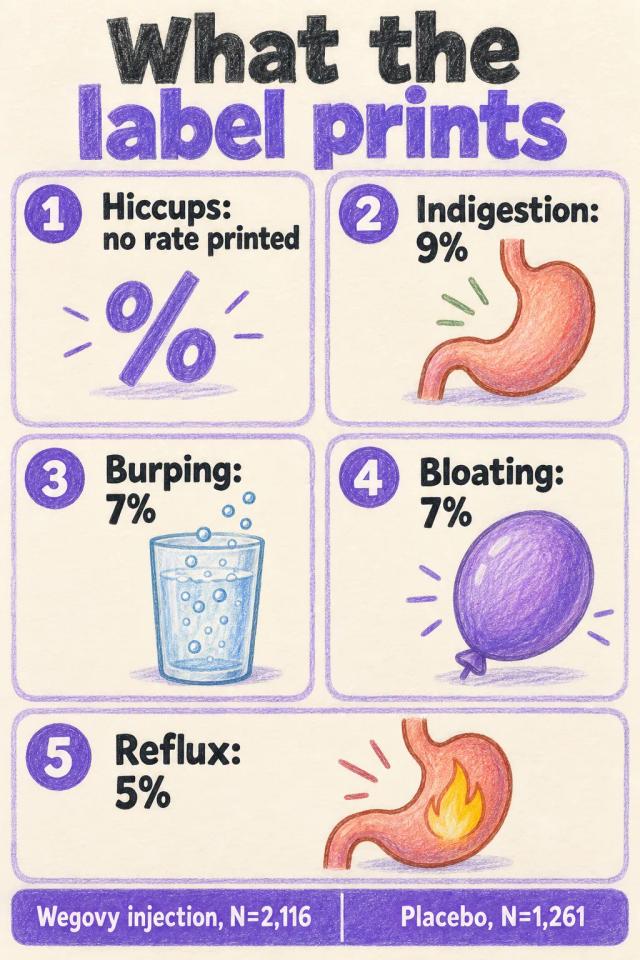
What the label does print are rates for the reactions listed in the same sentence as hiccups, all from Table 3 of the FDA label:
Reaction (Table 3) | Wegovy injection, N=2,116 | Placebo, N=1,261 | In Table 3? |
|---|---|---|---|
Dyspepsia (indigestion) | 9% | 3% | Yes |
Eructation (burping) | 7% | under 1% | Yes |
Abdominal distension | 7% | 5% | Yes |
Gastroesophageal reflux disease | 5% | 3% | Yes |
Gastritis | 4% | 1% | Yes |
Hiccups | no rate printed | no rate printed | No |
Source: the FDA label, Table 3, adults, the same three trials.
Those figures tell you the company hiccups keep, not their frequency.
Why does Wegovy cause hiccups?
The proposed route runs from slowed stomach emptying to a stretched stomach and increased vagal nerve firing, and the vagus nerve is one of the nerves that carry the hiccup reflex. Both halves of that route are sourced. The join between them is proposed, described in people on GLP-1 therapies generally, and never measured for hiccups.
Start with what semaglutide does to a stomach. Mayo Clinic puts it this way: "Semaglutide slows down the rate at which food leaves the stomach and enters the small intestine, a process known as delayed gastric emptying." The Medication Guide says the same thing in the label's own words: "WEGOVY slows stomach emptying and can affect medicines that need to pass through the stomach quickly."
Next, what a slowed stomach does to the nerves around it. A review of nausea and vomiting in GLP-1 based obesity therapies, published as a journal article (via PubMed Central), describes gastric distension and "increased vagal afferent firing" following from that slowing. Vagal afferent firing means signal traffic travelling up the vagus nerve from the gut.
Now the hiccup end. Cleveland Clinic explains the mechanics: "Hiccups happen when something irritates the nerves that cause your diaphragm to contract. These nerves, including your vagus nerve and phrenic nerve, make up a pathway that experts call a reflex arc." The diaphragm is the sheet of muscle under your lungs, and that involuntary jerk is what a hiccup is.
Put the two halves next to each other and you get a plausible line, not a measured one.
Can the reflux Wegovy causes trigger hiccups?
Reflux and hiccups sit on the same label list of reactions that occurred more often on Wegovy injection, and case reports suggest reflux may precipitate hiccups, though those same reports say other factors are involved. The case report, published as a journal article (via PubMed Central), carries its hedge inside the same passage: "Disappearance of protracted hiccups after treatment with PPI in some patients suggests that reflux may precipitate hiccups... However, persistence of hiccups after antireflux surgery in some reports... suggests that other factors may be involved."
That is case-report evidence, in people with reflux disease, not in people on semaglutide.
The vagus and phrenic path is the same one. Mayo Clinic says: "A cause of long-term hiccups is damage to, or irritation of, the vagus nerves or phrenic nerves. These nerves supply the diaphragm muscle."
If heartburn and hiccups arrived in the same week for you, that is two reactions from the same label sentence showing up together, which is worth telling your prescriber. More on the reflux side in semaglutide and acid reflux.
Why did my hiccups come back the week my dose went up?
Because a dose step is exactly where the label puts them. The sentence that follows the one naming hiccups in the FDA label says the reactions it has just listed, hiccups among them, "were most frequently reported during dosage escalation," and that is the label's only statement about when they cluster. So a hiccup that comes back the week your dose steps up is landing exactly where the label says these reactions land.
The literature says the same about the gastrointestinal group as a whole. The review published as a journal article (via PubMed Central) tells clinicians that "gastrointestinal symptoms are dose dependent, common during treatment initiation and escalation, usually transient, influenced by the starting dose, and speed of titration."
Here is the ladder those sentences are describing, straight from the FDA label: 0.25 mg once weekly for weeks 1 through 4, 0.5 mg for weeks 5 through 8, 1 mg for weeks 9 through 12, 1.7 mg for weeks 13 through 16, then a maintenance dose from week 17 of either 1.7 mg or 2.4 mg, with 2.4 mg the recommended maintenance dose for weight reduction in adults. Four step-ups, four points where the label's escalation sentence applies.
The label also states the reason the ladder exists at all: "Follow the dosage escalation in Table 1 to reduce the risk of gastrointestinal adverse reactions." That is a description of the schedule, not an instruction to change yours. Any change to your own ladder is your prescriber's call.
If the hiccups seem to track your dose steps, a dated record beats an impression. In MeAgain you can log the shot day and the dose as prescribed alongside the days the hiccups showed up, so you bring your prescriber two dose steps of dated entries instead of "it seems worse since the increase."
The free version is more than plenty to help keep track of all my doses and meals. This is the first app that I’ve actually stuck to and used for two months consecutively. I especially love the timer after taking my doses
Do hiccups on Wegovy get better as my body adjusts?
Not necessarily, and not on a schedule anyone can give you. Mayo Clinic's semaglutide page says "Some side effects may occur that usually do not need medical attention. These side effects may go away during treatment as your body adjusts to the medicine."
That sentence introduces Mayo Clinic's list of side effects that usually need no medical attention, and hiccups are not on it. The same page puts hiccups in its "check with your doctor right away" list instead, which is what the next section is about. The label attaches no duration to hiccups, so nobody can tell you how many days or weeks yours will run.
How do you stop hiccups on Wegovy?
Novo Nordisk's own instructions for an unsettled stomach on Wegovy are about pace and meal composition, and Mayo Clinic says "Most cases of hiccups go away on their own without medical treatment." The maker gives these instructions for early stomach symptoms generally and does not tie them to hiccups.
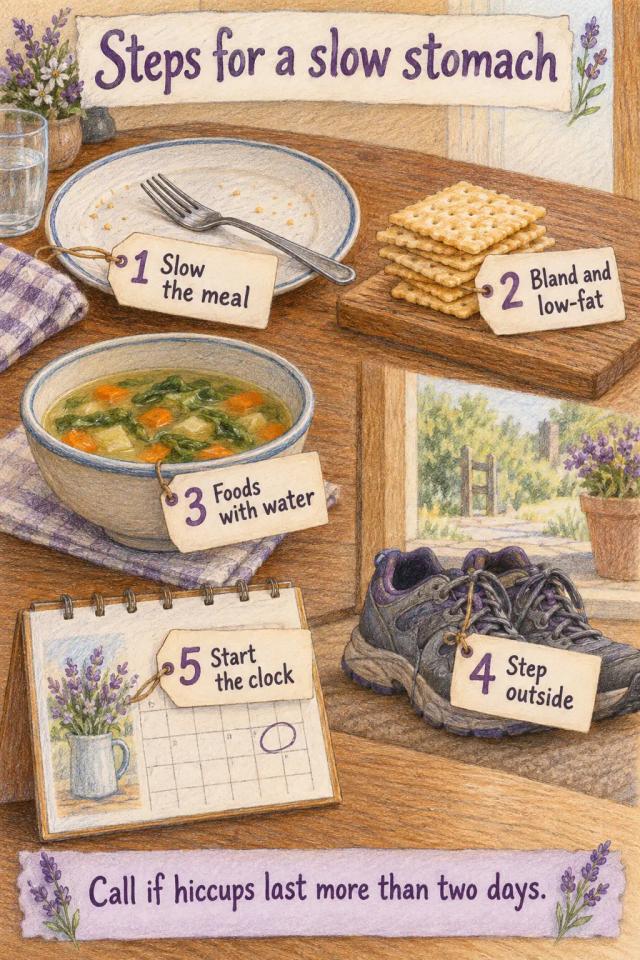
- Slow the meal down. Novo Nordisk lists "Intentionally eat more slowly" under what you can do. A smaller appetite plus an ordinary eating pace is a lot of food arriving fast into a stomach that empties slowly.
- Choose bland and low-fat. The same page names "crackers, toast, and rice" among things that may help.
- Add foods with water in them. It also names "Foods that contain water, like soups and gelatin."
- Stay upright after eating. Novo Nordisk lists "Lying down after eating" under what you may want to avoid, alongside "Eating greasy foods."
- Step outside. The same page lists "Get fresh air outside" under what you can do.
- Start the clock. If the hiccups have not stopped, note the hour they started. Two days is the threshold Cleveland Clinic and Mayo Clinic both use, and the call section below has who to contact and how fast.
Am I hiccuping because I am eating too much or too fast now?
Eating pace may be part of it and cannot be the whole of it. Mayo Clinic says semaglutide slows the rate at which food leaves the stomach, and the review published as a journal article (via PubMed Central) ties that slowing to gastric distension and increased vagal afferent firing. What Novo Nordisk asks of a slow stomach is the same either way: "Intentionally eat more slowly," and avoid "Eating greasy foods" and "Lying down after eating."
When hiccups mean you should call someone
Two days is the line two named authorities draw, and Mayo Clinic's semaglutide page puts hiccups in its check-with-your-doctor-right-away list rather than its no-attention-needed one.
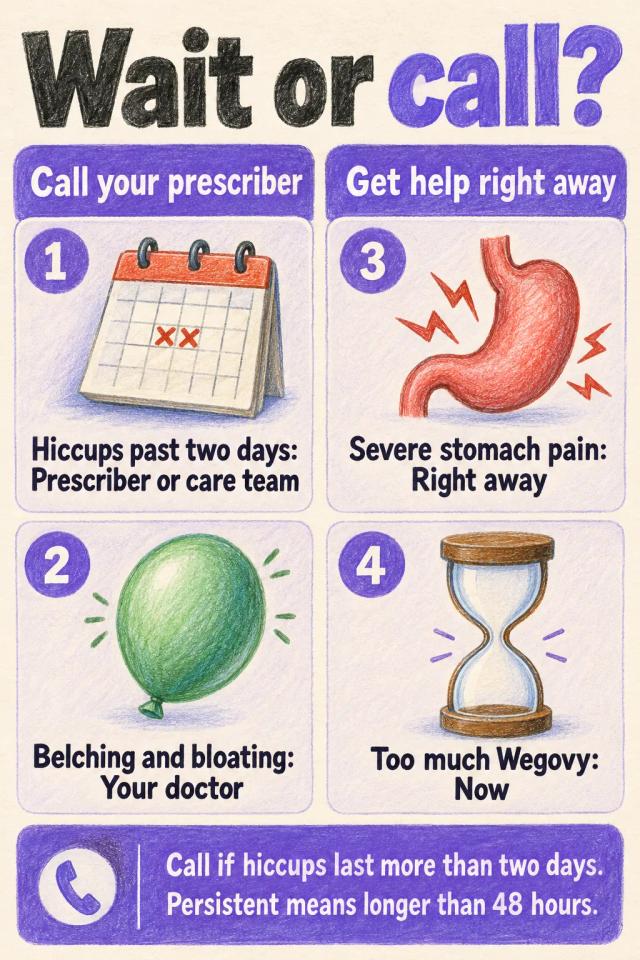
Cleveland Clinic sets the definition and the action: "Persistent hiccups last longer than 48 hours for up to one month," and "you should call one if your hiccups last more than two days." Mayo Clinic draws the same line: "If your hiccups last longer than two days, medicines or certain procedures may be needed." Both are general hiccup guidance, not Wegovy-specific rules.
The FDA label adds its own counseling line for the wider picture: "Instruct patients to contact their healthcare provider if they have severe or persistent gastrointestinal symptoms."
Sign | Who to contact | How fast |
|---|---|---|
"Persistent hiccups last longer than 48 hours for up to one month" (Cleveland Clinic, general clinical guidance, not a Wegovy rule) | Prescriber or care team | "you should call one if your hiccups last more than two days" |
"belching, bloated or full feeling, blood in stools, constipation, diarrhea, excess air or gas in the stomach, hiccups, nausea, stomach pain... or vomiting" (Mayo Clinic) | Your doctor | "Check with your doctor right away" |
"severe pain in your stomach area (abdomen) that will not go away, with or without nausea or vomiting. Sometimes you may feel the pain from your abdomen to your back" (the Medication Guide) | "Stop using WEGOVY and call your healthcare provider right away" | Right away |
"pain in your upper stomach (abdomen), yellowing of skin or eyes (jaundice), fever, clay-colored stools" (the Medication Guide) | "Call your healthcare provider" | Same day |
"nausea, vomiting, or diarrhea that does not go away" (the Medication Guide) | "Tell your healthcare provider right away" | Right away |
"Decreased urine output, dark-colored urine, dry skin, thirst, dizziness" (Johns Hopkins Medicine, general clinical guidance, not a Wegovy rule) | "Call your healthcare provider" | Same day |
"Persistent vomiting. Severe abdominal pain or cramping that comes and goes. Signs of dehydration" (Cleveland Clinic, general clinical guidance) | 911 or an emergency room | "seek immediate care" |
Too much Wegovy: "severe nausea, severe vomiting and severe low blood sugar" (the Medication Guide) | "Call your healthcare provider or Poison Help line at 1-800-222-1222 or go to the nearest hospital emergency room right away" | Now |
Frequently asked questions
I just took my first Wegovy shot and started hiccuping after dinner. Is that normal this early?
The first weeks are where the label puts these reactions, before any step-up has happened. Weeks 1 through 4 are the 0.25 mg starting dose, and the review published as a journal article (via PubMed Central) describes gastrointestinal symptoms as "common during treatment initiation and escalation."
I have been on Wegovy for months at the same dose and get hiccups mostly in the day or two after my shot. Is that a known pattern?
Not one the label describes. Its only statement about when these reactions cluster is about dosage escalation, so a pattern tied to your shot day rather than a dose step is outside what it reports. A dated record of shot days and hiccup days is the thing to bring your prescriber.
What if I already have reflux or a slow stomach before starting Wegovy?
GLP-1 receptor agonists delay gastric emptying, which a journal article (via PubMed) calls "a risk factor for gastroesophageal reflux disease (GERD). However, evidence linking these drugs to GERD is limited." For a slow stomach specifically, Novo Nordisk states that "Wegovy® is not recommended in patients with severe gastroparesis," which is a conversation to have with your prescriber before a dose step rather than after one.
Can I take an antacid or a PPI for the heartburn while I am on Wegovy?
That one goes to your prescriber and your pharmacist, because Wegovy slows stomach emptying and can affect medicines that need to pass through the stomach quickly. The Medication Guide's instruction for anything new, prescription or over the counter, is to "Know the medicines you take. Keep a list of them to show your healthcare provider and pharmacist when you get a new medicine."
Will hiccups change if I switch from the Wegovy injection to the Wegovy pill?
The label's hiccups sentence is written about injection-treated adults. What the label does report for the tablet is that severe gastrointestinal adverse reactions occurred in 2% of Wegovy tablet-treated patients and 0% of placebo-treated patients, and that the switch itself runs "One week after discontinuing WEGOVY 2.4 mg injection, initiate 25 mg of WEGOVY tablets orally once daily" (the FDA label). That is the label's schedule, not an instruction to switch; that call is your prescriber's.
I moved my injection day. Could that be why I am hiccuping?
The rule for moving it comes from Novo Nordisk: "You may change the day of the week or the time of the day you take Wegovy®, as long as your last dose was given 2 or more days before." Neither Novo Nordisk nor the label connects a shifted dosing day to hiccups.
I think I injected two doses. What do I do right now?
Do this now rather than waiting to see how you feel. The Medication Guide says that if you take too much Wegovy you may have severe nausea, severe vomiting and severe low blood sugar, and to "Call your healthcare provider or Poison Help line at 1-800-222-1222 or go to the nearest hospital emergency room right away."
Do children and teens on Wegovy get the same stomach reactions?
They are reported separately and at different figures. In the pediatric weight-reduction trial, 133 patients aged 12 and older on Wegovy injection against 67 on placebo, the FDA label reports gastrointestinal adverse reactions in 62% versus 42%, nausea 42% versus 18%, vomiting 36% versus 10% and diarrhea 22% versus 19%. Hiccups carry no pediatric figure.
Related reading