

An Ozempic bruise is needle trauma, not the drug: the needle nicks a capillary and blood leaks into the fat layer. The label reports injection-site reactions in 0.2% of patients.
You are three weeks or three months in, and there is a purple mark where Sunday's shot went. This page settles whether that came from the medication or the needle, what to change before your next shot, and which bruise means a phone call today.
This article is general information from public sources, not medical advice. Your prescriber and pharmacist know your history; take storage and dosing questions to them.
Last updated September 2026 · Sources verified against the FDA label, the Medication Guide and MedlinePlus.
Key takeaways
- A bruise at the injection site is capillary trauma: the needle damages small blood vessels and blood leaks into the tissue around them, per MedlinePlus.
- The FDA label reports injection-site reactions in 0.2% of Ozempic-treated patients, with injection-site discomfort and erythema among the named examples. That is a figure for injection-site reactions as a category, not a bruising rate.
- The FDA label tells you to use a different injection site each week when injecting in the same body region, Novo Nordisk adds a different spot even within one area, and after bleeding at the site Novo Nordisk says press lightly with a gauze pad or cotton ball and do not rub.
- Blood thinners including aspirin, warfarin and apixaban make bruising more likely, and Mayo Clinic says do not stop your medicines over it, talk with your health care professional.
- Call 911 or go to an emergency room now for extreme pressure in a bruised area that is large or very painful.
What happens under the skin when the needle causes a bruise
A bruise at your injection site is capillary trauma: the needle damages small blood vessels and blood leaks into the tissue around them. A journal article via PubMed Central puts it as "capillaries damaged by trauma, causing localized bleeding that extravasates into the surrounding interstitial tissues". The mark stays visible until the blood is absorbed by tissue or cleared by the immune system.
The injection deliberately targets the fat layer under the skin. Mayo Clinic says the subcutaneous route is preferred over intramuscular injection for its ease of administration and "reduced risk of impacting blood vessels or nerves". Reduced is not none, and the layer is threaded with small vessels you cannot see. The abdomen shows up so often for an ordinary reason: the FDA label puts all three in one instruction, "Inject OZEMPIC subcutaneously in the abdomen, thigh, or upper arm," without singling one out.
Why it bruises some weeks and not others with the same technique
A different spot means a different set of capillaries, which is why identical technique bruises one week and not the next. The needle simply lands somewhere a vessel is or is not.
Speed is the second variable. A journal article via PubMed Central reports that fast injection spreads the drug sideways into an elliptical depot while slow injection forms a spherical one, and concludes that "slow injection of drugs is better for reducing bruising or haematoma". That passage describes the authors' own injection figures, so read it as a mechanism, not as a human bruising rate.
Does Ozempic itself cause bruising?
The needle causes the bruise: a bruise at the site belongs to the injection rather than to the medication in your blood.
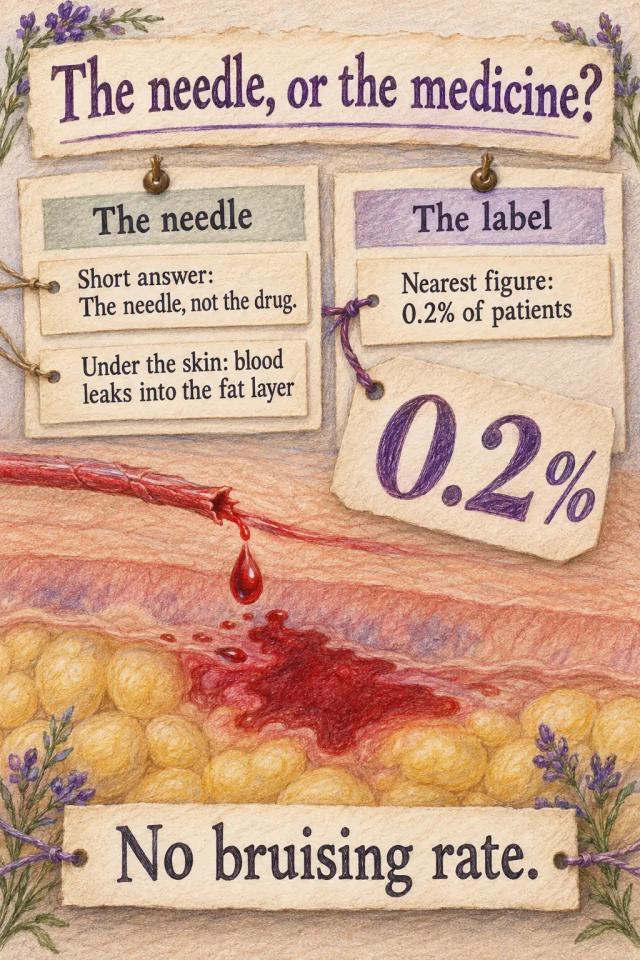
The nearest primary figure sits in the adverse reactions section of the FDA label, where injection-site reactions "were reported in 0.2% of OZEMPIC-treated patients" in the placebo-controlled trial pool. The examples visible in that sentence are injection-site discomfort and erythema, which is redness, and the sentence begins mid-list in every copy we hold, so the full set of reaction types is not visible. It is a figure for injection-site reactions as a category, never a bruising rate.
The insulin-technique literature counts something different in a different drug: a journal article via PubMed Central reports that in insulin users "lipohypertrophy (LH) and bruising (BR) frequently occur as a consequence of improper injection technique". The two sit side by side rather than one overruling the other. For the molecule-level version of this question, see does semaglutide cause bruising.
Is a bruise after the shot normal, or a side effect?
Novo Nordisk treats some bleeding at the site as part of a correctly given injection. Its pen side-effects page says: "After injecting Ozempic® exactly as instructed, some people may experience some bleeding at the injection site. Press on the area lightly with a gauze pad or cotton ball. Do not rub the area."
Novo Nordisk also sets its own limit: talk to your health care professional about "any irritation or reaction at the injection site that bothers you or doesn't go away". A mark that fades is one thing. A site that stays angry gets a call.
How do I avoid bruising when I inject Ozempic?
Seven things are worth changing before your next shot, starting with where the needle goes and how slowly you deliver the dose.
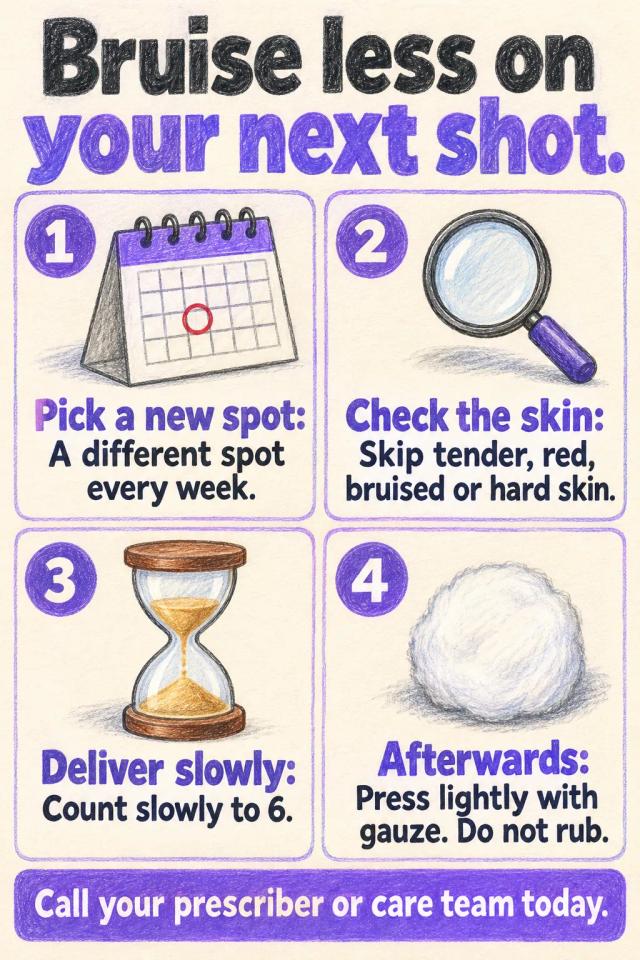
- Pick a new spot. The FDA label says to inject "in the abdomen, thigh, or upper arm" and to "use a different injection site each week when injecting in the same body region". Novo Nordisk's pen dosing page adds: "If you choose to inject in the same area, always use a different spot in that area." The Medication Guide rules out the rest: never into a muscle or a vein.
- Know why rotation matters. Cleveland Clinic describes lipohypertrophy as "a lump of fatty tissue under your skin caused by repeated injections in the same place" that "can affect your body's ability to absorb insulin". That is insulin evidence, and it is the clearest account of what one favorite patch of stomach does over months.
- Skip marked skin. Mayo Clinic says do not inject into skin areas that are "tender, red, bruised, or hard", or into areas with scars or stretch marks.
- Clean and dry the site. The EADSG insulin injection-technique guideline, in a journal article via PubMed Central, says the site "should be clean and dry" and that visibly dirty skin should be cleaned with plain water. It keeps injections 2.5 cm from scars and 5 cm from the umbilicus.
- Deliver slowly. Novo Nordisk's pen dosing page says: "After the dose counter reaches 0, slowly count to 6." That unhurried delivery is the spherical-depot mechanism, applied with the pen you already own.
- Press, do not rub. Novo Nordisk says to press on the area lightly with a gauze pad or cotton ball, and not to rub it.
- Log where it went. Mayo Clinic says "Keep track of where you give each shot to make sure you rotate body areas."
If you are logging shots anyway, put the date and the site in MeAgain each week, and log the injection-site reaction on the days it shows. "I bruise most weeks" then becomes a dated list you can hand your prescriber.
Great for tracking dose, injection site, side effects, and items like my macros and weight are imported from my other apps directly. This app really helps keep track of everything!
How do I treat the bruise I already have, and how long will it take?
Ice it, leave it alone, and expect it to change color for weeks rather than days. MedlinePlus says to place ice on the bruise to help it heal and reduce swelling, wrapped in a clean towel, never directly on the skin. It also gives one flat prohibition: "Do not try to drain the bruise with a needle."
The color course is the healing, not a worsening. NIH News in Health says newly trapped blood makes a bruise look pink or red, and over the next few weeks the body breaks it down and absorbs it, so the bruise changes color as it fades: "Some bruises can take weeks or months to heal."
While it settles, that patch of skin is off the rotation. Next week's shot goes somewhere else.
Do blood thinners or aspirin make injection bruising worse?
Blood thinners raise your baseline tendency to bruise, and none of that is an Ozempic interaction. MedlinePlus is direct: "If you take a blood thinner, such as aspirin, warfarin (Coumadin, Jantoven), dabigatran (Pradaxa), rivaroxaban (Xarelto), apixaban (Eliquis), or clopidogrel (Plavix), you are likely to bruise more easily." The apixaban FDA label adds that combining antiplatelet agents, fibrinolytics, heparin, aspirin and chronic NSAID use "increases the risk of bleeding", a statement about apixaban rather than about your weekly shot.
The action is not a hedge. Mayo Clinic says: "If you notice that you're bruising easily, don't stop taking your medicines. Talk with your healthcare professional about your concerns." Mayo Clinic's news network page says to bring a list of the medications you take to the appointment, since some drugs raise bruising risk.
If you have a bleeding disorder, low platelets or liver disease, the bruising may belong to that rather than to the needle. Mayo Clinic says easy bruising "sometimes may be a symptom of a serious health issue, such as a blood-clotting condition or a blood disease". That conversation belongs with your care team.
What if I have bruises nowhere near the injection site?
A bruise on skin you have never injected is a different question from an injection bruise, and it belongs with your care team rather than with your technique. A journal article via PubMed reports that in insulin users "Bruising was not present in skin areas other than those used for insulin injection", which is insulin evidence, in that report's patients. Call your prescriber or care team today if you are "bruising without any injury, fall, or other reason", per MedlinePlus, if you have "bruises that begin suddenly or seem to develop for no reason", per Mayo Clinic, or if the bruising is new, more frequent or more severe.
Where to get help
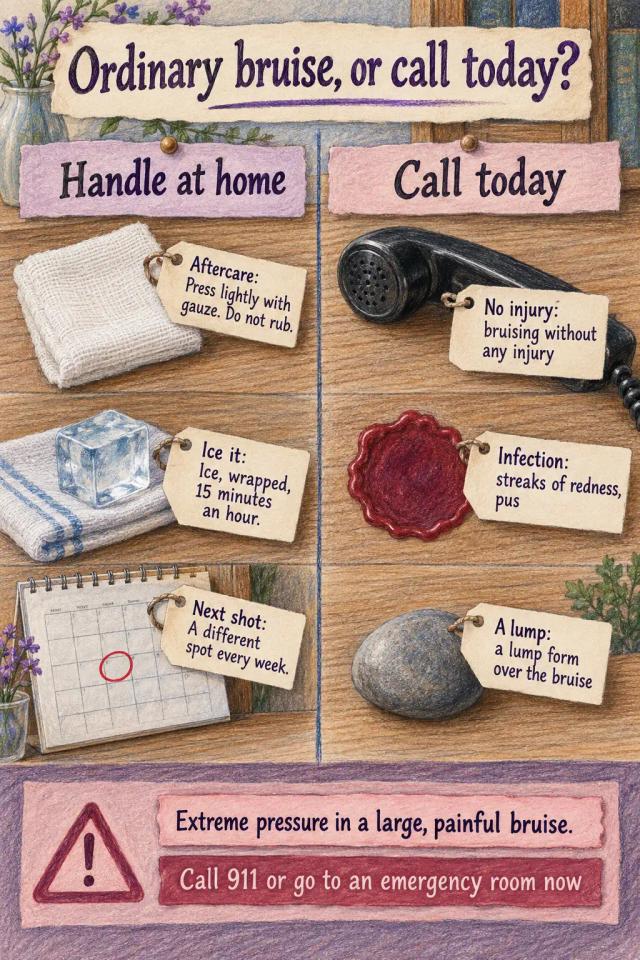
Match what you can see to the left-hand column and act at the speed in the middle.
Sign | Contact and how fast | Source |
|---|---|---|
"extreme pressure in a bruised part of your body, especially if the area is large or very painful" (possible compartment syndrome, "can be life-threatening") | Call 911 or go to an emergency room now | |
Any symptoms of a serious allergic reaction, "including swelling of your face, lips, tongue, or throat; problems breathing or swallowing; severe rash or itching; fainting or feeling dizzy; or very rapid heartbeat" | "Stop using Ozempic® and get medical help right away" | |
"signs of infection around the bruised area including streaks of redness, pus or other drainage, or fever" | Call your prescriber or care team today | |
"You are bruising without any injury, fall, or other reason" | Call your prescriber or care team today | |
"the bruising developed recently or has become more frequent or more severe" | Call your prescriber or primary care doctor today | |
"Notice a lump form over the bruise, which may be a sign of pooling blood, also called a hematoma" | Call your prescriber or care team today | |
"Have unusual bleeding, such as from the nose or gums" | Call your prescriber or care team today | |
"any irritation or reaction at the injection site that bothers you or doesn't go away" | Call your prescriber or care team today | |
More Ozempic injected than prescribed | Call Poison Help at 1-800-222-1222 or your prescriber, or "go to the nearest hospital emergency room right away" |
Frequently asked questions
My Ozempic injection bled and left a dark bruise. Did I still get my full dose?
Novo Nordisk says that after injecting Ozempic exactly as instructed, some people experience some bleeding at the injection site, so bleeding is not in itself a sign the injection went wrong. The pen's own check is the one you use next week: Novo Nordisk's pen dosing page says that after the dose counter reaches 0, slowly count to 6 before you remove the needle. Take the dose question itself to your prescriber.
What does an infected Ozempic injection site look like compared with an ordinary bruise?
An ordinary bruise changes color and fades. MedlinePlus says "streaks of redness, pus or other drainage, or fever" around the area are signs of infection, and those get a call to your prescriber or care team today.
Related reading