

Brain fog is not in Zepbound's adverse reactions table, but fatigue (5% to 7% by dose) and dizziness (4% to 5%) are, and the label's own hypoglycemia list names "confusion or drowsiness."
If you have read the side effect list looking for "brain fog" and not found it, this page explains what that silence does and does not prove, the words the labelling uses for your symptom instead, and the version of foggy thinking that means calling someone today. Tirzepatide is sold as Zepbound for weight and as Mounjaro for type 2 diabetes; the rates here come from Zepbound's obesity trials, and the same low blood sugar sign list appears in Mounjaro's Medication Guide.
This article is general information from public sources, not medical advice. Your prescriber and pharmacist know your history; take storage and dosing questions to them.
Last updated September 2026 · Sources verified against the FDA label, the Medication Guide and Mayo Clinic's tirzepatide page.
Key takeaways
- Brain fog, confusion and cognitive impairment are not listed in Zepbound's adverse reactions table in the FDA label.
- Fatigue ran 3% on placebo against 5% at 5 mg, 6% at 10 mg and 7% at 15 mg, and dizziness 2% against 4%, 5% and 4%, in 2,519 adults with obesity or overweight treated for up to 72 weeks, per the FDA label.
- The Medication Guide's list of low blood sugar signs includes "confusion or drowsiness," and that risk is far higher alongside a sulfonylurea: 10.3% versus 2.1% in Study 2 patients with type 2 diabetes.
- Confusion that has come on suddenly is a 911 call now, per MedlinePlus; confusion that has been building for days is a call to your prescriber today.
Does tirzepatide cause brain fog?
Tirzepatide has no measured effect on thinking in the labelling, so brain fog is not a proven side effect, and the explanations that have sources behind them are all indirect.
Brain fog is a description rather than a diagnosis. Cleveland Clinic calls it "a common group of symptoms that affect how you think, remember and concentrate," adding that "it's usually temporary, but the length of time you'll experience brain fog can vary." That is why it does not appear in a drug table: the table counts named reactions, and this is a bundle of them.
The mechanism the FDA label gives stops at appetite: "Both GIP receptors and GLP-1 receptors are found in areas of the brain involved in appetite regulation. Animal studies show that tirzepatide distributes to and activates neurons in brain regions involved in regulation of appetite and food intake," and the effects "are likely mediated by affecting appetite." Animal studies, and "likely."
So the useful question is which of four things is making this week foggy: low blood sugar, an intake that has fallen further than you noticed, a dose step, or something that has nothing to do with tirzepatide.
What the label lists, and what "not in Table 1" actually means
Zepbound's Table 1 lists fatigue and dizziness with rates by dose, and it does not list brain fog, confusion or cognitive impairment anywhere in it.
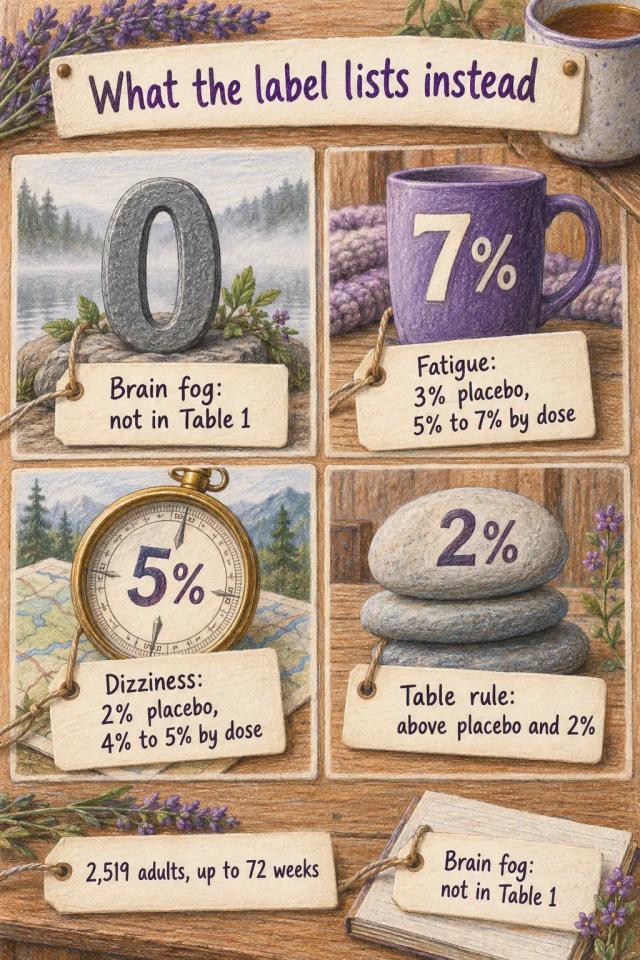
The table admits a reaction on two conditions at once. The FDA label states the rule: "These adverse reactions occurred more commonly with ZEPBOUND than with placebo and occurred in at least 2% of patients treated with ZEPBOUND." Because both had to be true, a reaction's absence proves neither one. It does not mean brain fog fell under that threshold, and it does not mean it matched placebo.
Fatigue's footnote is broader than the word suggests: "Includes asthenia, fatigue, lethargy, malaise." The rates come from a pool of two randomized, double-blind, placebo-controlled trials in 2,519 adults with obesity or overweight, mean age 47 and 37% male, treated for up to 72 weeks with a 4-week off-drug follow-up.
Reaction | Placebo | 5 mg | 10 mg / 15 mg |
|---|---|---|---|
Fatigue (includes asthenia, lethargy, malaise) | 3% | 5% | 6% and 7% |
Dizziness | 2% | 4% | 5% and 4% |
Severe gastrointestinal reactions | 1% | 1.7% | 2.5% and 3.1% |
Brain fog, confusion, cognitive impairment | not listed | not listed | not listed |
Rates from the FDA label, pooled Studies 1 and 2.
The label gives no duration for fatigue or dizziness. It does say that "the majority of nausea, vomiting, and/or diarrhea events occurred during dose escalation and decreased over time," but that sentence is about stomach side effects, not a timeline for foggy thinking.
Could this be low blood sugar rather than the drug itself?
The Medication Guide's list of low blood sugar signs includes "confusion or drowsiness," which is the closest thing in the labelling to what you are calling brain fog. Mayo Clinic's tirzepatide page uses your exact words: "confusion... difficulty with thinking, drowsiness."
The two sources disagree about the drug on its own. Mayo, retrieved September 2026, says "this medicine does not cause hypoglycemia (low blood sugar). However, low blood sugar can occur when you use tirzepatide with other medicines, including insulin or sulfonylureas." The FDA label, the same day, says hypoglycemia "has also been associated with ZEPBOUND and GLP-1 receptor agonists in adults without type 2 diabetes mellitus." Follow the label: it is the approved manufacturer labelling. Both agree the risk climbs sharply alongside other glucose-lowering medicines, and in Study 2, among patients with type 2 diabetes, those taking a sulfonylurea had hypoglycemia at 10.3% compared with 2.1% of Zepbound-treated patients not taking one.
Mayo also names the situations that produce low blood sugar without any second drug involved: you delayed or missed a meal or snack, exercised more than usual, drank alcohol, or could not eat because of nausea or vomiting.
A sick week counts twice. The Medication Guide names a separate harm, that "diarrhea, nausea, and vomiting may cause a loss of fluids (dehydration) which may cause kidney problems," and gives the instruction: "Tell your healthcare provider right away if you have nausea, vomiting, or diarrhea that does not go away." If those signs fit your foggy afternoons, call your care team today.
Could it be how little you are eating, or the dose you just stepped up to?
Two things can make a foggy week worse without brain fog ever being a drug effect: an intake that has fallen further than you noticed, and a dose step you are two weeks into.
The intake route
Appetite suppression can drop intake far enough to produce deficiency signs that feel exactly like fog. A review in a journal article via PubMed Central reports it as a clinical observation: "some individuals may experience profound appetite suppression, with caloric intake occasionally falling below 800 kcal/day. Such reductions may lead to micronutrient deficiencies and loss of lean body mass, potentially impairing functional capacity."
The signs that a shortfall, not the drug itself, is behind the tiredness are listed in a journal article via PubMed Central: "fatigue beyond expected levels, excessive hair loss, skin flakiness or itching, muscle weakness." That review's practical advice is to eat "a small breakfast and then additional small meals every 3-4 h while drinking adequate fluids." Our Mounjaro brain fog page carries the full routine.
The dose-step route
A fog that starts two weeks after a dose increase is worth dating, because the severity of the drug's measured reactions rises with dose: severe gastrointestinal reactions ran 1.7%, 2.5% and 3.1% against 1% on placebo, per the table above.
Tolerating a lower dose does not settle the next one. A case report in a journal article via PubMed Central describes one patient a year into tirzepatide whose dose was raised to 15 mg, with persistent nausea, vomiting and diarrhea starting about two weeks later.
The label reports fatigue as a rate, not a curve, so there is no documented post-injection peak to expect. If the fog seems to track your shot or a dose step, log the shot day, the dose, and the fog days with severity in MeAgain, alongside what you ate and drank.
I’m tracking my food easily and trying to achieve the goals for protein, fiber, water intake, carbs and fats. Love the barcode scanner. The integrated steps counter and activity log. It’s a keeper for me. The Capy feature can send you messages for logging your dosage or even your log your food at specific times.
Could this be your thyroid, your sleep, or something else entirely?
Several conditions produce this same symptom picture. Thyroid disease is the closest match by vocabulary: a review in a journal article via PubMed Central describes residual hypothyroid symptoms as "sometimes referred to as brain fog, these cognitive-, mood-, and QoL residual symptoms include mental fatigue, memory, and sleep problems, difficulty focusing and making decisions, anxiety, and mental confusion."
Sleep is the other. Seven percent of the trial population had obstructive sleep apnea at baseline, per the FDA label, and a journal article via PubMed Central describes repeated airway obstruction that "leads to unrefreshing sleep, fatigue, tiredness, or lack of energy." Low iron and perimenopause are reasonable things to raise with your prescriber.
Where to get help
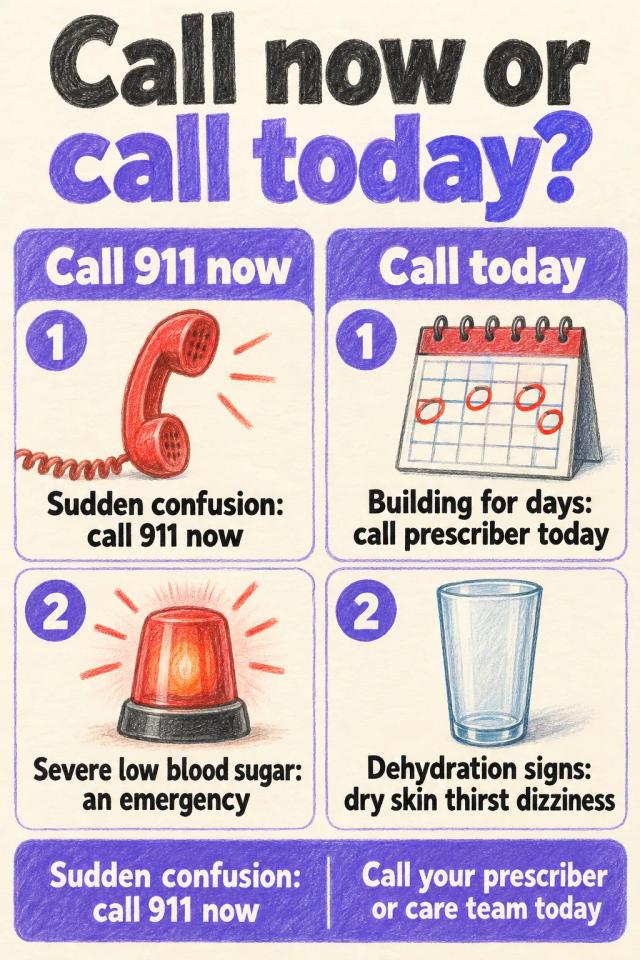
Confusion that comes on suddenly is a 911 call now; confusion that has been building over days is a call to your prescriber today.
Sign, in the source's words | Who and how fast | Source |
|---|---|---|
Low blood sugar signs: "dizziness or light-headedness sweating confusion or drowsiness headache blurred vision slurred speech shakiness fast heartbeat" | Call your prescriber or care team today | |
"Severe hypoglycemia should be considered an emergency" | "Don't hesitate to call 911, if needed, or if glucagon is not readily available" | |
Confusion that "has come on suddenly," or confusion with "other symptoms, such as: Cold or clammy skin. Dizziness or feeling faint. Fast pulse. Fever. Headache. Slow or rapid breathing. Uncontrolled shivering"; "this is the first time someone becomes confused for no reason"; "confusion came on after a head injury"; "the person is in danger of harming themselves or others"; or "the person becomes unconscious at any time" | Call 911 or go to an emergency room now | |
"Nausea, vomiting, or diarrhea that does not go away" | Call your prescriber or care team today | |
Two doses within 72 hours: "do not take 2 doses of ZEPBOUND within 3 days (72 hours) of each other" | Call your prescriber or Poison Help at 1-800-222-1222, or go to the nearest emergency room right away |
For fog that has simply been there for a week, MedlinePlus gives the non-urgent route: "if you have been experiencing confusion, contact your provider for an appointment." It adds: "a confused person should not be left alone."
Frequently asked questions
Is it safe to drive if I feel foggy after my shot?
The Canadian product monograph says, "No studies on the effects of the ability to drive and use machines have been performed," and adds that patients taking Zepbound with a sulfonylurea or insulin "should be advised to take precautions to avoid hypoglycemia while driving and using machines." Ask your prescriber about your own driving.
Related reading