

Yes: the FDA label counts dry mouth or dry throat in 1% of Zepbound-treated patients against 0.1% on placebo, and because vomiting and diarrhea may dehydrate you, the dryness is also a cue to check your fluids.
This is for you if your mouth has felt dry or sticky on Zepbound, or if you're watching a partner or parent go through it, especially in a week when nausea, vomiting or diarrhea has cut how much you drink. Below: the label's figure, why it happens, what eases it, and when to call your prescriber today or get emergency care now.
This article is general information from public sources, not medical advice. Your prescriber and pharmacist know your history; take storage and dosing questions to them.
Last updated September 2026 · Sources verified against the Medication Guide, the FDA label, and Lilly's side-effects page.
Key takeaways
- Dry mouth or dry throat: 1% vs 0.1%, Zepbound against placebo in the FDA label. Talk to your prescriber if the dryness bothers you or does not go away.
- Diarrhea and vomiting may cause dehydration, which the Medication Guide says may cause kidney problems. Vomiting or diarrhea that won't stop: call your prescriber or care team today.
- Lilly's side-effects page lists at least 8-10 glasses of clear fluids daily beside its stomach-upset tips; ask your prescriber how much you need.
Does Zepbound cause dry mouth?
Yes: the FDA label reports dry mouth or dry throat in 1% of Zepbound-treated patients against 0.1% on placebo. The label counts "dry mouth or dry throat" as one term.
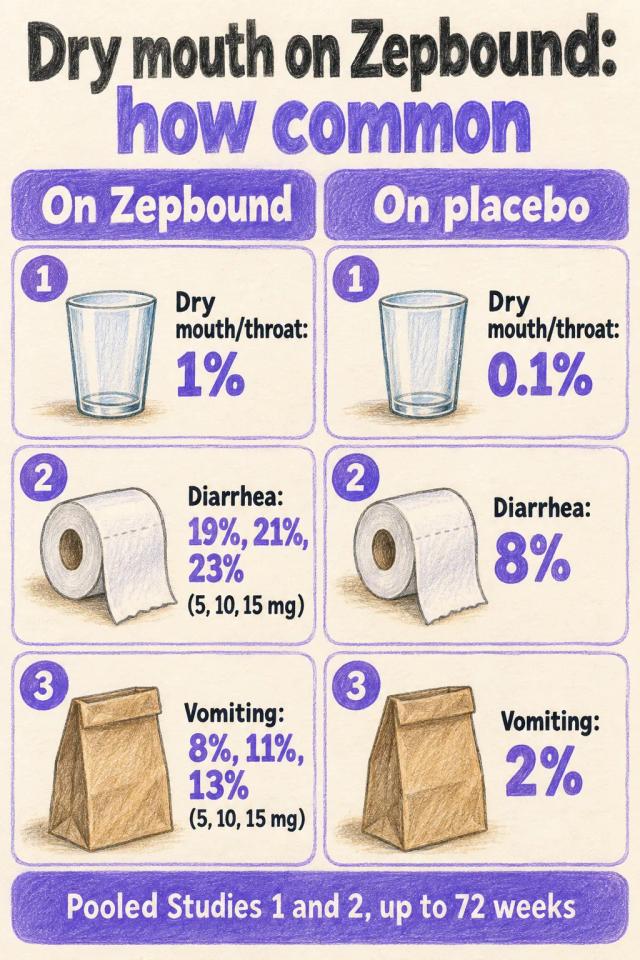
The figure pools every dose, in adults with obesity or overweight; 25% of them had type 2 diabetes. It sits outside the label's Table 1, which lists only reactions "≥2% and Greater than Placebo."
Dry mouth isn't on the Medication Guide's list of most common side effects either. The FDA label gives a rate for dry mouth or dry throat but no figure for how long it lasts, so the Medication Guide's rule applies: "Talk to your healthcare provider if you have any side effect that bothers you or that does not go away."
Pooled Studies 1 and 2, up to 72 weeks: 2,519 adults on Zepbound, 958 on placebo, in the FDA label.
Side effect | Zepbound | Placebo | How the label reports it |
|---|---|---|---|
Dry mouth or dry throat | 1% | 0.1% | Doses pooled, outside Table 1 |
Nausea | 25%, 29%, 28% (5, 10, 15 mg) | 8% | By dose, Table 1 |
Diarrhea | 19%, 21%, 23% (5, 10, 15 mg) | 8% | By dose, Table 1 |
Vomiting | 8%, 11%, 13% (5, 10, 15 mg) | 2% | By dose, Table 1 |
Why does Zepbound cause dry mouth?
One possible link is fluid loss: writing about dry mouth in general, not Zepbound, Cleveland Clinic says "your mouth gets dry when you're dehydrated."
Stomach side effects cost you fluids: the Medication Guide says "Diarrhea, nausea, and vomiting may cause a loss of fluids (dehydration)." If those symptoms don't go away, call your prescriber or care team today. Zepbound also cuts how much you eat: the FDA label says "Tirzepatide decreases calorie intake. The effects are likely mediated by affecting appetite."
Two further effects have been proposed, neither shown for tirzepatide. Researchers writing in a journal article (via PubMed Central) propose that GLP-1 agonism, the receptor action of this drug class, "may reduce thirst and water intake." Others, writing about semaglutide in a journal article (via PubMed), put forward as a hypothesis a direct effect on the salivary glands, which carry GLP-1 receptors "at low but detectable levels."
Why does my mouth feel dry every time my Zepbound dose goes up?
Dose steps can bring stomach side effects that cost you fluids: the FDA label raises doses slowly "to reduce the risk of gastrointestinal adverse reactions," though it reports dry mouth only across all doses combined. It also tells prescribers to monitor kidney function in patients whose side effects could lead to volume depletion (fluid loss), "especially during dosage initiation and escalation."
If your mouth goes dry the week after a step, check whether nausea or vomiting has cut what you drink. The tirzepatide dose schedule lays out the label's steps; yours come from your prescriber.
Is dry mouth on Zepbound a sign you are not drinking enough?
Dry mouth on Zepbound can be a sign you are low on fluids, especially in a week of nausea, vomiting or diarrhea: Cleveland Clinic says "your mouth gets dry when you're dehydrated." The Medication Guide warns that dehydration "may cause kidney problems" and says: "It is important for you to drink fluids to help reduce your chance of dehydration."
Say a dose step brought diarrhea and your mouth feels sticky: that dryness is a prompt to drink.
Behind that warning, the FDA label describes postmarketing reports, made after approval, of acute kidney injury in people treated with GLP-1 receptor agonists or Zepbound, "in some cases requiring hemodialysis" (a form of kidney dialysis). Most involved patients whose nausea, vomiting or diarrhea led to dehydration.
If nausea, vomiting or diarrhea does not go away, call your prescriber or care team today. For diarrhea itself, see diarrhea on Zepbound.
How much water should I drink each day on Zepbound?
Lilly's side-effects page advises: "Drink at least 8-10 glasses of clear fluids daily. Water is generally preferred." The line sits beside advice to limit dairy and try bland foods, so read it as stomach-upset advice, not a dry-mouth rule, and ask your prescriber how much you need. For the wider picture, see how much water to drink on a GLP-1.
If dry days seem to cluster around your dose steps, log your water in MeAgain's food and water logging, along with the days nausea, vomiting or diarrhea hit and how severe they were. MeAgain shows side effects next to your dose changes, and a dated record of low-fluid days around a step is easier to talk through with your prescriber than memory.
Love this app use it every day so helpful to make sure I eat enough protein and drink enough water really helping me achieve my goals highly recommended worth every cent for premium sub - thank you
What helps dry mouth on Zepbound
Steady sips through the day are the first fix for dry mouth on Zepbound, with sugar-free gum and a check on your fluids as backup.
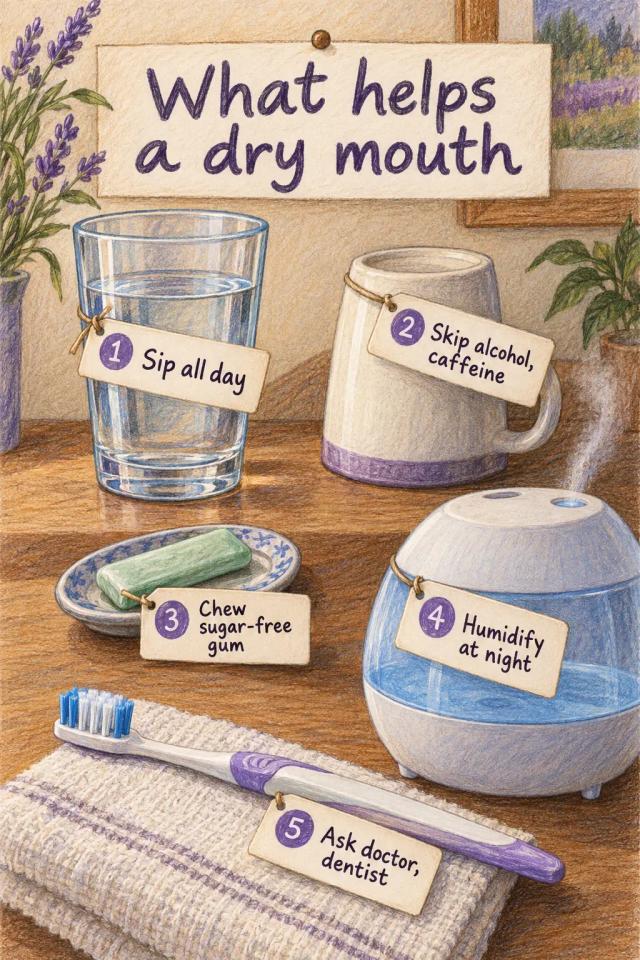
- Sip all day. Mayo Clinic says to sip water or other sugar-free liquids, or suck on ice chips, throughout the day.
- Skip alcohol and caffeine drinks. Mayo Clinic says both "can increase dry mouth and cause irritation."
- Get saliva going. Sugar-free gum or candy helps saliva flow, Mayo Clinic says.
- Top up on stomach-upset days. When nausea, vomiting or diarrhea hits, follow Lilly's fluid advice above.
- Humidify at night. Cleveland Clinic suggests a cool-mist humidifier, "especially if you breathe through your mouth at night."
- Ask your prescriber or dentist. If nothing helps, Mayo Clinic says to "talk to your doctor or dentist. The cause could be a medicine or another health problem."
Can I use sugar-free gum or lozenges for dry mouth on Zepbound?
Yes, in moderation: xylitol, often found in sugar-free gum and hard candies, "may cause diarrhea or cramps if a lot is eaten," Mayo Clinic says. That matters on Zepbound, where diarrhea is already a common side effect, so go easy in a week it has hit.
Can dry mouth on Zepbound cause cavities or gum problems?
Yes: lasting dry mouth can raise dental risk, because a systematic review in a journal article (via PubMed Central) notes, citing earlier work, that xerostomia, the medical name for dry mouth, "reduces salivary clearance and increases plaque accumulation, leading to greater gingival inflammation and higher periodontitis risk." In plain terms: more plaque, more gum inflammation, more risk of gum disease. Cleveland Clinic adds: "Dry mouth at night is more likely to cause cavities and other dental issues."
The same review points to what helps: people with dry mouth kept plaque control similar to people without it over long-term care, "provided recall visits and hygiene support were frequent." So keep your dental check-ups.
When to call your prescriber or get emergency care
Nausea, vomiting or diarrhea that does not go away means calling your prescriber or care team today, and severe cramping with vomiting and no stool is an emergency, in the table below. If vomiting or diarrhea means you can't keep fluids down, treat it as the Medication Guide's "nausea, vomiting, or diarrhea that does not go away" and call your prescriber or care team today; the instruction is "Tell your healthcare provider right away."
Warning sign (source wording) | Who and how fast | Source |
|---|---|---|
"nausea, vomiting, or diarrhea that does not go away" | Call your prescriber or care team today: "Tell your healthcare provider right away" | the Medication Guide; the FDA label ("promptly report") |
"stomach problems that are severe or will not go away" | Call your prescriber or care team today: "Tell your healthcare provider" | |
"severe abdominal pain, vomiting, and inability to pass stool"; "severe cramping alongside symptoms like bloating and vomiting" | Call 911 or go to an emergency room now: "Get medical help right away"; "a medical emergency that requires immediate care" | Johns Hopkins Medicine; Cleveland Clinic. General guidance, not a Zepbound label rule |
"any side effect that bothers you or that does not go away" | Call your prescriber or care team: "Talk to your healthcare provider" |
Frequently asked questions
Is a dry or scratchy throat on Zepbound the same side effect?
Yes: the FDA label folds mouth and throat into one term, so a dry throat counts. Cleveland Clinic suggests sipping water before you swallow tablets.
Does Zepbound cause dry mouth at night?
It can: night dryness is the same side effect the FDA label counts as dry mouth or dry throat. For nights, Cleveland Clinic suggests: "Use a cool-mist humidifier, especially if you breathe through your mouth at night."
How can I tell if an older adult on Zepbound is getting dehydrated when they say they are not thirsty?
Don't rely on their thirst: Cleveland Clinic says adults 65 and older "can't tell as easily when they're thirsty," and Mayo Clinic says many older adults "don't feel thirsty until they're dehydrated." Cleveland Clinic tells caregivers to "offer them drinks frequently."
Can antihistamines, antidepressants or diuretics make dry mouth worse on Zepbound?
Antihistamines, decongestants and some antidepressants dry the mouth on their own, Cleveland Clinic says, and Mayo Clinic adds medicines for depression, high blood pressure and anxiety. Any change to them, or to Zepbound, goes through your prescriber.
Could dry mouth on Zepbound be a sign of high blood sugar if I have diabetes?
It can: Cleveland Clinic says dry mouth "can be a symptom of high blood sugar in people with diabetes," so bring a new dry mouth to your prescriber or care team rather than putting it down to Zepbound.
Is dry mouth more or less common if I switch from Ozempic or Wegovy to Zepbound?
Zepbound's dry mouth rate can't be ranked against Ozempic or Wegovy: the FDA label says trial rates for one drug "cannot be directly compared to rates in the clinical trials of another drug." Plan any switch with your prescriber, since the Medication Guide says Zepbound "should not be used with other tirzepatide-containing products or any GLP-1 receptor agonist medicines."
How do I stay hydrated on a flight while taking Zepbound, and can I bring an empty water bottle?
Yes, bring it empty: the TSA allows an empty water bottle in carry-on and checked bags, and the TSA limits filled carry-on bottles to "3.4oz/100 ml" or less, as of September 2026. "The final decision rests with the TSA officer," so pack it empty and sip steadily once you're through.