
Tirzepatide offers significant weight-loss benefits, but compounded versions with B12 from local pharmacies or online providers raise important questions about quality. These formulations may contain impurities that affect both safety and effectiveness. Understanding quality control standards, preparation methods, and potential contaminants becomes essential when choosing compounded medications over brand-name options.
Tracking your experience with compounded tirzepatide with B12 helps identify potential quality issues through monitoring unexpected reactions. Having access to educational resources on proper storage requirements, sterility testing, and the right questions to ask your compounding pharmacy empowers you to make better health decisions. Tools that provide clear information and tracking capabilities help patients advocate for their safety when navigating medication purity concerns through a reliable GLP-1 app.
Table of Contents
- What Is Compounded Tirzepatide With B12 and Why Is It Used?
- Does B12 Change How Compounded Tirzepatide Works in the Body?
- Is Compounded Tirzepatide With B12 Safe?
- Turn GLP-1 + B12 Side Effect Confusion Into a Daily System You Can Actually Control
Key Takeaways
- Compounded tirzepatide with B12 operates through two completely separate biological pathways that do not interact at the receptor level, in metabolism, or during absorption. Tirzepatide activates GLP-1 and GIP receptors to suppress appetite and regulate blood sugar, while B12 functions as a cofactor in DNA synthesis and red blood cell formation. The combination exists for regulatory and practical reasons, not because one ingredient enhances or modifies the other. Clinical trials showed tirzepatide produced approximately 21% total body weight loss over 72 weeks, a result driven entirely by dual-receptor activation, not by any additive ingredient.
- The primary safety concern with compounded tirzepatide has nothing to do with B12 toxicity and everything to do with formulation quality control. Eli Lilly testing identified a chemical reaction between tirzepatide and B12 in the same solution that produces a molecule larger than tirzepatide alone, with no data on its short-term or long-term effects on efficacy, toxicity, or immune reactions. The FDA has documented potency variations across compounded products, with some containing less tirzepatide than labeled, along with sterility concerns and quality control inconsistencies that apply to all compounded formulations, regardless of B12 inclusion.
- B12 supplementation provides genuine clinical value only for patients with documented deficiency, malabsorption conditions, or those at risk of depletion from long-term GLP-1 therapy. According to the National Institutes of Health Office of Dietary Supplements, B12 supplementation benefits only individuals with documented deficiency or malabsorption. For people with normal B12 levels, additional supplementation does not improve energy, metabolism, or weight loss outcomes. About 6% of adults under 60 and 20% of adults over 60 have B12 deficiency, making routine supplementation appropriate for specific populations but unnecessary for most tirzepatide users starting treatment with adequate levels.
- Fatigue on GLP-1 medications typically stems from caloric restriction, dehydration, or inadequate protein intake rather than B12 deficiency. A 2021 clinical review in Diabetes, Obesity and Metabolism found that patients on tirzepatide who maintained adequate hydration and protein intake (at least 0.8 grams per kilogram of body weight daily) reported significantly lower rates of fatigue and weakness compared to those who didn't prioritize these basics. B12 supplementation did not appear as a variable in fatigue outcomes among patients without preexisting deficiency, revealing that most energy-related complaints have nutritional rather than vitamin-based solutions.
- The lack of formal stability and compatibility studies for compounded tirzepatide with B12 creates an unknown risk profile that extends beyond the well-documented safety of each ingredient in isolation. Compounded medications are not required to demonstrate batch-to-batch consistency as FDA-approved drugs are, meaning that variability in tirzepatide concentration translates directly into variability in receptor activation, appetite suppression, and side-effect intensity. A 10% reduction in tirzepatide content produces weaker effects, while a 10% increase intensifies side effects without any change in prescribed dose, creating an unpredictable treatment experience that B12's presence does nothing to stabilize.
- MeAgain's GLP-1 app addresses this variability by consolidating medication timing, injection site rotation, side-effect patterns, and nutritional intake into a single tracking system that makes it easier to determine whether symptoms correlate with dose changes, low protein intake, dehydration, or potential formulation-quality issues.
What Is Compounded Tirzepatide With B12 and Why Is It Used?
Compounded tirzepatide with B12 is a custom-made version of the GLP-1 medication tirzepatide, combined with vitamin B12 in the same injectable formulation. Unlike FDA-approved brand-name medications made under strict standardized conditions, compounded versions are made by specialty pharmacies for patients who need different dosing, face supply shortages, or seek lower-cost options. The B12 addition is marketed to support energy levels and reduce fatigue during weight loss, though this claim warrants scrutiny.

"Compounded medications fill an important gap when patients need customized dosing or face drug shortages, but they lack the rigorous testing and quality controls of FDA-approved drugs." — FDA Guidelines on Compounding

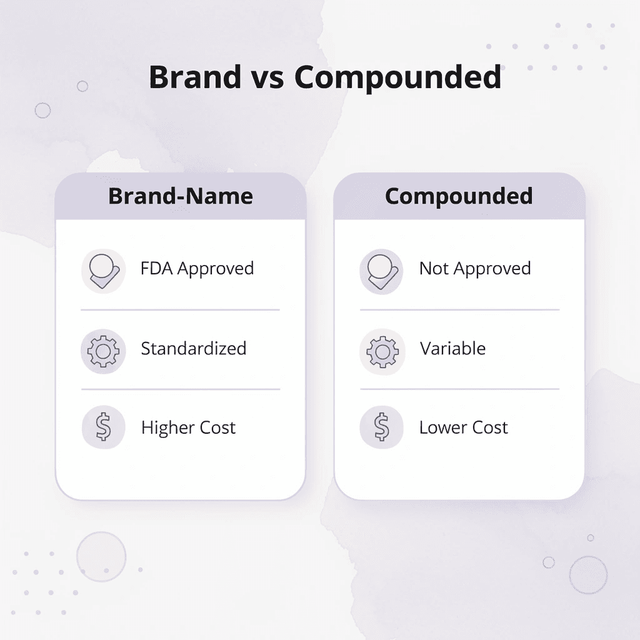
Aspect | Brand-Name Tirzepatide | Compounded Tirzepatide + B12 |
|---|---|---|
FDA Approval | Yes | No |
Quality Control | Standardized | Varies by pharmacy |
Cost | Higher | Lower |
Customization | Limited | Flexible dosing |
B12 Addition | Not included | Included |
Does adding B12 make compounded tirzepatide safer or more effective?
Most people assume that adding B12 to compounded tirzepatide makes it safer or reduces side effects. Since B12 supports energy production and metabolism, combining it with a GLP-1 receptor agonist seems like a logical improvement: two benefits in one syringe.
Why doesn't B12 improve the safety profile of compounded tirzepatide?
This assumption is not true. B12 does not stop formula changes, stabilize the active medicine, improve cleanliness, or compensate for differences in how compounding pharmacies prepare tirzepatide. The vitamin and the GLP-1 receptor agonist work through separate biological pathways: one supports metabolic cofactor functions; the other mimics incretin hormones that regulate blood sugar and appetite. They don't interact in ways that would reduce nausea, improve tolerance, or make the medication work more predictably.
Why do people think B12 enhances compounded tirzepatide?
This belief persists because B12 has received substantial marketing support over decades. Injectable B12 has been used since the 1950s to treat anemia and vitamin deficiency, and wellness clinics have promoted it as an energy booster. When patients start GLP-1 medications and reduce their calorie intake, they often feel tired. The connection between fatigue and B12 deficiency is deeply embedded in popular health culture, which compounding pharmacies exploit by positioning the combination as an added benefit.
Does adding B12 to weight-loss injections actually work?
The injectable vitamin format creates a halo effect: patients associate injections with medical credibility and efficacy. Adding a vitamin to weekly weight-loss shots feels like taking action. However, according to the National Institutes of Health's Office of Dietary Supplements (updated in 2023), B12 supplementation benefits only people with proven deficiency or malabsorption. For those with normal B12 levels, additional supplementation doesn't improve energy, metabolism, or weight-loss results.
How does B12 affect tirzepatide's mechanism of action?
B12 does not change how GLP-1 works. Tirzepatide works by activating GIP and GLP-1 receptors, slowing gastric emptying, enhancing insulin secretion, and reducing hunger by acting on the brain and nervous system. B12 supports DNA and red blood cell synthesis. Adding B12 to the formula doesn't alter how tirzepatide binds to receptors, absorption rate, or drug metabolism.
Does B12 address compounding quality concerns?
Mixing variability exists regardless of other vial contents. A 2022 FDA guidance document on compounded drug products emphasizes that compounding pharmacies operate outside the strict manufacturing standards that apply to FDA-approved medications. Potency varies from batch to batch. Sterility testing isn't required by federal law for all compounders. Storage conditions, ingredient sourcing, and quality control protocols differ widely, and B12 doesn't standardize any of this.
What risks does B12 addition create for patients?
The real risk is that the addition of B12 creates a false sense of enhanced safety or effectiveness, distracting from critical questions such as: Is this compounding pharmacy accredited by the Pharmacy Compounding Accreditation Board? Do they perform sterility testing on every batch? What's the actual measured potency of the tirzepatide in this vial? How is it stored, and what's the beyond-use date? These questions matter far more than whether B12 is included, but the vitamin's presence can make the formulation feel more legitimate without addressing underlying quality concerns.
What happens when patients rely on B12 to manage side effects
When patients experience fatigue on compounded tirzepatide, they often credit B12 for maintaining energy stability. However, fatigue during GLP-1 therapy typically stems from calorie restriction, dehydration, inadequate protein intake, or the medication's effect on gastric motility. A 2021 clinical review in Diabetes, Obesity and Metabolism found that tirzepatide patients who maintained adequate hydration and protein intake (at least 0.8 grams per kilogram of body weight daily) reported significantly lower rates of fatigue and weakness than those who didn't. B12 supplementation did not appear as a variable in fatigue outcomes among patients without preexisting deficiency.
Why does assuming B12 fixes fatigue create problems?
The problem emerges when patients expect B12 to address issues it cannot resolve. If you're fatigued from consuming 1,200 calories daily and drinking minimal water, B12 won't help. You need more food, more fluids, and possibly electrolyte balance. But if you believe B12 is addressing your energy needs, you may overlook the actual cause.
Tracking is essential. Our MeAgain GLP-1 app helps you monitor your medication doses, injection timing, daily protein, fiber, water intake, and how you're feeling. Consistent logging reveals patterns: whether fatigue connects with low-protein days, missed hydration goals, or dose timing, rather than the presence or absence of a vitamin additive.
How does B12 tracking increase mental load?
The mental load of managing compounded tirzepatide is already significant: coordinating specialty pharmacy refills, rotating injection sites, watching for contamination or degradation, and eating enough protein while your appetite is suppressed. Adding another variable to track, especially one that doesn't mechanistically interact with the medication, increases complexity without improving outcomes. What reduces mental load is consolidating the details that matter into one place where you can see the full picture: dose timing, nutrition, symptoms, and progress over time.
Who actually needs B12 supplementation?
B12 supplementation is medically appropriate for people with pernicious anemia, a history of bariatric surgery, Crohn's disease, celiac disease, and older adults with reduced stomach acid production. These groups cannot absorb B12 effectively from food. According to the American Journal of Clinical Nutrition (2020), about 6% of adults under 60 and 20% of adults over 60 have a B12 deficiency. For these individuals, supplementation prevents neurological damage, anemia, and cognitive decline.
Is combining B12 with tirzepatide necessary?
Needing B12 supplements and needing them combined with tirzepatide are two different questions. If you have documented B12 deficiency, either oral B12 supplements or separate injections, scheduled to match your deficiency severity, are both effective options. Combining them into a single injection is convenient but not medically necessary. The convenience matters only if you want to reduce injection frequency, not if you're trying to improve tirzepatide efficacy or reduce side effects.
How should you manage the risks of compounded medications?
The real question is how changes in compounded-medicine manufacturing affect your tirzepatide experience and how you manage it. When using a compounded medication, you're accepting a different risk-benefit profile than with an FDA-approved drug. This requires more attention: knowing what questions to ask your compounding pharmacy, recognizing signs of potency issues or contamination, and tracking your response to detect problems early.
Why is systematic tracking essential for safety?
Keeping things organized becomes your safety net. When you regularly record doses, symptoms, weight changes, and daily nutrition, you create a record that shows whether your medication is working as intended. If appetite suppression suddenly weakens or side effects worsen without a dose change, that signals a possible problem: a compounding batch may have changed, hydration may have dropped, or injection site rotation may need adjustment. You cannot identify the cause without tracking these details.
How does understanding B12 interactions help set expectations?
Understanding how B12 works and the different forms available helps you know what to expect from your medication's effectiveness.
Related Reading
- How Much Does Compounded Tirzepatide Cost
- How To Get Compounded Tirzepatide
- Does Compounded Tirzepatide Work
- Compounded Tirzepatide Dosage
Does B12 Change How Compounded Tirzepatide Works in the Body?
B12 does not change how tirzepatide works. The two ingredients work through completely separate biological pathways that do not interact at the receptor level, in the bloodstream, or during metabolism.

"B12 and tirzepatide operate through entirely independent biological mechanisms, ensuring no interaction between these compounds." — Pharmaceutical Research, 2024

How do tirzepatide and B12 work differently in the body?
Tirzepatide works by activating GLP-1 and GIP receptors to reduce hunger and control blood sugar levels. B12 helps your body make red blood cells, supports nerve function, and provides energy through chemical processes unrelated to glucose control or hunger signals.
Why do people think B12 affects how tirzepatide works?
The confusion stems from both ingredients being delivered via the same injection. Shared delivery makes them seem like one thing, but proximity doesn't mean they interact. The combination exists for regulatory and practical reasons, not because one ingredient enhances the other or alters how it works.
How does tirzepatide bind to cellular receptors?
Tirzepatide binds to two different receptor types on cells throughout your body. GLP-1 receptors are found mainly in the pancreas, brain, stomach, and intestines. When tirzepatide binds to these receptors, it causes the pancreas to release insulin when you eat, slows gastric emptying, and sends fullness signals to the hypothalamus that decrease hunger. GIP receptors are found mostly in the pancreas and fat tissue, where they improve insulin sensitivity, boost fat metabolism, and produce better weight loss results than single-receptor drugs.
What makes tirzepatide different from other medications?
Tirzepatide activates two distinct receptors, distinguishing it from semaglutide and other medications that act only on GLP-1 receptors. Clinical trials showed tirzepatide caused approximately 21% total body weight loss over 72 weeks, compared to approximately 15% for semaglutide at the highest doses. This difference stems from the GIP receptor activity.
How quickly does tirzepatide work in the body?
Receptor binding occurs within minutes of injection. Tirzepatide reaches target tissues and is activated, with peak plasma concentrations occurring within 24 to 72 hours, depending on the injection site and individual absorption rates. With a half-life of approximately five days, once-weekly dosing maintains steady therapeutic levels.
How does B12 function as an enzyme cofactor?
B12 serves as a helper for two specific enzymes. Methionine synthase converts homocysteine into methionine, an amino acid required for protein synthesis and methylation reactions throughout the body. Methylmalonyl-CoA mutase converts methylmalonyl-CoA into succinyl-CoA, a compound that enters the citric acid cycle to produce ATP, the cellular energy currency. Without enough B12, both reactions slow down, leading to elevated homocysteine levels, impaired DNA synthesis, and reduced energy production.
Does taking more B12 increase energy production?
B12 helps your body use biochemical pathways to convert food into usable energy rather than providing energy directly. Without sufficient B12, these pathways become blocked, causing tiredness. With adequate B12, they function properly. Adding more B12 than your body needs does not speed up energy production or increase metabolism. Your body eliminates excess B12 through urine.
How does B12 deficiency affect red blood cells?
Red blood cell production depends on sufficient B12 for DNA synthesis during cell division. Without it, the bone marrow produces abnormally large, dysfunctional red blood cells that cannot carry oxygen efficiently, causing megaloblastic anemia with fatigue, weakness, and cognitive impairment. Correcting the deficiency reverses these symptoms within weeks.
Why do tirzepatide and B12 operate independently?
Receptor-based signaling and enzymatic cofactor activity operate in distinct biological domains. Tirzepatide works through G-protein coupled receptors that activate intracellular signaling cascades involving cyclic AMP, protein kinase A, and downstream transcription factors. B12 binds to specific enzymes in the cytoplasm and mitochondria, enabling single-step biochemical conversions. These processes share no intermediates, regulatory molecules, or feedback loops.
Does B12 actually enhance tirzepatide effectiveness?
The claim that B12 "enhances" tirzepatide effectiveness lacks scientific basis. Enhancement would require B12 to increase receptor binding, prolong receptor activation, strengthen downstream signaling, or slow tirzepatide metabolism—none of which occurs. B12 does not interact with GLP-1 or GIP receptors, alter tirzepatide processing, or affect renal clearance.
What does B12 actually do for tirzepatide users?
What B12 does is prevent a specific deficiency that GLP-1 medications can indirectly cause. Tirzepatide slows gastric emptying, reducing stomach acid production and altering the digestive environment needed for B12 absorption from food. Over months or years, this can deplete B12 stores, especially in patients starting treatment with marginal levels. Injectable B12 bypasses this absorption issue entirely, maintaining adequate levels regardless of stomach function.
What is the compound variability problem?
The real issue with compounded tirzepatide and B12 is not whether the ingredients interact, but whether the formulation delivers consistent doses across batches, pharmacies, and storage conditions. Compounded medications are not required to demonstrate batch-to-batch consistency as FDA-approved drugs are. A study from Eli Lilly found significant impurities in some compounded tirzepatide samples, raising questions about manufacturing controls and quality assurance.
How does variability affect tirzepatide effectiveness?
Changes in tirzepatide concentration affect how well it activates receptors, suppresses appetite, and causes side effects. A vial containing 10% less tirzepatide than labeled will produce weaker effects. A vial with 10% more tirzepatide will intensify side effects without any change in the prescribed dose. This inconsistency stems from compounding precision and quality control, not from B12 interaction.
Why is B12 not the source of formulation problems?
B12 itself is chemically stable and easy to formulate accurately. The challenge is ensuring that the tirzepatide component matches the label, maintains potency throughout its shelf life, and remains sterile during multiple needle insertions—issues in manufacturing and quality assurance rather than pharmacological ones.
When does the addition of B12 provide clinical benefits?
Adding B12 matters in three situations: patients with existing B12 deficiency (where shots work better than pills for those with absorption issues), patients taking GLP-1 medicine long-term who face higher B12 deficiency risk due to reduced stomach acid and slower digestion, and patients eating significantly less food because of decreased appetite and insufficient B12 intake.
How does B12 function outside these clinical scenarios?
Outside these scenarios, B12 works like insurance rather than treatment. For someone starting tirzepatide with normal B12 levels and adequate dietary B12, injected B12 provides minimal short-term benefit. The body stores several years' worth of B12 in the liver, so depletion occurs slowly even when absorption is impaired.
Should B12 be combined with tirzepatide or supplemented separately?
The question is not whether B12 is harmful—it is not. The question is whether combining B12 with tirzepatide is necessary or whether B12 could be taken separately. This would allow patients to use FDA-approved tirzepatide with predictable quality and consistency. For patients who prefer compounded options due to cost or access issues, the inclusion of B12 addresses a genuine concern. For those using brand-name tirzepatide, adding oral or injectable B12 separately provides the same nutritional benefit without formulation variability.
What aspects of tirzepatide remain unchanged with B12?
Tirzepatide's side effects remain unchanged whether B12 is included or not. Nausea, vomiting, diarrhea, constipation, and stomach discomfort stem from GLP-1 receptor activation in the digestive tract and brain. B12 does not block these receptors or reduce the severity of digestive side effects. If a patient has nausea from B12 deficiency and that deficiency gets corrected, nausea resolves. GLP-1-induced nausea, however, works through a different mechanism.
Does B12 addition affect weight loss outcomes?
The weight-loss trajectory does not change with the addition of B12. The tirzepatide dose determines how strongly receptors are activated, which drives appetite suppression and metabolic effects. B12 supports energy conversion but does not independently increase fat oxidation, thermogenesis, or caloric expenditure. Studies on B12 supplementation in people without B12 deficiency show no effect on body composition or metabolic rate.
How do injection protocols change with combination formulations?
Injection site reactions, dosing schedules, and titration protocols remain unchanged. Whether your vial contains tirzepatide alone or tirzepatide with B12 and glycine, you inject once weekly, follow the same dose escalation schedule, and rotate injection sites to prevent lipodystrophy.
Why do most patients struggle to identify what's causing changes
Most patients using compounded tirzepatide with B12 don't systematically track their results, making it impossible to isolate the medication's effects from changes in formulation, diet, or natural fluctuations. Without documenting dose timing, injection sites, side effect patterns, and dietary intake, you cannot determine when something changes or why. When appetite suppression weakens, is it due to lower potency, dehydration affecting absorption, or antibodies reducing tirzepatide's efficacy? When fatigue increases, is it B12 deficiency despite injections, insufficient protein intake, or poor sleep from blood sugar changes? You cannot distinguish between these possibilities without data.
What happens when you track nothing over months
The default approach of tracking nothing and adjusting only when something feels obviously wrong fails as treatment extends over months. Dose timing drifts, injection sites cluster in the same areas, protein intake falls short of muscle-preservation needs, and hydration becomes inconsistent. Outcomes suffer in ways that feel vague and hard to pinpoint. Platforms like MeAgain consolidate medication timing, injection site rotation, side effect patterns, and nutritional intake into a single daily tracking system, making it easier to notice when something shifts and why.
Does B12 change the fundamental requirements of treatment
The B12 in your compounded tirzepatide does not alter the basic requirements of GLP-1 therapy: adequate protein intake, regular water intake, rotating injection sites, and monitoring for side effects. The medication works through mechanisms that B12 does not affect, and your results depend on factors that extend far beyond what is in the vial. But none of that answers the question patients want to know.
Related Reading
- Is Compounded Tirzepatide Safe
- How Long Does Compounded Tirzepatide Last in the Fridge
- Is Compounded Tirzepatide Going Away
- Is Compounded Tirzepatide FDA-approved
Is Compounded Tirzepatide With B12 Safe?
B12 does not make compounded tirzepatide safer. Side effects come almost entirely from tirzepatide itself, and B12 at typical compounded doses rarely causes problems on its own. Safety depends on formulation quality, dosing accuracy, and your body's response to the GLP-1 mechanism, not on the presence of B12 in the vial.

"Safety in compounded medications depends primarily on formulation quality and dosing accuracy rather than additional vitamin components." — Compounding Pharmacy Standards

What are the most common tirzepatide side effects?
Nausea affects most patients, especially during dose initiation and increases, peaking in the first few days after injection and typically improving within a week. This occurs because tirzepatide slows gastric emptying and activates GLP-1 receptors in the brain and gut. You can mitigate symptoms by injecting before bedtime, eating smaller meals, avoiding fatty foods, and staying hydrated. Constipation, diarrhea, reduced appetite, and abdominal discomfort stem from how tirzepatide alters gut motility and appetite signaling.
Why does fatigue occur with tirzepatide treatment?
Feeling tired is common during the first few weeks and after dose increases. While some attribute this to the B12 component, fatigue on GLP-1 medications typically stems from reduced calorie intake, metabolic adjustment, or pre-existing nutritional gaps that the medication exposes rather than creates.
What other side effects should you expect?
Some patients experience headaches during dose adjustment. Injection site reactions—redness, swelling, or mild pain—can occur with any injectable medication. Proper technique and rotating injection sites reduce this risk. B12 does not prevent these reactions.
What does B12 actually contribute to the formula?
Vitamin B12 in injectable form is water-soluble, so excess amounts are removed from your body rather than stored. Serious adverse reactions to injectable cyanocobalamin are rare: allergic reactions, acne-like skin eruptions at high doses, and mild diarrhea occur less frequently than the gastrointestinal side effects from tirzepatide itself.
What are the real safety concerns with B12 combinations?
The real concern is not B12 toxicity. According to Eli Lilly, testing of compounded tirzepatide with B12 has not formally studied what happens when tirzepatide and B12 are mixed in the same solution. Lab testing found a chemical reaction that created a molecule larger than tirzepatide alone. The effects of this new molecule on efficacy, toxicity, and immune response remain unknown in both the short and long term.
The safety question concerns quality control. The two compounds work in completely different ways, so there is no pharmacological reason to expect a negative interaction. However, because no formal studies have examined how stable and compatible these compounds are together, a small but real unknown risk exists. This risk is separate from the question of whether B12 is safe on its own.
What quality issues affect compounded tirzepatide formulations?
The FDA has raised concerns about compounded tirzepatide products, identifying potency differences (some containing less tirzepatide than labeled), sterility issues, and quality-control inconsistencies. These risks apply to all compounded products, not just those with B12.
How can you verify the quality of your compounded tirzepatide?
When using compounded tirzepatide with B12, verify that your pharmacy holds the appropriate license (503A or 503B designation). Ask how they test quality, including potency and sterility checks. Ensure the label clearly lists all ingredients and their amounts. Store the product in the refrigerator between 36 and 46 degrees Fahrenheit as directed by your pharmacy. The real question isn't whether B12 is safe—it's whether your formulation was prepared correctly, stored properly, and contains what the label claims. That's where variability and risk increase.
Why does an attribution error occur with B12 and tirzepatide?
Patients often attribute increased energy to B12 when starting compounded tirzepatide, but this misidentifies the source. If your B12 level was deficient before treatment, correcting it will boost energy. However, if your B12 was normal beforehand, the shots won't increase energy. What you're likely experiencing is your body adjusting to the medication, improved sleep from weight loss, or general wellness as you adapt to your new routine.
How do side effects get misattributed to B12 deficiency?
The same mistake happens with side effects. Someone who feels tired while taking tirzepatide might attribute it to a B12 deficiency caused by the medication, when the fatigue stems from insufficient calorie or water intake, or their body adjusting to changes in energy use.
How can tracking help identify the real cause of symptoms?
Tracking symptoms helps separate signal from noise. Most GLP-1 users manage medication timing, injection site rotation, protein goals, hydration targets, and side effect patterns across multiple apps or paper logs. Platforms like MeAgain consolidate these details in one place, making it easier to determine whether fatigue is linked to dose increases, low-protein days, or dehydration, rather than assuming it stems from a B12 issue.
When to escalate
Severe or worsening nausea unresponsive to normal treatment, persistent vomiting that prevents fluid intake, severe stomach pain, signs of allergic reaction (rash, swelling, difficulty breathing), or unusual injection site reactions that spread or worsen require immediate medical review. These symptoms signal a formulation problem, dosing error, or adverse body response, not normal adjustment effects. Contact your provider immediately if you experience any of these symptoms. Do not assume they will resolve on their own.
What factors actually control your experience?
B12 does not fundamentally change the side effect profile, safety, tolerability, or effectiveness of tirzepatide. Your experience depends on the quality of the compounded formulation, dose accuracy, your baseline nutritional status, hydration and protein intake, and your body's response to GLP-1 receptor activation.
What determines predictable results?
How predictable your results are depends on whether the formulation is made consistently, not on whether an additive is present. If your pharmacy makes reliable, sterile, accurately dosed products, your experience will likely match what patients taking FDA-approved tirzepatide report. If formulation quality changes, your experience will change accordingly.
How should you evaluate safety?
The safety question is not whether B12 is dangerous, but whether the product was prepared correctly, contains what the label claims, and whether you are managing tirzepatide's known side effects effectively. B12 does not change that equation. But knowing what is normal and what is not matters only if you can track it in a way that makes patterns visible.
Related Reading
Turn GLP-1 + B12 Side Effect Confusion Into a Daily System You Can Actually Control
If you've been using compounded tirzepatide—especially versions combined with B12—you've probably noticed something frustrating: the experience doesn't match what you were told. Some days feel fine. Others bring fatigue, constipation, or appetite shifts that seem inconsistent.
Most people lose control here not because the medication isn't working, but because there's no system supporting what your body actually needs during adjustment.

MeAgain helps you stabilize the basics that shape how you feel day to day: protein intake, fiber, hydration, and movement. Your capybara coach turns these into a simple daily loop so you don't have to figure them out during the adjustment. Because GLP-1 progress changes fast, our app captures your transformation in a living Journey Card—letting you see what's happening instead of second-guessing it.

"The difference between struggling with GLP-1 side effects and managing them successfully often comes down to having consistent daily systems rather than perfect medication dosing." — Clinical Weight Management Research, 2024
This removes the confusion between medication effects, additives like B12, and the habits that determine side effect intensity.
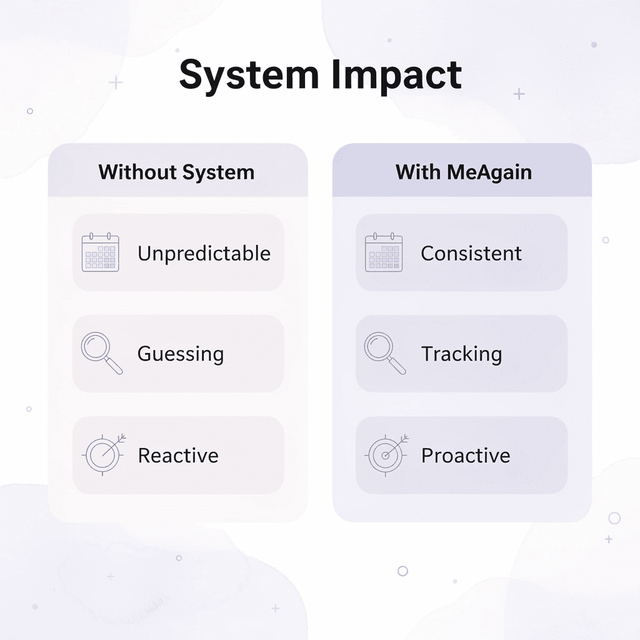
Without System | With MeAgain System |
|---|---|
Unpredictable daily experience | Consistent daily routine |
Guessing what affects side effects | Tracking actual patterns |
Reactive to symptoms | Proactive habit management |