
If you're considering tirzepatide for weight loss or diabetes management, the sticker shock of brand-name medications like Mounjaro or Zepbound might have sent you searching for alternatives. Compounded versions enter the picture, promising similar results at a fraction of the price. The real question becomes whether the lower price tag delivers genuine value or requires compromising on safety and effectiveness.
Understanding the true monthly cost of compounded tirzepatide means looking beyond advertised prices to see what you're actually paying for, including dosing flexibility and quality assurance. Whether compounded tirzepatide offers enough benefit to justify your investment depends on comparing costs with brand-name options, weighing the trade-offs in regulation and consistency, and knowing exactly what to expect from your treatment journey. MeAgain's GLP-1 app helps you cut through the confusion by providing personalized cost comparisons, tracking your progress with compounded medications, and connecting you with trusted providers who offer transparent pricing.
Table of Contents
- How Much Does Compounded Tirzepatide Cost in 2026?
- Compounded vs Brand Name Cost Comparison
- Is Compounded Tirzepatide Worth the Cost?
- If You’re Paying for GLP-1 Treatment, Make the Results Worth the Cost
Summary
- Compounded tirzepatide typically costs between $300 and $600 per month in 2026 through legitimate telehealth platforms paired with licensed 503A compounding pharmacies, compared to $900 to $1,200+ monthly for brand-name Mounjaro or Zepbound without insurance coverage. The 60 to 75% price reduction reflects a shorter supply chain that eliminates research recovery costs, national advertising budgets, and multiple distribution intermediaries, not inferior quality or a different molecule.
- Flat-rate pricing models create better economics for patients who require higher-maintenance doses. At a $349 monthly flat rate, someone on 15 mg weekly pays 83% less per milligram than someone on 2.5 mg weekly, since the cost remains constant while the dose increases. Tiered pricing structures that charge more as doses escalate often cost more over a full treatment course, even when the starting price appears lower.
- Medicare does not cover anti-obesity medications under current federal law, and commercial insurance coverage for weight management remains inconsistent across plans. Many insurers cover Mounjaro for type 2 diabetes but exclude or severely restrict coverage when prescribed solely for weight loss. Compounded tirzepatide is rarely covered by any insurance, though HSA and FSA funds often apply, making transparent pricing critical for budget planning.
- PCAB accreditation and Certificate of Analysis testing separate quality compounding pharmacies from operations that cut corners. PCAB-accredited pharmacies demonstrate compliance with sterile compounding protocols through independent audits, while CoA documentation from third-party laboratories confirms potency, sterility, and absence of contaminants in each batch. Providers who will not name their pharmacy or provide CoA documentation upon request raise material safety concerns that warrant addressing before payment.
- Treatment value depends on sustaining the protocol long enough to see results, not just accessing the lowest monthly price. A medication that costs $300 monthly but sits unused after two months delivers zero value compared to a $500 monthly protocol maintained for twelve months while building nutrition and movement habits that support lasting outcomes. GLP-1 treatment works best when supported by adequate daily protein intake to prevent muscle loss, proper hydration to manage side effects like nausea and constipation, and movement patterns that preserve metabolic health during weight loss.
- MeAgain's GLP-1 app addresses this by consolidating dose tracking, injection-site rotation, meal logging, symptom monitoring, and progress documentation into a single platform that reduces the mental load of managing treatment over months rather than weeks.
How Much Does Compounded Tirzepatide Cost in 2026?
Compounded tirzepatide costs $300–$600 per month in 2026 through a legitimate telehealth platform with a licensed 503A compounding pharmacy. Pricing varies by dose level, program tier, and whether doctor evaluation and ongoing support are included. Brand-name Mounjaro or Zepbound costs $900–$1,200+ per month without insurance coverage.

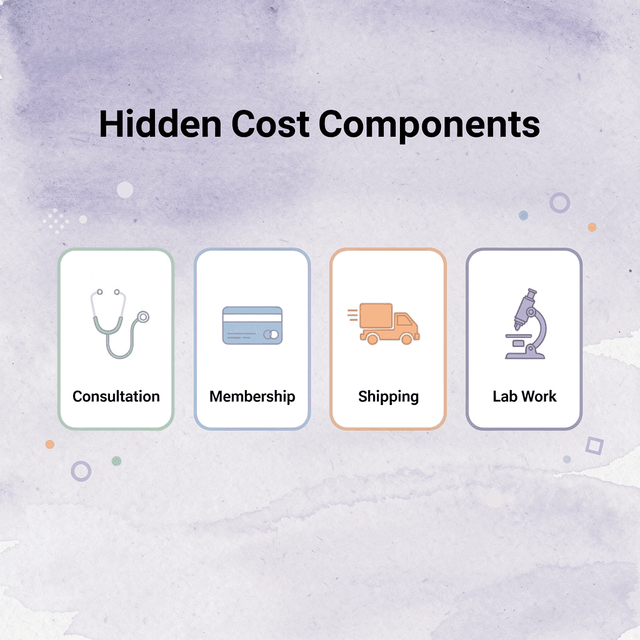
Advertised prices don't always show the complete picture. A $199 monthly medication cost might exclude consultation fees, membership charges, shipping, lab work, or charges for dosage increases. Transparent pricing means you understand what you're paying for before your first injection.

"Understanding the true cost of compounded medications requires looking beyond the advertised price to include all associated fees and services." — Healthcare Pricing Transparency Research, 2024
What do compounded options cost compared to brand-name?
In 2026, compounded tirzepatide from a licensed 503A pharmacy through a doctor-directed telehealth platform costs $300 to $500 per month at standard starting doses (2.5 to 5 mg weekly), including supplies. At higher maintenance doses of 10 to 15 mg weekly, costs reach $450 to $600, depending on the platform and pharmacy.
How much does brand-name Mounjaro cost with and without insurance?
Brand-name Mounjaro costs $1,069 per month at regular pricing without insurance, according to Eli Lilly's published pricing. With commercial insurance for type 2 diabetes, out-of-pocket costs drop to $25–$35 monthly with manufacturer savings cards.
For weight management, insurance coverage is rare, leaving many patients to pay full price. Compounded tirzepatide from a trusted doctor-directed telehealth platform costs roughly 60 to 75% less than brand-name Mounjaro without insurance.
Flat-Rate Pricing Model
Most telehealth providers use flat-rate pricing: a fixed monthly fee regardless of dosage. This benefits patients who need higher doses, as the cost per milligram decreases with higher dosage. At $349 per month, someone taking 15 mg weekly pays 83% less per milligram than someone taking 2.5 mg weekly. Since standard tirzepatide dosing involves gradually increasing from 2.5 mg to higher doses over several months, flat-rate plans become more affordable as treatment progresses.
Tiered Pricing Model
Some providers charge more as your dose increases. While this seems reasonable since higher doses use more active ingredient, tiered pricing often costs more than flat-rate pricing for patients needing moderate to high doses. A typical structure: $199 for 2.5 mg weekly, $249 for 5 mg weekly, $299 for 7.5 mg weekly, $349 for 10 mg weekly, and $449 for 12.5–15 mg weekly. Though the starting price appears lower, the total cost over a treatment course can exceed that of flat-rate providers. Calculate your expected total cost based on standard dose escalation, typically 4 weeks at each level before increasing.
Vial-Based Pricing
Some compounding pharmacies sell tirzepatide by vial instead of monthly subscription plans. Common sizes include 2 ml vials with 33 mg (priced around $500–$600) and 4.5 ml vials with 75 mg (priced around $550–$1,200). Vial pricing can save money for experienced users who know their exact needs, but you must handle reconstitution, storage, and dosing without medical oversight. Proper storage is critical: improper storage degrades the peptide, increasing your effective cost per milligram despite the lower sticker price.
How does the supply chain affect tirzepatide pricing?
Price transparency starts with understanding the supply chain. Eli Lilly spends billions developing, testing, manufacturing, and marketing Mounjaro, with costs spread across every vial and pen sold. Wholesalers, pharmacy benefit managers, retail pharmacies, and insurance intermediaries each take their cut before the drug reaches you.
A licensed 503A compounding pharmacy works differently: it buys pharmaceutical-grade tirzepatide from a DEA-registered, FDA-inspected API supplier, then a pharmacist prepares your specific dose per prescription and ships it directly to your home. There is no research and development cost recovery, no national advertising budget, no distribution network, and no pharmacy benefit manager intermediary taking a profit. This shorter supply chain explains the entire price difference.
Why do compounded tirzepatide prices vary so dramatically?
Even within compounded options, pricing structures vary so widely that comparing providers feels like deciphering different languages.
Related Reading
Compounded vs Brand Name Cost Comparison
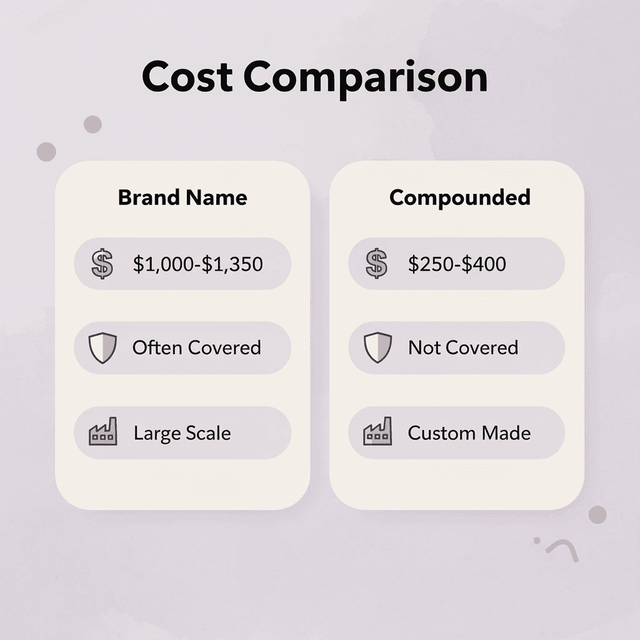
Most people think compounded tirzepatide is a cheaper copy of Mounjaro or Zepbound. The price difference stems from a different supply chain, not from a different molecule or lower quality.

Aspect | Brand Name (Mounjaro/Zepbound) | Compounded Tirzepatide |
|---|---|---|
Average Monthly Cost | $1,000-$1,350 | $250-$400 |
Insurance Coverage | Often covered with prior authorization | Typically not covered |
Manufacturing | Large-scale FDA facilities | Licensed compounding pharmacies |
Quality Control | Standardized FDA oversight | State board regulation |
Availability | Sometimes limited by shortages | More readily available |
Why are compounded medications so much cheaper?
Brand-name medications cost more due to clinical trials, FDA approval processes, national advertising campaigns, and complex distribution networks involving wholesalers, pharmacy benefit managers, and retail pharmacies. Compounded tirzepatide bypasses most of this infrastructure. A licensed 503A pharmacy sources pharmaceutical-grade API, prepares your dose per prescription, and ships directly to you without intermediaries, advertising costs, or layered markups.
What do brand-name and compounded versions actually cost?
Brand-name Mounjaro without insurance costs $1,000 to $1,200 per month at retail prices. With commercial insurance and a type 2 diabetes diagnosis, you might pay $25 to $150 per month. If your insurance covers weight management, expect to pay $300 to $800 monthly.
Compounded tirzepatide through a telehealth platform typically costs $300 to $400 for the initial dose (2.5 to 5 mg) and $400 to $600 for the maintenance dose (10 to 15 mg). Working directly with a compounding pharmacy costs $250 to $450 monthly, though you must maintain your own doctor relationship.
How does insurance coverage differ between options?
Medicare does not cover anti-obesity medications under current federal law, including brand-name GLP-1 and GLP-1/GIP agonists prescribed for weight management. Commercial insurance plans vary widely: many cover Mounjaro for type 2 diabetes but exclude or limit coverage for weight management. Compounded tirzepatide is rarely covered by insurance. However, HSA and FSA funds often apply to these medications.
What are the key differences in manufacturing and availability?
Brand-name medications include standardized FDA-approved manufacturing, large-scale clinical testing, and batch-to-batch consistency guarantees. Compounded options offer personalized dosing, faster titration schedules, and direct-to-home delivery.
The trade-off: compounded pharmacies lack supply-chain predictability. When shortages hit brand-name products, compounders can fill the gap. When the FDA removes a product from the shortage list, compounding legality shifts, creating regulatory uncertainty as part of the cost.
What hidden costs emerge over time?
The cheapest monthly option isn't always the lowest long-term cost. If your insurance drops coverage, your $35 monthly Mounjaro bill becomes $1,000. If the FDA removes tirzepatide from the shortage list and your compounding pharmacy stops production, you'll need to find alternatives.
If your telehealth platform raises prices after six months, you're locked into a higher rate or forced to restart with another platform. According to AKTW, brand-name GLP-1 medications cost upward of $1,000 per month without insurance. Treatment consistency matters more than short-term savings.
Does the cost justify the outcome?
But knowing the numbers doesn't answer the harder question: whether the cost justifies the result.
Is Compounded Tirzepatide Worth the Cost?
The value of compounded tirzepatide depends on whether the treatment aligns with your medical goals, budget, insurance situation, and ability to maintain it long enough to see results. A medication costing $300 monthly but abandoned after two months delivers zero value. Maintaining a $500 monthly protocol for twelve months while building nutrition and movement habits delivers compounding returns far beyond the initial price tag.

"A medication that costs $300 monthly but sits unused after two months delivers zero value compared to sustained treatment with lasting habit formation."

When does compounded tirzepatide offer strong value?
If your insurance denies coverage for brand-name tirzepatide, medication shortages make Mounjaro or Zepbound unavailable, or $1,000+ monthly costs prove prohibitive, compounded tirzepatide offers a cost-effective alternative. According to Doctronic, compounded tirzepatide costs $200-400 per month compared to Mounjaro's $1,000+ per month without insurance. Lower upfront costs remove a significant barrier to starting treatment.
If your insurance covers brand-name tirzepatide with manageable copays, you value standardized pharmaceutical manufacturing, or tightly controlled dosing and supply chain stability, then matters like monthly savings matter less. Paying more for Mounjaro or Zepbound may align better with your priorities. Brand-name medications offer regulatory oversight and manufacturing consistency that compounded preparations cannot fully replicate.
How do lifestyle factors affect treatment value?
GLP-1 treatment works best when supported by daily protein intake, hydration to manage side effects, and movement patterns that preserve metabolic health during weight loss. A patient paying $400 monthly for compounded tirzepatide who neglects these fundamentals will see diminished results compared to someone paying $200 who builds sustainable habits. The prescription is the catalyst, not the entire solution.
Platforms like MeAgain reduce the mental load of managing GLP-1 treatment by consolidating dose tracking, injection site rotation, meal logging, symptom monitoring, and progress documentation. Our $199 monthly tirzepatide option includes transparent pricing with no dosage-based increases, eliminating surprise costs when patients titrate from 2.5 mg to 10 mg weekly. Removing friction from daily tracking and cost management matters as much as the medication itself.
What determines long-term treatment success?
The real question is whether you can stick with treatment long enough for results to justify the investment. That depends on your ability to handle side effects, your willingness to track what you eat and how you feel, and whether clinical support helps you work through challenges when your initial motivation fades after a few months.
How to Verify Pharmacy Quality Before You Pay
Price matters, but the pharmacy that prepares your compounded medication determines what you receive. Verification takes fifteen minutes and prevents months of wasted treatment.
Valid state pharmacy license
Every 503A compounding pharmacy must have a valid pharmacy license in the state where it operates. Most states publish license verification through the state Board of Pharmacy website. If a pharmacy cannot provide a verifiable state license number, walk away immediately.
PCAB accreditation
The Pharmacy Compounding Accreditation Board (PCAB) audits compounding pharmacies to ensure they follow strict quality and safety standards. PCAB-accredited pharmacies demonstrate adherence to sterile compounding protocols, proper staff training, and quality testing. While not all reputable pharmacies hold PCAB accreditation, it's a strong positive indicator. Ask your platform which pharmacy it uses and whether it is PCAB-accredited. If they won't disclose the pharmacy name, that's a warning sign.
Certificate of Analysis (CoA) testing
A Certificate of Analysis is a document from a third-party laboratory that confirms the strength, cleanliness, and lack of harmful substances in a batch of compounded medication. According to GLP-1 After Denial, compounded tirzepatide pricing through telehealth platforms ranges from $229 to $ 349 monthly, though price alone reveals nothing about batch testing practices. Trustworthy pharmacies test every batch with CoA testing and provide this documentation upon request. If a pharmacy cannot or will not provide CoA documentation, that warrants investigation before payment.
USP <797> compliance for sterile preparations
Tirzepatide is given by injection under the skin, so it must be sterile. USP <797> sets standards for the preparation, testing, and storage of sterile compounded medications after compounding. Ask your pharmacy whether they compound tirzepatie in a clean room that follows USP <797> standards. If they hesitate or give vague answers about "following industry best practices" without mentioning the specific standard, the pharmacy likely does not meet the requirement.
Shipping and cold chain practices
Peptide compounds are sensitive to temperature changes and must be shipped in refrigerated packages with temperature monitoring to maintain efficacy during transit. Ask the pharmacy about their shipping methods, packaging materials, temperature controls, and post-delivery product expiration dates. Unclear answers about storage and shipping practices are a warning sign.
What questions should you ask about pharmacy credentials and medication quality?
Before starting any doctor-directed tirzepatide protocol, ask these questions. A legitimate provider will answer without hesitation.
Which compounding pharmacy prepares your medication, and can you verify it directly? Does it hold a valid state pharmacy license and PCAB accreditation? Does it provide a Certificate of Analysis (CoA) for each batch? What starting dose and titration schedule will you follow? How does pricing scale with dose increases? Is the medication compounded under active FDA shortage authorization for tirzepatide?
What monitoring and support should your provider offer?
What monitoring is included: labs, check-ins, vital sign tracking? What side effects should you watch for, and what's the protocol if they occur? How do you reach a clinician between visits? What happens if you need to pause or stop?
How can you identify providers to avoid?
If a provider pushes back, avoids the question, or gives unclear answers—especially about pharmacy quality and FDA compliance—find a different provider. Reputable providers answer these questions directly.
What are the warning signs of low-quality GLP-1 providers?
The growth in GLP-1 telehealth has attracted operators who prioritize subscription revenue over clinical quality. Watch for these patterns:
Which operational red flags indicate poor quality control?
No named pharmacy disclosed: if a platform won't identify which pharmacy fills your prescription, there's no accountability. Suspiciously low pricing at high doses—$200 per month for 10 mg weekly tirzepatide is nearly impossible at current API costs without quality compromises.
No physician interaction required: any program shipping tirzepatide without synchronous or asynchronous physician evaluation operates illegally. A prescriber must evaluate medical appropriateness. No monitoring offered: legitimate programs include ongoing support, while platforms that issue a prescription and disappear aren't providing physician-directed care.
Why should you avoid providers promising guaranteed results?
Be careful about promises of guaranteed results. No legitimate provider can guarantee weight loss outcomes. Clinical trial data are strong, but how much weight each person loses varies based on adherence to the plan, starting health, and lifestyle factors beyond any prescription's control.
What a Well-Structured Program Looks Like
A quality doctor-directed tirzepatide program includes an initial evaluation covering medical history, current medications, and screening for contraindications. You should receive a clear dose-escalation plan, a named compounding pharmacy with verifiable credentials, and cold-chain shipping. Monthly check-ins ensure a doctor oversees your care, with access to clinical support between visits for side effects or questions. Some programs include periodic lab panels to monitor metabolic markers. All of this should be explained before payment is made.
If You’re Paying for GLP-1 Treatment, Make the Results Worth the Cost
The difference between a well-run program and a prescription mill is the infrastructure around the medication itself. Whether you choose compounded tirzepatide for affordability or because insurance won't cover brand-name GLP-1s, the medication is only part of the investment. Many people focus on monthly prescription costs while overlooking the daily habits that determine whether treatment delivers sustainable results.

Side effects like muscle loss, fatigue, dehydration, and constipation become expensive setbacks if you're not hitting protein targets, staying hydrated, or moving enough to preserve lean mass. You're undermining fat loss and creating new problems that can derail treatment or force you to stop altogether. The monthly cost of compounded tirzepatide means nothing if you quit after three months because you feel worse instead of better.
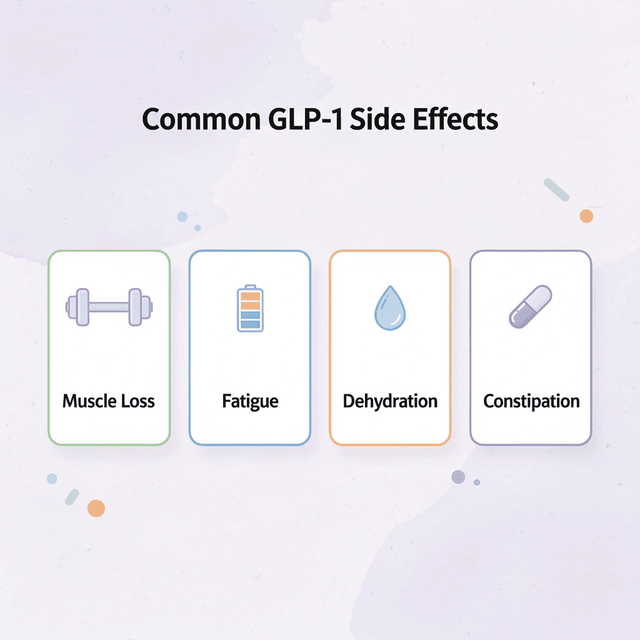
"Side effects from poor habits can force patients to discontinue GLP-1 treatment within 90 days, making the investment worthless." — Clinical Weight Management Research, 2024
MeAgain was built to protect the value of your GLP-1 treatment. If you're starting Ozempic, Wegovy, Mounjaro, Zepbound, or compounded tirzepatide, our app transforms the habits that support successful weight loss into a daily game. Your capybara helps you stay consistent with protein, fiber, water, and exercise goals to support fat loss without losing muscle. You can also document progress with your Journey Card, making it easier to see how your body changes over time rather than relying solely on the scale.

Download MeAgain, set your daily goals, and start building the habits that make your GLP-1 treatment more effective, sustainable, and worth your investment.