
Regulatory changes threaten access to compounded tirzepatide, with potential restrictions taking effect as early as 2026. FDA enforcement actions and drug shortage resolutions could eliminate this treatment option for patients currently using it for weight loss or diabetes management. The shifting regulatory landscape creates uncertainty for those who rely on compounded versions as their primary medication.
Planning ahead prevents treatment disruptions when access suddenly disappears. Understanding trigger events for compounded medication availability helps patients make informed decisions about continuing with compounded versions, switching to brand-name medications, or exploring alternative pathways. MeAgain's GLP-1 app provides regulatory updates, connects users with knowledgeable healthcare providers, and sends alerts about prescription changes before they affect treatment progress.
Table of Contents
- Is Compounded Tirzepatide Actually Going Away in 2026?
- Why Some Pharmacies May Stop Selling Compounded Tirzepatide
- Can You Still Legally Get Compounded Tirzepatide?
- What to Know Before Starting or Continuing a Compounding GLP-1 Medication
- Stay Consistent — Even If Your GLP-1 Treatment Changes
Summary
- Compounded tirzepatide isn't disappearing completely, but access is narrowing significantly. The FDA proposed removing tirzepatide from the 503B Bulk Drug Substances List, effective April 30, 2026, which would block large outsourcing facilities from compounding it in bulk. Traditional 503A compounding pharmacies can still prepare tirzepatide for individual patients with valid prescriptions and documented clinical need, but only when FDA-approved versions are not available for specific medical reasons. The shift moves compounded access from a shortage-driven pathway available to anyone seeking lower costs to a patient-specific exception requiring clinical justification.
- The FDA received more than 320 adverse event reports related to compounded tirzepatide as of early 2025, which influenced the tightening of regulations. Safety concerns, combined with the resolution of drug shortages, eliminated the original legal foundation that had allowed widespread compounding. Patients who started treatment during shortages now face transitions they didn't anticipate, and the regulatory uncertainty creates fragmented access, with availability depending entirely on which pharmacy pathway your provider uses.
- The distinction between 503A and 503B pharmacies determines whether your current prescription remains viable. Outsourcing facilities (503B) operated at scale during shortages but lost legal authority once tirzepatide leaves the shortage list and 503B Bulks List. Traditional compounding pharmacies (503A) work patient-by-patient and can continue preparing customized formulations when providers document medical necessity beyond cost savings or convenience. Understanding which pathway your pharmacy uses matters more than general headlines about compounding bans.
- Insurance barriers and prior authorization delays create treatment gaps when patients switch from compounded to FDA-approved medications. Brand-name Mounjaro and Zepbound can cost over $1,000 per month without coverage, compared to $150 to $300 for compounded versions. Manufacturer copay programs and patient assistance exist, but navigating eligibility criteria takes time, and many patients face weeks without medication while the paperwork processes. The financial shock, combined with regulatory uncertainty, drives some people to abandon treatment entirely rather than manage the transition.
- Approximately 90% of compounded GLP-1 medications contain salt forms, such as semaglutide sodium, rather than the FDA-approved base form that underwent clinical trials. This chemical difference matters because dosing equivalency gets complicated when switching formulations, and your provider needs to calculate the equivalent FDA-approved dose carefully. Tracking becomes essential during transitions because compounded formulations may vary in concentration, and maintaining a continuous record of how your body responds to specific formulations helps inform dosing adjustments when medication sources change.
- GLP-1 app addresses this by consolidating dose tracking, side-effect patterns, and nutrition data in one place, making it easier to maintain treatment continuity when regulatory changes require medication switches or provider transitions.
Is Compounded Tirzepatide Actually Going Away in 2026?
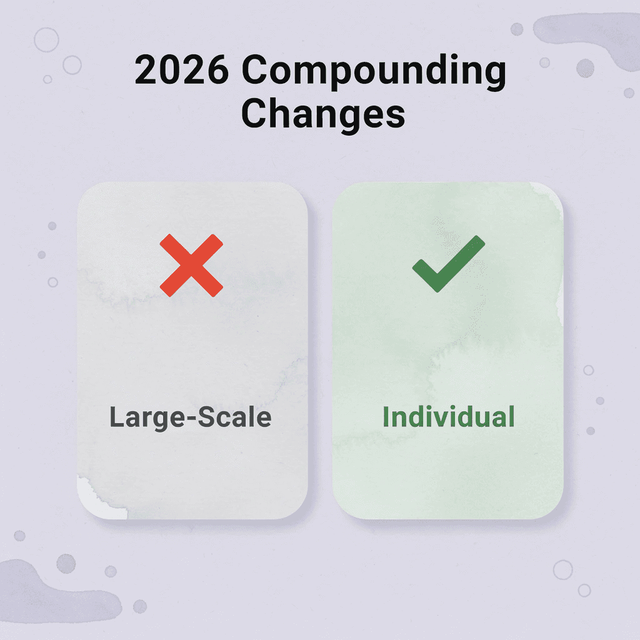
Compounded tirzepatide is not disappearing entirely in 2026, but access is changing significantly. On April 30, 2026, the FDA proposed removing tirzepatide from the 503B Bulk Drug Substances List, preventing large outsourcing facilities from manufacturing it from bulk ingredients. However, traditional 503A compounding pharmacies can still prepare tirzepatide for individual patients with valid prescriptions, provided they meet FDA requirements for dosage customization and clinical necessity.

"The FDA's removal of tirzepatide from the 503B Bulk Drug Substances List represents a significant shift in how compounded medications will be accessed by patients." — FDA Regulatory Update, 2024
What changes did the FDA announce for compounding regulations?
The FDA's announcement from Commissioner Marty Makary clarified that outsourcing facilities cannot legally compound using bulk substances when FDA-approved drugs are available unless there is a documented clinical need. The agency found no evidence that compounded tirzepatide products address medical unsuitability in ways FDA-approved versions do not. This follows semaglutide's pattern: it appeared on the drug shortage list in 2022, was removed in 2025, and the 503B Bulks List exclusion will close the outsourcing pathway.
How do 503A and 503B pharmacy regulations differ?
The difference between 503A and 503B pharmacies is now important. Outsourcing facilities (503B) work at a larger scale and compound tirzepatide, which appeared on the shortage list or the 503B Bulks List. Traditional compounding pharmacies (503A) prepare medications for individual patients based on specific prescriptions and can use active ingredients from FDA-approved drugs, even without a shortage designation. The FDA's proposal tightens rules around genuine customization versus copying commercially available products at lower cost.
Why does the confusion feel so personal?
People saw headlines about compounded GLP-1s disappearing while telehealth providers sent emails about policy changes and pharmacy partners adjusted formularies. According to Pharmacy Times, the FDA had received more than 320 reports of adverse effects related to compounded tirzepatide as of early 2025, which influenced the regulatory decision. The uncertainty hits harder when you've built weight loss progress around a medication routine that suddenly feels unstable, especially if compounded versions cost $150–$300 per month compared to brand-name options costing more than $1,000 without insurance.
What happens when access depends on regulatory changes?
The emotional weight comes from watching access depend on regulatory classifications you never considered before. Some providers are transitioning patients to brand-name Mounjaro or Zepbound, while others clarify which compounding pharmacies meet 503A requirements. You're left wondering whether your prescription will remain available, whether your provider stays in network, and whether you'll need to restart prior authorization or switch medications entirely.
How can you track transitions during regulatory uncertainty?
Our GLP-1 app tracks medication type, dosage changes, side effects, and shifts in prescription source. The app records progress data and symptom patterns, enabling informed decisions with your provider about trying 503A compounding, switching to brand-name medications, or exploring other options without losing track of what's worked for your body. The issue isn't whether compounded tirzepatide exists, but whether the version you've been using remains available through your current provider and pharmacy at a sustainable price.
Related Reading
- How Much Does Compounded Tirzepatide Cost
- How To Get Compounded Tirzepatide
- Does Compounded Tirzepatide Work
- Compounded Tirzepatide Dosage
Why Some Pharmacies May Stop Selling Compounded Tirzepatide
Many patients think compounded tirzepatide is being completely banned. In reality, the FDA removed semaglutide from the drug shortage list in February 2025, triggering a phased shutdown where 503A pharmacies had to stop by April 22, 2025, and 503B facilities by May 22, 2025. This isn't a complete ban, but the end of shortage-based compounding authorization. The underlying issue is regulatory inconsistency and pharmacy risk tolerance.

"The FDA's removal of semaglutide from the drug shortage list in February 2025 triggered automatic compounding restrictions for both 503A and 503B pharmacies within 60-90 days."

Pharmacy Type | Shutdown Deadline | Reason |
|---|---|---|
503A Pharmacies | April 22, 2025 | End of shortage-based authorization |
503B Facilities | May 22, 2025 | FDA compliance requirements |
Hospital Pharmacies | Varies | Internal risk assessment |

The original justification for compounding
Compounding was clearly legal under FDA drug shortage rules. When Novo Nordisk and Eli Lilly couldn't supply enough Wegovy and Zepbound to meet demand, the FDA allowed two pathways: 503B facilities could manufacture in bulk during shortages, while 503A facilities could compound medicine for individual prescriptions. William Soliman, a pharmaceutical expert and founder of White Manna Capital Partners, describes 503B as "small-scale manufacturing" versus 503A as "custom medicine made for each patient." Both existed because shortages created a documented need for treatment. Once supply improved, that legal foundation disappeared.
Why pharmacies are responding differently
The FDA's April 30 announcement excluded semaglutide, tirzepatide, and liraglutide from its 503B bulks list, citing no "clinical need" for bulk compounding once shortages were resolved. This created two distinct markets: companies using 503B facilities faced pressure to shut down, while those using 503A pharmacies (like Mochi Health) operated under different rules tied to individual patient prescriptions. The FDA sent approximately 100 cease-and-desist letters to telehealth sites in September 2025, though enforcement varied. Some pharmacies shut down to avoid regulatory risk, while others continued through 503A pathways, creating a fragmented landscape where patient access depended on which company they chose.
What timeline did patients face when losing access?
Treatment continuity was disrupted at different times across the pharmacy pathways. Patients using 503A providers lost access on April 22, 2025, while those on 503B-sourced medication had until May 22, 2025. Dr. Disha Narang, board-certified endocrinologist and director of obesity medicine at Endeavor Health, observed that what started as a shortage solution "has taken off into its own beast." When the FDA reassessed clinical need post-shortage, thousands of patients found themselves mid-treatment with no warning that their pharmacy might disappear. Price increases became unavoidable as the $99/month compounded option vanished and patients faced brand-name Ozempic at $1,000+/month.
How can patients maintain treatment continuity during transitions?
Platforms like MeAgain help patients track treatment patterns as they change medications. When your pharmacy changes or you switch from compounded to brand-name formulations, the app lets you monitor your dose, side effects, and progress data to make informed decisions with your provider.
What regulatory uncertainty remained after the disruption?
The FDA kept public comment open through June 29, 2026, leaving pharmacies and telemedicine companies operating without clear rules. Providers couldn't assure patients whether their current practices would remain compliant, causing some pharmacies to exit the market while others shifted focus to 503A patient-specific compounding. The question isn't whether compounded tirzepatide exists, but whether the version you need stays available through a legally viable channel for your provider.
Can You Still Legally Get Compounded Tirzepatide?
Yes, but only under specific conditions. If your healthcare provider determines you have a documented clinical need that FDA-approved products cannot address, a licensed 503A compounding pharmacy can prepare a customized version for you. This is patient-specific compounding, the same pathway used for decades when commercial medications don't fit someone's medical situation.

"Patient-specific compounding allows healthcare providers to customize medications when FDA-approved products don't meet individual patient needs." — FDA Guidance on Compounding

What medical conditions qualify for legal compounding?
Your prescriber must document why the FDA-approved version won't work for your specific case: perhaps you need a dose unavailable in prefilled pens, have experienced severe reactions to inactive ingredients in the commercial formulation, or have exhausted patient assistance programs. These situations qualify for legal compounding. What doesn't: seeking a cheaper option when the approved product would work, or preferring a different delivery method without medical necessity.
Why compounded access is breaking—and what actually works instead
The real issue isn't that tirzepatide is "going away." It's that the eligibility system behind compounding is collapsing back to strict FDA intent: clinical necessity only, not affordability or convenience.
That creates a clear failure point for most patients:
- Problem: You’re using compounded tirzepatide because it was cheaper or easier to access
- Mechanism: That access only existed under shortage-based enforcement discretion (503B + expanded 503A interpretation)
- Break: Shortage removal + 503B bulk exclusion = scale access shuts down first
- Fix path: Only patient-specific compounding (503A) survives—but only with documented medical necessity
- Outcome: Either (1) transition to FDA-approved GLP-1s OR (2) qualify for narrow 503A exceptions, OR (3) lose compounding access entirely
What this means in practice
If your goal is continued treatment without interruption, you now have only three viable pathways:
- Switch to FDA-approved GLP-1s (Mounjaro / Zepbound)
Works when insurance approval or out-of-pocket cost is feasible. - Qualify for 503A compounding under clinical necessity
Works only if your provider can document a specific medical reason commercial dosing or formulation doesn’t fit you. - Transition planning before enforcement tightens further
Works if you are currently stable and want to avoid being forced to discontinue during pharmacy shutdown cycles.
When compounding still makes sense
Compounded tirzepatide is now a precision tool, not a default option:
- It works when dose flexibility is medically required
- It works when ingredient sensitivity is documented
- It works when commercial formulations fail clinically—not financially
It does NOT work as:
- a cheaper substitute
- a convenience alternative
- a long-term bypass of FDA-approved products
That shift is the actual story—not “availability disappearing,” but access being reclassified from broad to narrow use cases.
The prescription pathway that still works
Getting compounded tirzepatide legally requires three things: a valid relationship between you and your provider with documented medical oversight, a medical need demonstrating why FDA-approved tirzepatide doesn't work for you, and a licensed 503A pharmacy that manufactures medications per individual prescription rather than in bulk. 503A-compliant pharmacies focus on making medications for specific patients instead of mass production. Novanex quality standards emphasize this difference, which determines what pharmacies can legally provide. Telehealth providers can prescribe compounded tirzepatide within this framework only when they document medical reasons beyond cost savings or patient preference.
What dosing gaps justify compounded tirzepatide?
Standard FDA-approved tirzepatide is available in specific doses: 2.5 mg, 5 mg, 7.5 mg, 10 mg, 12.5 mg, and 15 mg. If you need 3.75 mg because you experience unbearable nausea at 5 mg but insufficient results at 2.5 mg, compounding is justified. Similarly, if you're switching from a different GLP-1 and need a bridging dose unavailable in stores, your provider might justify compounding. Zepbound vials offer some dosing flexibility without compounding, but each vial lacks preservatives and must be used as a single dose, limiting precise adjustment.
How does microdosing work for sensitive patients?
Microdosing is a medical strategy for some patients, not a shortcut. People who stop taking GLP-1 treatment due to side effects at the lowest available dose might benefit from starting at a lower dose and increasing it more slowly, a decision requiring provider oversight. If your prescriber documents why commercial products cannot meet your specific needs, compounding remains an option.
What happens if you're already using compounded tirzepatide
Many people started using compounded GLP-1s during the shortage and haven't switched yet. Some don't know the rules have changed; others struggle to get insurance approval. If you're currently receiving compounded tirzepatide, your provider should discuss switching plans unless they've documented specific reasons you need to continue compounded medication.
How do you switch from compounded to FDA-approved tirzepatide?
Switching isn't always easy because determining the right dose can be complicated across different formulations. If you've been taking a custom-made version with a different strength or additional ingredients, your provider must carefully calculate the FDA-approved dose that matches. Insurance approval can take weeks, creating treatment gaps. Manufacturer copay programs and patient assistance options are available, but eligibility rules vary by insurance type and income level.
How can you track your transition effectively?
The GLP-1 app helps you track your dose, side effects, and nutrition information in one place. Our app makes it easier to see how your body reacts when you switch from compounded to FDA-approved medications. Instead of scattered notes, you have a single, continuous record that shows how different formulations affected your journey. But knowing you can still access compounded tirzepatide legally doesn't mean it's the right choice for your situation.
What to Know Before Starting or Continuing a Compounding GLP-1 Medication
Many people think compounded tirzepatide will stay available forever as a cheaper choice compared to brand-name GLP-1 medications. This idea comes from the 2022–2024 drug shortage, when FDA rules temporarily allowed many pharmacies to make compounded versions through both 503A and 503B pharmacies. Compounded versions became common through telehealth platforms at much lower prices ($150–$300 versus $1,000+ for branded drugs), leading people to believe they would be a steady, long-term option.
"The $150–$300 price point for compounded tirzepatide represents a dramatic cost reduction of up to 85% compared to branded alternatives during the shortage period." — Telehealth Market Analysis, 2024
Medication Type | Typical Cost | Availability |
|---|---|---|
Compounded Tirzepatide | $150–$300 | Shortage periods only |
Brand-name GLP-1s | $1,000+ | Always available |
Generic Options | Not yet available | Future availability |

Why is compounded tirzepatide availability changing?
That assumption is no longer valid. In 2025–2026, the FDA began removing tirzepatide from shortage-based compounding pathways, including its proposed exclusion from the 503B Bulk Drug Substances List effective April 30, 2026. Combined with over 320 reported adverse events tied to compounded GLP-1 medications and restored FDA-approved supply stability, the regulatory basis for large-scale compounding is collapsing.
What options remain for accessing compounded medications?
If you're currently using compounded tirzepatide or considering it, the legal landscape has narrowed your options but not eliminated them. You can still access these medications through 503A pharmacies when there's a documented clinical reason that FDA-approved products can't address. The key is understanding what qualifies as a legitimate need and what your provider must verify before writing that prescription.
What documentation does your provider need before prescribing?
Before any 503A pharmacy can legally compound tirzepatide, your provider must document why the FDA-approved version is not appropriate for your specific situation. According to HealthyWomen's analysis of compounded GLP-1 drugs, 90% of compounded GLP-1 medications contain salt forms such as semaglutide sodium rather than the FDA-approved base form, meaning the chemical makeup differs from that used in clinical trials. Your provider needs to confirm whether you need a dosage strength that Mounjaro or Zepbound don't offer, whether you've had documented allergic reactions to inactive ingredients in the commercial products, or whether insurance barriers remain impossible to overcome after trying manufacturer assistance programs.
What happens during the eligibility consultation?
Most providers can review your eligibility during a short telehealth consultation. Expect them to ask about your medication history, side effects you've experienced, insurance coverage, and whether you've applied for patient assistance programs. This conversation typically takes 15-20 minutes and results in either a prescription sent to a licensed 503A pharmacy or a recommendation to try the FDA-approved version first.
The questions you should ask in the next five minutes
Contact your current prescriber or a telehealth provider specializing in weight management and ask three specific questions. First, why is compounded tirzepatide being recommended over Mounjaro or Zepbound? The answer should reference a specific clinical need, not cost. Second, is the pharmacy a licensed 503A facility that compounds individually per prescription, and can they provide license verification? Third, what happens if the FDA tightens enforcement, and what's their backup plan for transitioning you to an alternative? Write these questions down before you call—the clarity you get determines whether you're on solid legal ground or operating in a gray area that could collapse.
How long does it take to receive your compounded medication?
Once your provider sends the prescription to a 503A pharmacy, you can expect a 3–5 day turnaround for your first order. The pharmacy will verify your prescription details, prepare your specific dosage, confirm your shipping information, and provide handling instructions. Compounded medications ship directly to your address in temperature-controlled packaging, unlike picking up Mounjaro from a local pharmacy.
What should you do when your medication arrives?
When the medication arrives, you'll receive vials or pre-filled syringes with dosing instructions for the compounded formulation. Since the compounded version may have concentrations different from those of FDA-approved products, careful tracking is essential. Tools like MeAgain's GLP-1 tracking app let you log each dose with formulation details, track your body's response, and maintain a valuable record if you switch medications later. Instead of relying on memory, you have timestamped data showing exactly when symptoms appeared relative to medication changes.
The safety verification you can't skip
Before your first injection, ensure the pharmacy includes a certificate of analysis showing the compound was tested for sterility, potency, and purity. Legitimate 503A pharmacies test each batch and provide documentation. If this paperwork isn't included, request it before using the medication. This verification confirms that the contents of the vial match your provider's prescription and meet basic safety standards. Even with proper documentation and legal prescriptions, compounded tirzepatide's long-term viability remains uncertain as the regulatory environment shifts.
Stay Consistent — Even If Your GLP-1 Treatment Changes
The regulatory shifts around compounded tirzepatide matter less than what you do every single day while you're on treatment. Whether you're using Mounjaro, Zepbound, or a compounded version, the outcomes depend on protein intake, hydration, physical activity, and fiber intake. Medications create the metabolic conditions for weight loss, but they don't prevent muscle loss, dehydration, or severe constipation on their own. Those protections come from consistent habits, not the prescription itself. Take 5 minutes to secure your treatment continuity before your next prescription change If you’re currently on compounded tirzepatide—or planning to switch—you’re at the exact point where small documentation gaps can cause treatment disruption later.
Before your next refill or provider appointment, do this:
- Log your current dose and formulation (503A or 503B if known)
- Record your last 7 days of side effects + weight change
- Save your insurance status or out-of-pocket cost
- Note whether your provider has discussed FDA-approved transition options
Then use a tracking system that keeps everything in one place so nothing gets lost during pharmacy or medication changes.
👉 In under 5 minutes, set up your GLP-1 tracking profile here:
https://meagain.com/
You’ll get:
- A structured dose + symptom timeline you can share with your provider
- Continuity tracking if your medication source changes
- A single record of your GLP-1 journey across compounded → brand transitions
Whether you're starting treatment, switching between brand-name and compounded options, or navigating insurance changes, the work that protects your results stays the same. Consistent tracking reduces the mental load of managing multiple tools and helps you see patterns that your provider needs to adjust your care. Download MeAgain and turn your weight loss journey into your favorite game.