

Injection site reactions, the label's umbrella for redness, itching, bruising, pain and rash, were reported in 6 to 8% of people on Zepbound versus 2% on placebo in Studies 1 and 2.
If you are looking at a warm red patch on your stomach or thigh tonight, whether this is your first shot or your fortieth, this page settles four things: what the label counts as an injection site reaction, how common it was in the trials, what the rotation rule is really protecting, and the two signs that change your evening.
This article is general information from public sources, not medical advice. Your prescriber and pharmacist know your history; take storage and dosing questions to them.
Last updated September 2026 · Sources verified against the FDA label, the Medication Guide and the Mounjaro prescribing information.
Key takeaways
- Injection site reactions were reported in 6% on 5 mg, 8% on 10 mg and 8% on 15 mg of Zepbound, against 2% on placebo, in the Study 1 and 2 pool.
- Reactions were more frequent in Zepbound-treated people with anti-tirzepatide antibodies (11.3%) than in those without them (1%), and the label found no clinically significant effect of those antibodies on how well Zepbound works.
- Swelling of your face, lips, tongue or throat, trouble breathing or swallowing, fainting, a very rapid heartbeat or severe rash means stop Zepbound and call 911 now. A warm red area spreading outside a pen outline means calling your prescriber today.
Why is my tirzepatide injection site red?
Redness at a tirzepatide injection site is injection site erythema, one of the skin events the Medication Guide groups under "injection site reactions" and lists among Zepbound's most common side effects, alongside nausea, diarrhea and fatigue.
What sits under that phrase is a list, not a single thing. The FDA label counts "injection site bruising, injection site erythema, injection site pruritus, injection site pain, injection site rash" together under one row.
No severe injection site reactions were recorded across the SURPASS-1 to -6 diabetes trials, Lilly's answers page reports. How long one lasts is a question for your prescriber.
Is it normal to get a red itchy patch the first time I inject Zepbound?
A red patch after a first dose is the same labelled event as one after a twentieth dose, and the Zepbound rate below covers both. A journal article (via PubMed Central) reports one man in his 70s whose first tirzepatide injection left a rash that enlarged over the following days, one person and not a timeline.
Why is it itchy, and what else counts as an injection site reaction?
Itching at the site is injection site pruritus, one of five terms the label's umbrella covers, alongside bruising, erythema, pain and rash.
If none of those five words fits what you see, the Canadian product monograph lists the longer set Lilly uses: haematoma, induration, inflammation, irritation, oedema, paraesthesia and swelling.
Whole-body hypersensitivity is a separate event from a sore spot on your thigh. In the Zepbound Study 1 and 2 pool, the FDA label reports immediate hypersensitivity reactions (within one day of the dose) in 2.1% of treated patients versus 0.4% on placebo, and non-immediate reactions in 3.5% versus 2.7%. If your symptoms are spreading beyond the skin around the injection, go to Where to get help.
How often does this happen, and does a higher dose make it more likely?
Injection site reactions were reported in 6% of people on 5 mg, 8% on 10 mg and 8% on 15 mg of Zepbound, against 2% on placebo, in a pool of two randomized placebo-controlled weight-reduction trials. The FDA label gives the pool as Study 1 and Study 2, 2,519 adults treated over up to 72 weeks.
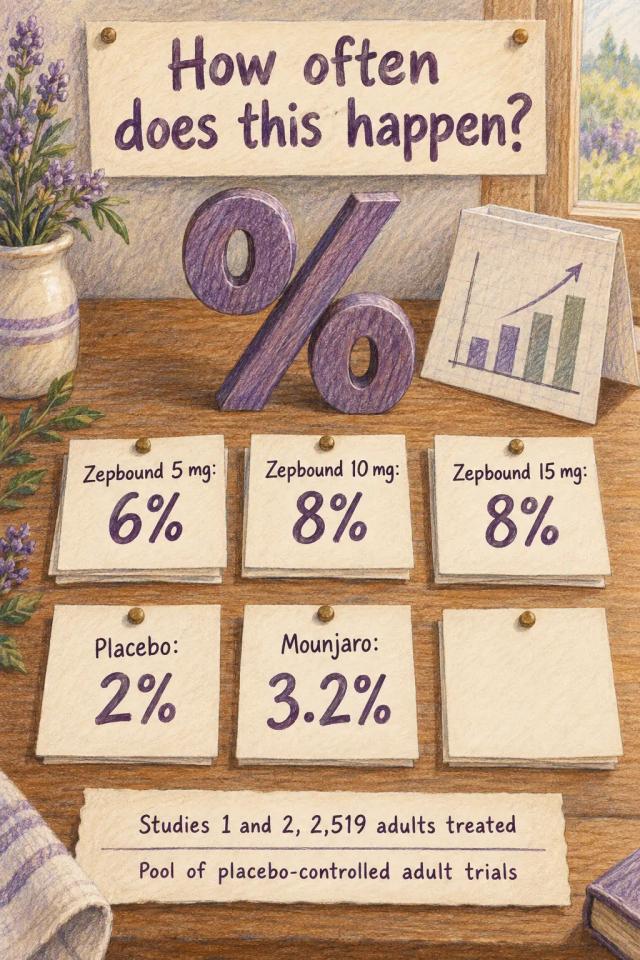
Read those three percentages as three separate trial arms, not as a staircase you climb: nobody's risk was measured before and after a step-up. The Mounjaro label reports 3.2% versus 0.4% on placebo in adults with type 2 diabetes, a different brand and a different trial program.
Group | Rate | Placebo in the same pool | Trial pool and size |
|---|---|---|---|
Zepbound 5 mg | 6% | 2% | Studies 1 and 2, N=630 vs placebo N=958 |
Zepbound 10 mg | 8% | 2% | Studies 1 and 2, N=948 |
Zepbound 15 mg | 8% | 2% | Studies 1 and 2, N=941 |
Mounjaro, type 2 diabetes | 3.2% | 0.4% | Pool of placebo-controlled adult trials |
Two brands, two indications, two pools, so there is no single tirzepatide rate to average. Your own dose is a conversation with your prescriber.
Why does it happen to me and not to someone else on the same dose?
Anti-tirzepatide antibodies are the measured difference the label reports between people who react and people who do not: in the FDA label's Study 1 and 2 pool, injection site reactions "were more frequent in those with anti-tirzepatide antibodies (11.3%) compared to those who did not develop anti-tirzepatide antibodies (1%)."
The FDA label for Mounjaro points the same way: reactions in 119 of 2,570 adults with type 2 diabetes who had antibodies (4.6%) and 18 of 2,455 without them (0.7%), across a pool of seven trials.
That is an association, not a demonstrated cause, and antibody status is a trial measurement rather than something you can know about yourself.
If you have been reacting for weeks and wondering whether the medication still works, the FDA label states that "No clinically significant effect of anti-tirzepatide antibodies on pharmacokinetics or effectiveness of ZEPBOUND has been identified."
Why does the Zepbound label say to rotate injection sites with each dose?
The label says to rotate to reduce your risk of lipodystrophy (pits in skin or thickened skin) and localized cutaneous amyloidosis (skin with lumps), not to prevent this week's red patch. The Instructions for Use say to change your site within the area you choose for each dose "to reduce your risk of getting lipodystrophy ... and localized cutaneous amyloidosis ... at the injection sites."
The Medication Guide puts it plainly: you may use the same area of your body, but choose a different site within it, and do not use the same site each week.
In MeAgain you can log each shot with its date and site, with rotation shown so the same spot is not reused too soon, and log the reaction by day and severity alongside your dose changes.
This app has been the best tool I’ve have to stay on track with the correct nutrition. Protein first is so important for success and I have a hard time getting enough. With this app, I’ve met or exceeded my protein goals. Thank you me again for helping MeAgain off on the right path.
Does rotating between my stomach, thigh and upper arm prevent reactions?
Lilly says tirzepatide is injected under the skin of the stomach, thigh or upper arm and that sites should be changed with each weekly injection, which is not the same as preventing this week's reaction. Lilly's answers page reports similar exposure to tirzepatide after injection in the abdomen, thigh or upper arm, and "There is no data from studies comparing these injection sites to assess efficacy and safety differences." More on choosing an area: where to inject GLP-1 for best results.
What injection technique mistakes can cause a site reaction?
The mistakes the label names are all about where the needle goes. The Instructions for Use say: "Do not inject where the skin has pits, is thickened, or has lumps. Do not inject where the skin is tender, bruised, scaly or hard, or into scars or damaged skin", and an abdominal shot goes at least 2 inches from the belly button. The insulin injection-technique guideline in a journal article (via PubMed Central), written for insulin and not for tirzepatide, adds that the site "should be clean and dry".
Can injecting in the same small area cause lumps or dents in the skin?
A hard lump that keeps returning where you inject has a name, lipohypertrophy. Cleveland Clinic ties it to repeated injections in one place: "Repeated injections in the same area cause lipohypertrophy, which involves a lump of fatty tissue under your skin. The area may feel lumpy, firm or rubbery."
So a lump changes next week's site, and a lump that keeps appearing is worth raising with your prescriber, see Where to get help.
How do I treat a tirzepatide injection site reaction?
Eli Lilly states outright, on Lilly's answers page, that "Eli Lilly and Company cannot provide treatment recommendations for injection site reactions", so this page names what you are seeing and tells you who decides the rest.
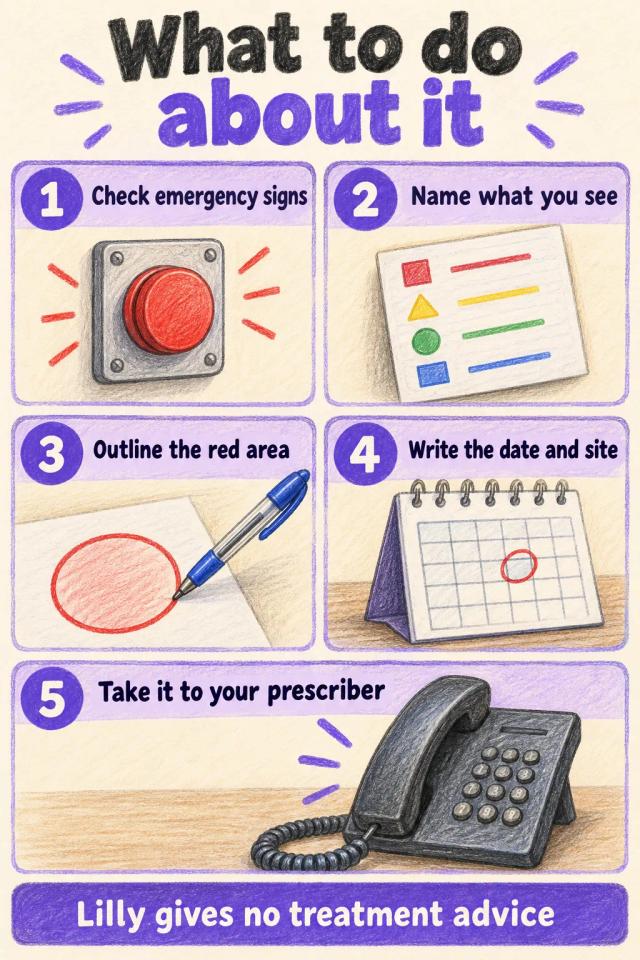
- Rule out the emergency first. The serious allergic reaction signs in the Medication Guide are in the table under Where to get help. If any of those are present, stop using Zepbound and call 911 now.
- Name what you see in the label's words. Using the same word your prescriber's notes use makes the phone call shorter.
- Outline a warm red area with a pen. Johns Hopkins Medicine advises marking the edge of a warm, red skin infection so that you and your healthcare provider "can then see how far and how quickly it spreads outside the line."
- Write down the date, the site and what it looked like. Mayo Clinic advises keeping track of where you give each shot, and that note carries forward to your next appointment.
- Take it to your prescriber. They decide what to do about your skin.
Where to get help
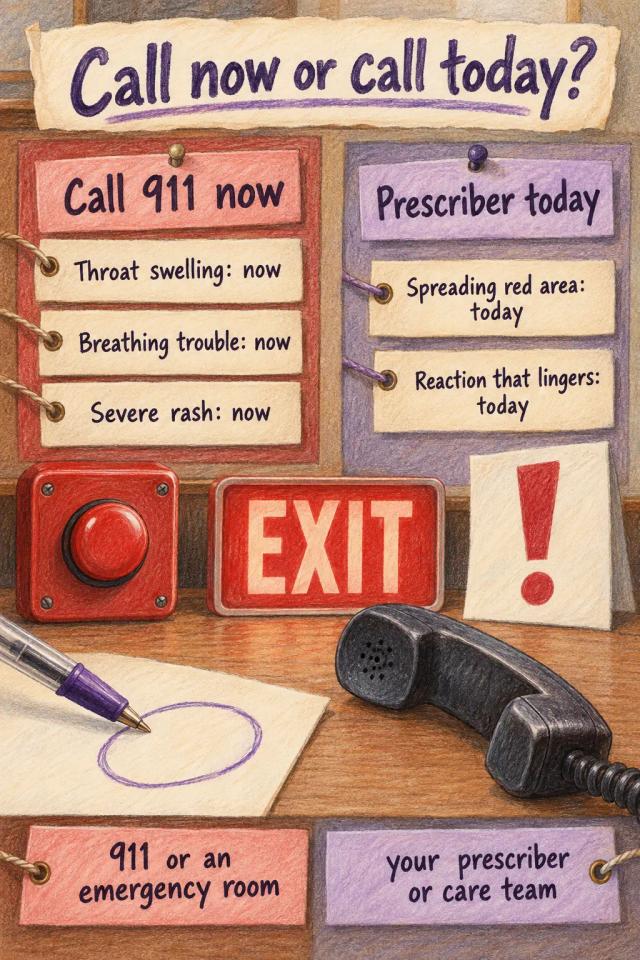
Three signs at an injection site send you somewhere, and the table gives each one, who to contact and how fast.
Sign | Contact | How fast | Source |
|---|---|---|---|
"swelling of your face, lips, tongue or throat ... fainting or feeling dizzy ... problems breathing or swallowing ... very rapid heartbeat ... severe rash or itching" | 911 or an emergency room, and stop using Zepbound | now | |
"a skin infection with a warm, red area" that is spreading outside a pen outline | your prescriber or care team | today | |
A site reaction that bothers you or that does not go away | your prescriber or care team | today |
On the top row, Mayo Clinic is blunt about the timing: "Don't wait to see if the symptoms go away."
Frequently asked questions
Why am I suddenly getting injection site reactions on Zepbound after months with none?
A reaction that returns after months, or keeps getting worse, is one that "bothers you or does not go away" in the Medication Guide's words, so it goes to your prescriber today. Lilly's answers page states there is no information available on injection site reactions that worsen over time.
My Mounjaro injection site bled and left a bruise, did the full dose of medicine still go in?
Your device confirms it. On the multi-dose KwikPen, count slowly to 5 while holding the dose knob in and check the icon is in the dose window. On the single-dose pen, press and hold the purple button for up to 10 seconds. With the vial and syringe, the needle stays in for at least 5 seconds, per the Instructions for Use. Blood afterwards is normal, so press gauze on the spot and do not rub it.
Do reactions happen with the vial and syringe as well as the single-dose pen?
Lilly's answers page says "There are no data available on injection site reactions with tirzepatide administered from a single-dose vial", the vial you draw up into a syringe yourself. Lilly does state that the vial and the prefilled single-dose pen carry the same drug formulation and analytical attributes.
Are injection site reactions more common with tirzepatide than with semaglutide?
In the one head-to-head trial, yes. The New England Journal of Medicine reports reactions in 1.9 to 4.5% of adults with type 2 diabetes on tirzepatide and 0.2% on semaglutide 1 mg over 40 weeks in SURPASS-2, mild to moderate in severity. A dermatology review, a journal article (via PubMed Central), words the same trials as "slightly more frequently, comparable to other GLP-1 receptor agonists as semaglutide".
Related reading