
Starting tirzepatide can feel like a breakthrough for weight loss, but a sudden tirzepatide rash or injection-site reaction can knock the wind out of you. Redness, itching, swelling, or hives at the injection site raise a clear question: is this a mild irritation, an allergic reaction, or something that needs medical attention? This article shows how to spot common skin reactions, how to limit irritation, and when to seek help. You will get practical checks and simple steps to keep your treatment smooth, safe, and worry-free so you can use tirzepatide confidently without uncomfortable rashes.
To put these steps into practice, MeAgain’s GLP-1 app gives you a single time-stamped log for every injection site, sends reminders before each dose, and surfaces patterns when redness or itching keeps coming back so your clinician can see exactly what changed and when.
Tirzepatide is the active molecule sold as Zepbound for weight loss and Mounjaro for type 2 diabetes — the rashes and injection-site reactions described here apply to all three brand names.
Last updated April 2026 · Sources verified against the Mounjaro FDA prescribing information, NEJM SURPASS-2, a 2026 review in Anais Brasileiros de Dermatologia, and the American Academy of Allergy, Asthma & Immunology.
Summary
- Across the SURPASS clinical trials documented in the Mounjaro FDA prescribing information, injection-site reactions affected approximately 3-7% of participants depending on dose, while true systemic allergic reactions are rare. Injection-site rashes most often reflect a local immune response, sensitivity to an excipient, or mechanical trauma from the injection itself. Typical mild reactions peak within 24 to 72 hours and improve with simple care.
- Typical mild reactions peak within 24 to 72 hours and usually improve with simple care, whereas spreading redness larger than a few inches, fever, or breathing difficulty requires urgent evaluation.
- A methodical rotation plan that leaves the same patch unused for 3 to 4 weeks, combined with technique adjustments like injecting over 5 to 10 seconds and holding the needle for 5 seconds, substantially reduces repeated-site irritation.
- Immediate self-care steps work well for many people: a cool compress for 10 to 15 minutes can ease redness and itching, a single-dose oral antihistamine can quiet the immune response, and 1% hydrocortisone may be used sparingly for short courses with your prescriber's go-ahead.
- Informal tracking with scattered notes or photos fragments the record and hides patterns during dose increases, making it harder to connect recurring reactions that worsen after two days to specific sites or dose changes.
- MeAgain's GLP-1 app addresses this by centralizing time-stamped injection-site logs, sending reminders, and producing clinician-ready timelines when reactions or dose changes need review.
Can Tirzepatide Cause Skin Rashes?
Yes. According to the Mounjaro FDA prescribing information, injection-site reactions — redness, itching, swelling, or pain at the injection point — occurred in approximately 3-7% of participants across the SURPASS clinical trials depending on dose. A 2026 review in Anais Brasileiros de Dermatologia confirmed these reactions are typically local, appear within 24 to 48 hours of injection, and resolve in 3 to 5 days without stopping treatment. True systemic allergic reactions (hives spreading beyond the site, facial swelling, breathing difficulty) are rare and require immediate medical attention.
These usually reflect a local immune response, sensitivity to an ingredient, or mechanical irritation from the injection, rather than a severe systemic allergy. However, any spreading, painful, or breathing-related symptoms should prompt urgent care.
Why Do Injection-Site Rashes Happen?
Local rashes most often come from three mechanisms:
- An immune response to the medication itself, sending histamine to the injection area
- Sensitivity to an inactive ingredient like a preservative or buffer in the formulation
- Mechanical trauma from the needle or a fast injection technique
The immune explanation is straightforward: a neighborhood-level alarm that sends histamine and inflammatory signals, producing redness and itch. Sensitivity to nonactive ingredients can look identical, and poor site preparation, reusing sites, or injecting too fast can create irritation that resembles a drug reaction. A recurring pattern among GLP-1 users is that rashes appear after dose increases or when site rotation slips, which points to technique and exposure dose as common contributors.
What Does A Normal Reaction Look Like Versus A Dangerous One?
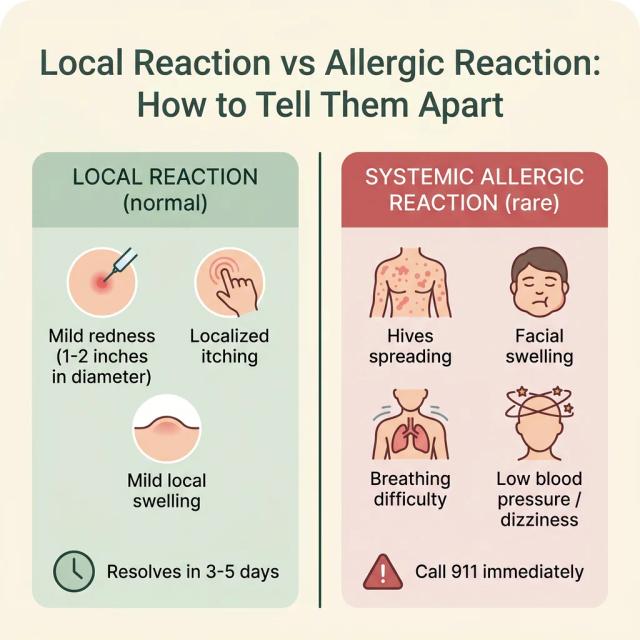
A small area of redness, mild swelling, warmth, and itch that peaks within 24 to 72 hours and then fades, sometimes helped by simple measures like a cold compress or topical soothing creams. Concerning signs that require medical attention include:
- Spreading redness larger than a few inches
- Red streaks
- Severe or worsening pain
- Fever or chills
- Hives away from the site
- Facial or throat swelling
- Any breathing difficulty
When symptoms worsen rather than improve, document the site with a photo and contact your clinician promptly so they can assess for infection or a true allergic response.
How Common are These Reactions, and How Worried Should You Be?
Clinical trial data tells a clear story. Across the SURPASS trials documented in the Mounjaro FDA prescribing information, injection-site reactions occurred in approximately 3-7% of participants depending on dose, while true systemic allergic responses (hives spreading beyond the site, facial swelling, breathing difficulty) are rare. A 2026 review in Anais Brasileiros de Dermatologia confirmed that most local reactions are mild and resolve within 3 to 5 days. The gap between low frequency and high anxiety is real: even a small percentage feels large when it happens to you.
What Should You Do Immediately If You Notice A Rash?
Start with practical, low-risk steps: clean the area gently with soap and water, avoid topical irritants, and avoid scratching. Over-the-counter oral antihistamines can help with itching, and a cool compress reduces heat and swelling. If the reaction is limited and improving within a couple of days, continued observation is reasonable. If it spreads, becomes painful, or you develop systemic signs, seek medical evaluation without delay.
How People Currently Manage This, and How That Creates Hidden Costs
Most people track injection reactions informally, using scattered notes or phone photos saved in folders, because it feels familiar and straightforward. That works at first, but the hidden cost is fragmentation: when reactions recur or change during dose escalation, patterns get missed, delays in clinician decisions occur, and anxiety spikes because nobody can show a clean, time-stamped record. Platforms like MeAgain provide structured injection-site logging, side-effect timelines, and smart reminders, giving people a single source of truth so patterns surface quickly and conversations with clinicians are faster and more precise.
The app has everything! Versatile and easy to use food searching, a dashboard with protien, water and fiber progress, activity tracker and shot reminders that also let you know where your last shot was so you rotate areas. Also lets you easily track side effects. I feel so supported.
A Practical Analogy
Think of a slight injection-site rash like a localized weather event, a brief thunderstorm over one block. Most pass in hours or a few days. A spreading rash is like a storm that keeps growing into a regional system; you do not wait to see if neighboring streets flood. That distinction is what determines action.
When You Should See a Specialist Or Stop Treatment
If a clinician suspects a true allergic reaction, they may recommend stopping tirzepatide and referring to an allergist for testing, or initiating short-course corticosteroids or other targeted treatments. If the rash clearly tracks with poor injection technique, improving technique and recording changes often resolves the issue without stopping therapy. If the reaction forces treatment interruption, document timing and severity precisely to guide next steps.
When To Call Emergency Services
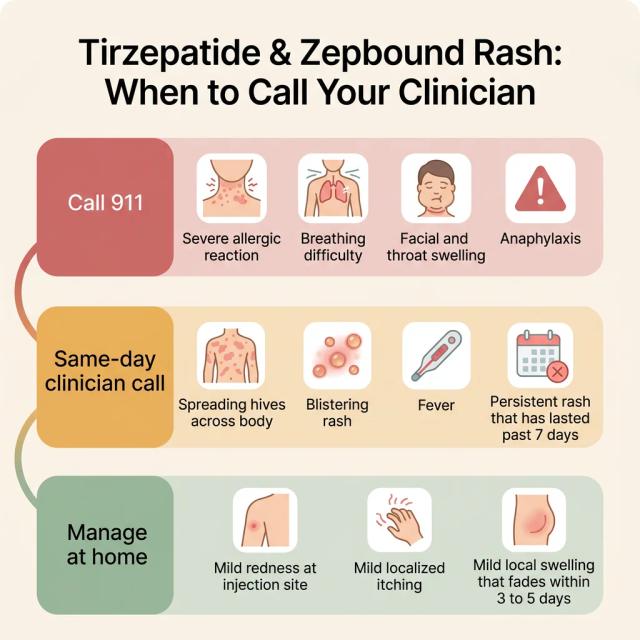
Call emergency services immediately for any breathing difficulty, throat or facial swelling, or sudden collapse. For a rapidly progressive rash with systemic symptoms, do not wait for a scheduled appointment. Tracking the timing, location, and progression of every reaction is what turns an isolated event into a clear picture your clinician can act on.
How to Reduce Tirzepatide Rashes and Itchy Injection Sites
A deliberate rotation plan, small technique changes, and fast pattern-tracking are the most reliable ways to prevent recurring tirzepatide, Zepbound, or Mounjaro injection-site rashes, because they prevent concentrated trauma before the skin reacts. For context, the Mounjaro FDA prescribing information lists injection-site reactions among the documented adverse events across the SURPASS trials at roughly 3-7% — uncommon but consistent enough that a methodical approach matters from day one.
How Should I Rotate Sites?
Break each body region into numbered sections and move through them in order, never skipping back to a recently used spot.
- For the abdomen, divide the area at least 2 inches away from your belly button into four quadrants.
- For thighs, map the top outer thirds into left and right columns.
- For upper arms, use the back portion in small vertical strips.
- For the buttocks, use only the upper outer quadrant.
Treat each numbered square like a cell in a calendar, and always keep injections at least 1 inch from the last mark, even within the same region.
What Does A Practical Rotation Schedule Look Like?
Create a four-week cycle that alternates between regions and quadrants so each patch sees an injection every 3 to 4 weeks.
Example:
- Week 1: Use the abdomen quadrant A on Monday and left thigh on Thursday.
- Week 2: Shift to the abdomen quadrant B and the opposite thigh.
- Repeat with arms and buttocks in weeks 3 and 4.
Mark the skin with a washable, skin-safe pen, or use time-stamped photos to confirm the site was rested for the full interval before you use it again.
Which Needle And Injection Nuances Reduce Irritation?
Small changes in technique dramatically reduce mechanical irritation. Use a new, sterile needle each time, inject slowly over 5 to 10 seconds, and keep the needle in place for 5 seconds after the dose to allow the solution to settle. For low-body-fat areas, pinch a bit of tissue and insert at 45 degrees if your clinician approves; otherwise, default to 90 degrees. Avoid rapid injections and high-speed plunges; they can cause microtrauma that can lead to persistent lumps and itchy nodules.
What Nonprescription Measures Are Worth Trying Right Away?
Apply a cool compress immediately after injection for 10 to 15 minutes — it constricts surface blood vessels and can noticeably reduce redness and itching while the immune response settles. If the itch persists, a single-dose, non-sedating oral antihistamine the evening after an injection can help; for topical relief, use 1% hydrocortisone sparingly and only on intact skin, and confirm with your prescriber if you plan to use it for more than a few days.
Why Do Some People Keep Getting Rashes Even After Trying Fixes?
This challenge appears consistently during dose increases and when rotation slips, and in people with sensitive skin, it often ties to sensitivity to an inactive ingredient or repeated needle trauma. That means changing only one variable, like cooling after injection, can help some people but not others. If your reactions cluster around the same quadrant or follow a dose increase, the failure mode is concentrated exposure, not random bad luck.
Transitioning from Informal Tracking to Centralized Digital Logging
Most people track sites with notes and photos because it is familiar, and that works at first. As reactions recur, that informal method fragments records, hides pattern timing, and turns conversations with clinicians into guesswork. Platforms like MeAgain centralize injection-site logging, generate side-effect timelines, and automate intelligent scheduling, so users can see when reactions align with dose changes or specific sites, reducing repeat-site errors and getting more precise answers faster.
I was a little hesitant getting an app at first I’ve talked to a few other people who have done GLP and didn’t use an app but I personally found it super helpful, especially with my shot tracking as sometimes I can forget where I had the shot the week before so it’s nice to keep a track record and rotate correctly!
What Else Helps With Daily Life And Clothing?
Wear loose, breathable fabrics for 24 to 48 hours after an injection, avoid tight waistbands over abdominal sites, and skip hot baths or saunas for a day so inflamed skin has time to settle. Many find that injecting before a quiet evening or bedtime reduces the immediate itch-related stress, because you can rest through the worst few hours and reassess in the morning.
When Should You Escalate Beyond Home Care?
If a reaction grows, becomes more painful after two days, or shows signs of infection, seek clinical evaluation promptly; also, prepare a short timeline and time-stamped photos to share. If patterns suggest sensitivity to an additive rather than a technique problem, ask your clinician about formulation alternatives and whether allergy testing would help.
More Related Reading
Frequently Asked Questions
How long does it take for a Zepbound or tirzepatide rash to go away?
Most tirzepatide and Zepbound injection-site rashes clear within 3 to 7 days without treatment. Mild redness and itching typically peak at 24 to 48 hours and fade by day 3. A 2026 review in Anais Brasileiros de Dermatologia found most local reactions are transient and resolve without dose adjustment. If a rash is still spreading or worsening past 48 hours, contact your prescriber — that timeline distinguishes a normal local reaction from one that needs evaluation.
How do you know if you're allergic to tirzepatide?
A true tirzepatide allergy (systemic hypersensitivity) is rare and involves symptoms beyond the injection site: hives spreading to other body areas, facial or throat swelling, difficulty breathing, or a sudden drop in blood pressure. The American Academy of Allergy, Asthma & Immunology distinguishes a normal local reaction (redness or itching only at the injection point) from a hypersensitivity reaction. If symptoms stay at the injection site and clear within a week, it is a local reaction. If symptoms spread beyond the site or breathing is affected, seek emergency care immediately.
What are the signs of taking too much tirzepatide?
Tirzepatide dose escalates every 4 weeks; taking more than prescribed or escalating too quickly can intensify side effects. Skin signs that may suggest the dose is high for your body include a widespread rash beyond the injection site, persistent swelling that does not clear between weekly doses, or new hives away from the injection point. Systemic signs — severe nausea, vomiting that prevents eating, or a resting heart rate above 100 bpm — are listed in the Mounjaro FDA prescribing information. Contact your prescriber before your next dose if any of these appear after a dose increase.
Can I keep taking Mounjaro or Zepbound if I get a rash?
For most local injection-site reactions — redness, itching, or mild swelling that clears within a few days — you can keep injecting on schedule. Switching to a fresh, well-rotated site and applying a cool compress for 10 to 15 minutes typically resolves the issue. Stop and call your prescriber before your next dose only if the rash spreads beyond the injection site, blisters, persists past 7 days, or comes with hives, facial swelling, or breathing difficulty. The Mounjaro FDA prescribing information does not list local injection-site reactions on their own as a reason to discontinue.
Download our GLP-1 app to Turn Your Weight Loss Journey into Your Favorite Game
I know an unexpected rash can shake your confidence in tirzepatide, especially when you cannot tell at a glance whether it is settling or spreading. MeAgain turns the daily work of rotating sites, watching reactions, and hitting protein, fiber, water, and exercise goals into a small, rewarding game with a capybara coach and a Journey Card to capture milestones. If you want one app that tracks doses, side effects, and nutrition while making healthy habits stick, try MeAgain. It's used by 780K GLP-1 members with a 4.8-star rating across more than 36K App Store ratings.
Love this APP!! Keeps track of ur journey. Very easy to use. I love that if u forget where u did ur shot this keeps track so u know. Tracking my food intake is great too because if I get any medication side effects I can just check here to see what I ate & if that exasperated the symptoms. Everyone on GLP1 should use that APP!!