

Body aches are not in Zepbound's labelled side effect table, but that table only lists reactions seen in at least 2 percent of patients and more common than placebo, so the label prints no figure for aching either way.
If you are a few weeks in, waking up with your calves cramping and your whole body feeling like the flu, you have probably already checked the carton and found nothing about muscle aches. This page settles what the label actually prints, what is most likely driving the ache you have, and which version of it means picking up the phone today.
This article is general information from public sources, not medical advice. Your prescriber and pharmacist know your history; take storage and dosing questions to them.
Last updated September 2026 · Sources verified against the FDA label, the Medication Guide and MedlinePlus.
Key takeaways
- Muscle aches, cramps and joint pain are not in Table 1 of the FDA label, and that table admits a reaction only when it was both more common than placebo and seen in at least 2% of patients, so the absence measures nothing.
- The two nearest labelled figures are fatigue at 5%, 6% and 7% versus placebo 3% (a category that includes asthenia, lethargy and malaise) and injection site reactions at 6%, 8% and 8% versus placebo 2% (a category that includes injection site pain).
- The one route with the label behind it runs from vomiting and diarrhea to fluid loss, which the label ties to reports of acute kidney injury, and it stops there.
- MedlinePlus makes muscle pain lasting more than 3 days, or starting with a medicine change, a reason to call your care team today, and each of these alone a 911 call: muscle weakness or being unable to move part of your body, vomiting, or urinating less than usual.
Does Zepbound cause body aches?
Muscle aches, cramps and joint pain are not in Table 1 of the FDA label for Zepbound, and that absence does not mean the drug never causes them.
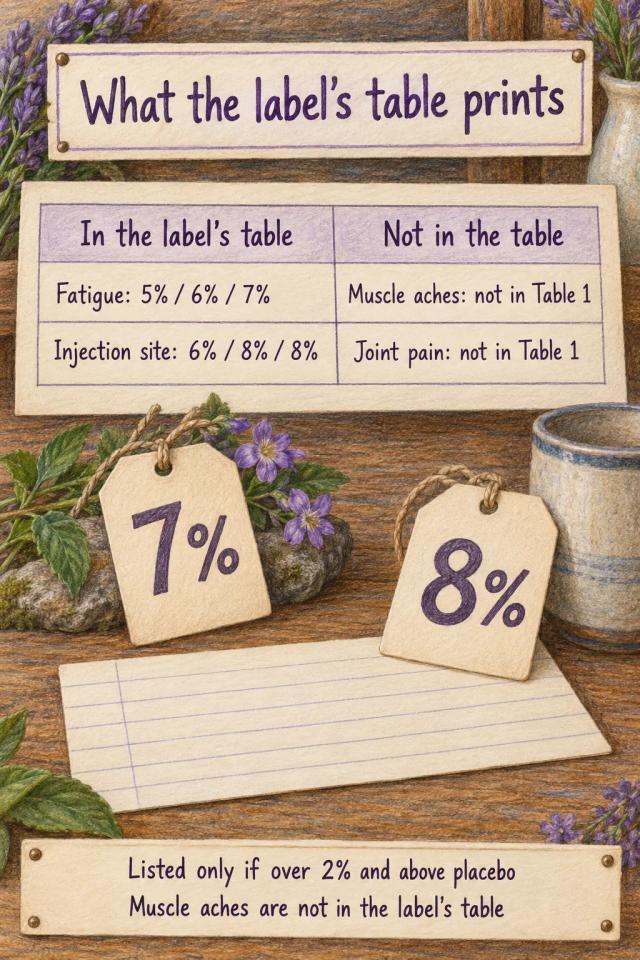
The label says of that table: these reactions "occurred more commonly with ZEPBOUND than with placebo and occurred in at least 2% of patients treated with ZEPBOUND." Two conditions have to be met at once. So an absent symptom tells you the reaction did not clear both bars, and nothing else.
The Medication Guide says so outright: "These are not all the possible side effects of ZEPBOUND."
Reaction as the label names it | Zepbound 5 / 10 / 15 mg | Placebo | What the label's category includes |
|---|---|---|---|
Fatigue | 5% / 6% / 7% | 3% | asthenia, fatigue, lethargy, malaise |
Injection site reactions | 6% / 8% / 8% | 2% | injection site pain, bruising, erythema, pruritus, rash |
Nausea | 25% / 29% / 28% | 8% | nausea |
Vomiting | 8% / 11% / 13% | 2% | vomiting |
Diarrhea | 19% / 21% / 23% | 8% | diarrhea, frequent bowel movements |
Myalgia, muscle cramps, arthralgia | not in Table 1 | not in Table 1 | not admitted: needs at least 2% and above placebo |
Figures from the FDA label, pooled placebo-controlled trials in adults with obesity or overweight (5 mg N=630, 10 mg N=948, 15 mg N=941, placebo N=958). The label adds that rates "cannot be directly compared to rates in the clinical trials of another drug."
How common are muscle aches on tirzepatide, and what does the label print instead?
Muscle aches are not in Table 1, and the two nearest labelled figures are fatigue and injection site reactions. Fatigue ran at 5%, 6% and 7% across the 5, 10 and 15 mg doses against 3% on placebo in the FDA label, a row it footnotes "Includes asthenia, fatigue, lethargy, malaise." Asthenia is weakness. Malaise is the flu-like feeling. That row is the closest the label comes to achy and wiped out, and it is not a stand-in for myalgia: the label does not say muscle pain was counted there.
One signal is worth naming, and it is not a rate. A disproportionality analysis of spontaneous adverse event reports, published as a journal article via PubMed, found that "GLP-1 RAs were linked to back pain, myalgia, and neck mass, while tirzepatide was associated with muscle atrophy and neck mass." That design cannot tell you how many people ache, and it does not establish cause.
Can a Zepbound injection leave the area sore for days?
Injection site pain is a labelled reaction, unlike generalised aching: injection site reactions ran 6%, 8% and 8% against placebo 2% in the FDA label, in a category the label defines as including injection site pain. The label prints no duration for them.
Lilly's Medication Guide says: "Do not inject ZEPBOUND into a muscle (intramuscularly) or vein (intravenously)," and the Instructions for Use adds: "Do not inject where the skin is tender, bruised, scaly or hard, or into scars or damaged skin." More in Zepbound injection site reactions.
How long do body aches last on Zepbound?
The Zepbound label prints no duration for aching, because it does not list aching as a reaction at all. What it does print about timing concerns the stomach side effects, and if your ache is downstream of those, that timing is the useful part.
Dose escalation exists, in the label's words, "to reduce the risk of gastrointestinal adverse reactions," and the FDA label reports that "The majority of nausea, vomiting, and/or diarrhea events occurred during dose escalation and decreased over time."
One duration marker comes from general muscle-pain guidance rather than from the drug's label: MedlinePlus lists "Your muscle pain lasts more than 3 days" as a reason to contact your provider, whatever the cause.
Your own record is the closest thing to a timeline. Log the shot day in MeAgain, the days the aching landed and how bad it was, your water, and any dose change. Three weeks of dated entries beats a memory of "most weeks" when you hand it to your prescriber.
Amazing APP I was on Tirzepatide before- lost waay to fast but regained most weight . This APP helps me lose sliw but steady with MO saggy skin!
Is it normal to feel achy or flu-like in the first week?
The label prints no rate and no duration for a flu-like first week, and the nearest labelled figure is fatigue, a row the FDA label footnotes as including asthenia, lethargy and malaise, at 5%, 6% and 7% against placebo 3%. The Medication Guide's standing instruction covers any symptom the table does not name: "Talk to your healthcare provider if you have any side effect that bothers you or that does not go away."
Why would Zepbound make you ache when it does not act on muscle?
The one route with the label behind it runs through vomiting and diarrhea to fluid loss, and the other two proposed routes are not measured in people who ache. Nausea, vomiting and diarrhea all ran well above placebo, at the rates in the table above.
Section 5.3 of the FDA label carries that forward: of the postmarketing reports of acute kidney injury, "The majority of the reported events occurred in patients who experienced gastrointestinal adverse reactions leading to dehydration such as nausea, vomiting, or diarrhea." The label follows that chain as far as kidney injury and stops there, without carrying it on to muscle pain. Lilly's fluid instruction on its side-effects page is to "Drink at least 8-10 glasses of clear fluids daily. Water is generally preferred."
Separately and generally, MedlinePlus lists "Electrolyte imbalance, such as too little potassium or calcium" among the causes of muscle pain. That is a statement about muscle pain in general, not a tirzepatide finding.
Two other routes are proposed rather than measured. GLP-1 receptors "are also found in skeletal muscles," per a case report via PubMed Central, whose authors add that the evidence tying these drugs to muscle breakdown "remains sparse." And a journal article via PubMed Central suggests tirzepatide "could induce a state of passive calorie restriction and malnutrition, which may cause" effects including muscle atrophy. Those hedging verbs are the authors' own.
Can losing weight fast on Zepbound cost me muscle, not just fat?
The label's own answer is that "Tirzepatide lowers body weight with greater fat mass loss than lean mass loss," in the FDA label section 12.2. The literature sits alongside it with wider figures and its own scope: the American Diabetes Association says "lean body mass can account for up to 15-40% of total weight loss from GLP-1 therapies," GLP-1 therapies as a class rather than Zepbound, and a journal article via PubMed Central, a review reporting others' trials, says participants "lost 10% or more of their muscle mass during the 68‐ to 72‐week interventions." The counterweight is that lean-mass results from these treatments are "highly variable," per a journal article via PubMed. More in Zepbound and muscle loss.
What else could be causing the aching?
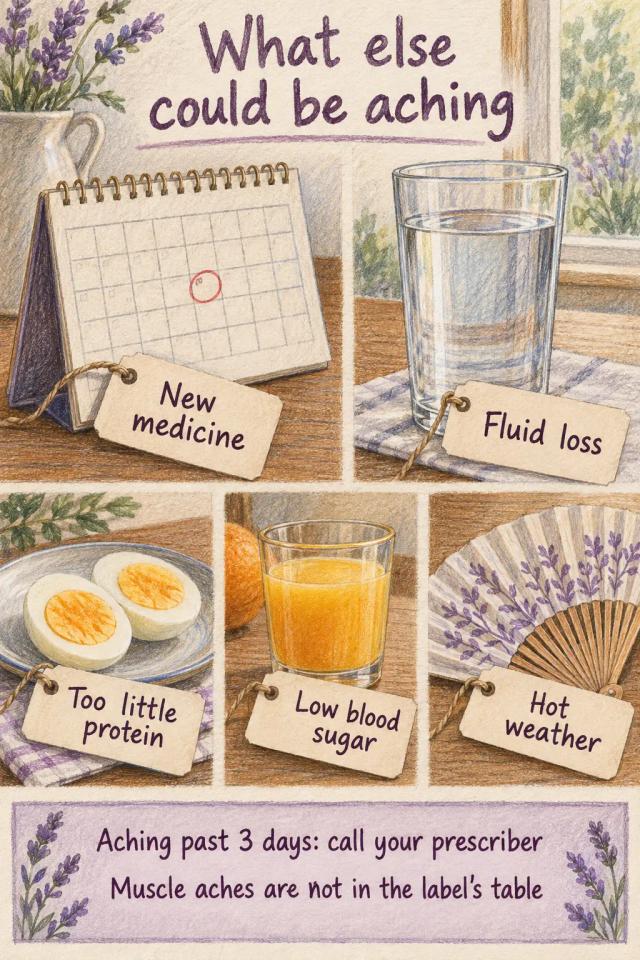
Four things change the answer for a woman aching on Zepbound: a statin, too little protein, insulin or a sulfonylurea, and heat.
Does my statin change the answer?
A statin is an independent and well-measured source of muscle symptoms. A journal article via PubMed Central reports that statins raise muscle symptoms in the first year of use from 14.0% on placebo to 14.8% on the statin, and that "Only 1 patient-reported muscle symptom in 15 is due to the statin."
Those are statin-alone figures, from trials with no tirzepatide co-exposure. It is still worth naming to your prescriber: MedlinePlus makes muscle pain "linked with starting or changing doses of a medicine, such as a statin" a reason to contact your care team.
Can too little protein make the aches and weakness worse?
Yes, and weakness is often the first marker to show. A journal article via PubMed Central lists the rest: "fatigue beyond expected levels, excessive hair loss, skin flakiness or itching, muscle weakness, poor wound healing, and unusual bruising."
Lilly's Canadian product monograph, rather than the US label, addresses it directly: "Risks associated with malnutrition include, but are not limited to, vitamin and mineral deficiency, protein deficiency, and low body weight."
Can insulin or a sulfonylurea cause weakness and shakiness?
Yes, indirectly: Zepbound taken with insulin or a sulfonylurea raises the chance of low blood sugar, and shakiness and weakness are two of its signs. Section 5.7 of the FDA label states: "ZEPBOUND lowers blood glucose and can cause hypoglycemia."
In a trial of patients with type 2 diabetes and BMI of at least 27, hypoglycemia was reported in 4.2% of Zepbound-treated patients versus 1.3% on placebo. Within that same trial, patients on a sulfonylurea ran 10.3% against 2.1% for those not taking one, and the label names insulin as increased risk without giving a rate. It also notes that "Hypoglycemia has also been associated with ZEPBOUND and GLP-1 receptor agonists in adults without type 2 diabetes mellitus."
Mayo Clinic names the conditions that open the window: delaying or missing a meal or snack, exercising more than usual, drinking alcohol, or being unable to eat because of nausea or vomiting.
Can hot weather and heavy sweating trigger cramps?
Yes, and heat cramps are a warning sign in their own right. Mayo Clinic explains that "the fluid and electrolyte loss that occurs through sweating often contributes to heat cramps," and that people who sweat a lot may be prone to them.
Cleveland Clinic describes heat cramps as a mild form of heat illness, but adds that "these cramps are a warning that more severe illness could occur if you don't take steps to cool down."
Where to get help
Use the row that matches what you have, not the closest one.
Sign, in the source's words | Who and how fast | Source |
|---|---|---|
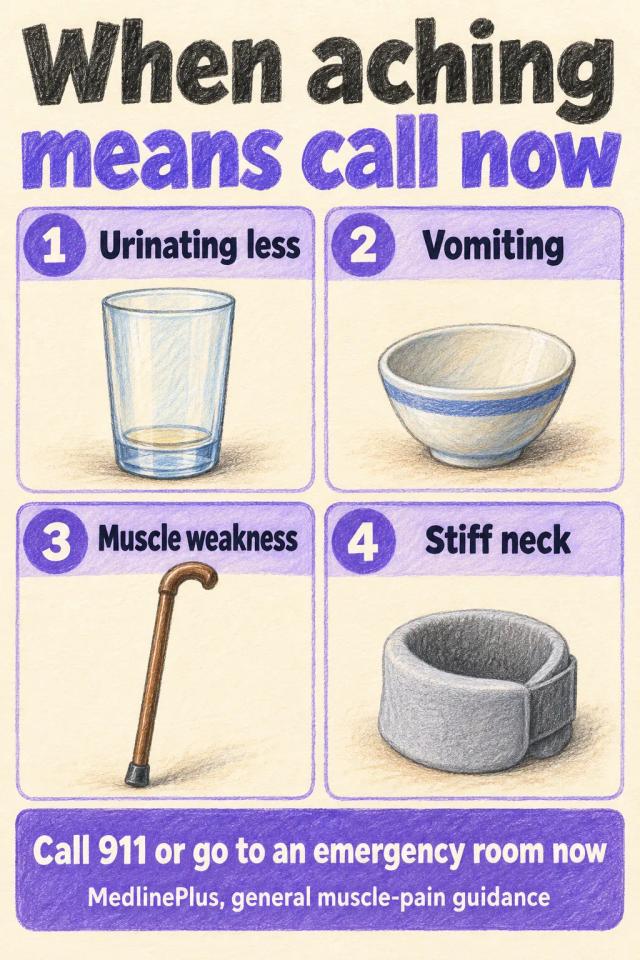
"You have sudden weight gain, water retention, or you are urinating less than usual" | Call 911 or go to an emergency room now | MedlinePlus, general muscle-pain guidance |
"You have muscle weakness or cannot move some part of your body" | Call 911 or go to an emergency room now | MedlinePlus, general muscle-pain guidance |
"You are vomiting, or have a very stiff neck or high fever" | Call 911 or go to an emergency room now | MedlinePlus, general muscle-pain guidance |
"Your muscle pain lasts more than 3 days"; "You have severe, unexplained pain"; "Your muscle pain is linked with starting or changing doses of a medicine, such as a statin" | Call your prescriber or care team today | MedlinePlus, general muscle-pain guidance |
"bloody urine, decreased urine output, muscle twitching, nausea, rapid weight gain, seizures, stupor, swelling of the face, ankles, or hands, or unusual tiredness or weakness" | "Check with your doctor right away" | |
"nausea, vomiting, or diarrhea that does not go away" | "Tell your healthcare provider right away" | |
Low blood sugar: "dizziness or light-headedness sweating confusion or drowsiness headache blurred vision slurred speech shakiness fast heartbeat anxiety, irritability, or mood changes hunger weakness feeling jittery" | Call your prescriber or care team today | |
"severe pain in your stomach area (abdomen) that will not go away, with or without nausea or vomiting. Sometimes you may feel the pain from your abdomen to your back" | "Stop using ZEPBOUND and call your healthcare provider right away" | |
"stomach problems that are severe or will not go away" | Call your prescriber or care team today |
Frequently asked questions
Should I tell my prescriber about aches that started after my first injection?
Yes. Aching is not in the label's table, and the Medication Guide covers exactly that case: talk to your healthcare provider about any side effect that bothers you or that does not go away.
What should I watch for in someone on Zepbound who has cramps along with vomiting or diarrhea?
Mayo Clinic says dehydration can lead to acute kidney injury, and to "Check with your doctor right away" for "bloody urine, decreased urine output, muscle twitching, nausea, rapid weight gain, seizures, stupor, swelling of the face, ankles, or hands, or unusual tiredness or weakness."
Related reading