

Joint pain is not in Zepbound's label table of common side effects, which only lists reactions hitting 2% and beating placebo, and it has still been reported since approval, in case reports and in a study of Facebook posts.
Four different things get called "aching" on tirzepatide, and only one of them means stopping the medicine and calling right away. A knee that aches after a dose step, a cramp after a thin day of fluids and a hot toe at 4am are three different problems.
This article is general information from public sources, not medical advice. Your prescriber and pharmacist know your history; take storage and dosing questions to them.
Last updated September 2026 · Sources verified against the FDA label, the Medication Guide and MedlinePlus.
Key takeaways
- Joint pain is not in Table 1 of the FDA label, and musculoskeletal pain has still been reported since approval, in case reports and in a study of Facebook posts; the FAERS signal for tirzepatide is muscle atrophy and neck mass, not joint pain.
- A reaction only enters Table 1 if it occurred in at least 2% of patients on Zepbound and more commonly than on placebo, so a real symptom can be absent from it.
- Injection site reactions, footnoted as including injection site pain, ran 2% among 958 adults on placebo against 6% at 5 mg and 8% at 10 and 15 mg among the 2,519 treated with Zepbound, over up to 72 weeks (the FDA label).
- Thiazide and loop diuretics are independently linked to incident gout (the diuretics study). If you take one and get gout, Mayo Clinic says ask whether to keep it or switch.
- Severe stomach pain that will not go away, sometimes felt through to the back: the Medication Guide says stop using Zepbound and call your healthcare provider right away.
Is joint pain a listed side effect of tirzepatide?
Joint pain is not in the Zepbound label's table of common adverse reactions, though that table only admits reactions clearing two thresholds at once, and musculoskeletal pain has been reported since the drug went to market. The FDA label states the rule for Table 1 plainly: those reactions "occurred more commonly with ZEPBOUND than with placebo and occurred in at least 2% of patients treated with ZEPBOUND." Every figure in the Zepbound columns comes from a pool of two randomized, double-blind, placebo-controlled trials in 2,519 adults with obesity or overweight treated with Zepbound for up to 72 weeks, against 958 adults on placebo.
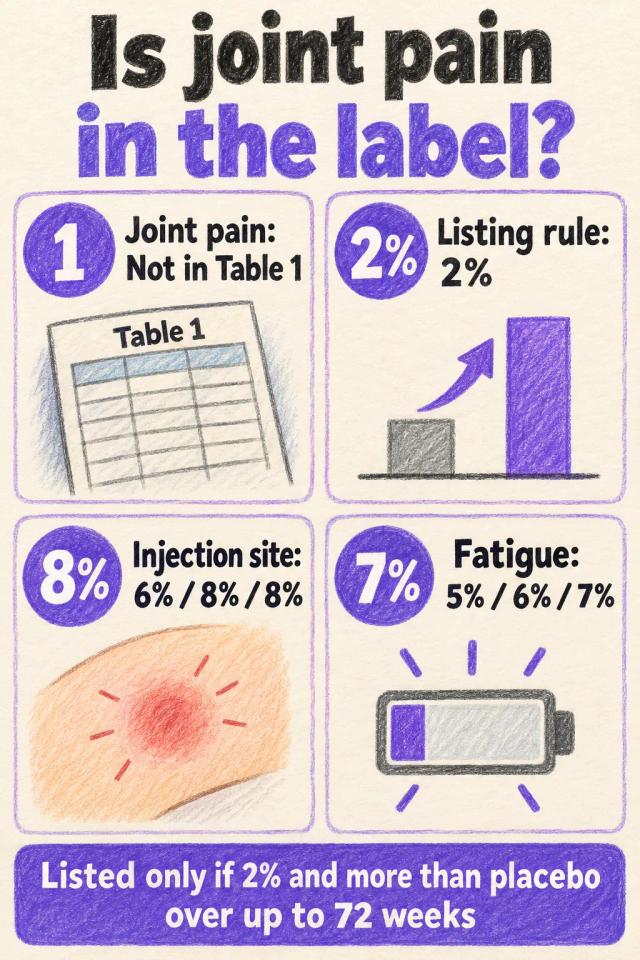
Reaction (label term) | Placebo (N=958) | 5 mg / 10 mg / 15 mg | What the footnote includes |
|---|---|---|---|
Injection site reactions | 2% | 6% / 8% / 8% | Bruising, erythema, pruritus, injection site pain, rash, reaction |
Fatigue | 3% | 5% / 6% / 7% | Asthenia, fatigue, lethargy, malaise |
Joint pain | Not in Table 1 | No rate in the label | Not a Table 1 term |
The Medication Guide closes its own side effect list by saying "These are not all the possible side effects of ZEPBOUND," and Lilly's side-effects page for Mounjaro names seven: nausea, diarrhea, decreased appetite, vomiting, constipation, indigestion, stomach pain. Joints are on none of these lists.
What exists instead is reporting from after approval. The case series of three patients with palpitations, musculoskeletal pain and headaches notes that "these symptoms were not reported during tirzepatide's clinical trials. This suggests that these may be postmarketing adverse events." A social-media study of Facebook posts found that "Joint pain was an additional adverse event that appeared on social media but is not yet attributed to these medications in clinical trials." In a FAERS study, "tirzepatide was associated with muscle atrophy and neck mass," not arthralgia.
Which of the four aches do you have?
People call four different things "aching" on tirzepatide: a stiff joint, sore or weak muscles, a cramp, and the abdominal or back pain the label warns about, and only the last one carries a stop-the-medicine instruction. MedlinePlus lists the ordinary causes of joint pain in any adult, crystals in the joint among them, and gives the signs of inflammation to look for: "Swelling. Warmth. Tenderness. Redness. Pain with movement." Its contact-your-provider list includes unintended weight loss, phrased "without trying," so that bullet does not describe deliberate loss on a prescribed medication.
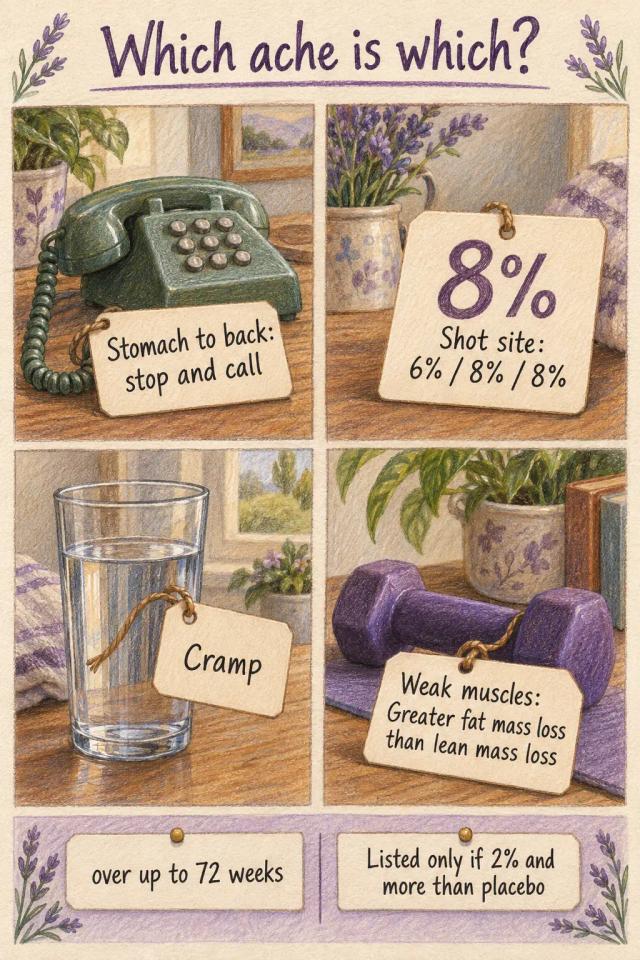
Soreness at the shot site is its own category and it is in the label: footnote d puts "injection site pain" inside the injection site reactions row, at 2% on placebo against 6%, 8% and 8% by dose (the FDA label).
The fourth ache is not musculoskeletal at all. The Medication Guide says to "Stop using ZEPBOUND and call your healthcare provider right away" for "severe pain in your stomach area (abdomen) that will not go away," sometimes felt through to the back.
Why do my joints hurt more after I increased my dose?
Lilly ties dose increases to gastrointestinal events, not joint symptoms, and the only tirzepatide report linking new musculoskeletal pain to a dose step is a single case. Lilly's side-effects page puts it this way: "In studies, most nausea, vomiting and diarrhea events occurred while the dose of Mounjaro was being increased."
The escalation schedule exists for the same reason. The FDA label sets 2.5 mg once weekly for 4 weeks, then 2.5 mg increases at least 4 weeks apart, to a maintenance of 5, 10 or 15 mg and a maximum of 15 mg, "to reduce the risk of gastrointestinal adverse reactions." On joints, the case series records one 37-year-old man with new neck and back pain after a step from 7.5 to 10 mg. One person, a temporal association, no rate.
If the ache seems to track your dose steps, MeAgain lets you log the shot day, your prescribed dose and the ache by day and severity, next to each dose change.
Great for tracking dose, injection site, side effects, and items like my macros and weight are imported from my other apps directly. This app really helps keep track of everything!
Why do my muscles feel weak and sore after losing weight?
The FDA label says tirzepatide "lowers body weight with greater fat mass loss than lean mass loss," so lean tissue is still being lost. A review summarising other trials' numbers reports that participants on these drugs "lost 10% or more of their muscle mass during the 68-to 72-week interventions, approximately equivalent to 20 years of age-related muscle loss."
The label adds that tirzepatide "decreases calorie intake" and that "the effects are likely mediated by affecting appetite." That "likely" is the label's own hedge. The weak half of your question has a label row of its own: fatigue, which footnote e defines as including asthenia. More on that in what happens to muscle on tirzepatide.
Why can eating and drinking less cause cramps?
Reduced intake and stomach side effects can limit fluids enough to cause dehydration and, in rare cases, electrolyte disturbance, and fluid depletion is a named risk factor for muscle cramps. A journal article describes the chain: "Nausea, vomiting, diarrhea, and early satiety, commonly reported during dose titration, can substantially limit oral fluid intake and lead to fluid loss." StatPearls names fluid depletion alongside medications, metabolic disorders and repetitive stress.
How long does joint pain last, and does it go away?
The FDA label gives no duration for joint pain, so the timeline you can act on is the general one: MedlinePlus says to contact your provider if "your joint pain lasts for more than several days."
What Lilly does say about duration concerns a different symptom set: after noting that most nausea, vomiting and diarrhea events occurred during dose increases, Lilly's side-effects page adds that "these events decreased over time." Stomach effects, not joints.
Can tirzepatide trigger gout, and what does a flare look like?
The documented direction runs the other way: weight loss lowers urate, and the gout risk with a name attached to it is a diuretic. An observational study in bariatric surgery patients states the opposite of the premise most readers arrive with: "Weight loss is known to be effective in reducing urate levels [7, 8], thereby reducing incidence of gout and associated diseases." A tirzepatide study set out "to test whether tirzepatide, a dual GLP-1RA/GIP agonist, approved for weight management, would be associated with lowered serum uric acid (SUA) levels via its weight reduction properties," so the question has been asked of this molecule directly.
Could sudden pain and swelling in the big toe be gout?
It can be: Mayo Clinic describes gout as "sudden attacks of intense pain, swelling, redness and tenderness in one or more joints. The big toe is the joint most affected." On timing, a book chapter says "the pain and swelling are usually at their worst 6 to 12 hours after an attack starts," and about a week for the swelling to settle. Mayo Clinic adds: "Seek medical care right away if you have a fever and a joint is hot and inflamed. These symptoms may mean you have an infection."
What if I take a diuretic or another blood pressure medicine?
A diuretic, not the tirzepatide, is the blood pressure medicine with a documented link to gout. The diuretics study, a prospective population-based study in middle-aged adults with hypertension, found that "both thiazide and loop diuretics were independently associated with an increased risk of incident gout," and adds that "other antihypertensive medications were associated with a decreased risk of gout." This is a read-across from the hypertension literature, not a tirzepatide finding.
Mayo Clinic gives the question to bring: if you develop gout while taking a diuretic for high blood pressure, "ask if you should keep taking the diuretic or switch to another medicine." That conversation belongs to whoever prescribes the blood pressure medicine.
Can I take ibuprofen or acetaminophen for aches on tirzepatide?
Lilly's Canadian product monograph states that no dose adjustment of acetaminophen is necessary when it is taken with tirzepatide (the Canadian product monograph). That monograph's interaction section answers acetaminophen and does not address ibuprofen, so whether to take one, and how much, is a question for your pharmacist or prescriber.
The FDA label reports that after a first dose of tirzepatide 5 mg, acetaminophen's peak concentration fell 55% and arrived 1 hour later, with "no meaningful impact" at Week 6 on 15 mg and overall 24-hour exposure "not influenced." The FDA label also says Zepbound "delays gastric emptying and thereby has the potential to impact the absorption of concomitantly administered oral medications. Caution should be exercised."
When to call your prescriber or go in
Severe stomach pain that will not go away, sometimes felt through to the back, means stopping the medicine and calling right away.
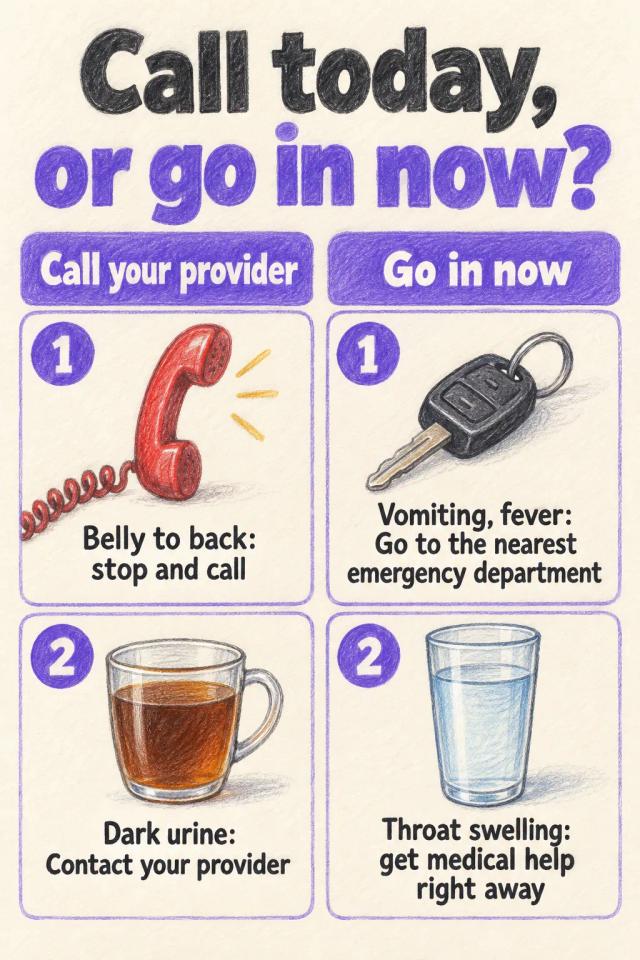
Sign | Who and how fast | Source |
|---|---|---|
"severe pain in your stomach area (abdomen) that will not go away, with or without nausea or vomiting. Sometimes you may feel the pain from your abdomen to your back" | "Stop using ZEPBOUND and call your healthcare provider right away" | |
"severe, constant abdominal pain, especially if you also have: Repeated vomiting, Fever, Trouble breathing, Fainting or severe dizziness, A fast heartbeat" | "Go to the nearest emergency department" | |
"nausea, vomiting, or diarrhea that does not go away" | "Tell your healthcare provider right away" | |
"a fever and a joint is hot and inflamed. These symptoms may mean you have an infection" | "Seek medical care right away" | |
"You have fever that is not associated with flu symptoms"; "You have severe, unexplained joint pain and swelling, particularly if you have other unexplained symptoms" (general joint-pain guidance, not tirzepatide-specific) | "Contact your provider," meaning your prescriber or care team today |
Severe muscle pain with dark urine
Severe, unexplained muscle pain with fatigue and dark urine is the combination clinicians are told to watch for as possible rhabdomyolysis: a case report tells them to "remain vigilant for rhabdomyolysis in patients presenting with nonspecific symptoms such as muscle pain, fatigue, and dark urine," and a second case report notes the evidence "remains sparse." Two single patients and no rate. Your route is the one in the table above: severe, unexplained pain with other unexplained symptoms goes to your prescriber or care team today.
Frequently asked questions
What if I already have rheumatoid arthritis or lupus?
Lilly's answers page answers this one directly: "Tirzepatide has not been studied in people with autoimmune abnormalities." It adds that participants were excluded from clinical trials if they were receiving or were likely to require systemic glucocorticoids during the study. The manufacturer's statement about its own drug is the answer, and it means the studies have not been done in you. Your rheumatology team should know you are on it.
Should I stop tirzepatide because of joint pain or a gout flare?
Starting, stopping or changing this medicine is your prescriber's call, and the FDA label gives one exit for a dose that is not tolerated: a lower maintenance dosage. The one instruction to stop is for a different pain: the Medication Guide says to "Stop using ZEPBOUND and call your healthcare provider right away" for "severe pain in your stomach area (abdomen) that will not go away."
Can losing weight improve knee osteoarthritis pain over time?
The nearest evidence is not tirzepatide. In Lilly's news release, the investigational triple agonist retatrutide reduced WOMAC knee pain "up to an average of 4.5 points (75.8%)" in 445 adults over 68 weeks, against "-2.4 points (-40.3%)" on placebo, with the percentages estimated post hoc. Different molecule, and placebo moved too.
Can getting dehydrated in hot weather cause muscle cramps and aches?
Heat and a thin day of fluids stack up. Cleveland Clinic says that when you are hot, sweaty and cramping, "Drinking something with electrolytes and cooling your body should help."
How can I avoid stiff, achy joints on a long flight?
The CDC says to extend your legs straight out and flex your ankles, pulling your toes toward you, and that some airlines suggest pulling each knee up toward the chest and holding it there for 15 seconds, repeated up to 10 times.
My whole body aches after injecting: could the injection have caused it?
The labelled reaction is at the site, not whole-body: footnote d in the FDA label covers injection site pain among the local reactions. The Instructions for Use says to "Change (rotate) your injection site each week" and not to inject "where the skin is tender, bruised, scaly or hard," and the stated reason is lipodystrophy and amyloidosis, not pain.
Who do I call with a question about a side effect?
Your prescriber or pharmacist first. Lilly's side-effects page also gives a manufacturer line: Lilly Support Services, 1-800-LillyRx (1-800-545-5979).
Related reading