
Choosing between Zepbound and compounded tirzepatide involves more than comparing prices or availability. The decision affects medication safety, effectiveness, and long-term health outcomes. Understanding the differences in regulatory standards, manufacturing processes, and clinical backing helps patients make informed choices that align with their health goals and budget.
Both options contain the same active ingredient, but they differ significantly in oversight, quality control, and proven results. Licensed healthcare providers can evaluate individual circumstances and recommend the most appropriate tirzepatide option based on medical history, insurance coverage, and treatment goals. MeAgain's GLP-1 app connects patients with qualified providers who offer personalized guidance throughout the decision-making and treatment process.
Table of Contents
- Is Compounded Tirzepatide as Effective as Zepbound? What the Clinical Evidence Actually Shows
- Why Compounded Tirzepatide Exists and Why It Is Not the Same as Zepbound
- Zepbound vs. Compounded Tirzepatide: 5 Differences to Consider
- No Matter Which You Choose, This Is What Determines Your Results
Summary
- Zepbound's FDA approval represents years of clinical trials involving over 5,000 participants, standardized manufacturing, and documented safety reviews. Compounded tirzepatide doesn't undergo this pre-market approval process because it's produced by individual pharmacies under state regulations rather than FDA oversight. This means compounded versions lack the extensive clinical validation and batch-to-batch consistency guarantees that come with FDA-approved medications.
- Clinical trials for Zepbound showed that participants achieved an average weight loss of 15% to 22.5%, depending on dosage, with results tracked over 72 weeks under controlled conditions. Compounded tirzepatide formulations vary too much between pharmacies to support standardized studies, making it impossible to assume they'll produce the same outcomes documented in Zepbound's trials. Different compounders add different inactive ingredients and use varying preparation methods, creating formulation inconsistency that wasn't present in the clinical research.
- Dosing errors occur more frequently with compounded tirzepatide because patients often receive unclear measurement instructions or misunderstand concentration differences between formulations. Reports to the FDA describe cases requiring hospitalization for severe nausea, vomiting, dehydration, and pancreatitis following compounded tirzepatide dosing mistakes. Australia banned compounded tirzepatide entirely after multiple adverse events linked to these administration errors.
- Quality control failures in compounded products pose documented safety risks beyond dosing confusion. FDA testing found bacterial contamination, high impurity levels, incorrect active ingredients, and one case where a compounded product contained no tirzepatide at all. Eli Lilly's independent analysis confirmed these findings, identifying real products that reached patients with contamination levels that posed infection and sepsis risks when injected.
- Compounded tirzepatide becomes a reasonable option when access barriers such as cost, insurance restrictions, or shortages prevent the use of FDA-approved Zepbound, provided you work with a qualified provider sourcing from a reputable 503B compounding facility. The trade-off involves accepting higher variability and reduced regulatory oversight in exchange for accessibility. Treating the two as interchangeable ignores structural differences in manufacturing standards, clinical evidence, and quality consistency that affect predictability and safety.
- MeAgain's GLP-1 app addresses the daily management gap that determines results, regardless of which tirzepatide formulation you choose, by tracking protein, hydration, fiber, and movement goals to prevent muscle loss and side effects while the medication works.
Is Compounded Tirzepatide as Effective as Zepbound? What the Clinical Evidence Actually Shows
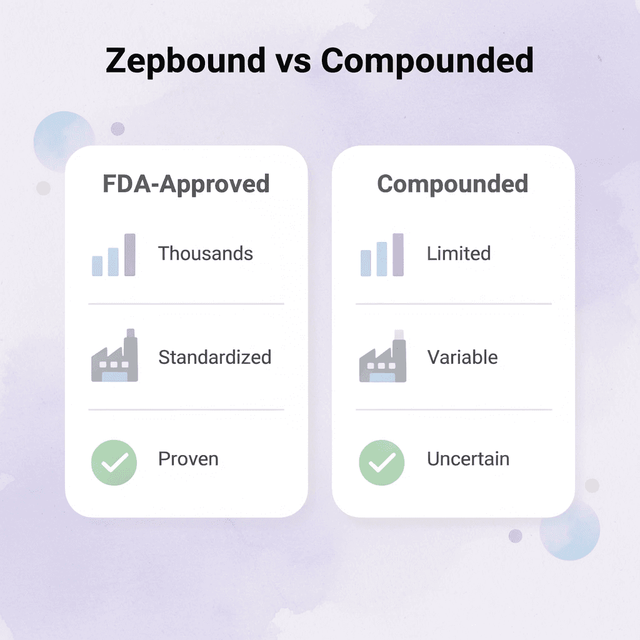
No, they are not clinically equivalent. Zepbound is FDA-approved tirzepatide backed by clinical trials involving thousands of participants, standardized manufacturing processes, and consistent dosing through prefilled pens. Compounded tirzepatide contains the same active ingredient but lacks standardized trial validation, regulatory oversight, and quality controls that ensure consistent dosing.

"FDA-approved medications undergo rigorous clinical trials with thousands of participants to establish safety and efficacy, while compounded versions lack this comprehensive regulatory oversight." — FDA Guidelines, 2024

Aspect | Zepbound (FDA-Approved) | Compounded Tirzepatide |
|---|---|---|
Clinical Trials | Large-scale studies with thousands of participants | Limited to small-scale validation |
Manufacturing | Standardized pharmaceutical facilities | Compounding pharmacy preparation |
Quality Control | Rigorous FDA oversight | Variable state-level regulation |
Dosing Consistency | Prefilled pens with precise dosing | Manual preparation with potential variation |
What Zepbound's Clinical Trials Actually Demonstrated
The SURPASS clinical trials showed that participants taking tirzepatide achieved an average weight loss of 15% to 22.5% of their starting body weight, depending on dosage. The 15 mg weekly dose produced the greatest weight reduction. These results reflect consistent dose amounts across manufacturing batches, controlled patient selection criteria, standardized administration protocols, and comprehensive monitoring of adverse events. The reported weight loss represents uniform drug concentration, identical injection devices, and thousands of data points collected under identical conditions.
Where Compounded Versions Diverge
Compounded tirzepatide varies in formulation, dosing consistency, and additional ingredients across pharmacies. A 4-week study found that only 48% provided proper use instructions on their websites, and subcutaneous products often lacked autoinjector pens that prevent dosing errors. Some compounding pharmacies add cyanocobalamin, niacinamide, glycine, docusate, or ondansetron to tirzepatide formulations—combinations that have never been tested together in clinical settings. These additions lack FDA approval for subcutaneous injection, and their effects on tirzepatide absorption, efficacy, and side effect profiles remain unknown.
Why doesn't the same active ingredient guarantee the same results?
Having the same active ingredient does not guarantee the same clinical result. Manufacturing precision determines whether each vial contains exactly 5 mg, 10 mg, or 15 mg of tirzepatide. Storage conditions affect protein stability. Delivery mechanisms influence absorption rate. Zepbound's prefilled pens eliminate user error in dose measurement. Compounded versions require patients to draw precise amounts from vials, which has led to reported administration errors where patients accidentally injected doses up to 10 times higher than prescribed, causing severe nausea, vomiting, abdominal pain, and weakness.
How can you track effectiveness across different formulations?
Tracking your GLP-1 journey across different medication sources presents a challenge: determining whether changes in side effects, hunger levels, or weight loss stem from the medication itself, dose adjustments, or formulation differences. Our MeAgain GLP-1 app logs every dose, injection site, meal, symptom, and progress photo in one place. When you switch from brand name to compounded tirzepatide or adjust dosing schedules, the app's tracking shows how your body responds, providing real data for conversations with your healthcare provider about whether your current formulation is working as expected.
What do studies show about compounded semaglutide effectiveness?
A retrospective study of 94 people using compounded semaglutide with cyanocobalamin showed an average loss of 2.7 kg of fat mass and 1.4 kg of lean mass after three months, compared with prospective studies of brand-name semaglutide, which showed approximately 10 kg of fat mass loss at seven months. The compounded version study did not compare results against the innovator product or show whether adding cyanocobalamin reduced the rate of vitamin deficiency. One large observational study of 461,382 patients taking GLP-1 medications found that 15.1% developed vitamin deficiencies over 12 months, including 13.6% with vitamin D deficiency, 0.0% with niacin deficiency, and 0.1% with thiamine deficiency.
Why do compounded alternatives exist, and what makes their legal status complicated?
To understand whether compounded formulations work differently from brand-name options, you need to know why these alternatives exist and what complicates their legal status.
Related Reading
- How Much Is Compounded Semaglutide
- How to Get Compounded Semaglutide
- Why is Semaglutide Compounded With B12
- Compounded Semaglutide Not Working
Why Compounded Tirzepatide Exists and Why It Is Not the Same as Zepbound
Compounded tirzepatide exists because of three converging realities: periodic drug shortages, cost barriers that price many patients out of brand-name medications, and legal provisions that allow pharmacies to create customized formulations when FDA-approved drugs are unavailable or unsuitable. When Zepbound and Mounjaro faced supply constraints starting in 2022, compounding pharmacies stepped in to fill the gap. Even after the FDA declared the shortage resolved in December 2024, many compounding operations continued, often by adding ingredients like vitamin B12 or vitamin D to differentiate their products from non-compounded versions.

"When FDA-approved drugs face supply constraints, compounding pharmacies can legally create customized formulations to meet patient needs." — FDA Guidance on Drug Shortages
What are compounding pharmacies legally permitted to do?
Compounding pharmacies work under FDA guidelines to create medications tailored to individual patient needs. The FDA permits compounding when patients cannot access FDA-approved alternatives due to allergies to inactive ingredients, need for a different dosage form (such as liquid instead of pills), or medication shortages. 503(b) compounding pharmacies can produce larger batches and distribute across state lines, expanding access during the tirzepatide shortage.
How do compounding pharmacies differ from FDA-approved medications?
Compounding pharmacies don't follow the same manufacturing controls as FDA-approved medications like Zepbound. They bypass strict approval processes that require extensive clinical trials to demonstrate safety, efficacy, and consistent quality. They don't guarantee batch consistency, meaning each dose may not contain exactly what the label states. Compounded medications are regulated differently because they're meant to be exceptions, not replacements for medications available at regular pharmacies.
Why do people assume these medications are equivalent?
The psychology is straightforward: similar names, similar active ingredients, and significantly lower prices create an assumption of equivalence. When someone sees "compounded tirzepatide" priced at a fraction of Zepbound's cost, the brain fills in the gaps—it sounds like the same medicine, made by a different pharmacy. The price difference feels like cutting out corporate markup, not cutting corners on quality control. This mental shortcut ignores the structural differences that matter.
What structural differences actually matter?
These structural differences appear in supply chains, oversight mechanisms, and consistency guarantees. Zepbound is produced at Eli Lilly's controlled manufacturing facilities under FDA oversight at every production stage. Compounded tirzepatide comes from individual pharmacies with varying quality standards, different sourcing for raw ingredients, and no requirement to prove batch consistency. The system doesn't require uniformity, which means patients bear the risk of variability.
How can you track medication consistency?
Most people tracking their GLP-1 journey face the same challenge: distinguishing what's working, what's inconsistent, and what's causing the changes they experience. Our MeAgain app helps by consolidating dose timing, side effects, nutrition patterns, and progress metrics in one place, making it easier to spot when results diverge from expectations or when dosing inconsistencies affect outcomes. That visibility matters even more when the medication itself has built-in variability. Understanding these differences affects your body, results, and safety when choosing between options.
Related Reading
- How To Travel With Semaglutide Compound
- What Color Is Compounded Semaglutide
- Does Insurance Cover Compounded Semaglutide
Zepbound vs. Compounded Tirzepatide 5 Differences to Consider
Choosing between Zepbound and compounded tirzepatide means understanding what you're getting and what trade-offs you're accepting. The active ingredient is identical, but manufacturing, testing, storage, and delivery create meaningful differences in predictability, safety, and results.

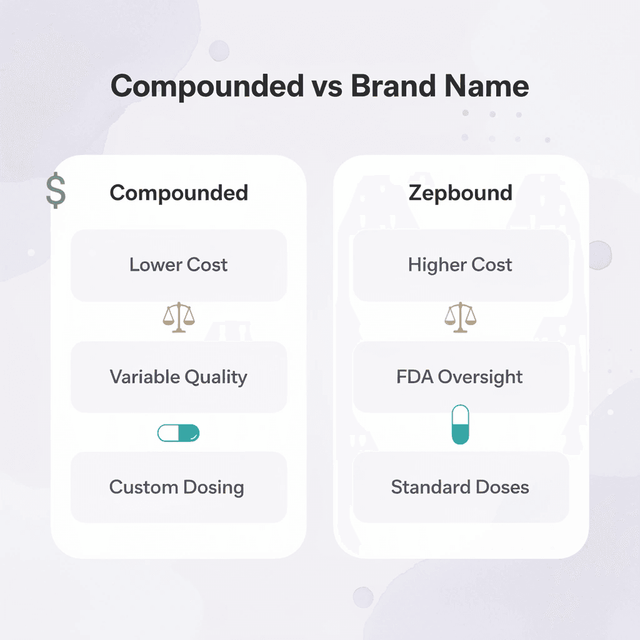
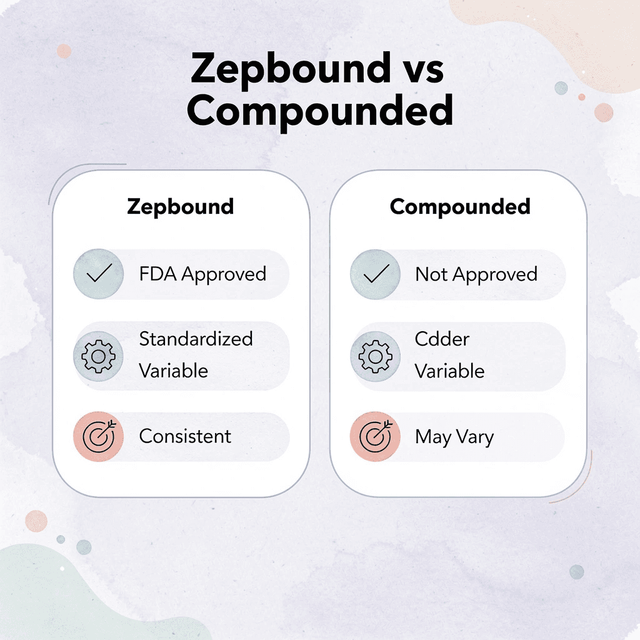
Factor | Zepbound | Compounded Tirzepatide |
|---|---|---|
FDA Approval | ✅ Full FDA approval | ❌ Not FDA approved |
Quality Control | ✅ Standardized manufacturing | ⚠️ Varies by pharmacy |
Dosing Consistency | ✅ Precise, uniform doses | ⚠️ Potential variations |
Cost | ❌ Higher price point | ✅ More affordable |
Insurance Coverage | ✅ Often covered | ❌ Usually out-of-pocket |
Availability | ⚠️ May have shortages | ✅ More readily available |
"The same active ingredient doesn't guarantee the same therapeutic outcome when manufacturing standards and quality controls differ significantly." — Pharmaceutical Quality Research, 2024

1. Zepbound is FDA-approved, while compounded tirzepatide is not
Zepbound passed years of clinical trials with thousands of participants, strict manufacturing inspections, and documented safety reviews. FDA approval means the agency verified not only that tirzepatide works, but that this specific formulation, made this specific way, in these specific doses, produces consistent and acceptable results.
How is compounded tirzepatide regulated differently?
Compounded tirzepatide bypasses this process. Individual pharmacies manufacture it under state Board of Pharmacy rules rather than FDA approval before market release. Some larger compounding facilities (called 503B outsourcing facilities) register with the FDA and follow stricter manufacturing standards, but they still don't submit the extensive clinical trial data required for approval. The version you get from one compounding pharmacy may differ from another in inactive ingredients, preparation method, or storage conditions, even if both contain the same amount of tirzepatide.
2. Zepbound has been studied extensively, and compounded tirzepatide has not
Clinical trials for Zepbound enrolled over 5,000 participants across multiple studies, tracking weight loss, side effects, dosing schedules, and long-term outcomes over 72 weeks. These trials established expected results at each dose level, the most frequent side effects, and typical timelines. All participants received an identical formulation under controlled conditions.
How does compounded tirzepatide differ in terms of research?
Compounded tirzepatide products vary significantly between pharmacies. Different compounders add different inactive ingredients (vitamin B12, niacinamide, or other substances), use different preparation methods, and provide different storage instructions. This variability means compounded tirzepatide may not produce the same results documented in Zepbound's trials, so you cannot use Zepbound's clinical evidence to predict outcomes with a compounded formulation.
3. Compounded tirzepatide may come in dosage forms and doses different from Zepbound
Zepbound comes as prefilled injection pens or single-dose vials with a set dosing schedule: start at 2.5 mg, increase to 5 mg after four weeks, then advance to 7.5 mg, 10 mg, 12.5 mg, or 15 mg based on tolerance and results. This schedule was tested in clinical trials and appears on FDA-reviewed labeling.
How do compounded tirzepatide formulations differ from FDA-approved options?
Compounded tirzepatide can be made in custom doses outside the standard range for patients who struggle to tolerate standard dose increases. Oral tirzepatide pills and sublingual drops are also being compounded, despite zero clinical trials or FDA evaluation of oral formulations. These forms exist without clear dosing guidelines, absorption data, or efficacy benchmarks: you're working without the evidence base that guides injectable use.
4. Zepbound and compounded tirzepatide may contain different ingredients
Both contain tirzepatide as the active ingredient. Zepbound includes specific inactive ingredients (buffering agents, stabilizers, pH adjusters) reviewed during FDA approval and tested in clinical trials. These serve defined purposes: reducing injection pain, maintaining stability during storage, and ensuring consistent absorption.
Compounded tirzepatide formulations often include additional substances not present in Zepbound, such as vitamin B12, niacinamide, or ondansetron. These additions lack clinical data on their combined effects with tirzepatide, potential interactions, or efficacy. Storage and handling instructions vary by pharmacy, affecting medication stability and potency.
5. Zepbound is manufactured under strict FDA standards
Zepbound is manufactured in FDA-registered Eli Lilly facilities that adhere to current Good Manufacturing Practice (cGMP) standards. These standards control ingredient sourcing, equipment calibration, batch testing, contamination prevention, and quality checks. Every batch is tested before release, and the FDA conducts unannounced inspections to ensure compliance. This guarantees each Zepbound pen contains exactly what the label states and is manufactured consistently.
How do compounding pharmacy standards compare?
Traditional compounding pharmacies work under different state rules. The 503B outsourcing facilities registered with the FDA follow stricter manufacturing requirements similar to those of regular drug manufacturers, though they bypass the pre-market review and batch-release testing required for FDA-approved products. Quality and consistency vary by pharmacy and regulatory level.
Is compounded tirzepatide safe?
Safety depends on the specific compounder, their practices, and how the medication is prescribed and used. Compounded tirzepatide carries risks absent from FDA-approved Zepbound due to differences in oversight and standardization.
What dosing errors occur with compounded tirzepatide?
Dosing errors occur more frequently with compounded versions. Patients receive unclear instructions about measuring doses, use the wrong syringe type, or misunderstand the differences between formulation strengths. Because tirzepatide remains in the body for days, dosing mistakes cause serious, long-lasting side effects. The FDA and international regulators documented cases requiring hospitalization for nausea, vomiting, dehydration, pancreatitis, and gallstones following compounded tirzepatide dosing errors. Australia banned compounded tirzepatide entirely after multiple reports of adverse reactions.
What contamination risks exist with compounded products?
Contamination and quality failures represent another risk category. The FDA found one compounding operation using non-sterile products, resulting in contaminated batches that posed infection and sepsis risks. Eli Lilly's testing of compounded tirzepatide products found bacterial contamination, high impurity levels, incorrect active ingredients, and in one case, no active ingredient at all. These documented failures affected real patients.
How do illegal sales complicate tirzepatide safety?
Illegal sales complicate the safety situation further. Some companies sell tirzepatide labeled "for research purposes only" or "not for human consumption" directly to patients for self-injection. The FDA has warned that these products may be counterfeit, contain harmful ingredients, or deliver inaccurate doses. Other sellers falsely claim their compounded products are "FDA approved" or "equivalent to Zepbound." Some bypass prescription requirements from licensed providers, eliminating the clinical oversight needed to identify contraindications, drug interactions, and inappropriate use.
When compounded tirzepatide is sourced from a reputable 503B facility and prescribed by a qualified provider who monitors your response and provides clear dosing instructions, the risks are significantly reduced. The problem is variability: not all compounders meet that standard, and patients often cannot easily verify which ones do.
When should you choose Zepbound over compounded tirzepatide?
Choose Zepbound when you want results backed by clinical studies and extensive safety information. If you have insurance coverage or access through programs like LillyDirect, Zepbound eliminates the uncertainty and quality concerns associated with compounding.
When does compounded tirzepatide become a reasonable option?
Compounded tirzepatide becomes a reasonable choice when barriers to the regular version exist—such as shortages, high cost, or insurance restrictions—and you're working with a qualified provider from a trusted 503B compounding facility with clear dosing protocols and close monitoring. You're trading the benefits of clinical testing and consistent manufacturing for better access.
What safety considerations apply to compounded tirzepatide?
Don't treat them as interchangeable. Compounded tirzepatide lacks the evidence base, quality controls, and regulatory oversight of FDA-approved versions. If you choose compounded, verify the pharmacy is a 503B facility, confirm sterility testing results, and ensure your prescriber understands the differences.
No Matter Which You Choose, This Is What Determines Your Results
Choosing between Zepbound and compounded tirzepatide is only part of the answer. The real difference in your results comes from how well you manage what happens alongside the medication. Without adequate protein, hydration, fiber, and movement, people encounter the same problems: muscle loss, severe constipation, and results that are difficult to maintain.

MeAgain solves that gap. If you're starting Zepbound, compounded tirzepatide, or another GLP-1, our app turns daily habits that protect your progress into a simple, trackable system. Your capybara guides you to hit your protein, fiber, water, and exercise goals while the medication does its job. Track your transformation with your Journey Card to see progress as it happens.
"Without proper nutrition and lifestyle support, even the most effective GLP-1 medications can lead to muscle loss and unsustainable results." — Clinical Weight Management Research, 2024
Download MeAgain, set your daily targets, and start tracking for consistent, sustainable, and worthwhile results.