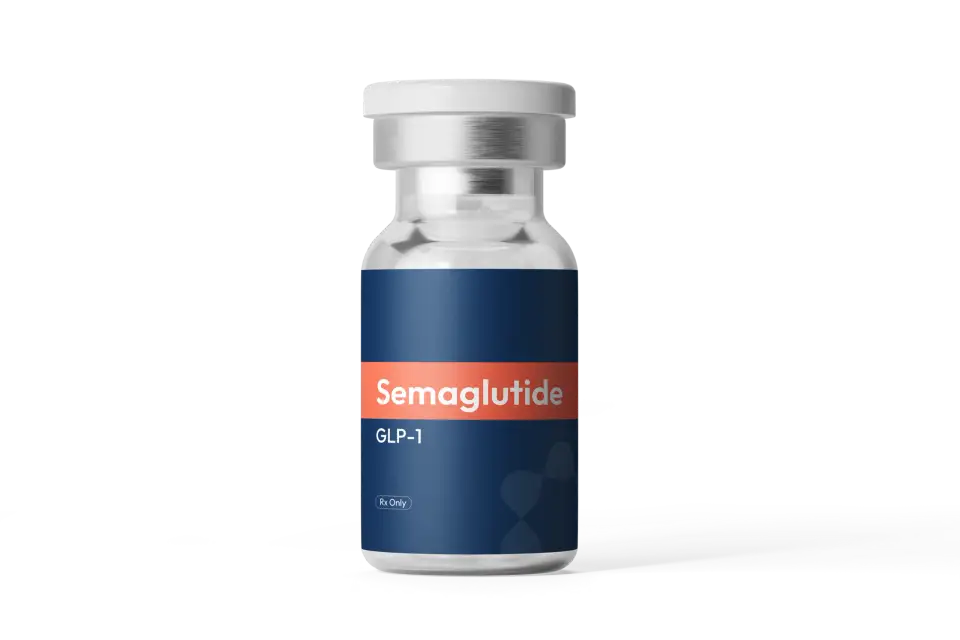

Semaglutide has shown remarkable results for weight loss, leading many to explore compounded versions as a more affordable alternative. However, prices for compounded semaglutide vary dramatically between pharmacies, ranging from $200 to over $600 per month. Understanding how much compounded semaglutide costs and why these prices fluctuate so widely helps distinguish between smart health investments and unnecessary overspending.
Several factors drive these price variations, including dosage strength, pharmacy overhead, and shipping fees. Rather than calling dozens of compounding pharmacies or guessing whether prices are fair, comparing actual costs and understanding local pricing factors leads to informed decisions based on facts rather than marketing claims. Tools that help navigate these complexities are valuable when evaluating options, and MeAgain's GLP-1 app proves genuinely useful.
Table of Contents
- How Much Is Compounded Semaglutide (And Why Prices Vary So Much)
- Why Compounded Semaglutide Pricing Is So Inconsistent
- Is Compounded Semaglutide Worth the Cost (And When It Makes Sense)
- If You’re Choosing Based on Cost, This Is What Protects Your Results
Summary
- Compounded semaglutide costs between $200 and $500 per month compared to brand-name Wegovy at $1,300+ or Ozempic at $900+. The wide price range reflects fundamentally different business models rather than differences in medication quality. Some providers charge $250 all-inclusive, while others advertise $250 but add $75 consultation fees, $20 for supplies, and $30 for shipping, pushing actual monthly costs to $375 without upfront disclosure.
- Telehealth platforms face a fundamental choice between marking up medication or charging for services. Most add a 30 to 50 percent margin to pharmacy wholesale rates, turning a $200 pharmacy cost into $260 to $300 at checkout. Platforms operating on zero-markup models make money from app subscriptions and tracking tools instead of inflating drug costs, though this approach remains rare because hidden medication markup scales more easily than building software people pay for directly.
- Compounded semaglutide lacks the standardization of FDA-approved medications. One vial might contain 98 percent of the stated potency while another contains 102 percent. For patients titrating doses from 1.0mg to 1.7mg weekly based on side-effect tolerance, this 4 percent variance makes fine-tuning harder because you cannot tell whether your body has adapted, whether you need a dose adjustment, or whether vial potency shifted between refills.
- Volume relationships explain much of the $200 to $500 monthly price spread. Established telehealth platforms processing 5,000 prescriptions monthly negotiate 20 to 30 percent discounts off standard pharmacy pricing. Smaller providers handling dozens of prescriptions pay full pharmacy rates, forcing them to either charge patients more or accept thinner margins that threaten long-term sustainability.
- Daily habits determine whether weight loss lasts beyond active treatment. Protein intake of 0.7 grams per pound of body weight prevents muscle loss during rapid weight reduction, while fiber intake reduces constipation that can derail adherence. When compounded formulations introduce slight potency variance, strong nutrition and movement habits create the buffer that keeps results predictable even when medication experience varies slightly month to month.
- MeAgain's GLP-1 app addresses this by turning protein tracking, fiber intake, hydration, and movement into a system you can follow in under five minutes daily, filling the gap between monthly provider check-ins and the 30 days of decisions that actually determine results.
How Much Is Compounded Semaglutide (And Why Prices Vary So Much)
Compounded semaglutide typically costs between $200 and $500 per month—significantly less than brand-name Wegovy at $1,300+ or Ozempic at $900+. However, this price range masks differences in what you receive.
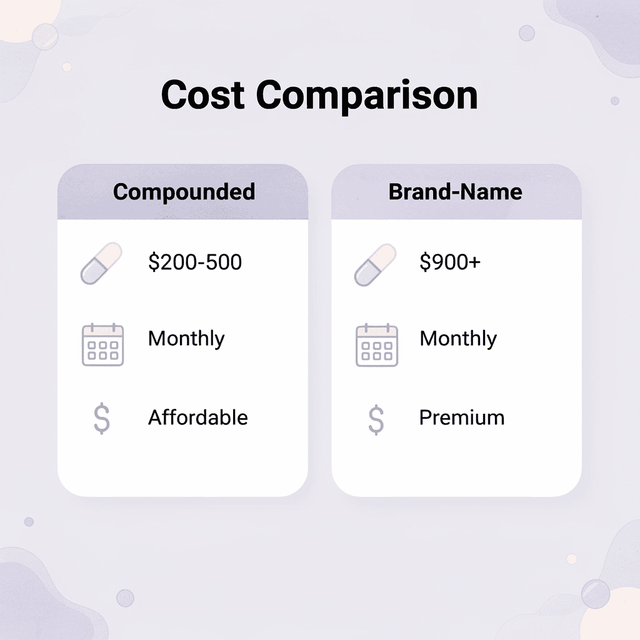
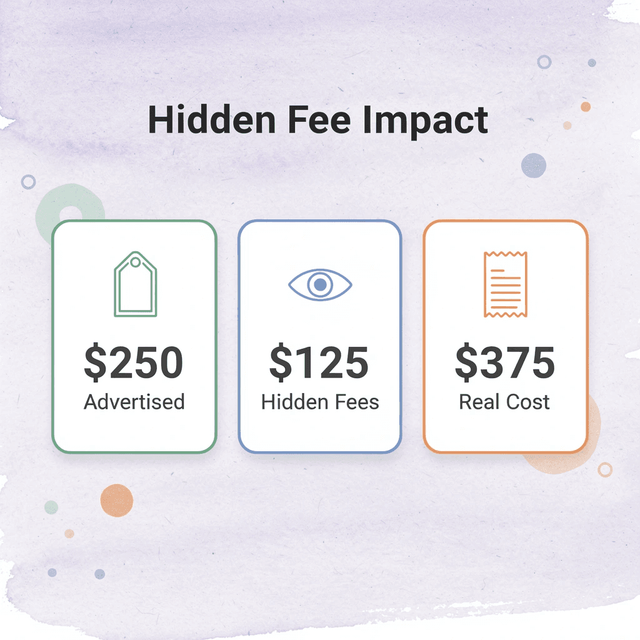
One provider charges $250 for everything (consultations, supplies, shipping), while another charges $250 plus $75 consultation fees, $20 for syringes, and $30 for expedited shipping, bringing your actual cost to $375. The advertised price often masks your true monthly spending.

"The advertised price often doesn't show what you'll really spend each month—hidden fees can increase costs by 50% or more."
What are you paying for with brand-name medications?
Brand-name pricing reflects a specific business model. Novo Nordisk spent billions on research, clinical trials, and FDA approval. Patents through 2032 prevent generic competition and allow them to control pricing. You're also paying for pre-filled pen devices, extensive marketing campaigns, and substantial profit margins. According to CED Clinic, patients without insurance face costs of $25–$100 per month when manufacturer savings programs apply, though most don't qualify or exhaust benefits quickly.
How does compounded semaglutide achieve lower costs?
Compounded semaglutide uses the same pharmaceutical-grade active ingredient. The cost difference stems from what surrounds the medication: no patent fees, no multi-billion-dollar advertising budgets, and no branded pen devices. Compounding pharmacies obtain semaglutide powder, mix it in sterile vials, and send it directly to you. The medication works identically.
Where the confusion multiplies
Different types of providers create the first layer of complexity. Low-cost online platforms ($150–250) raise quality concerns about oversight, testing, and ingredient sourcing. Mid-range telehealth providers ($250–350) balance cost with PCAB accreditation or 503B facility standards. Premium services ($350–500) may include third-party testing, concierge access, or formulation additions like B12 and L-carnitine. Local compounding pharmacies ($300–500) vary by region and prescriber relationship.
What hidden fees should you watch for?
The second layer is what's included in the price versus what costs extra. Some providers advertise $199/month, then charge $100 for an initial consultation, $50 for monthly follow-ups, and $15 for shipping. Others include everything in one price. You're comparing business models, not medication costs, and most people don't realize this until after signing up.
How does dosage affect your monthly costs?
Dosage pricing adds another variable. Most compounded providers charge the same monthly rate regardless of dose (0.25mg to 2.4mg weekly). Some charge more for higher-concentration vials, so your cost increases as treatment progresses. That $250 starter price becomes $400 at the maintenance dose.
Which platforms offer transparent pricing?
Tools like MeAgain's GLP-1 app help solve this problem by showing your total monthly cost broken down by parts: medication, consultation, supplies, and shipping. Our platform uses zero-markup medication pricing, earning revenue from app subscriptions rather than drug markups. When providers pass through actual pharmacy costs without adding profit, that $299 advertised price is what you pay—no extra consultation charges or surprise fees. But even when you understand the pricing structure, another question emerges: why does the same medication cost $100-200 more per month at some pharmacies than others with similar qualifications?
Related Reading
Why Compounded Semaglutide Pricing Is So Inconsistent
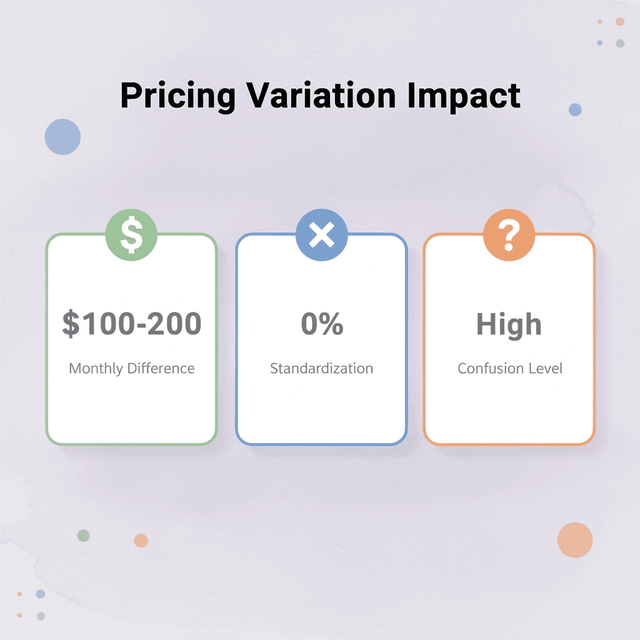
The same medication from different providers varies by $100-200 per month because the compounding industry lacks a standardized pricing framework. Unlike brand-name medications with fixed wholesale prices, compounded semaglutide operates in a market where every pharmacy sets its own rates, telehealth platforms structure business models differently, and service bundles include different components. You're comparing different supply chains, overhead structures, and profit strategies that produce the same active ingredient.

"The same medication from different providers varies by $100-200 per month because there's no standardized pricing framework in the compounding industry."
How do compounding pharmacies structure their costs?
Compounding pharmacies purchase pharmaceutical-grade semaglutide powder and mix it in sterile facilities in accordance with strict regulations. According to the SkinnyRx Blog, compounded semaglutide costs range from $200 to $500 per month. Some pharmacies operate large facilities with automated systems and bulk purchasing, which lowers costs per prescription. Others run smaller operations with higher per-prescription costs. PCAB-accredited facilities invest in stricter quality controls, third-party testing, and regulatory compliance that non-accredited pharmacies forgo. These investments affect pricing.
What factors cause pricing variations between pharmacies?
The raw ingredient cost remains consistent across suppliers, but everything surrounding it varies significantly. Sterile compounding requires special equipment, trained pharmacists, climate-controlled storage, and strict testing protocols. A pharmacy that invests in mass spectrometry testing to check potency adds $20-30 per vial, while another pharmacy that skips this step saves money but creates quality problems that emerge only when treatment results disappoint.
How do markup-based platforms structure their pricing?
Telehealth platforms that work with compounding pharmacies typically mark up medications instead of charging a service fee because it generates more revenue. They negotiate a wholesale rate with the pharmacy, then add a 30-50% margin before passing costs to you. A $200 pharmacy cost becomes $260–300 at checkout, with the platform keeping the difference.
What makes zero-markup models different financially?
Platforms using zero-markup models generate revenue differently. MeAgain's approach charges a subscription fee while passing through pharmacy costs without markup. When the pharmacy charges $199, you pay $199. Our platform monetizes tracking tools, meal logging, and progress management features instead. This model needs more user engagement to succeed financially, which explains why it's rare: most platforms find it easier to hide profit in medication markup than to build software that people want to pay for directly.
What makes bundled pricing so confusing to compare?
The $250 advertised price means little without knowing what's included. Some providers bundle the first consultation, monthly follow-ups, supplies (syringes, alcohol wipes, sharps container), and shipping into one flat rate. Others charge $199 for medication, then add $75 for the first consultation, $50 for each monthly check-in, $15 for supplies, and $20 for expedited shipping, bringing your actual monthly spend to $359. You didn't see it coming because you compared the advertised price of the medication rather than the total cost of treatment.
How do hidden fees affect your treatment budget?
Many people discover these add-ons only after paying for their first month. Direct price comparison becomes difficult when one provider's $279 all-inclusive rate competes against another's $229 medication-only price, which rises to $344 after required fees. You're figuring out pricing structures that are intentionally unclear and designed to appear competitive at first glance.
Volume relationships and negotiating power
Big telehealth platforms processing thousands of prescriptions monthly negotiate better pharmacy rates than smaller providers handling dozens. A platform shipping 5,000 prescriptions per month can secure 20-30% discounts off standard pharmacy pricing. Research from Minimal shows that compounded semaglutide prices range from $200 to $500 per month, with volume relationships accounting for much of the variation. Smaller platforms, lacking negotiating power, pay full pharmacy rates, forcing them to charge more or accept smaller profit margins that threaten their viability. Does the provider's pricing strategy align with your long-term needs or their short-term goals for customer acquisition?
Is Compounded Semaglutide Worth the Cost (And When It Makes Sense)
Compounded semaglutide makes sense when cost barriers block access to FDA-approved medications and physician-guided use ensures proper oversight through legitimate compounding pharmacies. It does not make sense when consistency and predictability matter more than savings, when FDA-approved options are accessible through insurance or savings programs, or when you choose based on the lowest price without understanding what you are trading away.

"Cost barriers shouldn't prevent access to effective treatments, but safety and efficacy must remain the primary considerations when choosing between compounded and FDA-approved medications."

When cost barriers justify the trade-off
Brand-name Wegovy costs approximately $1,349 per month without insurance coverage. Compounded semaglutide at $250–350 monthly can determine whether uninsured patients who don't qualify for manufacturer savings programs can afford treatment. Legitimate compounding pharmacies that follow 503B facility standards or PCAB accreditation use strict rules for clean preparation, strength testing, and quality control. They mix pharmaceutical-grade semaglutide powder in facilities designed for clean compounding, with trained pharmacists following FDA-regulated processes. When a doctor guides dosing and monitoring, this becomes a medically sound option for patients who cannot afford brand-name alternatives.
Why does dosing consistency matter with compounded semaglutide?
Being consistent matters when adjusting doses to find the right amount for you. FDA-approved medicines undergo rigorous testing to ensure each dose contains exactly what the label states, with minimal variation between batches. Compounded versions lack this same level of consistency. One bottle might contain 98% of the stated potency, and another might have 102%. For most patients, that 4% difference has no medical significance. But when you're adjusting from 1.0mg to 1.7mg weekly based on how you feel and your weight loss, unpredictable potency makes it harder to calibrate the correct dose.
What happens when potency varies between vials?
People report inconsistent results: one month, appetite suppression works as expected, the next month, the same dose from a different vial produces increased nausea or weakened appetite suppression. You cannot determine whether your body has adapted, whether you need a dose adjustment, or whether potency has shifted. That uncertainty worsens when establishing a maintenance dose that balances efficacy with tolerability. When predictability is critical to treatment success, paying more for FDA-approved standardization eliminates a variable that can cause confusion and delay progress.
What you are actually replacing (and what you are not)
Compounded semaglutide uses the same active pharmaceutical ingredient as Wegovy or Ozempic, but everything else differs. Brand-name medications come in pre-filled, pre-measured pen devices with built-in safety features and dose accuracy verified through extensive testing. Compounded versions require you to draw doses from vials using syringes and manage your own injection technique. While the active ingredient works identically, the user experience and quality assurance processes do not.
How do the trade-offs stack up for different situations?
The trade-offs stack up differently depending on your situation. You trade cost savings for standardization, accessibility for predictability, and immediate affordability for FDA oversight and manufacturer accountability. According to the SkinnyRx Blog, compounded semaglutide typically costs between $200 and $400 per month, making it financially accessible when brand-name options are not. However, lower cost does not guarantee equivalent outcomes when potency variance, preparation quality, or pharmacy credibility introduces uncertainty.
What does transparent pricing reveal about actual costs?
Clear pricing models show what you're paying for. MeAgain's zero-markup approach shows actual pharmacy costs without added profit, earning revenue from app features like dose tracking rather than raising medication prices. When providers pass pharmacy costs directly to you, that $299 price reflects actual compounding and delivery costs, not artificially inflated profit margins. Clear pricing eliminates confusion about overpaying, though it doesn't eliminate the inherent trade-offs between compounded and FDA-approved medications. But even when pricing is clear and trade-offs are understood, one question remains: how do you know the compounded medication you receive is safe and effective?
If You’re Choosing Based on Cost, This Is What Protects Your Results
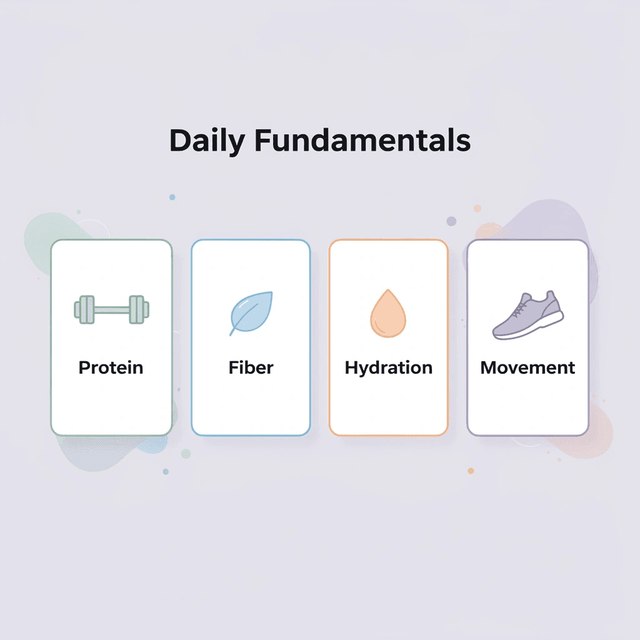
The medication you choose matters less than what you do while taking it. People obsess over whether they're paying $250 or $400 monthly, then ignore the daily habits that determine whether the weight stays off. Protein intake prevents muscle loss during rapid weight reduction. Fiber intake reduces constipation, the most common side effect that derails adherence. Hydration supports the medication's appetite suppression without triggering dehydration-related fatigue. Movement preserves metabolic rate as body composition shifts. These fundamentals don't change based on whether your semaglutide came from a compounding pharmacy or a brand-name pen.

Most people discover this gap three months into treatment. Weight drops steadily, then progress stalls because they're eating 800 calories daily with minimal protein and wondering why they feel exhausted. The medication did its job; the support structure around it didn't exist. When compounded formulations introduce slight potency variance or delivery inconsistency, strong daily habits create a buffer that keeps results predictable even when the medication experience varies slightly month to month.

"When compounded formulations introduce slight potency variance, strong daily habits create the buffer that keeps results predictable even when the medication experience varies month to month."
Platforms like MeAgain's GLP-1 app turn these fundamentals into a trackable system you can follow in under five minutes daily. Our app's capybara guide prompts you to log protein grams, fiber intake, water consumption, and movement. We fill the gap between your monthly provider check-ins and the 30 days of decisions that determine your results. When your medication costs $250 instead of $400, you save $1,800 annually. Investing part of those savings into tracking tools that prevent muscle loss and side effect-related treatment abandonment makes the cost difference meaningful.
Daily Fundamental | Why It Matters | Target |
|---|---|---|
Protein Intake | Prevents muscle loss during weight reduction | 0.7g per pound of body weight |
Fiber Intake | Reduces constipation (top side effect) | 25-35g daily |
Hydration | Supports appetite suppression without fatigue | 8+ glasses daily |
Movement | Preserves metabolic rate | 30 minutes daily |
Download the app, set your daily protein target based on your current weight (aim for 0.7 grams per pound), and track your intake for your first day. The medication creates the opportunity. Your daily choices determine whether that opportunity compounds into lasting change or temporary weight loss that reverses when treatment ends.