

Dramatic weight loss transformations flood social media, but realistic Wegovy before-and-after outcomes look quite different for most people. Clinical data show that patients typically lose 10-15% of their body weight over 68 weeks, with gradual progress that unfolds month by month rather than through sudden dramatic changes. Understanding these evidence-based expectations helps set achievable goals and prevents disappointment when results don't match exaggerated online claims.
Tracking individual progress is essential, as everyone responds differently to Wegovy treatment. Monitoring gradual changes, celebrating meaningful milestones, and understanding personal response patterns help maintain motivation throughout the journey. For comprehensive progress tracking and personalized support, consider using MeAgain's GLP-1 app to document your authentic transformation.
Table of Contents
- Why Most Wegovy Before and After Photos Can Be Misleading
- The Reality Behind Wegovy Results (And Why Most Transformations Are Misunderstood)
- Wegovy Before and After Results: What You Can Actually Expect
- How to Maximize Your Wegovy Results Without Stalling or Regaining Weight
- Turn Your Wegovy Results Into a System You Can Actually Stick To
Summary
- Dramatic online transformations compress months of effort into two photos, without showing the dosage adjustments, persistent side effects, lifestyle changes, or inevitable plateaus that happened in between. Clinical trials show Wegovy participants lost an average of 14.9% of their body weight over 68 weeks, but that required medication combined with reduced-calorie diets and increased physical activity, not medication alone.
- Response rates vary significantly across individuals, with 10-15% of patients showing no weight loss response to GLP-1 drugs despite perfect adherence. In the same trials where some participants lost 20% or more of their body weight, one in four people didn't reach the 10% threshold after 68 weeks. Genetics, gut microbiome composition, and metabolic history influence outcomes in ways researchers don't yet fully understand.
- The medication's effects follow a specific timeline that most before-and-after photos obscure. During the first four weeks at 0.25 mg dosing, some people can lose up to 2-3% of body weight (5 to 8 pounds for someone starting at 220 pounds). The average weight loss is about 15% across 68-72 weeks, not in the first months when people expect dramatic and visible results.
- Muscle loss during weight reduction undermines long-term success by slowing metabolism and making weight maintenance harder after stopping medication. Eating 25-30 grams of lean protein at each meal and incorporating resistance training two to three times weekly preserves muscle tissue while burning fat stores. Two people losing the same 40 pounds will have vastly different maintenance outcomes depending on whether they protected muscle mass during the process.
- Sustainable habits built during treatment determine whether results last after medication stops. The appetite suppression window creates an opportunity to establish eating patterns that feel normal rather than restrictive, but most people focus only on scale numbers without asking whether their current approach requires constant mental effort. Tracking protein intake, fiber consumption, hydration, and movement provides the structure needed for consistency that survives beyond the prescription period.
- GLP-1 app addresses this by tracking injection schedules, logging meals with AI assistance, and monitoring protein, fiber, water, and movement goals in a single system designed to manage medication side effects while preserving muscle mass.
Why Most Wegovy Before and After Photos Can Be Misleading
The dramatic changes you see on social media aren't fake, but they're rarely the whole story. You're seeing the end result of months or years compressed into two pictures side by side, without information about dosage progression, major lifestyle changes, side effect management, and periods when progress stopped. What looks easy requires hard work.

"Social media transformations compress months of effort into a single comparison, hiding the real journey behind weight loss success."

How do misleading claims affect your expectations?
According to a Yale School of Medicine study published in JAMA Health Forum, 40.5 percent of online ads claimed the drugs worked for uses not listed on FDA-approved branded drug labels. Starting Wegovy with the expectation of losing 100 pounds in 12 months, based on someone else's results, sets you up for disappointment if your body responds differently or your circumstances change.
What hidden efforts don't make it into success stories?
The person in that before-and-after photo probably didn't mention that they walked 4 miles 4 times a week, tracked every meal in an app, dealt with ongoing constipation, or forced themselves to eat when their appetite disappeared. They might not share that they started at a higher weight (which enables faster initial losses) or that they're 20 years younger with a different metabolic baseline. These details distinguish understanding what's required from believing medication alone creates change.
Why do people hide their medication use?
People worry that others will not take their success seriously if they say they used medication. One user shared how disclosing their Wegovy journey prompted comments like "Oh, well, if I had a magic pill too." That worry causes many people to share only final results without showing the hard work in between, creating an incomplete picture that makes others feel like they are failing when their experience doesn't match.
What gets left out of the frame
Most photos don't show how long things took. User 1 lost 152 pounds from 318 pounds over sustained effort, not quickly. User 3 lost 99 pounds while becoming a widow and moving house, proving life doesn't pause for weight loss, and consistency matters more than perfect conditions. These details are invisible in photos but essential to understanding realistic progress. The same Yale study found that 13.9 percent of advertisements failed to disclose that medications were compounded versions, not FDA-approved brand-name drugs. Without transparency about what's being taken, honest context about results becomes impossible.
Why does individual data tracking matter more than photo comparisons?
You can't build lasting change based on someone else's plan. Bodies respond differently to GLP-1 medications: how fast the dose increases, side effects, hunger patterns, and weight loss vary from person to person. You need to understand your own patterns: how your weight changes week to week, which foods make you feel sick, when you get hungry between doses, and what lifestyle changes work for you.
How can apps help you focus on personal progress instead of comparisons?
Platforms like MeAgain's GLP-1 app shift focus from comparison to personalization by tracking your injection schedule, logging meals with AI assistance, and monitoring your unique progress patterns. Instead of wondering why you're not matching someone's Instagram timeline, you're building data about what works for your body and celebrating milestones that matter to your journey. Understanding what's misleading about these photos is the first step toward knowing what to expect instead.
Related Reading
The Reality Behind Wegovy Results (And Why Most Transformations Are Misunderstood)
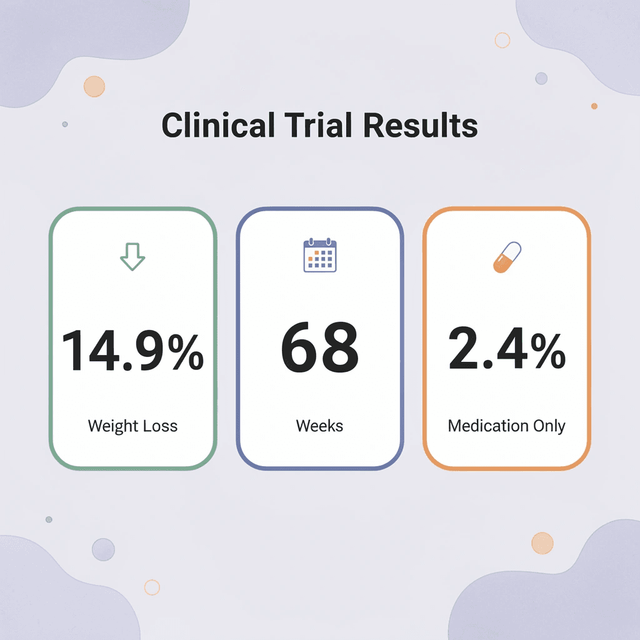
Wegovy requires three things to work: the medicine, eating fewer calories, and moving your body more. Clinical trials showed that people lost an average of 14.9% of their body weight over 68 weeks when they did all three. Without lifestyle changes, results drop to 2.4%, marginally better than a placebo.

"People lost an average of 14.9% of their body weight over 68 weeks when combining Wegovy with lifestyle changes, but only 2.4% without them." — New England Journal of Medicine
The numbers everyone quotes (and what they actually mean)
When you see "average weight loss of 14.9%," that's a population-level outcome, not a promise. Novo Nordisk reported that 34.4% of participants lost at least 20% of their body weight at the highest doses: roughly one in three people saw dramatic results, while others lost less. The medication creates possibility, not uniformity.
For someone starting at 220 pounds, that 14.9% average translates to about 33 pounds over 16 months, not six weeks or three months. The transformation photos compress that timeline into two images, making it appear instantaneous when, in reality, it involved hundreds of individual choices between those shots.
What causes some people not to respond to GLP-1 medications?
Scientific American reports that 10-15% of patients do not respond to GLP-1 drugs. Their bodies don't respond to the appetite-suppression mechanism as most people's do. They may see improvements in blood pressure, blood sugar control, or cholesterol levels, but the scale doesn't budge. No amount of willpower or dietary perfection changes that biological reality.
Why do response rates vary so much between patients?
People taking Wegovy who don't see weight loss often feel alone, believing everyone around them is succeeding while they're failing. How well the medicine works varies based on factors not fully understood, including genetics, gut microbiome composition, sleep quality, stress levels, and metabolic history. Dr. Richa Mittal notes that weight-loss medicine specialists have identified patterns in who tends to respond better, though predicting who will respond remains difficult.
How does Wegovy mimic your body's natural hunger signals?
Wegovy mimics GLP-1, a hormone that helps regulate hunger and signals fullness to your brain. You feel satisfied after eating smaller amounts, crave high-fat and sugary foods less, and think about food less often. This creates the calorie deficit needed for weight loss, though the medication doesn't burn fat directly or increase metabolism. You still need to eat less than you burn. The drug makes eating less sustainable rather than feeling like constant deprivation.
Why do lifestyle changes still matter with the medication?
This mechanism explains why lifestyle changes remain essential. If you override fullness signals by eating calorie-dense foods in smaller volumes or compensate for reduced appetite by moving less, the caloric deficit never materializes. The medication removes one barrier—overwhelming hunger—but it cannot remove all of them.
Tracking what you eat, when hunger returns, and how your energy levels shift reveals patterns rather than guessing why results aren't matching expectations. Our MeAgain GLP-1 app helps you log meals with AI assistance and monitor injection schedules, turning individual data points into patterns that show what works for your specific body. But knowing the mechanisms doesn't prepare you for what the first few months feel like.
Wegovy Before and After Results: What You Can Actually Expect
Clinical trials show that adults taking Wegovy lost an average of 19% of their body weight over 72 weeks when combined with diet and exercise: roughly 47 pounds for someone starting at 250 pounds. Results require a full year and a half of consistent weekly injections, not a few months, so expecting month-three results to match month-eighteen results will be frustrating.
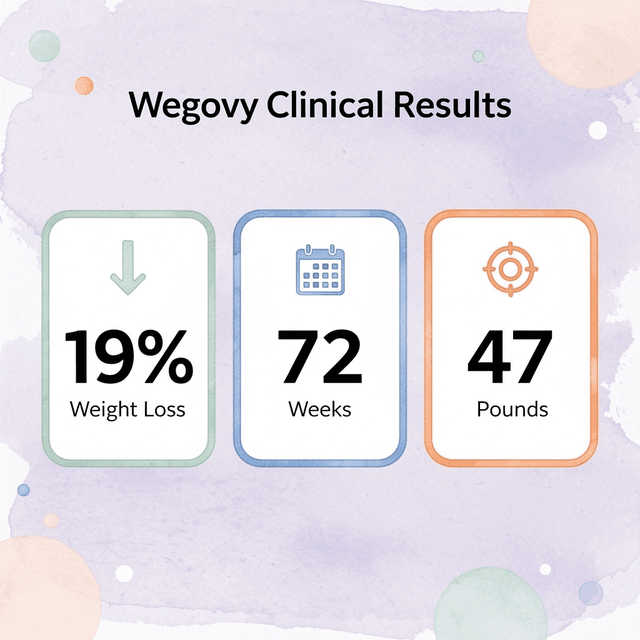
"Adults taking Wegovy lost an average of 19% of their body weight over 72 weeks when combined with diet and exercise." — Wegovy Clinical Trials

What happens in the first four weeks?
The first four weeks use the lowest dose (0.25 mg), where Apollo Pharmacy's analysis of Wegovy outcomes shows most people lose 2–3% of body weight: 5 to 8 pounds at a 220 lb starting weight. You may notice changes in appetite and feel full faster, but visible changes in how your clothes fit or how you look are unlikely.
When do major transformations occur?
By three months, after dose increases to 1.0 mg or higher, fat loss becomes visible: pants feel looser, and faces look noticeably different. Appetite suppression strengthens, making calorie restriction sustainable. At six to twelve months on the 2.4 mg maintenance dose (or up to 7.2 mg under medical supervision), a major transformation occurs. The 16-19% average weight loss cited in studies occurs at the 68 to 72-week mark, not halfway through.
Why do weight loss results vary so much between people?
According to clinical trials analyzed by IQ Doctor, 86.6% of people lost at least 5% of their body weight after 68 weeks, while 75.3% lost more than 10%. One in four people failed to reach the 10% goal despite regular medication use and lifestyle changes. Some bodies respond strongly to GLP-1 agonists, others moderately, and 10-15% show no meaningful response even with perfect adherence.
How does starting weight affect your results
Your starting weight significantly affects your results. Someone starting at 320 pounds will often lose weight faster initially than someone starting at 180 pounds, because a heavier person's body has more stored energy to use. Comparing your results to someone else's without knowing their starting point tells you little about whether your treatment is working.
How does adherence determine your success rate?
Sticking with the treatment plan determines everything. The 72-week study showed 12% of Wegovy HD participants stopped treatment compared to 29% on placebo. Consistency amid side effects, weight-loss plateaus, and life disruptions separates those who reach the 19% average weight loss from those who don't. Missing injections allows appetite to return completely, often triggering rebound eating that erases weeks of caloric deficit in days.
Why are lifestyle changes still required with medication?
Lifestyle changes aren't optional add-ons. Both major studies combined Wegovy with reduced-calorie diets and increased physical activity because the medication suppresses appetite; it doesn't burn fat on its own. If you eat calorie-dense foods in smaller amounts or move less, the deficit never happens.
Tracking what you eat, when hunger returns between doses, and how energy levels change reveals patterns specific to your metabolism. Our GLP-1 app helps users log meals with AI assistance and monitor injection schedules, converting observations into actionable data rather than relying on population averages. Platforms like MeAgain's GLP-1 app make this tracking seamless and personalized. Hitting those averages is only half the challenge; keeping the weight off requires a different strategy than losing it.
How to Maximize Your Wegovy Results Without Stalling or Regaining Weight
Wegovy reduces appetite but doesn't build the habits that sustain weight loss after you stop taking it. The medication creates a window where eating less feels manageable: what you do during that window determines whether you keep the loss or watch it return.

Why does muscle preservation matter during weight loss?
Most people focus on the scale without realizing they're losing muscle along with fat. Muscle loss slows your metabolism, making it harder to maintain weight after stopping medication.
Eating 25–30 grams of lean protein at each meal (chicken breast, fish, Greek yogurt, legumes) signals your body to preserve muscle tissue while burning fat stores. Two people can lose the same 40 pounds, but the one who maintains muscle will keep it off more easily and feel stronger.
How do you maintain protein intake when appetite is suppressed?
When your appetite is suppressed, eating enough protein feels counterintuitive—you're not hungry, and forcing yourself to eat seems to contradict the medication's purpose. Yet skipping protein leads to faster muscle loss, undermining your long-term success. Think of protein as fuel your body needs, not as something optional. Your body requires it to maintain a strong metabolism so you can continue losing weight after stopping Wegovy.
Why is resistance training essential for muscle preservation?
Strength training stops muscle loss in ways that walking or cycling cannot. Lifting weights, using resistance bands, or doing bodyweight exercises (pushups, squats, lunges) signals your body that muscle tissue is needed and shouldn't be broken down for energy. Two or three 20-minute sessions weekly, focusing on major muscle groups, provide sufficient stimulus to preserve lean mass during a caloric deficit.
How does muscle preservation affect long-term metabolism?
People often skip strength training because it feels harder than cardio or because they believe cardio burns more calories. The goal isn't to burn the most calories during the workout itself; it's to preserve muscle tissue that keeps your baseline calorie burn elevated every day, even at rest. That cumulative effect matters far more than the 200 calories burned in a single session.
Why do small changes work better than dramatic overhauls?
Trying to change your whole diet overnight creates unsustainable pressure that collapses under stress. Eliminating all processed foods, cutting sugar completely, and committing to daily meal prep rarely lasts beyond a few weeks.
Instead, make one small change, let it become automatic over two weeks, then add another. Start by drinking water instead of sweetened beverages. Once that feels normal, add a vegetable to dinner, then swap white bread for whole grain. These incremental shifts avoid the deprivation that derails most diets.
How does this approach work with medication effects?
The medication already handles appetite suppression. Your job isn't to fight hunger with willpower, but to build eating patterns that feel sustainable when hunger eventually returns. If your current approach requires constant effort and discipline, it will fail once Wegovy's effects wear off. Sustainable change feels boring because it doesn't require heroic effort—that's why it works. But building those habits matters only if you can maintain them after the medication stops—that's when most people discover the real test begins.
Turn Your Wegovy Results Into a System You Can Actually Stick To
Real changes come from consistently hitting your protein goals, getting enough fiber to avoid digestive issues, and staying on track when initial excitement fades. Most people lose momentum not from a lack of willpower, but from manually tracking everything while managing side effects and changes in hunger.

Building habits that survive the medication window
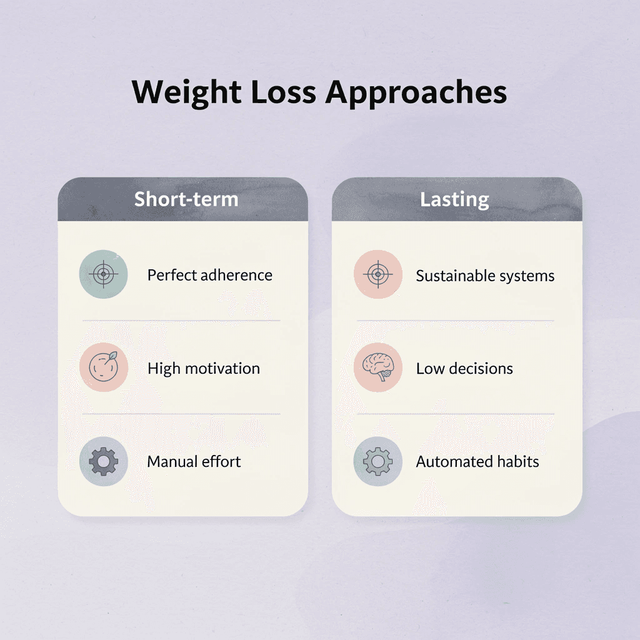
Wegovy temporarily reduces hunger, but that benefit disappears when you stop taking it. What remains are the eating habits you created while on the medicine. If you ate fewer calories or skipped protein because you weren't hungry, you missed the opportunity to build lasting eating habits. The real goal isn't losing weight fast—it's creating a system that works after you stop taking the prescription.
Most people focus on the scale without considering whether they're losing fat or muscle, if they have sufficient energy to sustain their pace, or if their plan demands excessive mental effort. When the medication stops, they lack a maintenance strategy because they never created one. Consistency outperforms intensity, but consistency requires a plan independent of motivation.
What actually needs tracking
You need to monitor four things: protein intake, fiber consumption, hydration, and movement. These variables determine whether you retain muscle mass, avoid constipation, maintain stable energy, and preserve your metabolic rate. Neglecting any one undermines the others: eating sufficient protein without resistance training still leads to muscle loss, and drinking water without fiber still causes digestive problems.
MeAgain brings these four priorities together into one daily system with visual progress markers. Our app is built for people using Ozempic, Wegovy, or Mounjaro who need to manage GLP-1 side effects while maximizing fat loss and preserving muscle. You can start in under two minutes because our app sets your first goals automatically based on your current situation.
The real test isn't whether you can lose weight on Wegovy—it's whether you can keep it off after you stop. That requires building sustainable habits, tracking variables that matter, and celebrating progress beyond the scale. Your transformation depends on what you do between injections, not the medication itself.