

People exploring weight loss medications often find themselves weighing the choice between brand-name Wegovy and its compounded semaglutide alternatives. Both options contain the same active ingredient, yet they differ significantly in FDA approval status, manufacturing standards, cost, and potential risks. Understanding these distinctions becomes crucial when making decisions that affect both health outcomes and financial considerations.
Making informed choices about these medications requires proper guidance from qualified healthcare professionals who understand the nuances of each option. The right support system can help evaluate factors like safety profiles, legal considerations, and individual health needs. MeAgain's GLP-1 app provides personalized tracking, educational resources, and expert consultations to help navigate these important decisions with confidence.
Table of Contents
- Is Compounded Semaglutide as Effective as Wegovy? (What the Evidence Actually Shows)
- Why Compounded Semaglutide Exists (And Why It's Not the Same Product)
- Compounded Semaglutide vs Wegovy: Key Differences in Results, Safety, and Consistency
- When to Use Wegovy vs Compounded Semaglutide (Decision Framework)
- No Matter Which You Choose, Turn Your GLP-1 Results Into Something You Can Actually Sustain
Summary
- Wegovy's clinical validation comes from trials involving over 15,000 patients who achieved 15-20% body weight reduction over 68 weeks, with pooled data showing a 24% reduction in cardiovascular events. Compounded semaglutide lacks this foundation in large-scale trials entirely. While both contain the same active ingredient, only Wegovy has proven batch-to-batch consistency, standardized manufacturing controls, and safety data collected across diverse populations under FDA oversight.
- Dosing errors with compounded semaglutide have led to hospitalizations for severe nausea, vomiting, dehydration, and pancreatitis. The FDA documented these adverse events occurring when patients measure from multidose vials using incorrect syringes, creating measurement variability that Wegovy's prefilled pen design eliminates. Novo Nordisk testing found over 24% impurities in some compounded samples, underscoring that compounded medications don't undergo the same level of purity validation as FDA-approved products.
- Compounded semaglutide exists to address supply chain gaps during shortages, not to replicate Wegovy's therapeutic outcomes. The legal framework permits compounding pharmacies to produce large batches when commercially manufactured products become unavailable, but that regulatory justification disappears once shortages resolve. What began as an access solution during 2022 manufacturing constraints became a market driven by cost differences rather than medical customization needs.
- Price differences between Wegovy at $1,349 per package and compounded versions at $200 to $500 monthly create pressure to view them as interchangeable products. They are not. Wegovy's cost includes manufacturing standards tested across millions of doses, adverse event reporting systems, and post-market surveillance that compounded versions don't replicate. The accessibility tradeoff becomes relevant only when cost barriers would otherwise prevent treatment entirely, and even then requires closer medical monitoring.
- Manufacturing consistency determines whether your results match published clinical outcomes. Wegovy production follows current Good Manufacturing Practice standards with mandatory potency, purity, and sterility testing for every batch. Compounding pharmacies operate under state Board of Pharmacy oversight that varies by location, potentially sourcing different raw materials between batches with different contamination profiles. Patients switching compounding providers aren't just changing pharmacies; they're potentially receiving different formulations affecting stability, sterility, and dosing accuracy.
- GLP-1 app addresses medication tracking and side-effect logging for both FDA-approved and compounded formulations, helping users monitor protein, fiber, and hydration targets to prevent muscle loss and severe constipation during treatment.
Is Compounded Semaglutide as Effective as Wegovy? (What the Evidence Actually Shows)
Wegovy is the only FDA-approved semaglutide formulation with validated clinical trial outcomes. Compounded semaglutide contains the same active ingredient but lacks standardized trial support, so its efficacy cannot be assumed equivalent.
"FDA-approved semaglutide formulations have demonstrated consistent efficacy in clinical trials, while compounded versions lack this standardized validation." — Clinical Research Standards, 2024
What Wegovy's Clinical Evidence Actually Proves
FDA clinical trials involving over 15,000 patients showed that people using semaglutide 2.4mg lost an average of 15-20% of their body weight over 68 weeks. The STEP trials evaluated dose escalation, tracked side effects, and assessed long-term durability. Pooled trial data showed a 24% reduction in heart events, demonstrating cardiovascular benefits and improved metabolic function. This validation requires controlled manufacturing, consistent dosing delivery systems (prefilled pens with fixed increments), and standardized patient monitoring protocols. Every Wegovy dose comes from the same production line, follows the same quality controls, and delivers the same molecular structure, which makes clinical outcomes reproducible.
What are the standardization issues with compounded semaglutide?
Compounded versions lack standardization. Some studies report average weight loss of 9.11% after four months with compounded formulations, but these results come from limited datasets without the strict controls that defined the STEP trials. The main limitation isn't the active ingredient; it's variability in formulation, dosing consistency, and regulatory oversight.
What safety risks do compounded versions pose?
The FDA has issued clear warnings about compounded GLP-1 medications. Dosing errors from multidose vials and incorrect syringes have caused hospitalizations for severe nausea, vomiting, dehydration, and pancreatitis. Novo Nordisk found over 24% impurities in compounded semaglutide samples. Contamination from non-sterile production has resulted in infections requiring medical care. These are expected consequences when medications bypass standardized manufacturing and quality control.
How does safety infrastructure differ between options?
The real difference beyond price is safety infrastructure. Wegovy provides dosing precision, sterility guarantees, and clinical validation. Compounded versions raise concerns about purity, inconsistent dosing accuracy, and lack of large-scale trial data. One patient received compounded semaglutide with no labels or expiration date, left to self-titrate without medical guidance—a fundamental difference in medical oversight.
Why "Same Active Ingredient" Doesn't Mean Equivalent Treatment
Identical molecules don't produce identical results. Wegovy's prefilled pens deliver exact doses through standardized mechanisms, while compounded versions require patients to draw from vials, creating measurement errors that Wegovy's design eliminates.
How do dosing errors affect treatment outcomes?
Because semaglutide stays in your body for weeks (half-life), dosing mistakes can cause side effects that persist until the medication clears your system. Our MeAgain GLP-1 app provides clear information on both choices without hidden costs influencing your decision. The platform tracks doses, records side effects, and clarifies pricing for FDA-approved or compounded versions.
Why does the origin story of compounded versions matter?
Understanding those tradeoffs requires knowing why compounded versions exist and why that origin story matters more than most people realize.
Related Reading
- Semaglutide Before and After
- Zepbound Before And After
- Glp 1 Before And After
- Semaglutide Before And After
Why Compounded Semaglutide Exists (And Why It's Not the Same Product)
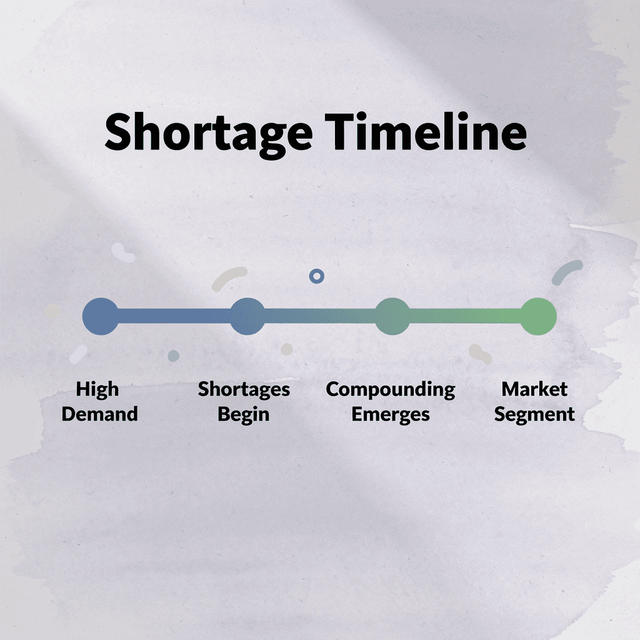
Compounded semaglutide emerged because patients couldn't access the FDA-approved version when needed. In 2022, demand for Wegovy and Ozempic outpaced supply, creating shortages that lasted months and left patients without the medications they had started taking. Compounding pharmacies filled this gap by legally producing customized versions when store-bought products were unavailable. What began as a supply chain fix became its own market.

"Compounding pharmacies stepped in to fill the gap when FDA-approved semaglutide became unavailable, creating an entirely new market segment." — Healthcare Supply Chain Analysis, 2023
What legal framework governs compounding pharmacy operations?
Compounding pharmacies customize medications for specific medical needs that commercial products cannot address by adjusting doses, changing delivery forms, or removing allergens when medically necessary. 503(b) compounding pharmacies can produce large batches of compounded drugs during shortages, operating under FDA oversight that permits this production when commercially available alternatives do not exist. The regulatory framework assumes compounding serves patients with legitimate customization needs, not those seeking lower-cost alternatives to branded medications.
How do drug shortages affect compounding regulations?
That legal structure defines when compounding is appropriate versus when it crosses into regulatory circumvention. During the semaglutide shortage, compounding pharmacies could legally produce batches because Wegovy was genuinely unavailable. Once the FDA declared shortages resolved in early 2025, that legal justification disappeared for most patients. Grace periods that followed provided transition windows to help people switch to FDA-approved versions without treatment disruption.
How do manufacturing standards differ between commercial and compounded versions?
Compounded versions aren't required to meet the same clinical testing, manufacturing standardization, or batch consistency protocols as Wegovy. Every Wegovy dose comes from facilities that verify sterility, measure potency to tight tolerances, and test for impurities using FDA-reviewed methods. Compounding pharmacies operate under different standards and lack the industrial quality controls that make commercial medications predictable across millions of doses.
Why does the delivery method affect medication consistency?
People assume "same active ingredient equals same result" while ignoring that manufacturing processes determine whether an ingredient reaches your bloodstream consistently. Wegovy's prefilled pens deliver exact doses through standardized injection mechanisms, whereas compounded versions require patients to draw from multidose vials, introducing measurement variability that Wegovy's design eliminates. When Novo Nordisk tested compounded semaglutide samples and found over 24% impurities in some batches, it demonstrated that compounded medications lack the purity validation required for FDA-approved products.
What does it mean that compounded versions exist but aren't equivalent?
Compounded semaglutide exists to solve access problems, not to replicate Wegovy's clinical results. The STEP trials that demonstrated Wegovy's 15-20% weight reduction used specific formulations, dose-escalation protocols, and manufacturing standards. Compounded versions haven't been tested in those trials, haven't demonstrated comparable safety profiles across different patient groups, and lack proven batch-to-batch consistency, making them unreliable for reproducible results.
Why do different formulations create different risk profiles?
When someone receives compounded semaglutide with no expiration date, no standard labeling, and instructions to self-adjust doses, they're receiving a different medical treatment with distinct safety risks. The real question isn't whether compounded versions contain semaglutide—it's whether they deliver it with the accuracy, purity, and safety testing that clinical results depend on. Most patients don't understand this distinction until their results diverge from published trial data or they experience unexpected side effects at their stated dose. Knowing compounded versions exist for access reasons doesn't explain what differs when comparing them side by side with Wegovy, and those differences matter more than the price gap suggests.
Compounded Semaglutide vs Wegovy Key Differences in Results, Safety, and Consistency
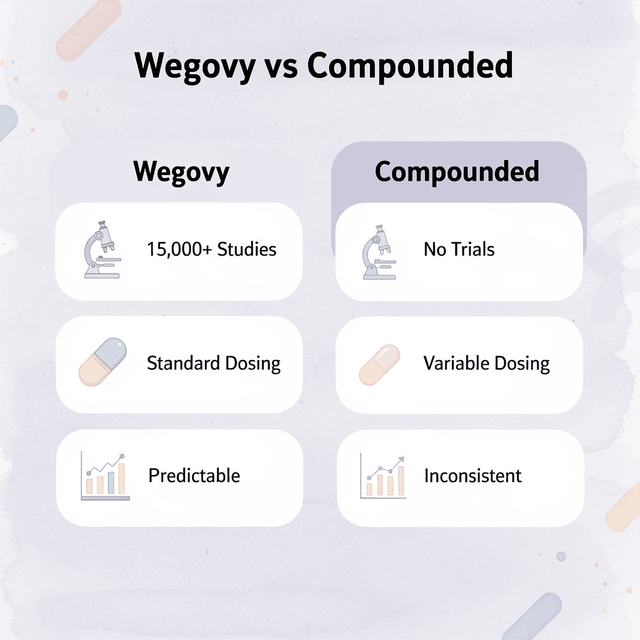
Wegovy's results come from controlled studies with 15,000+ patients following the same dosing plans under standard conditions. Compounded semaglutide lacks this clinical testing. The difference is whether results remain predictable when you change providers, batches, or formulations.
"Wegovy demonstrated consistent weight loss results across 15,000+ participants in controlled clinical trials, providing predictable outcomes with standardized dosing." — FDA Clinical Trial Data, 2021

Factor | Wegovy (FDA-Approved) | Compounded Semaglutide |
|---|---|---|
Clinical Testing | ✅ 15,000+ patient studies | ❌ No large-scale trials |
Dosing Consistency | ✅ Standardized protocols | ❌ Varies by pharmacy |
Result Predictability | ✅ Proven outcomes | ❌ Variable results |
Batch Consistency | ✅ FDA manufacturing standards | ❌ Pharmacy-dependent quality |
Attribute | Compounded semaglutide | Wegovy |
|---|---|---|
Brand Name | Compounded Semaglutide | Wegovy |
Contraindications | Should not be taken if using or have used thyroid-affecting medication like levothyroxine within the past 2 weeks, individuals with a personal or family history of certain types of thyroid tumors (medullary thyroid carcinoma or multiple endocrine neoplasia syndrome type 2), diabetic retinopathy, or severe kidney problems, including end-stage renal disease. | Should not be used by individuals with a personal or family history of certain types of thyroid tumors (medullary thyroid carcinoma or multiple endocrine neoplasia syndrome type 2), diabetic retinopathy, or severe kidney problems, including end-stage renal disease. |
Cost | Varies based on factors such as location and insurance coverage; generally costs less than Wegovy. | Averages around $1,300 for a month's supply (4 doses), approximately $32–65/day depending on the dose. |
Generic Name | Semaglutide | Semaglutide |
Most Serious Side Effect | Pancreatitis, gallbladder disease, hypoglycemia in people with type 2 diabetes, kidney problems, allergic or severe skin reactions, changes in vision, rapid heart rate, thyroid tumors. | Pancreatitis, gallbladder disease, hypoglycemia in people with type 2 diabetes, kidney problems, allergic reactions, goiter, changes in vision, and rapid heartbeat. |
Severe Drug Interactions | Not specified, but caution is advised with thyroid-affecting medications. | Not specified, but caution is advised with thyroid-affecting medications. |
Typical Dose | Starts at 0.25 mg per week for the first four weeks, then increases to 0.5 mg weekly from the fifth week onwards. Can be increased to 1 mg per week if necessary for better glycemic control. | Begins with a dosage of 0.25 mg injected under the skin once a week. After four weeks, this dose is increased to 0.5 mg weekly and then further increased by increments of 0.5–1 mg each month for two months until the maintenance dose of 2.4 mg per week is reached. |
What's the difference in active ingredients?
Wegovy uses semaglutide, the same form studied in clinical trials and approved by the FDA. Compounded semaglutide introduces variables. Some pharmacies use salt forms like semaglutide acetate or semaglutide sodium, which the FDA explicitly prohibits for compounding because they differ chemically from the approved base form. Others add vitamin B-12, vitamin B-6, or L-carnitine; combinations have never been studied for safety or effectiveness with semaglutide.
Why does ingredient consistency matter?
Two compounded products from different pharmacies won't necessarily work the same way. One might use a salt form that alters how the medication behaves in your system; another might include ingredients that affect absorption. No standardized testing exists to show whether these variations matter in real medical situations, meaning you're accepting uncertainty that doesn't exist with Wegovy.
Dosage Forms Pens, Vials, and Everything Between
Wegovy comes in fixed-dose prefilled pens, ranging from 0.25 mg to 2.4 mg, with once-weekly injections and precise dosing. Compounded semaglutide requires hand-measured doses with syringes, increasing the risk of weekly dosing errors. Some pharmacies offer sublingual tablets, oral drops, or nasal sprays: delivery methods that lack extensive human studies and have unclear absorption reliability. People often struggle with dosing consistency when drawing from vials, especially as medication levels drop and measurements become less precise. This inconsistency can lead to variable appetite suppression week to week. Fixed-dose pens eliminate that variable.
How does Wegovy's clinical testing compare to compounded alternatives?
Wegovy underwent years of clinical trials with thousands of participants before approval. Researchers documented side effects, established dosage schedules, identified patient populations most likely to benefit, and demonstrated that the medication delivers approximately 15% body weight loss under controlled conditions. This creates predictability: you know what to expect, your doctor knows how to guide you, and serious adverse events remain rare.
What safety risks exist with compounded semaglutide?
Compounded semaglutide lacks this foundation. No standardized clinical trials exist. Safety and effectiveness depend on the quality of preparation, ingredient choices, storage conditions, and provider dosing protocols. The FDA has flagged higher frequencies of adverse events with compounded formulations, including serious gastrointestinal issues and dosing errors leading to hospitalization. Without regulatory oversight ensuring consistent manufacturing standards, quality varies between pharmacies and batches.
Insurance Coverage Predictable Versus Out-of-Pocket
Wegovy's FDA approval makes it eligible for insurance coverage, though many plans require prior authorization, where your provider must establish medical necessity. Compounded semaglutide typically isn't covered because insurance companies won't pay for non-FDA-approved medications. Out-of-pocket costs vary significantly by compounding pharmacy, complicating long-term budgeting.
Some insurance plans cover compounded versions during FDA-approved medication shortages, but these exceptions are temporary and inconsistent. The financial accessibility that draws people to compounded options disappears if you cannot reliably obtain it month after month or if quality concerns force you back to branded medications.
How does trial data establish Wegovy's predictable outcomes?
Wegovy's formulation delivers consistent results that compounded versions cannot match. Clinical trials for Wegovy demonstrated 15% body weight loss because all participants received semaglutide via prefilled pens with standardized dosing and injection methods. The trials tracked dose escalation, adverse event frequency at different dose levels, and long-term efficacy across diverse populations.
Why do compounded versions lack predictable results?
Compounded versions work without this trial foundation. When pharmacies prepare semaglutide using different salt forms, such as semaglutide acetate or semaglutide sodium, instead of semaglutide base, they're using molecular variants the FDA hasn't approved for compounding. These structural differences affect how the medication behaves in your body, but no large-scale studies exist showing whether outcomes match Wegovy's trial results. Some patients report comparable weight loss, while others experience minimal results or side effects at doses that should be well-tolerated based on Wegovy's safety data.
How does FDA oversight ensure Wegovy's safety monitoring?
Wegovy's safety profile stems from clear rules tested with tens of thousands of patients. The STEP trials recorded nausea rates, gastrointestinal side-effect frequencies, and rare serious events, such as pancreatitis, at specific levels. The FDA's approval process requires manufacturers to establish reporting systems for adverse events, conduct post-market safety checks, and maintain surveillance programs that track safety issues as millions use the medication.
What safety gaps exist with compounded semaglutide monitoring?
Compounded semaglutide is subject to state Board of Pharmacy oversight, which varies significantly by location. Some compounding pharmacies operate as FDA-registered outsourcing facilities with stricter manufacturing standards, while most follow state regulations that lack equivalent safety-monitoring systems.
When dosing errors occur because patients measure from multidose vials using incorrect syringes, there is no centralized reporting system to capture those events, as FDA-approved medications track adverse outcomes. The FDA has documented hospitalizations for severe dehydration, vomiting, and pancreatitis linked to compounded GLP-1 medications, but these reports represent only the most severe cases.
How do FDA manufacturing standards ensure the consistency of Wegovy?
Wegovy is manufactured in FDA-registered facilities where every batch undergoes testing to confirm efficacy, purity, and sterility before distribution. The manufacturing process adheres to current Good Manufacturing Practice (cGMP) standards, which establish acceptable ranges for active ingredient content, require validation of sterile production areas, and mandate impurity testing using FDA-reviewed methods. NovoMedlink's product information specifies that each 2.4 mg injection delivers that exact dose within tight tolerances because the prefilled pen design eliminates manual measurement variability.
Why do compounded versions lack consistency guarantees?
Compounded versions lack this batch-to-batch consistency guarantee. When Novo Nordisk tested compounded semaglutide samples and found over 24% impurities in some batches, it underscored that compounded medications don't undergo the same level of quality validation.
A pharmacy might produce one batch with acceptable purity, then source raw materials from a different supplier for the next batch, resulting in a different contamination profile. Patients switching between compounding providers receive different formulations with different inactive ingredients affecting stability, different preparation methods affecting sterility, and different quality control standards affecting what ends up in each dose.
How does mass production create reliability through standardization?
Mass production under federal pharmaceutical regulations creates consistency through standardized processes, validated equipment, and mandatory testing. Compounding creates flexibility through customization, but this variability means your experience may differ from someone else's, and your next refill may differ from your current one.
Related Reading
When to Use Wegovy vs Compounded Semaglutide (Decision Framework)
The choice between Wegovy and compounded semaglutide depends on matching your medical needs to what each option offers: predictability versus accessibility. The wrong choice creates either unnecessary cost barriers or avoidable medical risks.

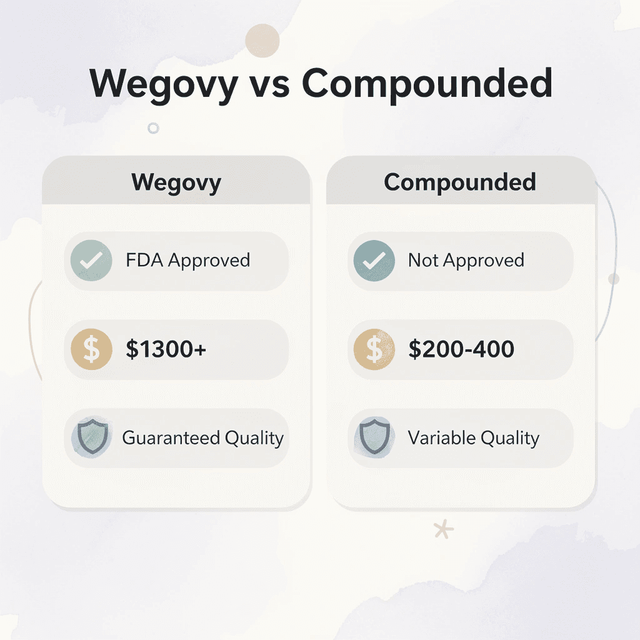
Factor | Wegovy | Compounded Semaglutide |
|---|---|---|
FDA Approval | ✅ Full approval | ❌ Not FDA-approved |
Cost | $1,300+/month | $200-400/month |
Insurance Coverage | ✅ Often covered | ❌ Rarely covered |
Quality Control | ✅ Guaranteed | ❌ Variable |
Availability | ❌ Frequent shortages | ✅ More accessible |
Dosing Precision | ✅ Pre-filled pens | ❌ Manual preparation |
"The decision between brand-name and compounded medications should always prioritize patient safety and treatment consistency over cost considerations alone." — American Medical Association Guidelines

When does Wegovy make the most sense for treatment?
Wegovy should be your first choice when you have access and want the most predictable, clinically validated results under medical supervision. If insurance covers it, you can afford it through manufacturer savings programs, or if you're starting GLP-1 treatment for the first time, the standardized dosing and proven safety profile eliminate variables that compounded versions introduce. You're paying for batch-to-batch consistency, sterility guarantees tested across millions of doses, and adverse event data collected from trials involving over 15,000 patients.
What are the cost considerations with Wegovy?
Wegovy lists at $1,349.02 per package, creating significant affordability barriers. That price reflects manufacturing standards that compounded versions don't replicate. When your priority is maximum clinical certainty, particularly with complex medical conditions or multiple medications where drug interactions matter, Wegovy's validated formulation reduces unknowns that could complicate treatment.
When does compounded semaglutide make sense for patients?
Compounded semaglutide works for specific situations: when shortages prevent access to regular versions, when you have documented allergies to inactive ingredients in Wegovy, or when cost barriers would otherwise prevent treatment. If compounded semaglutide ranges from approximately $200 to $500 per month, and that price difference enables you to stay on treatment, the accessibility tradeoff may be worth considering under medical supervision. For some people, compounded access represents the only viable option.
What are the key differences between compounded and branded versions?
Compounded versions are not interchangeable with branded products because they have different levels of clinical validation and predictability. When you choose compounded semaglutide, you accept variability in formulation quality, potential batch inconsistency, and the absence of large-scale trial data confirming your outcomes will match Wegovy's published results. Your prescriber should monitor more closely, adjust doses more cautiously, and watch for adverse effects that standardized products would make more predictable.
How can pricing transparency help with medication decisions?
Pricing creates pressure to view compounded and branded options as equivalent when only the cost differs. Platforms like MeAgain's GLP-1 app address this transparency gap by providing zero-markup access to compounded medications while clarifying what you're choosing and why. Our revenue comes from app subscriptions that help you track doses, log side effects, and manage your GLP-1 journey, not from markups on medications. When cost barriers would otherwise end your treatment, understanding what you're paying for and what support tools you need matters as much as the medication choice itself. The correct choice depends on whether your priority is maximum clinical certainty or accessibility under constraint. One isn't universally superior; they serve different needs. But choosing the right medication is only the beginning of what determines whether your results last beyond the prescription.
No Matter Which You Choose, Turn Your GLP-1 Results Into Something You Can Actually Sustain
The medication helps control hunger, but it doesn't teach you how to preserve muscle mass or prevent constipation that might require urgent care. Whether you choose Wegovy's clinical standardization or compounded semaglutide for cost access, your results depend on daily fundamentals: protein intake sufficient to preserve lean tissue, fiber to support digestion, hydration to prevent dehydration-related hospitalizations, and movement that signals your body to maintain strength. Most people start GLP-1 treatment focused on the prescription, then discover weeks later that muscle loss and side effects appeared because they never built the habits that prevent them.

This is where treatment plans fail. You get the medication and generic nutrition advice, then you're left guessing whether you hit your protein target or why you feel weak despite losing weight. Our MeAgain GLP-1 app turns those fundamentals into trackable targets with a capybara guide that makes hitting your protein, fiber, water, and exercise goals feel less like medical homework and more like visible progress. You're tracking what protects your results while the medication does its job, with a Journey Card that captures your progress so you can see changes as they happen, not just on the scale.
"Most GLP-1 patients experience significant muscle loss alongside fat loss when protein intake falls below 0.8g per pound of body weight." — Clinical Nutrition Research, 2024
It takes under five minutes to set up. Download the app, enter your daily targets based on your provider's guidance or the app's recommendations, and start logging your first day. You'll know immediately whether you're meeting the thresholds that prevent muscle loss and severe constipation, or whether you need to adjust before side effects derail your treatment. The medication creates the opportunity; the daily habits determine whether that opportunity becomes lasting change or another cycle of weight loss followed by regain when the prescription ends.