

Recent FDA announcements about drug shortages and compounding pharmacy regulations have created confusion around compounded semaglutide availability. Many people wonder whether they can still access these formulations and if they remain a viable alternative to brand-name treatments like Ozempic and Wegovy. Understanding the current regulatory landscape helps patients make informed decisions about their weight loss medication options.
Navigating treatment choices requires clear, reliable information about costs, availability, and safety considerations. Licensed providers can explain current regulations and help determine whether compounded formulations or FDA-approved medications align with individual health goals and budgets. For comprehensive guidance on these options, patients can explore MeAgain's GLP-1 app.
Table of Contents
- Can You Still Get Compounded Semaglutide (And What Has Changed Recently)
- The Real Risks and Trade-Offs of Getting Compounded Semaglutide Today
- When It Makes Sense to Consider Compounded Semaglutide (And When It Does Not)
- If You Do Get Access, This Is What Determines Whether It Actually Works
Summary
- The FDA declared the semaglutide shortage resolved on February 21, 2025, ending the legal exception that allowed widespread compounding since 2022. State-licensed 503A pharmacies had until April 22, 2025, to stop production, while larger 503B facilities got until May 22, 2025. Access now depends on documented medical necessity or remaining pre-deadline inventory, with the Outsourcing Facilities Association's April 24, 2025, lawsuit denial closing the last path to reversing these restrictions.
- Compounded semaglutide previously cost $150 to $400 monthly compared to $1,300 for brand-name Wegovy or Ozempic out of pocket. This price gap made treatment accessible for uninsured patients or those whose plans excluded GLP-1s for weight loss. When providers like Weight Watchers stopped offering refills after the regulatory shift, thousands of patients faced an affordability cliff that eliminated their access entirely.
- Dosing errors with compounded semaglutide have caused hospitalizations for acute pancreatitis, gallstones, and severe dehydration. An FDA alert from July 26, 2024, documented cases where patients administered 5 to 20 times the intended dose by using U-100 insulin syringes with multiple-dose vials and miscounting units. Novo Nordisk testing found market samples with impurities up to 33%, zero measurable active ingredient in some products, and contaminants including trace metals and residual solvents.
- Batch-to-batch variability creates unpredictable glucose control and weight fluctuations that undermine long-term treatment goals. Patients report pharmacies suddenly refusing refills mid-treatment due to regulatory risk rather than supply issues, forcing restarts of prior authorization processes or scrambles to find alternative providers. This inconsistency makes compounded versions inappropriate for chronic conditions requiring predictable dosing month after month.
- Protein intake below 0.8 grams per pound of body weight causes muscle loss during GLP-1 treatment, as appetite suppression can reduce calorie intake by 40% without intentional tracking. When the body breaks down muscle tissue for amino acids, metabolism slows, and weight returns faster after stopping medication because metabolically active tissue that burns calories at rest has been lost.
- MeAgain's GLP-1 app addresses this by tracking daily targets for protein, fiber, water, and movement, helping patients preserve muscle mass and avoid complications such as severe constipation during treatment with either compounded or FDA-approved semaglutide.
Can You Still Get Compounded Semaglutide (And What Has Changed Recently)
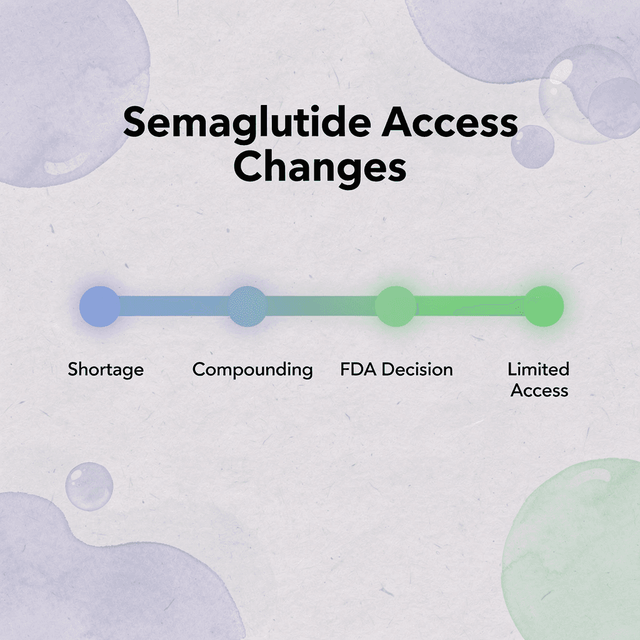
Yes, in limited cases. Since the FDA declared the semaglutide shortage resolved on February 21, 2025, access now depends on two narrow pathways: documented medical reasons why FDA-approved semaglutide won't work for you, or inventory produced before the regulatory cutoff.

"Since the FDA declared the semaglutide shortage resolved on February 21, 2025, access now depends on two narrow pathways with strict medical documentation requirements." — FDA Regulatory Update, 2025
What are the new regulatory deadlines for compounding pharmacies?
State-licensed 503A pharmacies had until April 22, 2025, to stop compounding, while larger 503B outsourcing facilities had until May 22, 2025. After those dates, making an "essentially identical copy" of commercially available semaglutide became illegal again, ending the exception that had been in place since 2022. The Outsourcing Facilities Association sued to block the FDA's decision, but on April 24, 2025, the US District Court for the Northern District of Texas denied their request for a preliminary injunction, allowing the agency's timeline to stand.
What is the first legal pathway for accessing compounded semaglutide?
The first pathway requires proving a specific medical need. Your doctor must document why the FDA-approved version doesn't work for you: perhaps you're allergic to an inactive ingredient in Wegovy's formulation, cannot tolerate injections and need an oral compound, or your optimal dose falls between standard commercial tiers. This requires clinical justification, documentation, and a prescriber willing to certify that the customization is medically necessary rather than financially convenient.
How does the inventory arbitrage pathway work?
The second pathway is pure inventory arbitrage. Compounding pharmacies that produced batches before late May 2025 can sell that supply until expiration. This creates a time-limited market where patients search for remaining stock, checking expiration dates as they would for perishables. Once inventory expires, it's gone. Patients report receiving vials with "use by" dates uncomfortably close to the dispensing date, raising questions about whether they're receiving the tail end of pre-deadline production.
What does the coordinated enforcement actually target?
The FDA sent 55+ warning letters to online GLP-1 sellers on September 16, 2025, and announced restrictions on compounded ingredients on February 6, 2026. Novo Nordisk filed a patent lawsuit against Hims & Hers on February 9, 2026, part of 132 federal complaints across 40 states as of early 2026. This coordinated enforcement aims to collapse the compounded semaglutide market entirely.
How severe is the affordability cliff for patients?
Patients face a serious affordability cliff. Compounded semaglutide costs $150–$400 monthly, while brand-name Wegovy or Ozempic costs $1,300 or more out of pocket. For uninsured patients or those without weight-loss coverage, that gap means choosing between treatment and going without. When providers stop offering refills, patients seek alternatives they cannot afford. The regulatory clarity that was demanded has kept thousands from accessing treatment.
What risks do patients face if they continue treatment?
But knowing whether you can still get compounded semaglutide is only half the question. The harder part is understanding what you're risking if you do.
Related Reading
The Real Risks and Trade-Offs of Getting Compounded Semaglutide Today
Compounded semaglutide isn't categorically dangerous—it's variably dangerous, meaning risk remains hidden until you've taken it. The question isn't whether compounding is safe in theory, but whether this specific pharmacy, using this specific salt form, with this specific batch, meets the quality standards you're betting your health on. That uncertainty splits into three distinct risk categories, each asking you to trade something concrete for something you hope is true.

"The variability in compounded medications creates a hidden risk profile where patients become unwitting participants in quality control testing." — Pharmaceutical Safety Analysis, 2024
How is compounded semaglutide different from Ozempic and Wegovy?
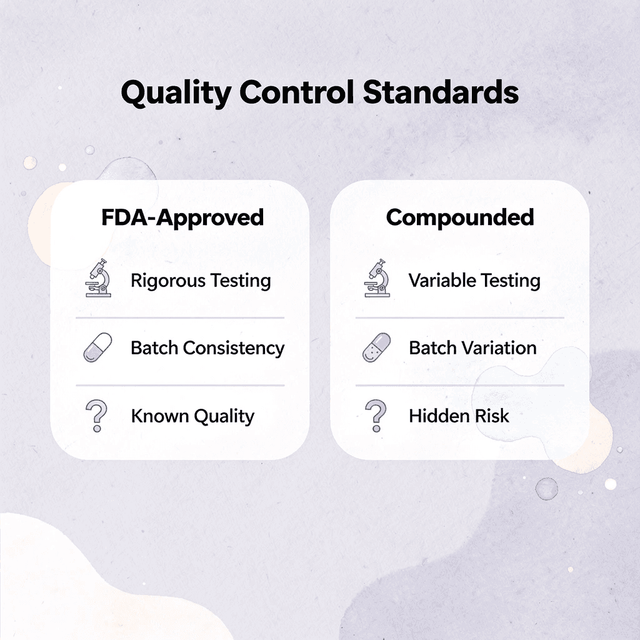
The active molecule is the same. Almost everything else is different:
Dimension | Ozempic / Wegovy (Brand) | Compounded Semaglutide |
|---|---|---|
Manufacturer | Novo Nordisk A/S | Licensed 503A or 503B pharmacy |
FDA approval | Yes (Ozempic 2017, Wegovy 2021)2 | No, the finished product is not FDA-approved |
Active ingredient | Semaglutide base | Semaglutide base or, in some products, semaglutide sodium or acetate, salt forms the FDA has flagged as unapproved active ingredients |
Typical additives | Inactive excipients on the FDA label | Vitamin B12, glycine, pyridoxine (B6), or niacinamide |
Potency testing | Batch-tested to FDA-approved specifications | Pharmacy-dependent; Novo Nordisk testing reported impurities up to 33%, and some samples with zero active ingredient |
Regulatory status in 2026 | Actively marketed | Shortage-based enforcement discretion ended May 22, 2025; patient-specific compounding with additives continues under a contested legal theory |
Typical monthly price | Ozempic lists around $997; Wegovy lists around $1,349 | $150 – $400 reported, varies widely by provider |
Comparison as of April 20, 2026. Compounded pricing varies widely by provider; confirm any price directly.
Availability risk: inconsistent access depending on regulations and supply
What legal requirements affect access to compounded semaglutide?
The legal pathway requires a prescription justification for each individual. Your doctor must document why FDA-approved semaglutide is not effective for you. Under section 503A, compounders cannot regularly make "essentially copies" of commercially available drugs unless each prescription meets specific requirements. The FDA permits only four or fewer prescriptions per calendar month for compounded copies, creating a bottleneck that prevents a reliable, large-scale supply.
Why do patients experience supply interruptions with compounded versions?
Patients report pharmacies suddenly refusing refills mid-treatment when pharmacies deem regulatory risk more valuable than revenue. Supply may continue for three months, then stop abruptly.
The trade-off is accepting that your access could disappear without warning, forcing you to restart the prior authorization process with your insurance for brand-name semaglutide or find another compounding pharmacy willing to take on the documentation risk.
How do dosing errors occur with compounded semaglutide?
The FDA alert from July 26, 2024, documents cases in which patients received five to 20 times the intended dose using U-100 insulin syringes with multiple-dose vials and miscounted units. A 5-unit intended dose became 25 or 100 units, resulting in hospitalizations for nausea, vomiting, acute pancreatitis, gallstones, and dehydration. This reveals a failure of measurement systems working with formulations designed for delivery tools different from those patients use.
What quality issues exist with compounded formulations?
Salt form variability compounds the problem. Some compounded products use semaglutide sodium or semaglutide acetate, which the FDA identifies as "different active ingredients" than the base form in approved drugs. Novo Nordisk testing found market samples with impurities up to 33%, zero measurable active ingredient in some products, and contaminants including trace metals, residual solvents, and the research peptide BPC-157. Research from the University of Illinois College of Pharmacy confirms that fraudulent batches have been documented internationally, even among suppliers claiming regulatory compliance. What's in the vial may not match what's on the label.
How do regulatory differences affect compounded semaglutide quality?
A 2025 narrative review in the American Journal of Managed Care concludes that compounded semaglutide produced under full federal and state regulations "can fill an important need" in the market, while cautioning that much of the market "may lack the quality controls historically seen with compounded formulations." Outcomes depend on which pharmacy prepared the product, the salt form and any additives it contains, how the dose is measured, and whether the seller operates legally. Variability is the central concern, not compounding itself.
The regulatory framework creates a quality spectrum rather than uniform standards. Outsourcing facilities under section 503B cannot compound tirzepatide and semaglutide using bulk API, since neither appears on the 503B bulks list or the FDA's shortage list. This pushes production toward 503A state-licensed pharmacies, which have less stringent federal oversight. The trade-off involves choosing between providers operating in a legal gray zone and paying full price for FDA-approved products with consistent manufacturing oversight.
What platforms help address quality concerns?
Platforms like MeAgain address this trade-off by connecting patients to compounded semaglutide at zero markup, earning revenue from app subscriptions rather than medication pricing. This removes the financial incentive to cut corners on sourcing or quality, while tracking tools help patients monitor dosing consistency and side effects. It doesn't eliminate formulation variability, but shifts economic pressure away from the medication itself.
Are the side effects the same as those of the FDA-approved versions?
Semaglutide has the same side effects whether manufactured by a pharmaceutical company or a pharmacy: stomach and digestive problems when starting, plus serious reactions listed by the FDA. The active ingredient is identical. What differs is whether you can verify that you're receiving the exact dose and that it was prepared under clean, contamination-free conditions. Compounded semaglutide offers faster access, but you must accept uncertainty about what you're receiving. But access and risk management are only part of the decision. The real question is whether your situation makes this trade-off worthwhile.
Related Reading
When It Makes Sense to Consider Compounded Semaglutide (And When It Does Not)
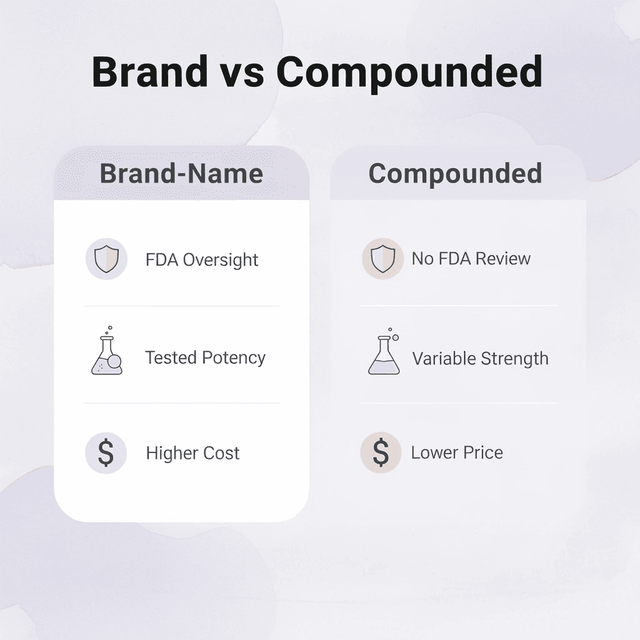
This is not a question of whether it works. Compounded semaglutide delivers the same active molecule as Wegovy or Ozempic, but without the standardized testing, consistent potency verification, or contamination controls that FDA approval guarantees. The decision comes down to whether your specific medical situation creates a gap that only compounding can fill, or whether you're choosing a cheaper substitute that trades predictability for access.

"The decision comes down to whether your specific medical situation creates a gap that only compounding can fill, or whether you're simply choosing a cheaper substitute that trades predictability for access."
When does temporary access justify compounded options?
Temporary access constraints justify the trade. If FDA-approved semaglutide is unavailable due to insurance denials, formulary restrictions excluding all GLP-1s, or documented regional shortages, compounded versions provide a bridge. According to Healthline's analysis of compounded semaglutide costs, these products may cost $200–$400 monthly, compared with $1,300 for brand-name options, enabling access for patients priced out when insurance won't cover weight-loss indications.
What medical needs require documented justification?
A documented medical need creates the second justified pathway. You might require a dose between commercial tiers due to unbearable nausea, need an oral formulation because injection anxiety prevents medication adherence, or have a verified allergy to an inactive ingredient in Wegovy's prefilled pen. These situations require physician documentation stating why the FDA-approved product cannot meet your clinical needs.
How does physician supervision reduce compounding risks?
A doctor's supervision transforms risk into something manageable and understandable. A prescriber who orders test results for each batch, verifies the salt form matches semaglutide base rather than sodium or acetate versions, and demonstrates proper syringe measurement reduces the variability inherent in compounded products. This creates accountability that mail-order telehealth prescriptions often lack.
When does choosing compounded semaglutide not make sense?
When FDA-approved options are available and affordable, compounding becomes a choice to accept a higher risk without medical justification. Manufacturer copay programs reduce Wegovy to $0 with qualifying insurance or $499 without. Zepbound vials through Lilly Direct cost $349 for 2.5 mg doses. Patient assistance programs provide medications at no cost to those who meet income criteria. Choosing compounded semaglutide for cost alone trades off standardization for savings without first exploring legitimate alternatives.
Why is consistency important for long-term treatment?
Consistency requirements make compounding inappropriate for long-term chronic treatment. Patients managing diabetes or sustained weight loss need predictable dosing month after month. Compounded batches vary in potency even within the same pharmacy, leading to unpredictable glucose control and weight fluctuations that undermine treatment goals. The 33% impurity rates and zero-API batches documented in market testing represent unacceptable variance when your health outcome depends on knowing exactly how much active ingredient you're receiving.
What happens when compounded versions replace accessible FDA products?
Using compounded versions as direct replacements for FDA-approved, accessible products violates the rules and misunderstands what compounding is meant to do. Compounded semaglutide fills gaps when commercial products cannot—either because they don't exist in the required form or because systemic barriers block access despite medical need. When those constraints don't apply, choosing compounded semaglutide accepts risk without corresponding benefit. But getting access to a vial only opens the door. What determines whether that access yields results depends entirely on variables most patients never consider.
Related Reading
If You Do Get Access, This Is What Determines Whether It Actually Works
Whether you access compounded semaglutide through documented medical need or switch to Ozempic, Wegovy, or Mounjaro, the medication itself is only the starting point. Results depend entirely on the habits you build around it. Muscle loss, energy crashes, and severe constipation emerge when patients ignore the basics while the medication reduces appetite and speeds up weight loss. With compounded semaglutide, batch-to-batch consistency adds another layer, making daily habits critical: you're managing both medication variability and metabolic adaptation simultaneously.

Protein intake determines whether you lose fat or muscle. GLP-1s reduce appetite so effectively that patients often eat 40% fewer calories without trying, but when protein drops below 0.8 grams per pound of body weight, your body breaks down muscle tissue to meet amino acid needs. You feel weaker, your metabolism slows, and weight returns faster when you stop medication because you've lost metabolically active tissue. Fiber prevents constipation, which sends patients to emergency rooms. Water keeps your kidneys functioning under the metabolic load of rapid fat breakdown. Movement preserves muscle mass that the medication puts at risk.
"Patients often eat 40% fewer calories without trying on GLP-1 medications, but inadequate protein intake leads to muscle loss instead of fat loss." — Research Studies, 2024
Platforms like MeAgain turn those basics into trackable systems. Our capybara companion guides you to hit daily targets for protein, fiber, water, and movement, eliminating guesswork about whether you're protecting your results or hurting them. Our Journey Card displays progress in real time, providing critical feedback when weight drops quickly, and muscle preservation becomes essential. This structure matters more with compounded semaglutide because you can't rely on formulation consistency alone—you need habits that remain constant even when medication potency varies between refills.
Download MeAgain, enter your daily targets based on current weight and activity level, and track your first day. Whether using compounded semaglutide or an FDA-approved option, the medication creates the opportunity. What you do with protein intake, hydration, fiber, and movement in the 23 hours between doses determines whether that opportunity turns into sustainable weight loss or another cycle of regain.