

Starting Foundayo for weight management brings new challenges, such as tracking doses, managing side effects, and maintaining consistency. Many people wonder if dedicated apps exist to simplify this process and provide the structure needed for success. The right digital tool can transform an overwhelming routine into a manageable system that supports long-term results.
Several apps cater specifically to GLP-1 medications, offering features like dose tracking, symptom logging, and progress monitoring. These tools eliminate the need to juggle multiple calendars and notebooks while providing clear insights into treatment patterns. For comprehensive support tailored to GLP-1 users, MeAgain's GLP-1 app offers an integrated solution that keeps everything organized in one place.
Summary
- Managing Foundayo treatment requires tracking variables that standard health apps weren't designed to connect. Dose timing, appetite fluctuations, side effects, and weight changes all influence one another, yet most tools treat them as separate data points. According to clinical research, health app effectiveness depends heavily on how well the tool aligns with the specific health intervention, and generic tracking doesn't automatically translate to meaningful outcomes when the intervention itself is medication-driven.
- Sometimes people don't immediately see GLP-1 benefits, often because they can't identify whether the medication is working or how to optimize their response to it. Without integrated tracking, users can't distinguish effective treatment from ineffective dosing or behavioral mismatches. The medication creates change, but fragmented data makes it impossible to understand what's driving results or what needs adjustment.
- Most Foundayo users end up managing multiple apps simultaneously because no single tool covers everything the medication affects. You track calories in one app, log doses in another, monitor side effects in a third, and maybe use separate tools for fitness or hydration. This fragmentation isn't just inconvenient; it undermines consistency and momentum, making tracking feel like a second job rather than a support system.
- Appetite suppression from GLP-1 medications doesn't follow the linear patterns that standard calorie-tracking apps expect. You might log 1,200 calories one day and feel completely satisfied, then struggle to hit 1,500 the next day despite identical meal planning. Traditional apps show you the numbers but miss the critical context of medication timing, dosage changes, or how your body is responding to treatment across the medication's cycle.
- Progress on Foundayo includes normal fluctuations that feel random without connected data. Your appetite might suppress dramatically one week, stabilize the next, then spike unexpectedly after a dosage change or during high stress. Weight loss might accelerate for two weeks, plateau for three, then resume at a different pace. These patterns aren't failures; they're tracking systems that can't connect medication response to physical changes or behavioral shifts, making them feel discouraging instead of normal.
- MeAgain's GLP-1 app addresses this by treating medication tracking, appetite logging, and progress monitoring as interdependent variables instead of separate tasks scattered across multiple platforms.
Table of Contents
- Are There Any Apps for Foundayo? (And Why Most Fall Short)
- Best Types of Apps to Use with Foundayo (What Actually Helps)
- What Foundayo Users Actually Need (And What Most Apps Don't Do)
- Stop Juggling Apps — Use One System for Foundayo
Are There Any Apps for Foundayo? (And Why Most Fall Short)
There's no official app for Foundayo, but dozens of general health and weight loss apps claim compatibility. The question is whether they help when you're on a medication that fundamentally changes how hunger, appetite, and weight loss work. Most don't: the gap between what they track and what's happening in your body creates more confusion than clarity.

"The disconnect between traditional weight loss tracking and medication-assisted weight management creates a blind spot that can derail progress."

Why do standard calorie trackers fall short with Foundayo?
Most people assume that any calorie tracker or weight-loss app will support their Foundayo journey the same way it would for regular dieting. But Foundayo, as a GLP-1 medication, does more than help you eat less. It reduces hunger at the hormonal level, changes how you think about food noise, and creates weight-loss patterns that don't follow the simple "calories in, calories out" model that standard apps are built around.
What context do traditional apps miss when tracking medication-driven changes
When you're tracking calories, but medication has altered your appetite, the data doesn't tell the real story. You might log 1,200 calories one day and feel completely satisfied, then struggle to hit 1,500 the next day and feel hungry. Traditional apps show you the numbers but miss important context, such as medication timing, dosage changes, side effects, and how your body responds to treatment. According to clinical research, the effectiveness of health apps depends on how well the tool matches the specific health intervention. Generic tracking doesn't automatically produce meaningful outcomes when the intervention is medication-driven.
Why do standard tracking apps fail with medication-assisted weight loss?
You weigh yourself daily using a standard app, notice fluctuations, and wonder if the medication is working. You track protein intake because someone online said it matters, but the app doesn't explain why appetite suppression makes it harder to hit protein targets on some days. You log workouts consistently, but when you pause Foundayo for a medical procedure or side effects, the app cannot explain how that break affects your progress. You're collecting data without gaining insight, and that gap between numbers and understanding breeds self-doubt, a need for community validation, and a desire to abandon tracking altogether.
How do medication effects differ from traditional weight loss patterns?
Regular apps can't distinguish between stable behavior and metabolic changes caused by medicine. They track weight changes over time but don't connect those changes to dose adjustments or explain how GLP-1 medications alter satiety signals. MeAgain's GLP-1 app bridges this gap, helping you understand how your medication affects your body's signals and informing smarter dose decisions. They're made for a different approach to weight loss, one where your body's hunger signals remain consistent and predictable.
Why medication-specific tracking changes everything
Our GLP-1 app was built for this gap. Rather than treating Foundayo as an add-on to traditional dieting, it tracks what matters on medication: dose timing, appetite changes, side effects, and how your body responds across the medication's cycle. The app connects those patterns to your treatment plan, providing context that transforms raw data into an actionable understanding. It's not about tracking more—it's about tracking what matters when medication drives the change. But which types of tracking help, and which ones add noise to an already complex process?
Related Reading
Best Types of Apps to Use with Foundayo (What Actually Helps)
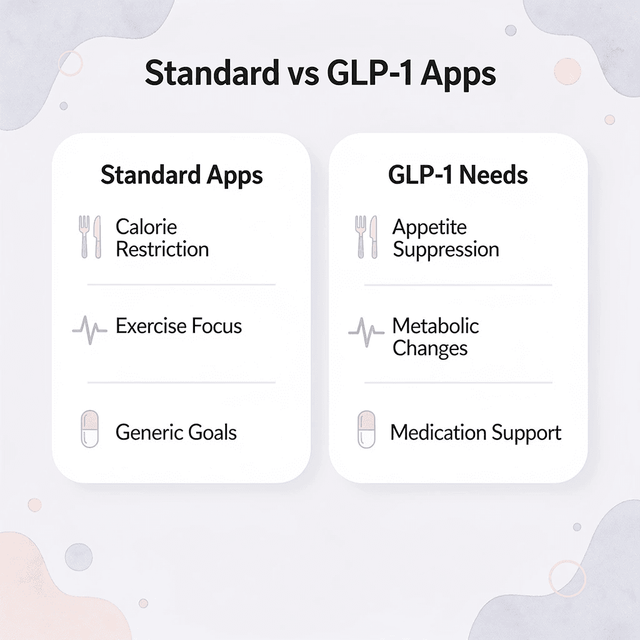
No app is built specifically for Foundayo, but certain categories can support users in different ways. The challenge is understanding which tools match how GLP-1 medications work and where their limitations create significant gaps. Most people download traditional dieting apps, only to discover they weren't designed for medication-driven weight loss.

"Traditional diet apps fail to account for the 70-80% reduction in appetite that GLP-1 medications typically produce, leading to inappropriate calorie targets and unrealistic expectations."
How do nutrition tracking apps provide awareness without adaptation?
Apps like MyFitnessPal and Lose It! help you identify eating patterns and baseline habits before Foundayo starts suppressing your appetite. You log meals, see calorie totals, and track macronutrients, which provides useful information for establishing a routine.
Why don't these apps account for medication effects?
The problem arises once the medication takes effect. These apps don't account for how Foundayo alters your hunger signals or metabolic response. You might log 1,000 calories one day and feel satisfied, then struggle to reach 1,400 the next day despite identical meal planning. The app shows the numbers but cannot explain why your appetite changes with dose timing, side effects, or treatment duration. It tracks intake, not how the medication affects it.
What benefits do habit tracking apps provide?
Habit trackers like Streaks help you build routines and stay consistent, which matters when taking Foundayo daily. They remind you to log doses, drink water, or complete small daily actions that support your treatment plan. For people who struggle to remember to take their medication, these apps provide structure and accountability.
What limitations do these apps have with medication management?
But they work separately from the medicine itself. They can't adapt based on how Foundayo affects your energy levels, appetite patterns, or physical responses. If you miss a dose because of side effects or pause treatment for a medical procedure, the app doesn't adjust your habit goals or explain why consistency might look different during that time.
What are the benefits of health and symptom tracking apps?
Symptom diaries and health tracking apps let you record side effects, stomach discomfort, or how your body responds to Foundayo. This helps you identify triggers—such as whether certain foods worsen nausea or if taking your dose at a different time reduces stomach issues. Research shows symptom tracking becomes more useful when it connects to the specific intervention driving those symptoms, rather than general wellness monitoring.
Why do tracking apps fail to provide complete insights?
The problem is that these apps stay disconnected from your nutrition and habit data. You might log nausea in one app, track meals in another, and monitor medication timing in a third. You can see that you felt nauseous on Tuesday, but you cannot easily connect that to what you ate, when you took your dose, or whether you've been gradually increasing your dosage. The data exists, but the relationships between those data points do not.
Why does app fragmentation break medication tracking?
Most people rely on multiple apps because no single tool covers everything. You track calories in MyFitnessPal, log doses in Streaks, monitor side effects in a symptom diary, and perhaps use a separate app for fitness or hydration. Each app works independently, but managing health becomes messy and difficult to follow. You're collecting data across platforms that don't communicate with each other, manually assembling patterns that should be obvious if everything existed in one place.
How does fragmentation affect treatment consistency?
That fragmentation breaks consistency and momentum. When tracking feels like a second job—switching between apps, remembering where to log what, and connecting insights yourself—people stop tracking altogether. The tools meant to support your treatment become the reason you disengage from it. The real cost is losing clarity about what's happening in your body and whether the medication is working. But which apps fall short doesn't answer the deeper question: what do Foundayo users need that these tools aren't providing?
Related Reading
- Will there be compounded orforglipron (Foundayo)?
- Who Makes Foundayo?
- Foundayo Side Effects
- Is Foundayo a GLP-1
What Foundayo Users Actually Need (And What Most Apps Don't Do)
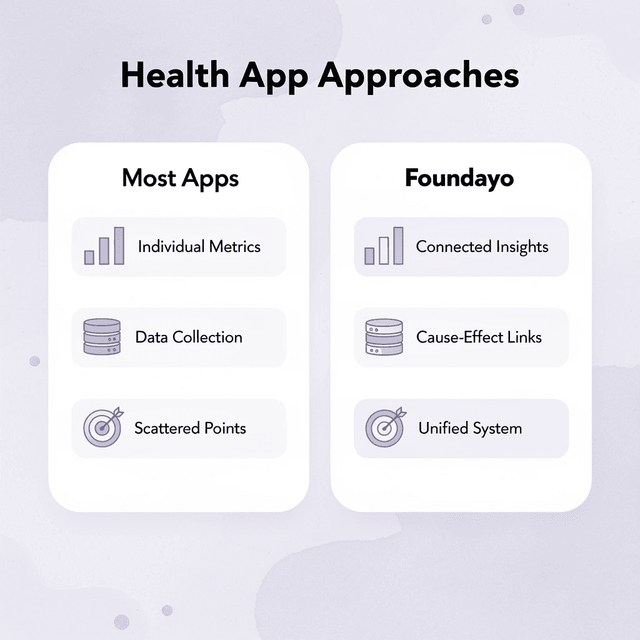
The problem isn't a lack of apps—it's the lack of a system that connects medication response to physical changes to behavioral shifts in one place. Foundayo users need to see how dose adjustments affect appetite, how appetite changes influence eating patterns, and how those patterns translate to weight trends. Standard apps collect isolated data points without showing the relationships between them.

"Most health apps focus on tracking individual metrics, but users need to understand the cause-and-effect relationships between their medication adjustments and lifestyle changes."
What happens when health data gets scattered across multiple apps?
When you use separate apps to track calories, log doses, monitor side effects, and record weight, you create data silos that require manual interpretation. You take your dose on Tuesday morning, feel nauseous by afternoon, skip dinner, and weigh yourself on Wednesday. Each event gets logged in a different place. The pattern exists, but you must reconstruct it yourself by remembering what happened when, cross-referencing timestamps, and determining whether the nausea came from the medication, something you ate, or stress.
Why does manual data reconstruction cause people to give up?
That's where most people lose momentum in the reconstruction work. One user, managing 14 medications and coordinating 11 doctors, described how difficult it was to track everything by hand, especially with physical tremors making data entry difficult. Without a system that connects medication changes to symptoms and daily functioning, the information becomes overwhelming rather than helpful. You're struggling because the tools force you to be your own data analyst, while your body is actively changing its response to food and hunger.
How does complete integration connect all aspects of treatment?
A complete solution connects your dose timing to changes in hunger, changes in hunger to dietary intake, and dietary intake to your body's response during medication activity. When you log unusual hunger three days after a dose increase, the system should flag that pattern and help you determine whether it's normal, signals a need to adjust timing, or is unrelated to the medication.
What makes systems different from simple tracking apps?
When side effects appear, check what you ate beforehand, when you took your last dose, and whether this matches patterns from previous weeks. Apps show you what happened. Systems help you understand why it happened and what to do next. Often when people struggle with GLP-1, it is because they cannot identify whether the medication is working or how to optimize their response. Without integrated tracking, users cannot distinguish between effective treatment and ineffective dosing or behavioral mismatches.
Why do GLP-1 results fluctuate so much?
Progress on Foundayo doesn't follow a straight line. Your appetite might decrease significantly one week, remain stable the next, then increase unexpectedly after a dosage change or during high stress. Weight loss might accelerate for two weeks, plateau for three, then resume at a different pace. These changes aren't failures; they're normal responses to how GLP-1 medications work with your metabolism, eating behavior, and daily life. But if your tracking system can't connect those dots, the changes feel random and discouraging.
How does connected tracking provide clarity?
MeAgain's GLP-1 app treats medication tracking, appetite logging, and progress monitoring as interconnected parts of a single system rather than separate tasks. You log how you're feeling, and the app automatically connects that to your dose schedule and eating patterns. When something changes, you see context instead of confusion. But knowing what a system should do leaves the harder question: what happens when you try to build that system yourself using tools never designed to work together?
Related Reading
Stop Juggling Apps — Use One System for Foundayo
Most apps treat your data separately: calories, doses, side effects, and weight each live in different places. MeAgain connects all of these together in one system.
- Dose tracking: log when and how you take Foundayo.
- Appetite and symptom logging: note hunger, cravings, or side effects for each dose.
- Progress monitoring: track weight and consistency of habits over time.
Our app analyzes patterns to show how dose changes affect appetite and weight trends. Users can identify whether skipped doses lead to weight plateaus, understand appetite changes associated with dosage adjustments, and make informed optimizations. Early testers report full clarity within 30 days, compared to managing multiple apps where insight is delayed or lost. MeAgain App validates whether your Foundayo treatment is working and predicts which changes drive real progress. Within 30 days, you'll see clear patterns and actionable insights. Only 3 free onboarding spots remain: no long-term commitment, risk-free. Download MeAgain and simplify your Foundayo tracking now